Lilian Weng has resigned.
Just now, Peking University alumna Lilian Weng posted a resignation letter on social media, announcing that tomorrow will be her last day at Thinking Machines Lab.
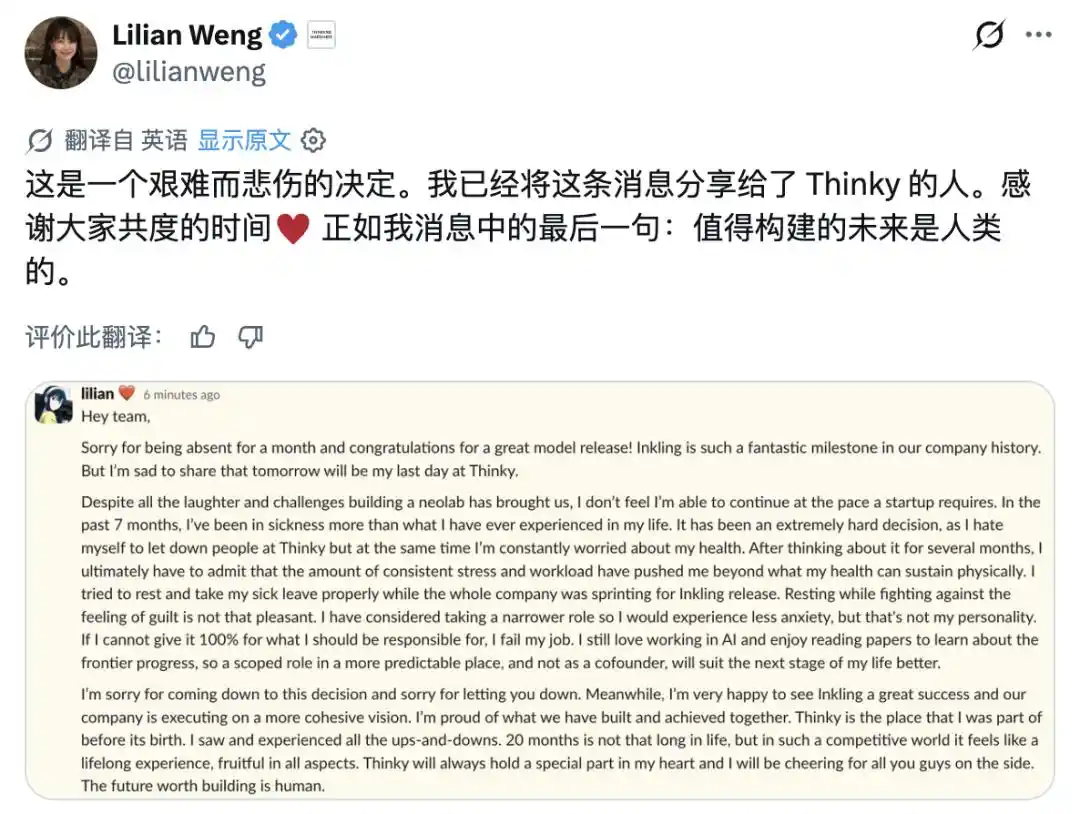
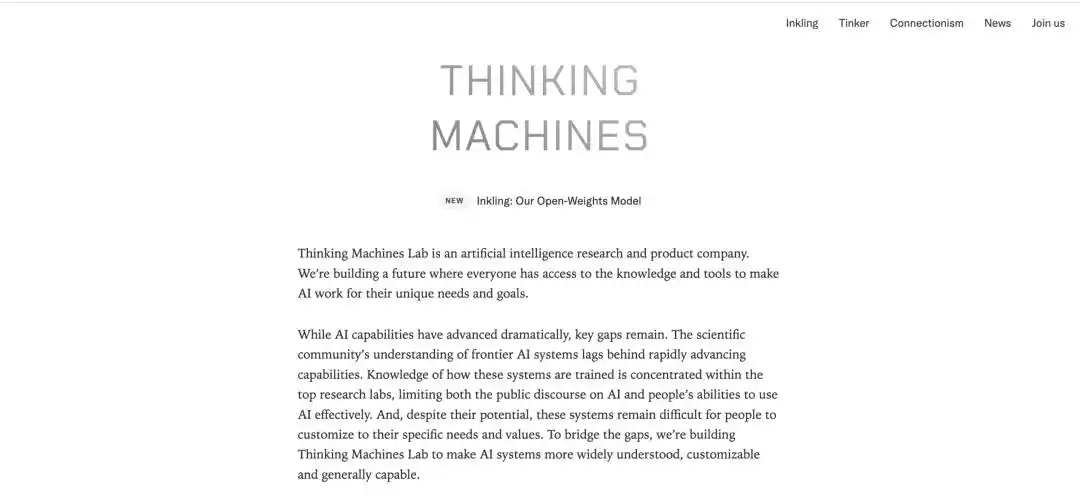
It has been exactly 20 months since she co-founded the company with OpenAI's former CTO Mira Murati. A few days ago, Thinking Machines just released its first open-source large model, Inkling, which Weng called an "incredible milestone in the company's history" in her letter.
It is somewhat surprising that a co-founder chooses to leave just after the release of the first model.
A Resignation Letter Filled with 'Apologies'
A word that appears repeatedly in Lilian Weng's resignation letter is "health".
She mentioned that in the past 7 months, she has been sick more times than in any other period of her life. While the entire company was sprinting for the Inkling release, she had to take sick leave and rest, while also grappling with guilt for being unable to participate in the work.
She described that state of resting while battling feelings of guilt as unpleasant.
Weng also considered scaling back her responsibilities and taking on a role with less pressure and uncertainty. But she ultimately found that such an arrangement didn't suit her. According to her, if she couldn't devote her full energy to the responsibilities at hand, she would feel she wasn't doing the job well.
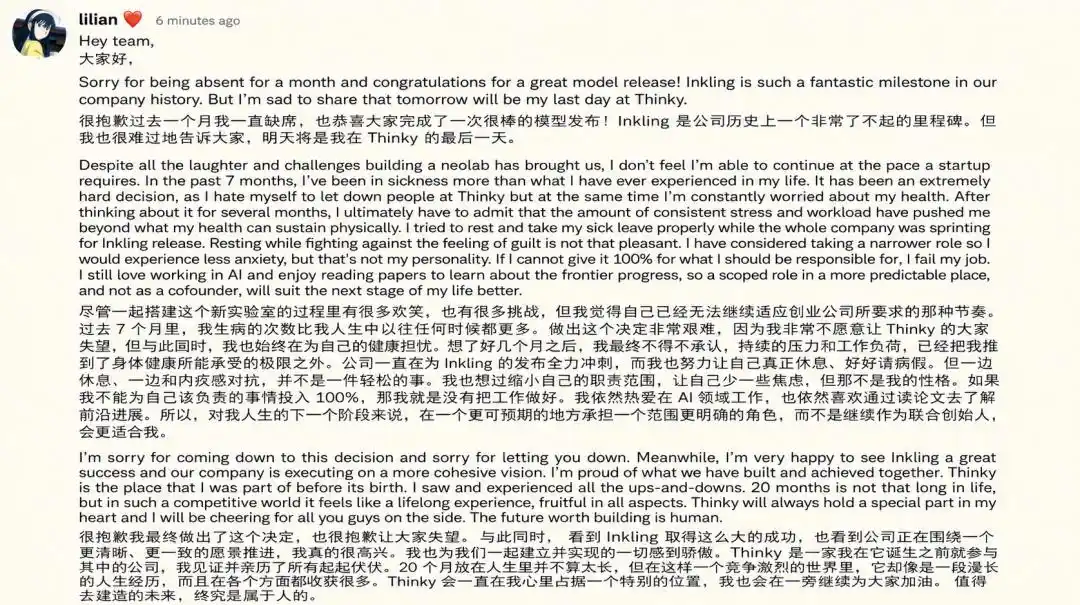
Throughout the letter, expressions like "sorry" and "letting you down" appear multiple times.
Weng, who once built OpenAI's safety team from scratch and led a team of over 80 people, was most worried about letting her colleagues down even at the moment of farewell. The recurring apologies also reflect her guilt and reluctance about leaving.
After the resignation letter was posted, many former colleagues and peers came to leave comments.
Mira Murati said the experience of co-creating Thinking Machines was precious and she was glad Weng was willing to prioritize her health. PyTorch core developer Soumith Chintala, Saurabh Garg, and others also sent their blessings, with most comments conveying the same sentiment: Health is more important, rest well.

The departure is restrained, and the farewell is sufficiently graceful.
Many people might not be familiar with Lilian Weng's background, so a brief introduction to her position in the AI industry is necessary.
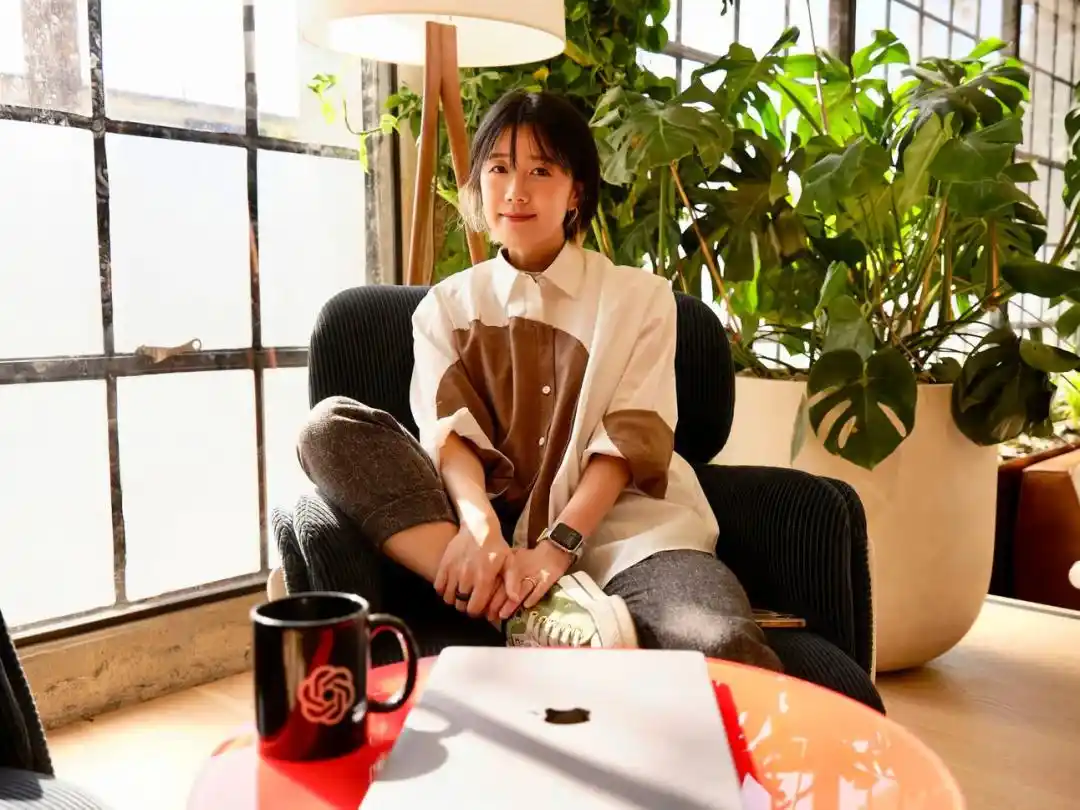
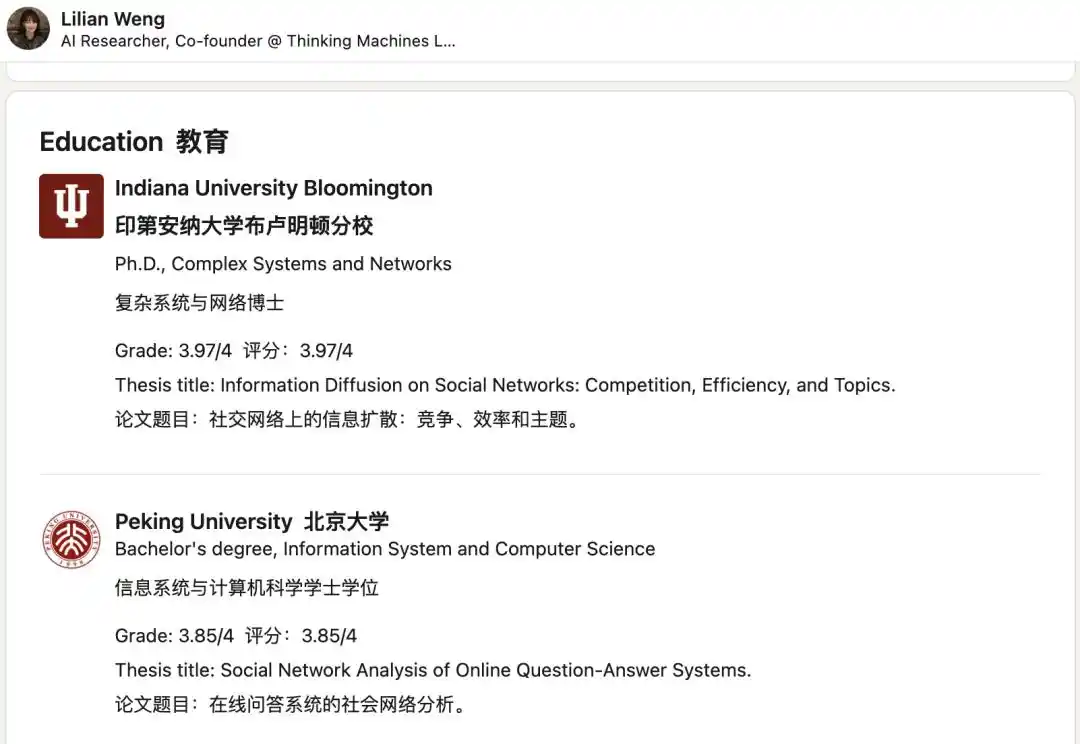
Lilian Weng was born in Shaanxi. In 2004, she won the first prize in the National High School Mathematics League in Shaanxi Province. In 2005, she entered Peking University's Information Management and Information Systems program, where she received a National Scholarship during her undergraduate studies.
Thereafter, she went to Indiana University Bloomington for her Ph.D., with research primarily focused on network science, complex systems, and information diffusion in social networks, which is not exactly the same as the large model research she is more widely known for today.
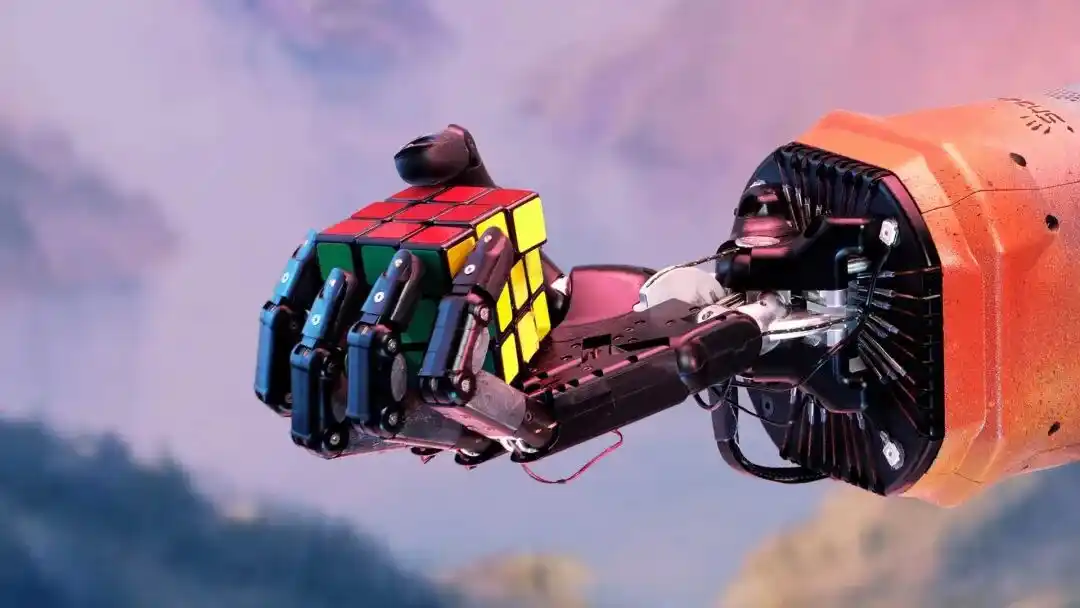
In 2018, Weng joined OpenAI. The first major project she participated in was the robotic hand Dactyl. The research team spent two years teaching the robotic hand to solve a Rubik's Cube with one hand, and Weng was one of the core contributors to the project.
After the release of GPT-4, she started building the Safety Systems team from scratch. By the time she left OpenAI, the team had grown to over 80 people. Some of the safety mechanisms and evaluation systems used by ChatGPT today are also related to the work she promoted during her tenure.
In August 2024, Weng was promoted to Vice President of Research and Safety at OpenAI. Three months later, she left OpenAI. In February 2025, she co-founded Thinking Machines Lab with Mira Murati and others.
In the broader tech community, Weng is also widely known for another identity: the author of the technical blog Lil'Log.
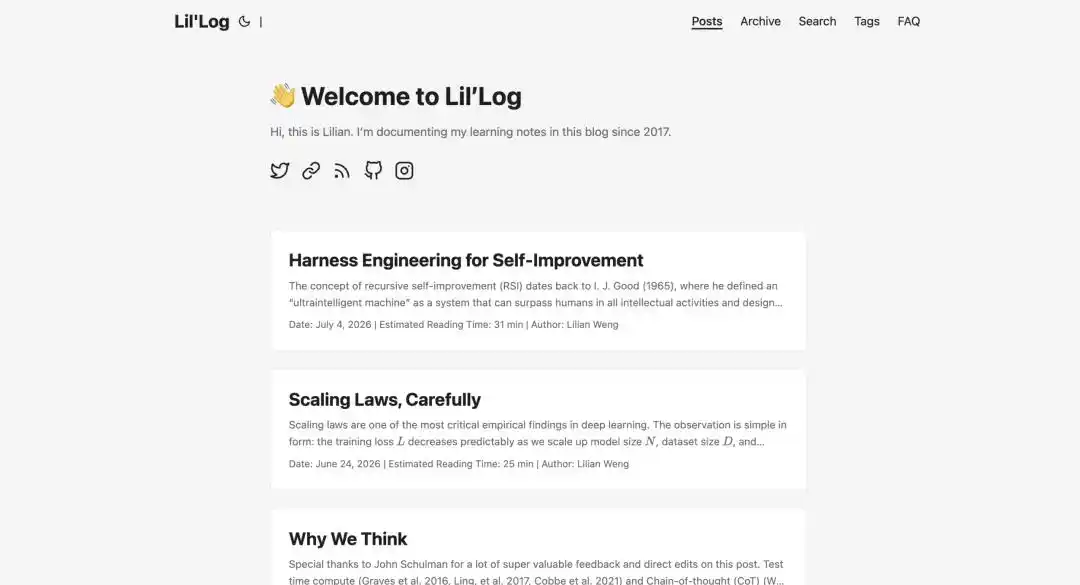
Lil'Log has long been systematically documenting cutting-edge technologies like reinforcement learning, Transformer, and Agents. It is one of the most widely circulated personal technical blogs in the AI field, with some articles even listed as reference materials for university courses.
She once wrote that clearly explaining a concept is the best way to test whether one truly understands it. In a way, this statement also summarizes her influence within the AI community.
Viewing Weng's departure against the backdrop of Thinking Machines' development trajectory over the past year adds further complexity.
High Valuation Brings Pressure on Both Product and Team
Thinking Machines garnered significant attention from its inception.
In July 2025, the company completed a seed round of approximately $20 billion, setting a record for the largest seed round for a startup at that time. The round was led by a16z, with participation from NVIDIA, AMD, Jane Street, and other institutions, resulting in a post-money valuation of $120 billion.
At that time, the company had not released any formal product. Rumors suggested that both Apple and Meta had expressed interest in investing or acquiring, but were turned down by Murati.
The high starting point brought extremely high expectations, but subsequent product progress and personnel changes were not as smooth.
In November 2025, Thinking Machines attempted to initiate a new funding round at a valuation of $50-60 billion. By January 2026, the negotiations fell through, and market valuations returned to around $120 billion.
The core team also experienced ongoing changes.
Co-founder Andrew Tulloch was recruited by Meta. In January 2026, co-founder and CTO Barret Zoph and co-founder Luke Metz resigned and returned to OpenAI.
There was public disagreement surrounding Zoph's departure. Murati stated he was fired for "misconduct," and OpenAI later responded that it did not agree with Thinking Machines' description of the matter. Subsequently, several more researchers left the company.
External skepticism about Thinking Machines has mainly focused on several aspects: overvaluation, relatively slow product releases, massive compute costs, and an unproven business model. The continuous flow of core talent has further amplified market uncertainty.
However, the company still possesses considerable resources.
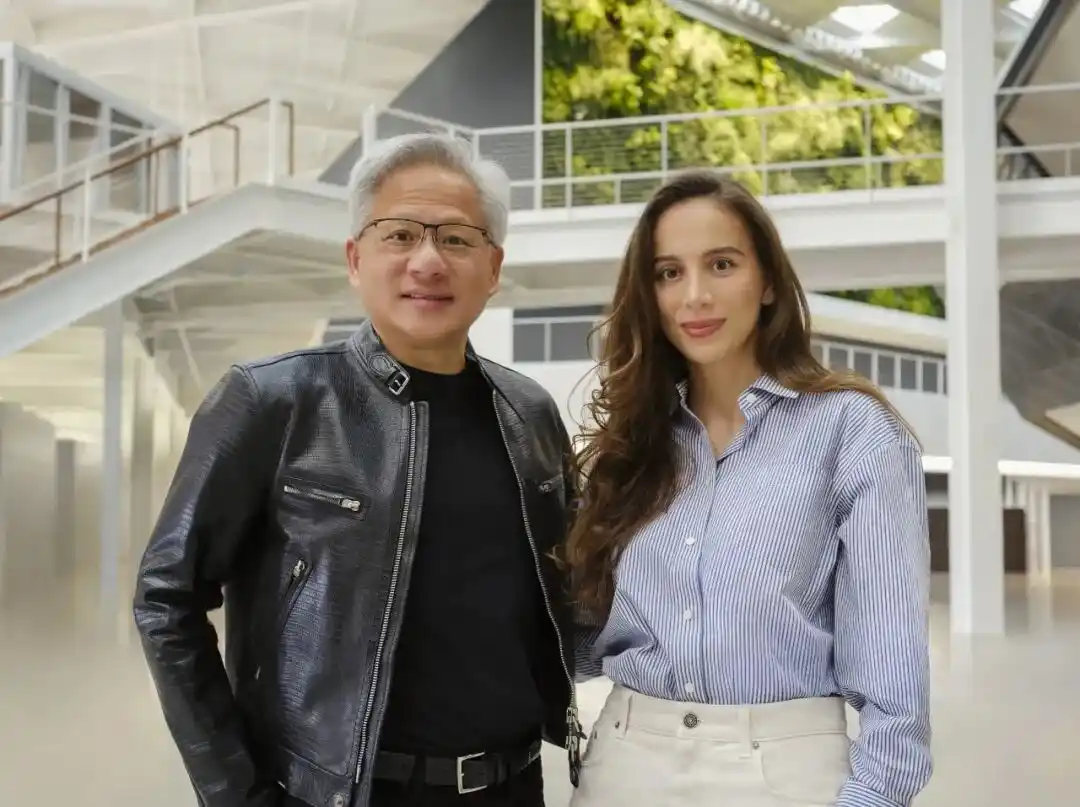
Thinking Machines has entered into a multi-year strategic partnership with NVIDIA, planning to deploy at least 1 gigawatt of next-generation Vera Rubin systems starting in 2027; the company has also signed a compute agreement with Google Cloud worth tens of billions of dollars.
On the product side, the model fine-tuning tool Tinker is already online, and the first open-source large model, Inkling, was released recently. The company is finally shifting from fundraising and talent stories to actual product delivery.
Therefore, market judgment on Thinking Machines has not completely turned pessimistic. It faces many problems, but its financial, talent, and compute resources also far exceed those of most AI startups.
People Cannot Scale Infinitely Like Models
Weng's resignation letter does not discuss valuation, fundraising, or internal personnel changes. The entire letter revolves around one reason: long-term stress has exceeded what her body can endure.
She states that she still loves AI and continues to read papers and track research progress. Moving forward, she hopes to find an environment with a more predictable pace and clearer boundaries of responsibility, free from the constant pressure and uncertainty that a co-founder must face.
This year, competition in the AI industry has accelerated to the point of being measured in "days."
A model is barely released before the countdown to the next update begins; a capability becomes an industry standard, only for a new technical path to emerge soon after. Startups must simultaneously chase product, compute, funding, and talent. Everyone fears that being one step slower means being left behind by the next wave.
In the hottest fields, speed is no longer just a competitive advantage; it is gradually becoming an inescapable pressure.
Models can increase parameters, extend context length, and run continuously on more compute. But people have their limits. Sleep cannot be compressed, the body cannot skip recovery, and accumulated fatigue does not automatically disappear with one product release.
Twenty months is not a long time, yet Weng writes in her letter that the experience "felt like a lifetime."
Perhaps she realized earlier than many that standing at the forefront of the AI wave means participating in shaping an era, but it also means bearing the fastest and most intense pressures of this era.
Inkling has become a milestone for Thinking Machines, and the AI industry will continue to advance. New models will be released, new companies will rise, and leaderboard positions will keep changing.
For Lilian Weng, what's more important now is to allow herself to stop.
Leaving does not always mean failure. Sometimes, admitting that the body can no longer bear the strain, letting go of responsibilities not yet fulfilled, and taking good care of oneself also require great courage.
Reference links:
https://x.com/lilianweng/status/2081816923088814421
https://lilianweng.github.io/
This article is from the WeChat public account "APPSO", author: 发布明日产品的