Iran and the Fed -- Three Scenarios That Will Impact Global Markets Next

marsbitPublished on 2026-05-28Last updated on 2026-05-28

Abstract

"Three Scenarios for Iran and the Fed Shaping Global Markets" Iranian geopolitics and the Fed's monetary policy path are two dominant themes for markets. Deutsche Bank Research outlines three scenarios linking Iran ceasefire outcomes to Fed policy, with oil prices as the key transmission channel. **Scenario 1: Peace Deal.** A breakthrough leading to the Strait of Hormuz reopening would ease near-term Fed tightening pressure. Recent inflation would be viewed as a temporary energy shock. However, medium-term risks remain; rate hikes could resurface in 2027 if inflation persists. **Scenario 2: Stalemate.** A breakdown in talks and a prolonged Strait closure, but no major escalation, is deemed the scenario with the *highest* Fed hike risk. Sustained high oil prices would feed into core inflation and threaten inflation expectations, while not severely damaging demand enough to give the Fed a reason to pause. This environment could necessitate multiple Fed rate hikes in 2026. **Scenario 3: Conflict Escalation.** Renewed conflict and sharply higher oil prices create a two-way risk for Fed policy. On one hand, it would risk severe inflation expectations de-anchoring, forcing a hawkish response. On the other, extreme oil prices could severely damage demand and the labor market, potentially shifting the Fed's focus toward easing. The ultimate policy decision would depend on which risk materializes first. Overall, Deutsche Bank's framework emphasizes that the path for oil prices, d...

Author: Dong Jing

Source: Wall Street News

The direction of the Iran situation and the outlook for the Federal Reserve's monetary policy are becoming the two most critical factors influencing global markets.

Deutsche Bank's economic research team, in its latest report, systematically outlined the potential impact on the Fed's policy path based on three possible outcomes of the Iran ceasefire negotiations—ranging from the fading of near-term interest rate hike risks to multiple hikes in 2026, and to two-way policy uncertainty. Each scenario corresponds to a distinct market logic.

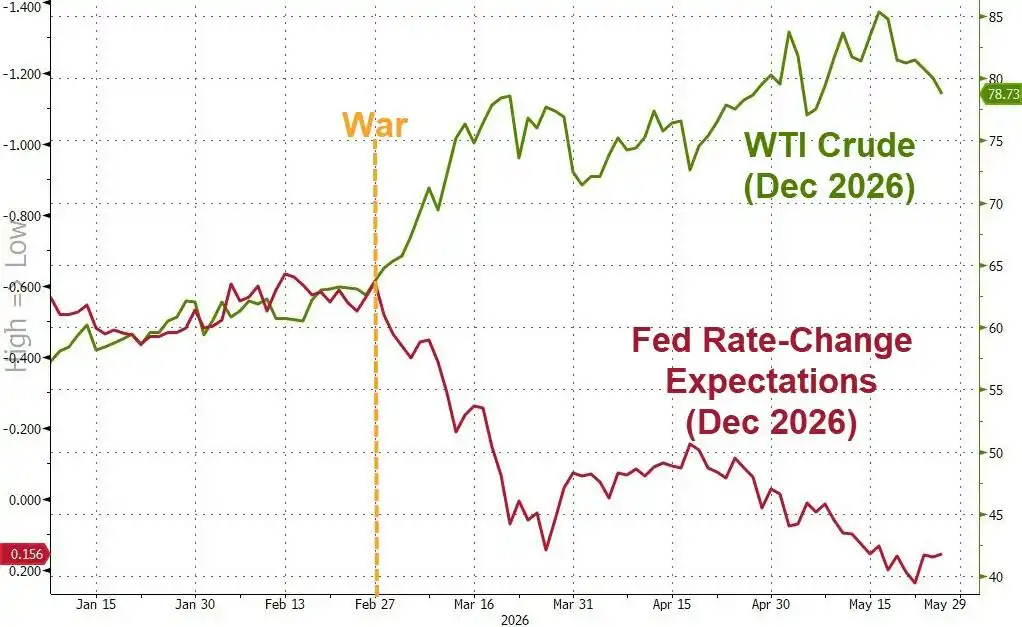
The analysis points out that oil price movements will directly affect the anchoring of inflation expectations, thereby determining whether the Fed needs to restart rate hikes. In the bank's view, the most concerning scenario currently is not the extreme conflict escalation, but the intermediate state of "failed negotiations and a stalemate"—this scenario is most likely to force the Fed to take substantive tightening action in 2026 due to persistently high oil prices.

Currently, the latest developments in the geopolitical situation show that negotiations on extending the ceasefire agreement and reopening the Strait of Hormuz have made some progress, with markets reacting optimistically. Brent crude oil futures fell below $100 per barrel, touching a near one-month low; the yield on the 10-year U.S. Treasury note also retreated significantly, erasing most of the gains from the past week. However, uncertainties remain in the negotiation details, and core disputes such as Iran's nuclear program remain unresolved.
Scenario One: A Peace Agreement is Reached – Near-term Rate Hike Pressure Fades, but Medium-term Risks Linger

In Deutsche Bank's first scenario, the negotiations achieve a breakthrough, the Strait of Hormuz reopens, oil prices extend their recent downward trend but remain above pre-war levels; U.S. Treasury yields fall further, risk asset markets strengthen overall as tail risks dissipate, and financial conditions ease.

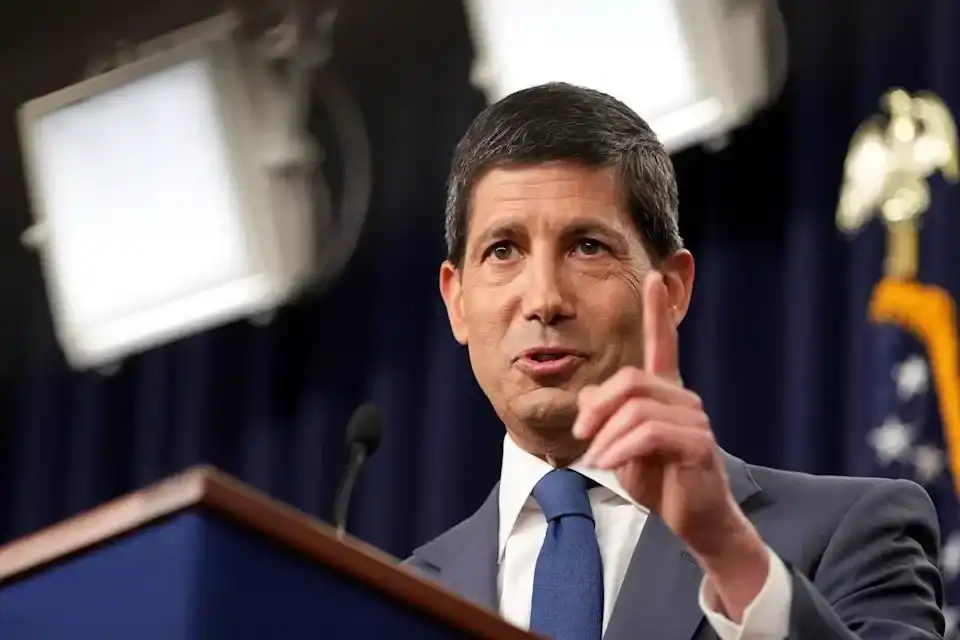
Against this backdrop, the pressure on the Fed to raise interest rates at its upcoming meetings will significantly diminish. With overall inflation data softening and short-term inflation expectations retreating, Fed officials would be inclined to view recent core inflation pressures as temporary disturbances caused by the energy price shock, opting to "look through" them rather than respond immediately. Deutsche Bank expects the new Fed Chair, Warsh, to reinforce this inclination.

However, the bank simultaneously warns that the baseline narrative of "inflation not being persistent" will take time to be disproven, and rate hike risks do not disappear entirely. If the labor market remains tight, inflation expectations shift further upward, or inflation remains stubbornly high after tariff and energy pressures fade, the risk of policy rate increases will more likely materialize in 2027.

Scenario Two: Negotiations Fail, Stalemate Persists – Highest Rate Hike Risk in 2026

Deutsche Bank characterizes the second scenario as having the "highest rate hike risk" among the three current ones. In this scenario, peace agreement talks fail, the Strait of Hormuz remains closed long-term, but the conflict does not escalate further, with oil prices maintaining high levels rather than surging sharply.

Persistently high oil prices would transmit more significantly into core inflation and pose a greater risk of unanchoring inflation expectations. Meanwhile, oil prices in this scenario are not high enough to severely damage demand and force the Fed to shift its focus to the labor market, meaning the Fed would face one-sided inflation pressure without the justification to "stand pat due to an economic downturn."

The bank believes the Fed is unlikely to take rate hike action before the September meeting—a policy pivot would need to go through multiple steps: removing the easing bias (June), some officials publicly discussing the possibility of rate hikes (July to September), and the committee reaching a consensus.

However, it also points out that Fed Governor Waller recently stated that rate hikes could be a reasonable choice if "inflation does not decline fast enough," suggesting the Fed may be willing to tighten policy more rapidly. Therefore, the possibility of multiple rate hikes in 2026 should not be ruled out.

Scenario Three: Conflict Escalates Again – Policy Outlook Faces Two-way Risks

The third scenario envisions a renewed escalation in the Iran situation, leading to a larger and more persistent surge in oil prices. Deutsche Bank believes this scenario does not necessarily mean the Fed will unilaterally move towards rate hikes, but rather introduces two-way uncertainty to the policy outlook.

On one hand, conflict escalation would drive a larger and more sustained rise in overall inflation, with core inflation facing more significant transmission risks, and the possibility of inflation expectations becoming unanchored would rise tangibly. The Fed would then need to signal clearly through policy communication its willingness to tighten policy to address price stability risks.

On the other hand, a significant and sustained rise in oil prices would increase the risk of non-linear shocks to the real economy, eventually affecting the labor market.

Deutsche Bank notes that consumers can currently still tolerate energy prices near current levels, with tax cut policies partially offsetting the pressure from rising oil prices; but if oil and gas prices rise substantially further, this buffer will be depleted. At that point, the labor market could slide out of its current fragile equilibrium of "low hiring, low layoffs," with further demand contraction or a wave of layoffs finally arriving.

In this scenario, the Fed's ultimate policy stance would depend on the sequence in which the above two types of risks materialize: if the economy remains resilient but inflation expectations become unanchored first, forceful tightening would be needed; if cracks appear in the labor market first, the Fed might instead lean towards rate cuts, citing prospective easing price pressures.

Synthesizing the three scenarios, Deutsche Bank's analytical framework reveals a clear logic chain: the Iran situation determines oil price trends, oil price trends determine the nature and duration of inflation pressure, and whether inflation expectations become unanchored ultimately determines the Fed's policy space.

Key signals currently worth monitoring include: substantive progress in ceasefire talks, whether Brent crude can stabilize below $100 per barrel, and changes in the rhetoric of Fed officials in upcoming meetings—particularly whether they begin to remove the easing bias or if any officials publicly discuss the possibility of rate hikes. These signals will be crucial observation windows for judging the probability distribution of the above three scenarios.

Related Questions

QAccording to the Deutsche Bank report, which of the three Iran scenario poses the highest risk of triggering Fed rate hikes in 2026?

AThe second scenario, where peace talks fail and a stalemate ensues with the Strait of Hormuz remaining closed, presents the highest risk of Fed rate hikes in 2026. In this case, persistently high oil prices would significantly transmit to core inflation and risk unanchoring inflation expectations, without causing enough demand destruction to give the Fed a reason to stay on hold.

QWhat is the key factor that connects the Iran situation to the Federal Reserve's monetary policy decisions, as outlined in the article?

AThe key connecting factor is the path of oil prices. The Iran situation directly influences oil price movements, which in turn determine the nature and duration of inflationary pressures. Whether these pressures cause inflation expectations to become unanchored ultimately determines the Federal Reserve's policy space and potential actions.

QWhat are the two opposing risks for Fed policy in the scenario of a renewed escalation of conflict in Iran?

AIn the conflict escalation scenario, Fed policy faces a two-way risk. On one hand, a large, sustained oil price spike could unanchor inflation expectations, necessitating a hawkish policy response. On the other hand, such a spike could non-linearly damage the real economy and labor market, which could force the Fed to consider a dovish pivot and potential rate cuts.

QWhy does the 'peace deal' scenario not completely eliminate the risk of future Fed tightening, according to Deutsche Bank?

AWhile a peace deal would ease near-term rate hike pressure by allowing the Fed to 'look through' temporary energy price shocks, the risk of future tightening does not disappear. If a tight labor market persists, inflation expectations continue to rise, or inflation remains stubbornly high even after tariff and energy pressures fade, the risk of policy rate increases could materialize later, potentially in 2027.

QWhat specific signals does the article suggest are crucial for assessing the probability of the three different scenarios?

AThe key signals to watch are: 1) Substantive progress in the ceasefire negotiations. 2) Whether Brent crude oil stabilizes below $100 per barrel. 3) Changes in the rhetoric from Federal Reserve officials in upcoming meetings, particularly if they begin removing the easing bias or if some officials start publicly discussing the possibility of rate hikes.

Related Reads

In the Era of Agent Users, Where Does Crypto Value Flow?

Title: Who Makes Money from Agents? The rise of AI Agents as potential blockchain users raises a crucial question: if they become the next billion users, who will capture the value? Traditional crypto value capture theories—like "fat protocols" (where value accrues to the base layer) and "fat applications" (where value accrues to user-facing apps)—assume human users who value UX, brand, and convenience. Agents, however, operate differently: they interact via APIs, have no brand loyalty, and can switch services with near-zero cost. This shift could disrupt existing value flows. Applications might become "headless," offering their routing and infrastructure as APIs to Agents. Alternatively, Agents might bypass intermediaries entirely, allowing protocols to regain value capture ("fat protocols" reborn). A more extreme scenario is that Agents, being purely rational and cost-sensitive, could commoditize the entire stack, compressing margins toward marginal cost and turning crypto into a low-margin utility. However, Agents may not just amplify existing activities; they could enable entirely new ones—like continuous, sub-penny portfolio rebalancing, machine-to-machine commerce, and new market types only viable at automated speeds. This expands the economic pie rather than just redistributing it. Ultimately, the key question for builders is: what will make an Agent return to your service instead of a cheaper alternative? The answer may not be UX but factors like liquidity, latency, settlement guarantees, or a yet-unnamed business model. As humans and Agents will coexist as users, value capture may split: "fat apps" for human-facing services, and a new, evolving model for the Agent-dominated layer.

marsbitJust now

In the Era of Agent Users, Where Does Crypto Value Flow?

marsbitJust now

Base MCP, The Next Step for x402

Base has officially launched Base MCP, allowing users to connect their Base Account to AI Agents to perform actions like swaps, transfers, portfolio tracking, and transaction history queries through conversational commands. This move aligns with Base's strategic focus on AI, driven by the broader competition in the emerging Agent-to-Agent payment sector. The evolution of Agent payments has accelerated. In late 2024, the primary method involved insecure browser automation. By 2025, solutions like Coinbase's x402 (providing crypto wallets for Agents), Google's AP2, and Visa's token-based system emerged. x402 has since processed 176 million transactions totaling over $70 million, with a median value between $0.01 and $0.10. Stablecoins, particularly USDC, dominate these settlements due to their negligible transaction costs compared to traditional payment fees, which are prohibitive for micro-payments. Coinbase faces competition from Stripe, which has built a comparable infrastructure for Agent payments with its Tempo blockchain, Privy wallets, Bridge routing (acquired for $1.1B), and the recently launched MPP protocol. Both companies are now competing at the application layer. The core reason AI is central to Base's strategy is to expand the scenarios for Agent payments, ensuring more transactions occur on its network. By securing a dominant position and scale advantage in this nascent field, Coinbase aims to capture the future commercial potential of Agent-driven payments. The launch of Base MCP is thus a strategic step in this larger ambition.

marsbit6m ago

Base MCP, The Next Step for x402

marsbit6m ago

Reframing Ethereum's Valuation: Why the Fee Model is Wrong, and the 'Treasury Logic' is the Future?

"Rethinking Ethereum's Value: The 'Vault Logic' Framework" Traditional valuation models incorrectly treat Ethereum as a company, valuing ETH based on transaction fees ("revenue"). This is flawed. Fees are network friction; a successful network aims to reduce them to zero. Ethereum's average fee has dropped from over $50 in 2021 to around $0.20 today, while transaction volume has tripled. Instead, view Ethereum as a digital vault securing ~$250 billion in on-chain assets (stablecoins, RWAs, L2 bridged funds, wBTC, etc.). Post-merge, Ethereum's security is directly purchased with its own asset: ETH. To attack the network, an attacker must acquire and control staked ETH. Therefore, the vault's security level is intrinsically tied to ETH's market value. Currently, the value of all staked ETH is only ~$72B, protecting ~$250B in assets—a dangerous imbalance. For robust security, the staked ETH securing the network should be valued significantly *higher* than the total value it protects. Applying a conservative security multiplier suggests ETH's fair value should be closer to ~$6,900 (vs. ~$2,070 currently). As on-chain asset value grows into the trillions, ETH's price must rise proportionally to maintain this security budget. Comparisons to free infrastructure like Linux or low-margin utilities like the DTCC are misguided. Their security is provided externally (community, law, banks). Ethereum's security is internal and must be purchased in the open market using ETH. ETH is not the clearinghouse; it is the collateral backing it. The model is not a short-term price predictor but a structural framework. The economic force for ETH appreciation grows monotonically with the adoption of Ethereum for settling value. The narrative that high fees are good is backwards; low fees enable more activity, which increases the value needing protection, thus demanding a more valuable ETH.

marsbit13m ago

Reframing Ethereum's Valuation: Why the Fee Model is Wrong, and the 'Treasury Logic' is the Future?

marsbit13m ago

Justin Sun’s Interview with Hurun Report: A New Order and Certainty for Value Flow in the Era of Transformation

In an interview with *Hurun Report*, Justin Sun, founder of TRON, discussed the evolution of the Web3 industry as it moves from initial exploration to large-scale adoption. He emphasized that the core value of blockchain lies in building an open and inclusive internet of value, enabling anyone globally to transfer and use funds efficiently and at low cost, regardless of location or access to banking. Sun highlighted that projects with lasting impact are those built on genuine demand and real-world usage. He pointed to the stablecoin payment ecosystem as the most mature and scalable application currently, noting that TRON has rapidly become one of the world's largest stablecoin networks. The circulation of USDT on TRON has surpassed $86.3 billion, driven by actual use cases such as cross-border transfers and daily payments, demonstrating strong network effects. Regarding strategy, Sun outlined a methodology combining data-driven iteration, rapid execution, and user-centric focus. He cited the decision to partner with Tether to launch TRC-20 USDT as a key strategic move, based on an assessment of market trends and long-term potential, which has become a significant growth engine for the TRON ecosystem. On globalization, Sun stressed the importance of local compliance and cultural adaptation, noting that success in different markets depends on deep understanding and local partnerships. He also addressed the convergence of AI and blockchain, describing it as a transformative direction where blockchain provides decentralized infrastructure for AI, while AI enhances the intelligence and user experience of blockchain systems. For industry participants and young entrepreneurs, Sun advised continuous learning and adaptability in a fast-changing environment, focusing on building irreplaceable core strengths rather than spreading resources too thinly. Through infrastructure development, global strategy, and technological foresight, TRON aims to advance the practical implementation and evolution of the value internet.

marsbit45m ago

Justin Sun’s Interview with Hurun Report: A New Order and Certainty for Value Flow in the Era of Transformation

marsbit45m ago

Samsung Leverages Technology Cycles, SK Hynix Relies on HBM, What Enabled Micron to Win a Trillion-Dollar Market Cap?

Micron Technology, the Idaho-based memory chip maker, recently saw its market cap surpass $1 trillion, securing its position as one of the top three DRAM manufacturers alongside Samsung and SK Hynix. Its survival and growth story is marked by a unique combination of political maneuvering and hard-won manufacturing efficiency, but also strategic missteps that now challenge its future. Founded in 1978 in Boise without significant government or capital backing, Micron repeatedly turned to Washington for survival during critical junctures. In the 1980s, it filed anti-dumping complaints against Japanese firms, leading to the U.S.-Japan Semiconductor Agreement. Ironically, this created an opening for Samsung, which Micron had earlier licensed its 64K DRAM technology to. In 2002, Micron avoided heavy fines in a price-fixing investigation by acting as a whistleblower against its competitors, cementing its reputation as a "political opportunist." A major strategic error occurred in 2013 with its $2.5 billion acquisition of bankrupt Japanese firm Elpida. This deal burdened Micron with integrating incompatible manufacturing processes just as the industry was pivoting toward HBM (High Bandwidth Memory), a critical technology for AI. SK Hynix had launched its first HBM chip that same year. By the time AI demand exploded with ChatGPT in 2022, SK Hynix commanded about 85% of the HBM3 market, while Micron, playing catch-up, held only around 3%. In 2017, Micron employed similar tactics against a new competitor, Chinese startup Fujian Jinhua, by alleging intellectual property theft, which led to U.S. sanctions effectively crippling the firm. However, this strategy backfired in 2023 when China banned Micron's products from its critical infrastructure, causing its revenue share from China to plummet from 14% in FY2023 to just 7.1% by FY2025. Today, Micron faces a triple squeeze: it lags in the high-margin HBM race, faces pricing pressure in low-end DRAM from Chinese manufacturers like CXMT, and has lost crucial access to the booming Chinese AI server market. Despite its political strategies, Micron's core strength is its exceptional manufacturing cost control, achieved through decades of engineering. Its DRAM chips have a smaller cell area than its rivals, yielding more chips per wafer. This efficiency has been vital for weathering industry downturns. However, this advantage cannot compensate for the decade lost in HBM development. Micron is now racing to ramp up production of its HBM3E, certified by NVIDIA, and develop HBM4. Its future hinges on whether it can close this technological "time debt" through relentless R&D and execution, in a marathon where its competitors, having started earlier, are not slowing down.

marsbit1h ago

Samsung Leverages Technology Cycles, SK Hynix Relies on HBM, What Enabled Micron to Win a Trillion-Dollar Market Cap?

marsbit1h ago

Trading

Spot
Futures
活动图片