Author | Meltem Demirors
Compiled by | Odaily Planet Daily (@OdailyChina)
Translator | DingDang (@XiaMiPP)

Institutions have finally "entered crypto"—but they're not here to take over your bags. They're here to turn the crypto economy into a fee-generating machine for their AUM (Assets Under Management) accumulation. This isn't a judgment or criticism, just an observation of fact.
The following thoughts primarily address crypto as a digital currency/token economy, not merely as financial infrastructure blockchains (the latter, in the vast majority of cases, does not require a native token, as proven by the architecture of most DeFi governance tokens).
This is a view I've held since last year's Digital Assets Summit, where the title of my opening keynote was "Believe in Something." Everything that has happened in the past twelve months hasn't changed my view, only made the picture clearer.
Recently, my friends Evgeny from Wintermute and Dean from Markets Inc wrote two great articles discussing what so-called "institutional adoption" really means and its impact on market cycles. This inspired me to write a third piece, building on their work and adding a new perspective—the changing capital landscape and the erupting AUM war.
If you're short on time, here's the one-sentence summary:
"Institutional adoption" is not a mission; it's an extraction strategy. The only question left is: Can crypto build and fund its own institutions fast enough to keep economic value on-chain, rather than letting it continuously leak out to TradFi?
TradFi is Already Extracting Most of the Crypto Economy's Value
Just follow the money flow to see who the real winners are in the crypto world today: not DeFi protocols, but the very financial companies that Satoshi Nakamoto sought to replace in the Bitcoin whitepaper.
- Just the two major stablecoins, USDT and USDC, generate approximately $10 billion in net interest spread annually, accruing to Tether (a private company), Coinbase, and Circle (public companies). These companies are certainly important participants in the crypto economy, but they serve their shareholders first.
- Cantor Fitzgerald—led by current US Secretary of Commerce Howard Lutnick—earns hundreds of millions of dollars annually by holding US Treasuries for Tether and organizing trades around digital asset companies and investment products.
- Former US President Trump, his family, and partners have also cumulatively profited billions of dollars through expanding crypto projects and token vehicles.
- BlackRock's Bitcoin ETF, IBIT, grew to approximately $100 billion AUM in about 18 months, becoming the fastest-growing ETF in history and one of the company's most profitable products (more on that later).
- Apollo Global Management and its peers are quietly funneling crypto collateral and corporate treasury balances into their own credit and multi-asset funds.
Annually, traditional financial institutions extract tens of billions of dollars in assets and profits from the crypto economy—and in many cases, they capture more economic upside than the protocols that initially created the value.
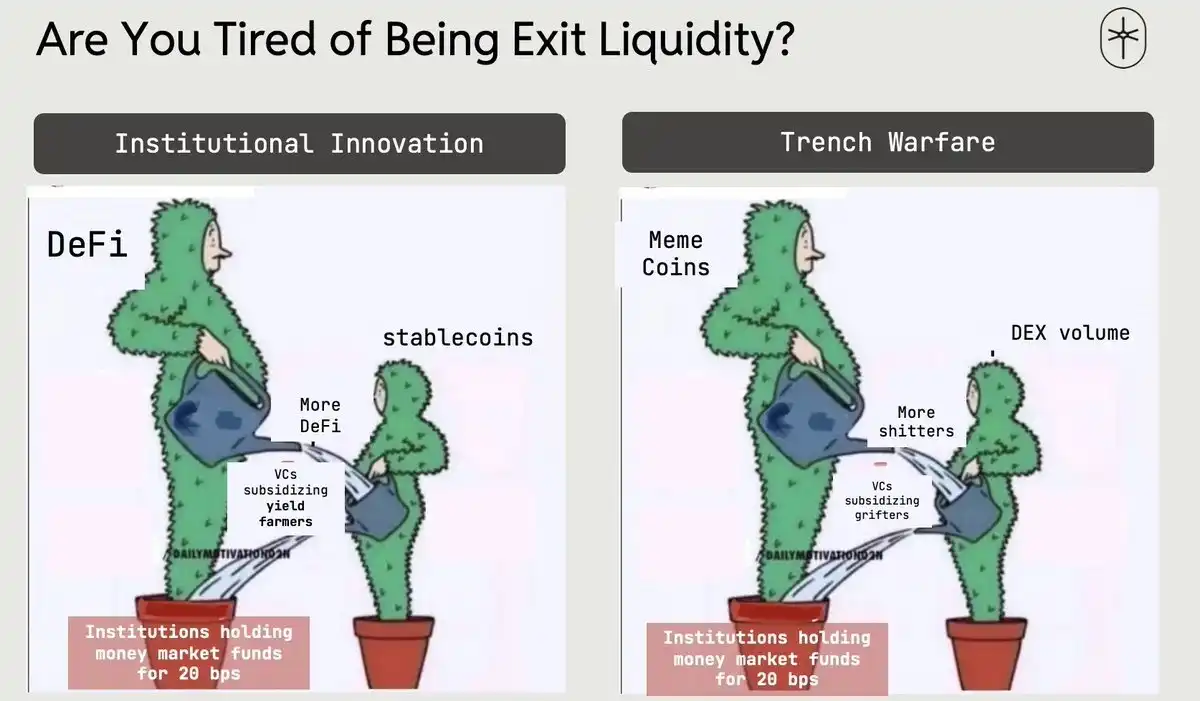
Those "institutional innovators" cheering for "adoption" at countless conferences and the trench warriors obsessing over memecoins on Twitter are more alike than you think. We should stop licking boots and start using our brains.
How Do Institutions Actually Think?
Corporations have one core function: profit maximization. Cryptocurrency can achieve this in two ways:
- Cost Side: Distributed ledgers, on-chain collateral, and instant settlement can significantly reduce back and middle-office operational costs, improving collateral liquidity and utilization (see my previous notes on fungible liquidity).
- Revenue Side: Packaging crypto into ETFs, tokenized funds, structured products, custody services, basis trade packages, lending, treasury management solutions... all throw off hefty fee streams, plus mindless hype from the crypto community on Twitter.
Over the past decade, institutions focused primarily on the first way.
When we founded DCG in 2015, I spent three full years pitching the advantages of Bitcoin's global ledger and final settlement mechanism to almost every financial institution. At that time, financial services firms did not see crypto as a new revenue source. It was considered too risky; and the potential gains from shilling altcoins weren't enough to convince boards to take on the reputational and compliance risk.
After leaving DCG, I joined CoinShares in early 2018. The company's AUM grew from tens of millions to billions of dollars gradually. The few independent investment managers who dared to embrace Bitcoin—like Cathie Wood, Murray Stahl, Ross Stevens—were ultimately richly rewarded for their courage.
Early 2024 became a watershed moment. Institutions began using crypto as a tool for the second path: a new revenue source.
While there had been sporadic institutional participation before, the launch of BlackRock's IBIT Bitcoin ETF blew the dam wide open. IBIT became the most successful ETF ever, significantly boosting BlackRock's earnings. Key numbers:
- IBIT reached $70 billion AUM in its first year, becoming the fastest ETF to reach that size in history, about five times faster than the previous record holder, SPDR Gold Shares (GLD).
- After IBIT options launched in late 2024, it attracted over $30 billion in new inflows, while competitors' flows largely stalled, giving it over half the market share of all Bitcoin ETF AUM.
- IBIT's current ~$100 billion AUM generates hundreds of millions of dollars in annual fee revenue for BlackRock, making it even more profitable than the company's nearly trillion-dollar S&P 500 index fund.
The conclusion: IBIT showed the playbook to every major asset manager and financial services firm—take Bitcoin or other digital assets → package into traditional fund structures → list them → become a stable, hefty fee stream. Everything that follows—DATs, tokenized treasuries, on-chain money market funds—is just running that playbook over and over.
The AI Capex Supercycle: A Black Hole for Capital
Switching gears slightly to another mega-trend—this is also why we launched Crucible immediately after IBIT's launch in 2024. The energy-compute value chain is reshaping the global capital stack in real-time.
Building the AI economy—chips, data centers, power, factories, etc.—will require trillions of dollars in capital expenditure over the next decade, and that money has to come from somewhere. All liquid assets not directly tied to AI—crypto, non-AI stocks, even credit—are being sold to chase those perceived as "must-have" AI plays.
Simultaneously, many LPs are over-allocated in private markets, with slower exits and distributions, and are quietly cutting or delaying new private credit and PE commitments. This leads to longer, lumpier, less predictable fundraising cycles, and a fierce battle for quality AUM channels between asset managers and PEs. The result is that anything that looks like a capital pool gets drained.
On-Chain Capital: The Next AUM Frontier
In this AUM war, crypto is no longer a quirky toy but trillions in potential management规模, sitting right there.
IBIT proved crypto is both a money printer and a "honeypot" for institutional allocators. The Trump administration has also made it clear it will create an extremely permissive environment for all sorts of crypto innovation.
On-chain asset management and treasury规模 already amount to hundreds of billions:
- ~$300 billion in stablecoin supply, with ~60% in USDT and 25% in USDC;
- DeFi Total Value Locked (TVL) of ~$90–100 billion, spread across Ethereum, Solana, BSC, Hyperliquid, etc.;
- Hundreds of billions more in Real World Asset (RWA) products via tokenized money funds (like BlackRock's BUIDL), tokenized gold (like Tether Gold, PAXG), and consumer credit products (like Figure's tokenized HELOCs).
But the average yield on this on-chain capital is only 2–4%, while traditional money market funds offer ~4.1%, and even Lido's $18 billion stETH pool yields only ~2.3%.
To a hungry asset accumulation machine, this isn't "DeFi TVL," it's under-monetized cash flow—ready to be packaged, staked, re-lent, and fee'd. For institutions, this is as natural as breathing.
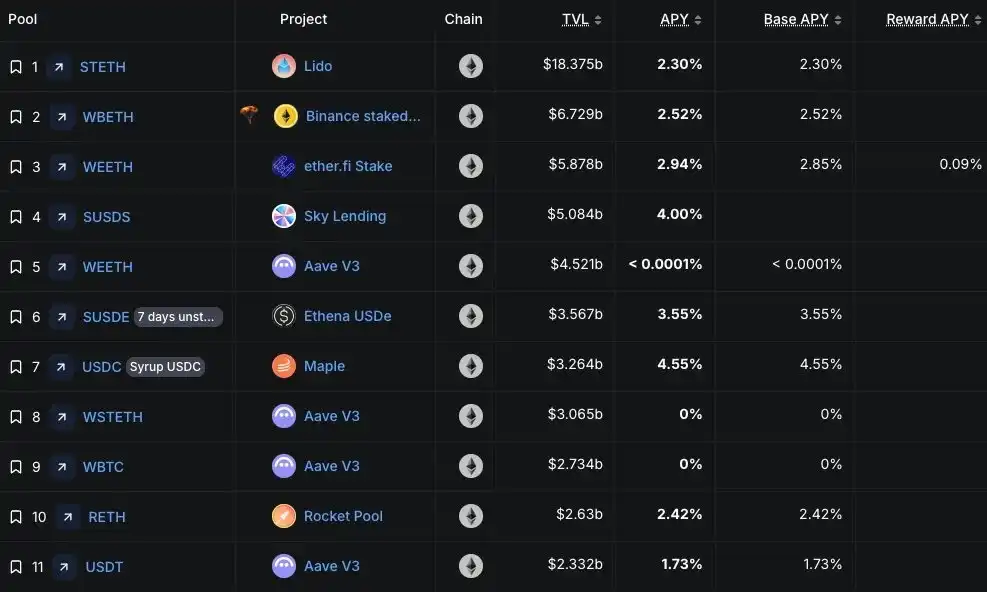
Image from DefiLlama
Tokenization and regulated wrapper products have turned previously "untouchable" crypto capital into fee-generating AUM that fits existing custody and risk frameworks. As companies, DAOs, and protocols accumulate large crypto treasuries and seek safer external yield, asset managers can repackage these assets into tokenized funds, money market funds, and structured products. For firms facing fundraising pressure and saturated traditional channels, "raiding" crypto balance sheets is one of the cleanest paths to grow fee AUM.
A Wake-Up Call
Just as Western economies introduced populations that did not share their culture and values and are now suffering the social and economic consequences, crypto stands on the brink of a similar existential crisis. The crypto economy and its leading thinkers are introducing financial institutions that do not share our values, institutions that are not here to co-build native economic growth, and our industry will soon taste the same social and economic bitterness.
Left unchecked, the crypto economy will become just another liquidity sleeve for TradFi's AUM machines. The only way out is to accelerate the building and scaling of our own native institutions—on-chain asset managers, risk managers, underwriters, financial products, crypto-native allocators—to compete for treasury AUM, design products that truly serve crypto's long-term interests, and keep more economic value inside the crypto ecosystem rather than leaking out to corporate P&Ls.
If we don't prioritize working with crypto-native institutions now, "institutional adoption" won't be a victory; it will be an annexation.
Believe in something. Otherwise, we'll have nothing left.
Related Reading
The War Between Stablecoins and Banking Probably Doesn't Exist




![Will Bittensor [TAO] hold $193 or sink to $186? Watch out for 2 signs!](https://d1x7dwosqaosdj.cloudfront.net/images/2026-07/41f6627611d24a5f96cbc0fe7b981e2b.jpg)