INJ price prediction – Can Injective’s SEC filing trigger a breakout above $5.20?

ambcryptoPublished on 2026-07-17Last updated on 2026-07-17

Abstract

Injective (INJ) has recovered above $5, but faces key resistance at $5.20 to break out from its July consolidation range. This price movement follows the project's filing for transfer agent registration with the U.S. SEC, aiming to bring regulated, on-chain record-keeping for tokenized real-world assets and securities. The filing initiates the process and does not imply SEC approval. Injective also published a MiCAR whitepaper to support expansion in the EU, highlighting a broader regulatory push. While the RSI indicates strengthening buying momentum, a decisive move above $5.20 is needed to signal an extended recovery. Failure could see a retest of lower support levels.

Injective [INJ] traded back above $5 as the token attempted to extend its recovery from June lows, with buyers now facing resistance around the $5.20 region.

The latest price move comes as Injective filed its transfer agent registration with the U.S. Securities and Exchange Commission [SEC]. This is part of the blockchain network’s push to bring on-chain regulated real-world assets [RWAs] and securities infrastructure.

Injective files for SEC transfer-agent registration

Injective announced on July 16 that it had officially filed its transfer agent registration with the SEC.

Transfer agents maintain official ownership records for securities and process changes when those assets change hands. Injective wants to bring this function on-chain, allowing the ownership record to exist on the same blockchain as the tokenized security rather than relying on a separate off-chain database.

According to Injective, moving the transfer-agent function on-chain could allow market participants to record and transfer ownership of tokenized securities within seconds while reducing the need for multiple intermediaries to reconcile transactions.

The filing begins the registration process and should not be interpreted as SEC approval or confirmation that Injective is already operating as a registered transfer agent.

Regulatory push extends beyond the U.S.

The SEC filing forms part of Injective’s broader push to expand its regulated financial infrastructure.

Injective said the announcement came hours after it published its MiCAR whitepaper, which the project says will support its expansion across European Union member states within the region’s regulatory framework.

Together, the developments highlight Injective’s efforts to position its blockchain infrastructure for institutional and regulated markets across the U.S. and Europe.

However, the developments have yet to trigger a decisive breakout for INJ.

Can INJ break above $5.20?

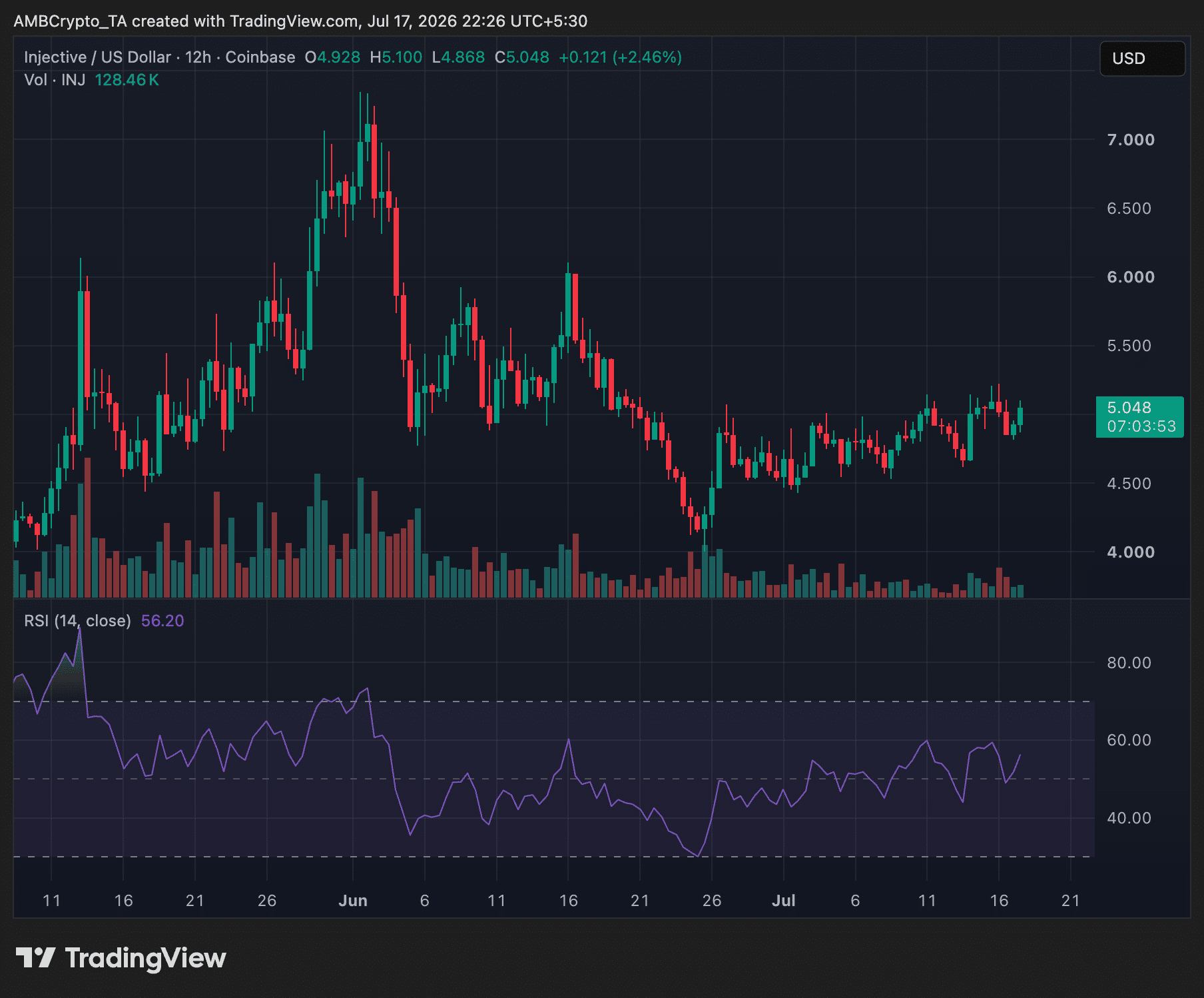
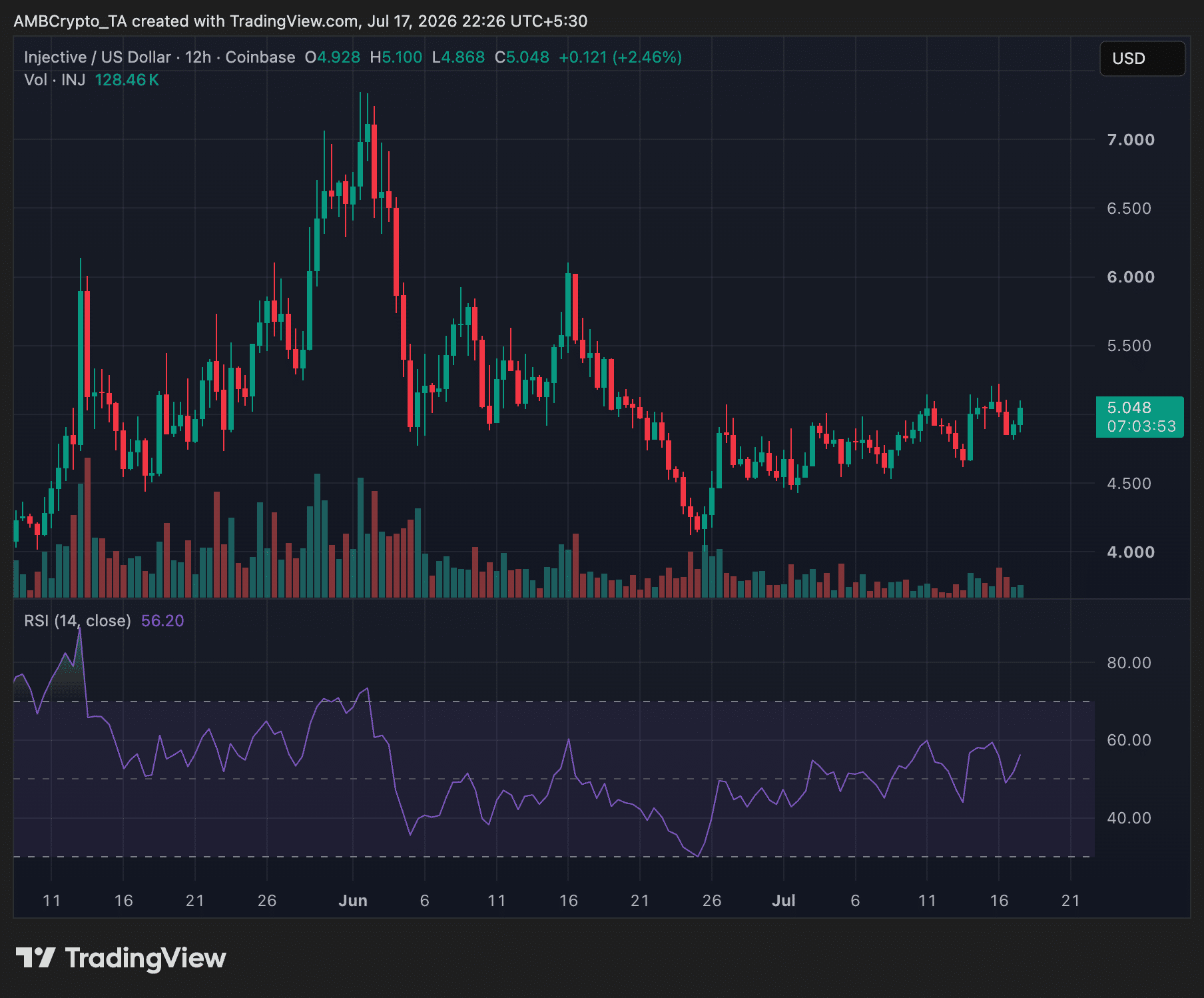
At press time, INJ was trading at approximately $5.05, with the latest 12-hour candle gaining around 2.5%.

The token has recovered considerably since falling towards $4.10 in late June. However, its price action throughout July has largely remained within a consolidation range between approximately $4.50 and $5.20.
Source: TradingView

The Relative Strength Index [RSI] stood at 56.20, above the neutral 50 level, suggesting that buying momentum had strengthened. However, the indicator remained well below overbought territory, leaving room for further upside if demand increases.

The immediate challenge is the $5.20 region, which has repeatedly limited INJ’s recovery attempts during July. A decisive move above this area could signal a breakout from the recent consolidation range and strengthen the case for an extended recovery.

Failure to overcome the resistance, however, could leave INJ range-bound and expose the token to another test of support around the lower end of its recent trading range.


Final Summary

  • Injective has filed for SEC transfer-agent registration to bring official ownership records for tokenized securities on-chain.
  • INJ has recovered above $5 with its RSI rising to 56.20. Still, the token must overcome resistance around $5.20 to confirm a breakout from its July consolidation range.


Trending Cryptos

Related Questions

QWhat is the significance of Injective filing its transfer agent registration with the SEC?

AIt is part of Injective's push to bring regulated real-world assets and securities infrastructure on-chain. A transfer agent maintains ownership records, and moving this function on-chain would allow faster recording/transfer of tokenized securities and reduce intermediaries.

QWhat is the key price level that INJ must overcome to signal a breakout according to the article?

AThe key resistance level is around $5.20. A decisive move above this area is needed to break out of its recent consolidation range and signal an extended recovery.

QBesides the SEC filing, what other regulatory effort did Injective announce recently?

AInjective published its MiCAR whitepaper, which is intended to support its expansion across European Union member states within the region's regulatory framework.

QWhat does the Relative Strength Index (RSI) reading of 56.20 for INJ suggest about its momentum?

AAn RSI of 56.20, above the neutral 50 level, suggests that buying momentum has strengthened. However, it is still well below overbought territory, indicating potential for further upside if demand increases.

QWhat is the current trading range for INJ mentioned in the article?

AThroughout July, INJ's price action has largely remained within a consolidation range between approximately $4.50 and $5.20.

Related Reads

Technological Self-Reliance in China: A War from Lithography Machines to ABF Films

"China's Tech Independence: A Battle from Lithography Machines to ABF Film" In August 2026, Japan's Ajinomoto announced a 30% supply cut of ABF film to Chinese mainland clients, causing industry-wide shock and fears of price hikes and shortages in the semiconductor supply chain. That same year, Chinese company Lotus Holdings, known for its MSG business, acquired a small domestic ABF film startup for 103 million yuan, aiming to change this passive situation. ABF film is a core insulating material for advanced CPU, GPU, and AI chip packages. Ajinomoto, originally a food flavoring company, has monopolized over 95% of the global ABF film market for nearly 30 years, deriving its technology from byproducts of monosodium glutamate production. With AI chips consuming 5-10 times more ABF film than traditional chips, the supply-demand gap is widening. Ajinomoto's supply cut to China, where domestic ABF film production accounts for less than 5%, directly threatens the production of domestic high-end AI chips and their substrates. This incident highlights a crucial but often overlooked truth: the vulnerabilities in China's quest for technological self-reliance extend beyond headline areas like lithography machines to critical but seemingly minor components—insulating films, photoresists, electronic specialty gases, etc. The article frames China's tech independence as a multi-front war. While major breakthroughs have been achieved in chip design (e.g., Huawei's HiSilicon), foundry (e.g., SMIC), and memory chips (e.g., YMTC), countless smaller "Ajinomoto-style" chokepoints remain. Lotus Holdings' acquisition represents a significant shift: the battle is no longer fought only by tech giants but has become a collective, industry-wide effort involving companies from diverse backgrounds. Historically, external blockades have often spurred China's technological breakthroughs, as seen with Huawei's Kirin chips and YMTC's 3D NAND flash memory. Ajinomoto's supply cut, while a short-term challenge, may similarly catalyze domestic innovation in ABF film and other critical materials. The path to technological sovereignty is long and arduous, requiring sustained patience and investment to fill every gap in the complex supply chain. Lotus's move is not an immediate solution but a step towards that future, symbolizing a broader, relentless march toward independence.

marsbit2m ago

Technological Self-Reliance in China: A War from Lithography Machines to ABF Films

marsbit2m ago

The Great Ethereum "Rate Cut" Debate: Is Now the Golden Window for Staking with the Unconventional EIP-8363?

Ethereon's economic policy is under review as a new proposal, EIP-8363, sparks debate over potential "interest rate cuts" for staking. The unconventional proposal suggests gradually increasing the proportion of newly issued ETH rewards that are burned as the total staked ETH ratio rises, with issuance fully offset by burns once the ratio nears 50%. This would drive the protocol-level staking APR towards 0%, though validators would still earn transaction fees and MEV. This discussion emerges as staked ETH approaches 35% of supply, with the current protocol APR at ~2.6%. The core question is whether Ethereum needs to continue paying high issuance costs for marginal gains in security once sufficient participation is achieved. EIP-8363 aims to optimize security spending, but critics warn it could disproportionately impact solo stakers and potentially increase centralization among large, resilient operators. Paradoxically, this debate coincides with the Pectra upgrade (EIP-7251), which introduces native compounding for staking rewards, significantly improving capital efficiency for long-term holders. This creates a dual narrative: the protocol is making staking more efficient while reconsidering the economic incentive to stake. For long-term ETH holders, this environment may present a "time window" rather than a fixed-rate opportunity. While future APRs are expected to trend downward, starting staking earlier maximizes the compounding effect over time. The decision to stake depends on individual factors like investment horizon, liquidity needs, and risk tolerance regarding options like native validation, staking services, or liquid staking tokens (LSTs). The evolution from encouraging staking to managing its economic cost marks a new, mature phase for Ethereum's tokenomics, where the true value of staking may increasingly lie in the long-term power of compounding time.

marsbit11m ago

The Great Ethereum "Rate Cut" Debate: Is Now the Golden Window for Staking with the Unconventional EIP-8363?

marsbit11m ago

Analyst States Bitcoin Remains Within $61-68k Range

An analyst stated that Bitcoin is likely to remain within a trading range of $61,000 to $68,000. According to Kirill Komalenkov, director of strategic communications at Bitbanker, Bitcoin continues to trade sideways amidst declining market volatility. He attributes its current stability to high market liquidity, with volatility near three-year lows. Komalenkov warned that sustained low activity carries risks of a price decline, with potential tests of support at $62,300 and $61,600. He suggested that major market players might use the current situation to accumulate liquidity, meaning any initial breakout from the range could be a false move. The analyst expects this sideways movement to persist until the latter part of August. Key factors for determining future market direction include fund flows into Exchange-Traded Funds (ETFs) and trader activity. However, Komalenkov noted a potential negative scenario for the second half of August, where heightened geopolitical tensions or hawkish rhetoric from US monetary authorities could trigger a new decline. In such a case, Bitcoin could fall to a range of $45,000–$50,000 by early autumn, which might form a new base for a potential market recovery later in the season. Separately, a Russian deputy finance minister recently announced that non-qualified investors in Russia will soon be allowed to legally purchase Bitcoin, Ethereum, and popular stablecoins, with an annual limit of 300,000 rubles per intermediary.

cryptonews.ru13m ago

Analyst States Bitcoin Remains Within $61-68k Range

cryptonews.ru13m ago

Trading

Spot

Hot Articles

Discussions

Welcome to the HTX Community. Here, you can stay informed about the latest platform developments and gain access to professional market insights. Users' opinions on the price of S (S) are presented below.

活动图片