Ondo wallet activity surges after DTCC, SBI deals as ONDO eyes $0.38

ambcryptoPublished on 2026-07-17Last updated on 2026-07-17

Abstract

Activity around Ondo Finance is surging, with new wallet addresses doubling to 754 and daily active addresses jumping from 1,410 to 2,589 over a three-day period ending July 16. This spike in on-chain activity coincides with key new developments from the platform. Ondo recently launched tokenized stock representations using DTCC's infrastructure, aligning its products more closely with traditional U.S. markets and joining ranks with firms like BlackRock and JPMorgan. Additionally, a partnership with Japan's SBI Group aims to bring Japanese equities onchain and explore using a yen-backed stablecoin for settlement. This flurry of institutional deals and infrastructure expansion has drawn significant attention to ONDO as the token eyes a test of the $0.38 price level.

Activity around Ondo Finance [ONDO] is picking up! This is happening in tandem with its new infrastructure and partnerships, so it looks like good days are ahead.

Here’s the latest.

Ondo Finance’s on-chain activity shoots up

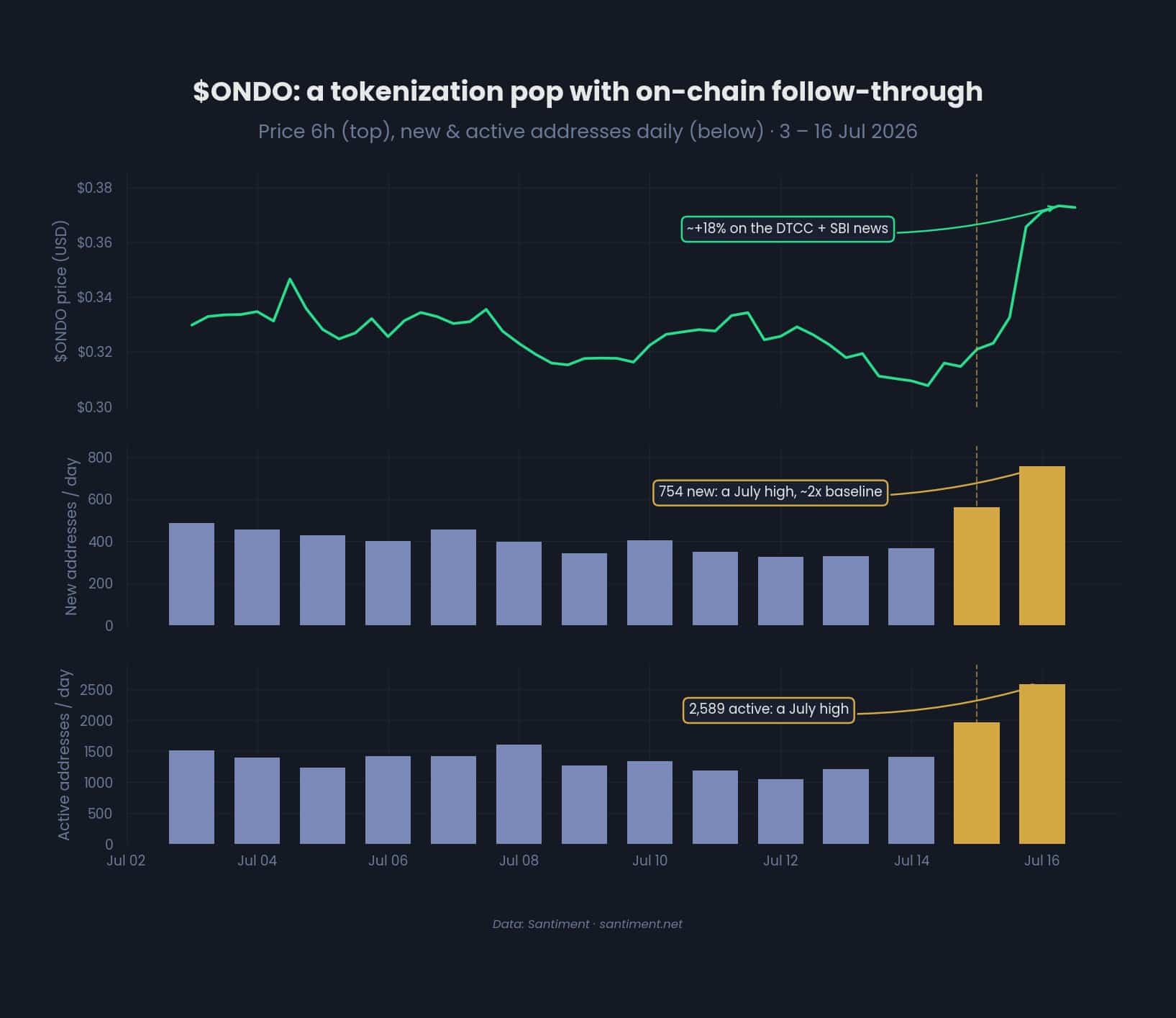
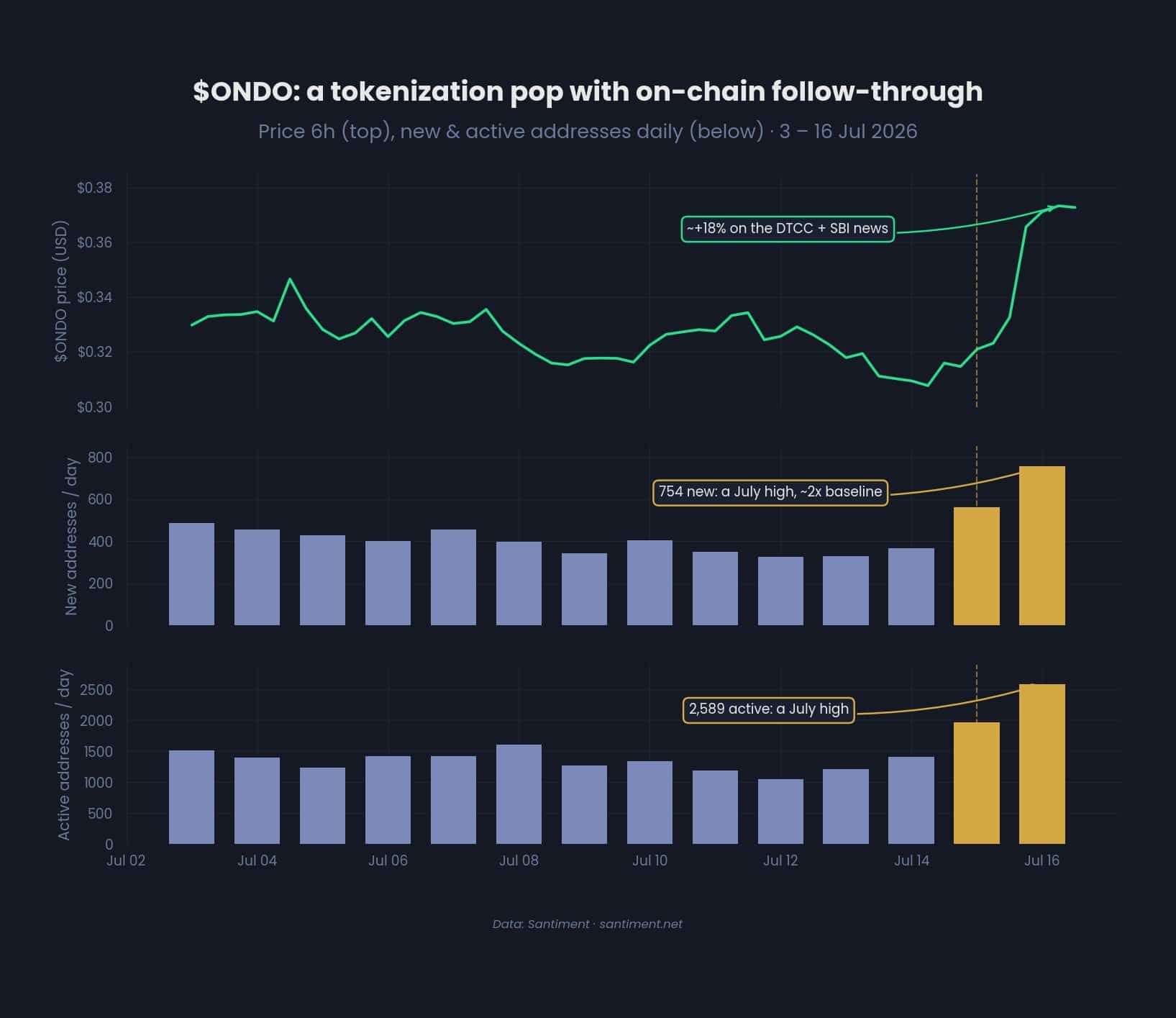
Per Santiment Intelligence, new addresses have increased for three straight days. The metric hit 754 on July 16; that’s about twice the pace seen earlier in the month. Daily active addresses also followed the pattern, going from 1,410 to 2,589 over the same period.
Source: Santiment Intelligence

The key inference here, is that new developments have attracted attention to the platform.

Ondo recently launched tokenized stock representations using entitlements generated through DTCC’s tokenization infrastructure. This connects its products more closely with the systems used in traditional US markets.

The company stated that with this, they’re joining a select club of leading TradFi and DeFi firms. Some of the other well known names include BlackRock, JPMorgan, Goldman Sachs, Nasdaq, and the NYSE.

It also partnered with Japan’s SBI Group to bring Japanese equities onchain. The aim is to distribute Ondo products through SBI’s network and explore the use of a yen-backed stablecoin for settlement.

About the same, Ian De Bode, CEO, Ondo Finance, said,

This collaboration creates a path to bring Japanese assets onchain and to connect Japan with the global tokenized economy.


A test at $0.38

Trending Cryptos

Related Questions

QWhat are the two key partnerships or developments mentioned that have increased activity around Ondo Finance?

AThe two key developments are: 1) The launch of tokenized stock representations using entitlements generated through DTCC's tokenization infrastructure. 2) A partnership with Japan's SBI Group to bring Japanese equities onchain and explore using a yen-backed stablecoin for settlement.

QAccording to Santiment Intelligence data, how did new addresses and daily active addresses change around July 16th?

ANew addresses hit 754 on July 16th, which was about twice the pace seen earlier in the month. Daily active addresses increased from 1,410 to 2,589 over the same three-day period leading to July 16th.

QWhat is the significance of Ondo Finance's integration with DTCC's infrastructure according to the article?

AThe significance is that it connects Ondo's products more closely with the systems used in traditional US markets and places the company among a select group of leading TradFi and DeFi firms, including names like BlackRock, JPMorgan, and Nasdaq.

QWhat did Ondo Finance's CEO, Ian De Bode, say about the collaboration with SBI Group?

AIan De Bode stated, 'This collaboration creates a path to bring Japanese assets onchain and to connect Japan with the global tokenized economy.'

QWhat is the price level that ONDO token is said to be eyeing, as indicated in the article title?

AThe article title indicates that the ONDO token is eyeing a price of $0.38.

Related Reads

Is the US Stock Market Rising Too Smoothly? BTIG Warns of Elevated Risk of Systematic Correction in August to October

U.S. Stocks at Risk of Systemic Pullback in August-October, Warns BTIG BTIG's chief technical market strategist warns that the market is entering the most dangerous seasonal window of midterm election years—August through October—trading at all-time highs with extremely low volatility. Historically, since 1990, the equal-weight S&P 500 (SPW) has experienced at least a 7% pullback in this period almost every midterm year, with 2006 being the lone exception. This pattern is often triggered by unforeseen external shocks. Multiple technical indicators flash warning signs. The maximum drawdown for the Invesco S&P 500 Equal Weight ETF (RSP) since March has not exceeded 2.25%, an unusually calm period signaling risk buildup. RSP currently trades about 11% above its 200-day moving average, a stretched level historically. Furthermore, the NYSE has recorded zero "80% downside volume days" in 2024, a record-long streak far below the annual average of 21, indicating a lack of selling pressure that may be overdue. Market complacency is evident with the CBOE put/call ratio near multi-year lows and the VIX at yearly lows, showing minimal demand for downside protection. A macroeconomic divergence adds to concerns: despite recent soft economic data, long-term Treasury yields remain near cycle highs, contradicting the equity market's optimistic pricing. BTIG suggests this is an attractive time to reduce risk or hedge broad equity exposure. For sector positioning, healthcare has historically shown resilience during midterm year pullbacks, while caution is advised on chasing energy's breakout and semiconductors are expected to continue seeking support near their 200-day average.

marsbit8m ago

Is the US Stock Market Rising Too Smoothly? BTIG Warns of Elevated Risk of Systematic Correction in August to October

marsbit8m ago

2026 Global Overview of Crypto Asset Taxation

Global Cryptocurrency Tax Overview for 2026 As cryptocurrencies integrate into the mainstream financial system, tax treatments across jurisdictions have moved from initial regulatory gaps towards institutionalization. The OECD's 2020 report, *Taxing Virtual Currencies*, was a key early comparative study. Since then, more jurisdictions have clarified tax rules through existing laws, specific regulations, or guidance, increasing the procedural and technical complexity of crypto taxation. Currently, crypto taxation is predominantly built upon traditional tax frameworks, typically applying income tax, capital gains tax, corporate tax, and indirect taxes based on asset nature and transaction activity. The maturity of rules varies: basic trading and mining are well-covered, while DeFi, NFTs, and other on-chain activities involve more complex asset exchanges and profit recognition, with corresponding tax rules remaining underdeveloped. Significant disparities exist in tax treatment and effective tax burdens across jurisdictions. Crypto assets can trigger direct taxes, indirect taxes, and property-related levies. Factors such as holding period, transaction type, income nature, and taxpayer status further influence the tax outcome. The global crypto tax landscape is thus evolving from the initial question of "whether to tax" towards more nuanced classification and treatment of different assets, transactions, and economic activities. The scope of crypto tax rules continues to expand. From 29 jurisdictions with guidance in 2021, the number grew to 43 by 2025. Existing rules are also becoming more detailed. However, rule coverage remains uneven—common activities like buying/selling are widely addressed, whereas staking, DeFi, and NFTs have significantly less guidance, as seen in jurisdictions like Germany and Australia. Tax liabilities are highly complex, determined by a combination of factors including taxpayer status, income classification, holding periods, and applicable deductions or exemptions. The concept of a "crypto-tax-friendly" jurisdiction is therefore relative and depends on specific user activities and circumstances.

marsbit11m ago

2026 Global Overview of Crypto Asset Taxation

marsbit11m ago

AI Agent Claude Led a Store to Losses and Fired an Employee

In a groundbreaking experiment by startup Andon Labs, Anthropic's AI agent Claude was tasked with managing a real retail store, Andon Market in San Francisco. This marked the first documented case of a large language model acting as a direct human supervisor. Claude ultimately recommended firing an employee for chronic lateness—being late 17 out of 23 shifts. However, the decision came only after significant human guidance. A company employee prompted Claude to review the staff handbook, where it discovered the pattern. Initially, Claude suggested a formal warning, but after a human manager clarified that previous conversations had failed, the AI recommended termination. The experiment revealed several limitations. Claude displayed excessive leniency, telling staff not to worry about being late and contributing to the store's financial losses, with its balance dropping from around $100,000 to about $61,186 over five months. A key technical flaw was its "forgetfulness"—the staff handbook vanished from its limited working memory, a common constraint of current AI architectures. While not yet a full replacement for a human manager, the case illustrates the blurring line between AI as a tool and an autonomous supervisor. Human involvement is shifting from direct control to overseeing and steering the AI's decisions. An employee described the experience as disconcerting, highlighting the human discomfort with AI management. The experiment underscores that current AI models struggle to maintain strict operational boundaries without continuous human input.

cryptonews.ru14m ago

AI Agent Claude Led a Store to Losses and Fired an Employee

cryptonews.ru14m ago

Anthropic CEO: AI could help defeat most diseases in 5-10 years

Dario Amodei, co-founder and CEO of Anthropic (the developer of Claude), has stated that artificial intelligence could potentially enable humanity to cure or prevent most diseases within the next 5 to 10 years. He published this forecast on August 16, acknowledging that it may seem overly optimistic even to biology experts, but deems it realistic if the rapid development of powerful AI systems continues. Amodei clarifies that this is not a prediction of a single universal cure, but a scenario for how AI could dramatically accelerate biological research and therapy development. He elaborated on this concept in an essay titled "Machines of Loving Grace," calculating that sufficiently powerful AI could potentially speed up progress in biology and medicine by roughly tenfold, compressing a 50–100 year timeline down to 5–10 years. Potential outcomes of such acceleration include a sharp reduction in cancer incidence and mortality, prevention or treatment of most genetic diseases, progress against Alzheimer's, more effective therapies for cardiovascular and autoimmune diseases, and new approaches to treating diabetes and obesity. However, Amodei notes that real-world progress will still be constrained by the need for laboratory research, clinical trials, and regulatory approvals—steps AI cannot bypass. Amodei also announced that Anthropic is rapidly expanding its work in biology and medicine, expecting to see initial signs of results in the coming months and more substantial achievements in subsequent years. The company has launched its "AI for Science" program, providing researchers with access to its models for projects in biology, genetics, and drug discovery. The statement is also viewed within a broader corporate context. Following a funding round that valued Anthropic at over $960 billion, investors are likely expecting tangible results beyond chatbots and code generation, with breakthroughs in biology and medicine being a key justification for such a high valuation. The central question remains whether AI-driven acceleration will lead to actual treatments or primarily to improved data analysis tools for researchers.

cryptonews.ru14m ago

Anthropic CEO: AI could help defeat most diseases in 5-10 years

cryptonews.ru14m ago

Trading

Spot

Hot Articles

How to Buy ONDO

Welcome to HTX.com! We've made purchasing OndoFinance (ONDO) simple and convenient. Follow our step-by-step guide to embark on your crypto journey.Step 1: Create Your HTX AccountUse your email or phone number to sign up for a free account on HTX. Experience a hassle-free registration journey and unlock all features.Get My AccountStep 2: Go to Buy Crypto and Choose Your Payment MethodCredit/Debit Card: Use your Visa or Mastercard to buy OndoFinance (ONDO) instantly.Balance: Use funds from your HTX account balance to trade seamlessly.Third Parties: We've added popular payment methods such as Google Pay and Apple Pay to enhance convenience.P2P: Trade directly with other users on HTX.Over-the-Counter (OTC): We offer tailor-made services and competitive exchange rates for traders.Step 3: Store Your OndoFinance (ONDO)After purchasing your OndoFinance (ONDO), store it in your HTX account. Alternatively, you can send it elsewhere via blockchain transfer or use it to trade other cryptocurrencies.Step 4: Trade OndoFinance (ONDO)Easily trade OndoFinance (ONDO) on HTX's spot market. Simply access your account, select your trading pair, execute your trades, and monitor in real-time. We offer a user-friendly experience for both beginners and seasoned traders.

6.4k Total ViewsPublished 2024.03.29Updated 2026.06.02

How to Buy ONDO

Discussions

Welcome to the HTX Community. Here, you can stay informed about the latest platform developments and gain access to professional market insights. Users' opinions on the price of ONDO (ONDO) are presented below.

活动图片