India’s USDT premium surges above 8.5% as regulatory pressure tightens supply

ambcryptoPublished on 2026-06-30Last updated on 2026-06-30

Abstract

India's USDT premium has surged above 8.5% as regulatory pressure tightens the supply of stablecoins domestically. This has pushed the price of USDT to ₹102.88 against an official USD/INR rate of ₹94.65, widening the premium well beyond its typical 3-4% range. The supply contraction, driven by enforcement actions and increased oversight discouraging capital inflows, has created a significant imbalance. Demand from traders, cross-border users, and businesses remains strong for uses like payments and dollar-backed value storage, but compliance risks are hindering arbitrage and new USDT inflows. Market data shows high transaction counts but low volumes, with buy volume severely lagging sell volume, indicating constrained liquidity and reduced market-making capacity. Prolonged regulatory uncertainty risks sustaining elevated premiums, pushing activity toward informal channels or offshore liquidity. The summary concludes that while demand for USDT in India is resilient, clearer regulations and improved compliance pathways are needed to restore supply, efficient pricing, and market efficiency by narrowing the premium.

India’s USDT premium is in the news after it climbed above 8.5% due to a contraction in the availability of stablecoins domestically. As it stands, capital flows into the country are being discouraged by regulators through both enforcement actions and greater oversight.

That imbalance pushed Tether’s value [USDT] to ₹102.88 against an official USD/INR rate of ₹94.65. This shift also led to a widening of the premium well beyond its typical 3–4% range. The growing spread may be a sign that arbitrage has become less effective as compliance risks discourage capital inflows.

Meanwhile, traders, cross-border users, and businesses continue to compete for limited stablecoin supplies. If regulatory uncertainty persists, elevated premiums could remain and encourage greater reliance on informal trading channels.

Otherwise, clearer regulations and improved liquidity may gradually narrow the pricing gap and restore more efficient market conditions.

Regulatory pressure reshapes stablecoin liquidity

That tightening premium is increasingly reflecting deeper changes in India’s stablecoin market structure rather than temporary pricing disruptions. In recent months, regulatory enforcement has slowed down fresh USDT inflows, reducing liquidity across P2P markets, OTC desks, and exchange order books.

Due to this fall in supply, both exchanges and on-chain flows demonstrated that there were minimal top-ups made to local inventory levels. Nonetheless, the total number of active wallet addresses, along with transaction volume, has remained relatively strong.

The resilience of these metrics may be evidence of the demand for using USDT. This includes sending cross-border payments, settling trade, and storing value backed by dollars, which has not abated together with the decrease in supply.

These divergences mean that regulations have constrained the supply of USDT in India greater than they have the end-use or need for it. Should the availability of compliant inflow channels be limited, then the liquidity shortage could continue.

However, regulatory clarity and better market access may gradually restore supply and narrow India’s elevated USDT premium.

Can India’s stablecoin market regain its efficiency?

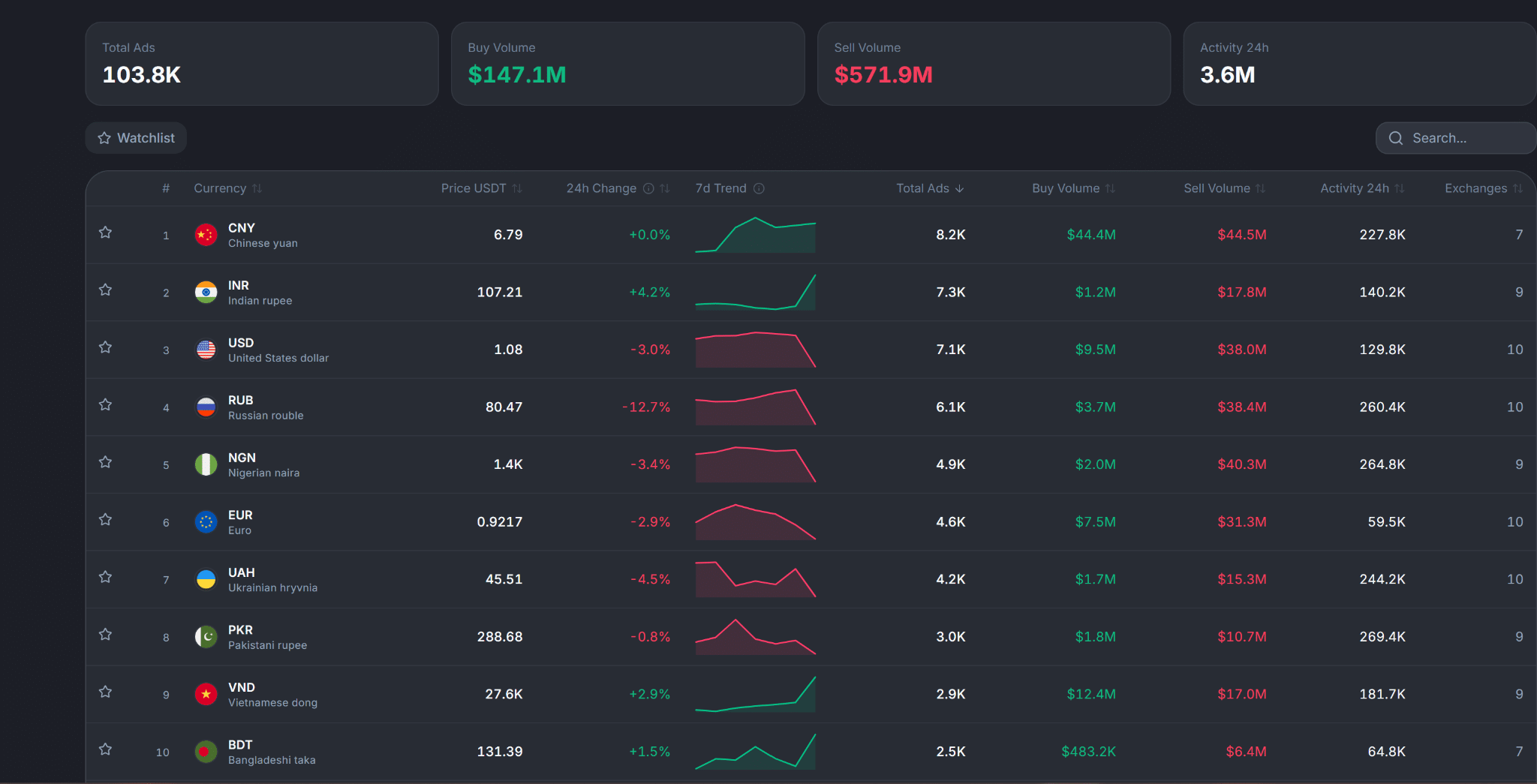
Rather than just driving up the price, the increasing regulatory pressure is also affecting how the Indian stablecoin market operates. According to P2P transaction data, for instance, the INR/USDT rate was approximately at Rs 107.21 at press time.
Source: P2P Army

The daily transaction count was over 140,000, but the amount of money changing hands was relatively low due to reduced liquidity. Meanwhile, buy volume reached only $1.2 million, compared with $17.8 million in sell volume, highlighting constrained market-making capacity.

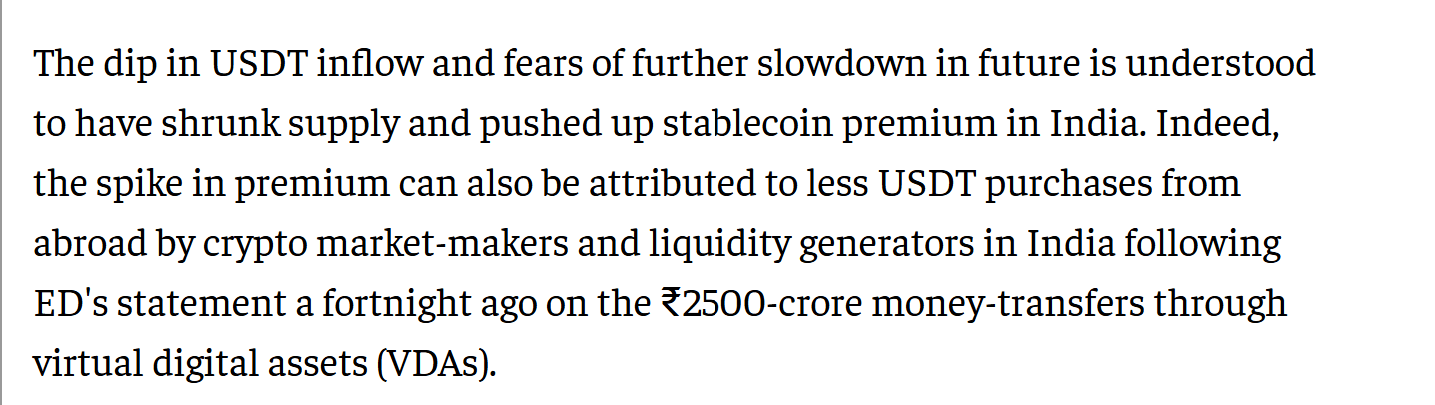
This demonstrated an inability for market makers to operate in this environment. Furthermore, the enforcement actions and scrutiny surrounding ₹2500 crores in VDA transfers. This has additionally led to less new USDT inflow into the Indian market, thereby sustaining the ongoing supply shortages.
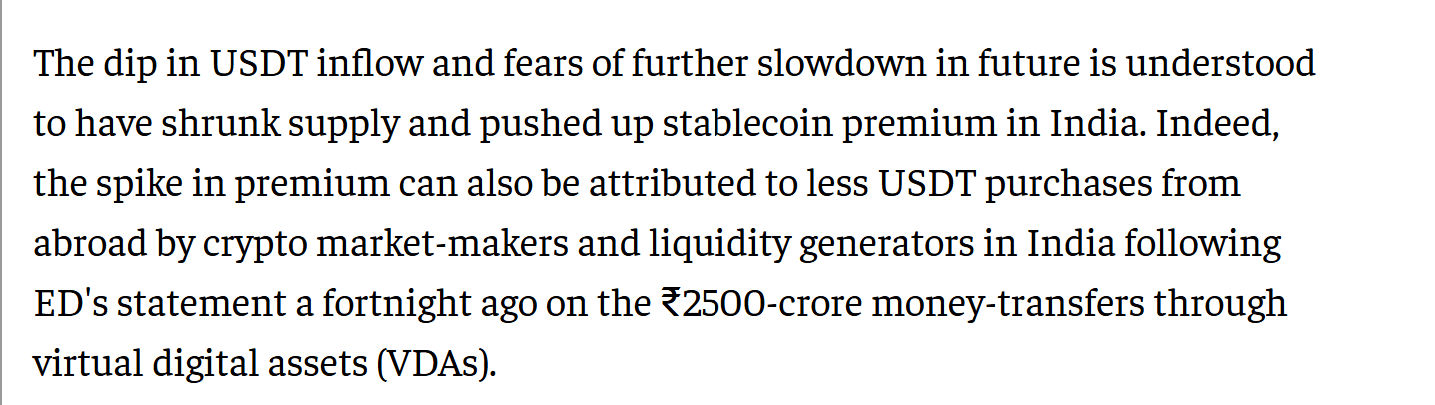
Source: The Economic Times

These imbalances might mean that regulatory uncertainty is currently diminishing market efficiency and increasing cost to acquire dollar liquidity. In the long run, if conditions remain as they are now, it will lead traders to seek alternative means or offshore dollar liquidity.

Clearer regulations would help restore arbitrage opportunities, increase available dollar liquidity, and eventually reduce India’s USDT premium.


Final Summary

  • Tether [USDT] demand remains resilient in India, but prolonged supply constraints could keep domestic premiums elevated.
  • USDT liquidity depends on regulatory clarity, with stronger compliance pathways needed to restore efficient pricing.


Trending Cryptos

Related Questions

QWhy is India's USDT premium surging above 8.5%?

AIndia's USDT premium is surging above 8.5% due to a contraction in the domestic supply of stablecoins. This shortage is caused by regulatory pressure and enforcement actions that discourage capital inflows, creating an imbalance between high demand and limited supply.

QWhat are the main factors driving the persistent high demand for USDT in India?

AThe main factors driving persistent high demand for USDT in India are its use for sending cross-border payments, settling trade, and as a dollar-backed store of value. This demand remains strong despite the regulatory constraints on supply.

QHow have regulatory actions specifically impacted the liquidity of USDT in the Indian market?

ARegulatory actions have slowed down fresh USDT inflows into India, reducing liquidity across P2P markets, OTC desks, and exchange order books. This has led to minimal top-ups of local inventory and constrained market-making capacity, sustaining the supply shortage.

QWhat does the data on P2P transaction volume reveal about the current market dynamics for USDT/INR?

AP2P transaction data reveals high transaction counts but low monetary volume due to reduced liquidity. Specifically, buy volume is significantly lower than sell volume ($1.2 million vs. $17.8 million), highlighting a severe constraint in market-making capacity and a supply-constrained environment.

QWhat is identified as the key long-term solution to reduce India's elevated USDT premium and restore market efficiency?

AThe key long-term solution identified is clearer regulations and improved market access. This would help restore effective arbitrage opportunities, increase the availability of compliant dollar liquidity channels, and gradually narrow the pricing gap to restore efficient market conditions.

Related Reads

Will History Repeat Itself? Fidelity Lists Five Catalysts to End the Crypto Winter

Fidelity's new report suggests that the current crypto winter for Bitcoin may be nearing its end, identifying five potential catalysts that could drive a market turnaround based on historical patterns. First, Bitcoin's approximately four-year cycle, driven by its halving mechanism, historically marks peaks and troughs. The last bottom was in November 2022, potentially pointing to the next around November 2026, though cycle length can vary. Second, clearer regulation has often preceded past bull markets. The focus is now on the CLARITY Act, which aims to clarify US digital asset oversight between the SEC and CFTC. Its passage could unlock domestic activity currently held back by legal uncertainty. Third, Federal Reserve monetary policy plays a role. A shift to lower interest rates tends to correlate with rising crypto prices by reducing borrowing costs and boosting risk appetite, though markets may price this in well ahead of any official change. Fourth, the emergence of breakthrough applications can fuel investor interest. Current trends like real-world asset tokenization, AI-related crypto infrastructure, and stablecoins are being watched, but history shows the biggest catalysts are often unexpected. Fifth, a new wave of institutional adoption could be a trigger. While ongoing adoption in 2026 hasn't sparked a new bull run, a major unexpected move—like a significant purchase by a tech giant or adoption as a hedge in a global crisis—could create a powerful new narrative. Fidelity concludes that while the market is in a downturn, historical turning points have often resulted from a combination of such factors, and the next phase for Bitcoin may depend on which of these catalysts materializes first.

Foresight News7m ago

Will History Repeat Itself? Fidelity Lists Five Catalysts to End the Crypto Winter

Foresight News7m ago

US CFTC Launches Broad Investigation into Polymarket, Is the Prediction Market Party Coming to an End?

The U.S. Commodity Futures Trading Commission (CFTC) is conducting a broad investigation into the prediction market platform Polymarket, focusing on its business practices including social media promotions. This follows a bipartisan letter from U.S. senators urging the CFTC to probe alleged fraudulent marketing tactics used to promote gambling-like products. The action coincides with a period of explosive growth for the prediction market sector, driven by events like the World Cup, with platforms like Kalshi and Robinhood reporting record trading volumes and revenue. The investigation signals a potential end to the sector's unregulated expansion and may lead to clearer federal oversight, particularly regarding investor protection and distinguishing prediction markets from traditional sports betting. The CFTC's move has also intensified a jurisdictional conflict with multiple U.S. states (including Kentucky and New York), which have sued platforms like Polymarket and Kalshi, accusing them of operating illegal sports betting and threatening state gambling tax revenues. Furthermore, the CME Group has sued the CFTC, challenging its approval of certain prediction market products. The report also highlights the political and capital interests intertwined with the industry. Donald Trump Jr. holds advisory and investment roles in both Kalshi and Polymarket, and the Trump administration has previously emphasized federal regulatory authority over these markets. The CFTC's investigation into Polymarket is framed as a step towards formalizing the industry's regulatory landscape, moving it from a phase of "wild growth" towards a more structured future.

marsbit2h ago

US CFTC Launches Broad Investigation into Polymarket, Is the Prediction Market Party Coming to an End?

marsbit2h ago

U.S. CFTC Launches Extensive Investigation into Polymarket, Is the Prediction Market Frenzy Season Cooling Down?

The U.S. Commodity Futures Trading Commission (CFTC) has launched a broad investigation into the prediction market platform Polymarket, focusing on its business practices including social media activities. This follows a bipartisan letter from U.S. senators urging the CFTC to probe allegations of paid influencer false marketing and fraudulent promotion of gambling-like products to American users. The investigation comes as the prediction market sector experiences explosive growth, largely driven by the World Cup. Weekly trading volumes have hit record highs, exceeding $14.4 billion, with platforms like Kalshi and Robinhood's new venture seeing significant activity. Major firms like Meta are also showing interest in the space. This regulatory scrutiny signals a potential end to the sector's "wild growth" phase. The CFTC's move also highlights an escalating jurisdictional conflict between federal regulators and state authorities. Over a dozen states, including Kentucky and New York, have sued platforms like Polymarket and Kalshi, accusing them of operating illegal sports betting, which threatens state gambling tax revenues. The CFTC is countersuing to assert its exclusive federal jurisdiction over these "event contracts" as derivatives. Furthermore, the CFTC's approval of Kalshi's Bitcoin perpetual futures contract has sparked a lawsuit from traditional exchange CME, alleging regulatory overreach. The political and capital landscape is intricate, with Donald Trump Jr. holding advisory roles and investments in both Kalshi and Polymarket. This connects capital, political influence, and regulatory bodies, suggesting the current investigation may be a step toward formalizing the industry's rules rather than halting its progress.

Odaily星球日报2h ago

U.S. CFTC Launches Extensive Investigation into Polymarket, Is the Prediction Market Frenzy Season Cooling Down?

Odaily星球日报2h ago

Trading

Spot

Hot Articles

Discussions

Welcome to the HTX Community. Here, you can stay informed about the latest platform developments and gain access to professional market insights. Users' opinions on the price of S (S) are presented below.

活动图片