In the AI Code Review Niche, a Unicorn Worth 108 Billion Yuan Emerges

marsbitPublished on 2026-08-17Last updated on 2026-08-17

Abstract

AI-powered code review startup CodeRabbit has become a unicorn with a valuation exceeding $1.5 billion following a $143 million Series C funding round. Founded in 2023 and based in San Francisco, the company specializes in automating code reviews for platforms like GitHub and GitLab. Its core platform analyzes pull requests (PRs) using repository context to detect logic, quality, and security issues, providing actionable suggestions to reduce manual review burdens. Responding to the surge in AI-generated code, CodeRabbit launched "Agentic Change Management," a new platform designed to handle the increased volume and complexity of changes. This system integrates four key functions: AI Code Review for pre-merge validation; CodeRabbit Triage, which acts as an intelligent dispatcher to prioritize and route PRs based on risk; CodeRabbit Change Stack for organizing and explaining changes; and CodeRabbit Security for continuous vulnerability monitoring throughout the code lifecycle. The company, led by serial entrepreneur and CEO Harjot Gill, reports a fivefold increase in annual revenue. Its platform now conducts over 2 million code reviews weekly, serving more than 17,000 enterprise customers and 150,000 open-source projects. CodeRabbit plans to invest over $10 million in the next year to continue offering free AI code review services to the open-source community.

Focusing solely on the AI code review niche can also breed a unicorn!

CodeRabbit,now valued at over $1.5 billion (approximately 10.8 billion RMB).
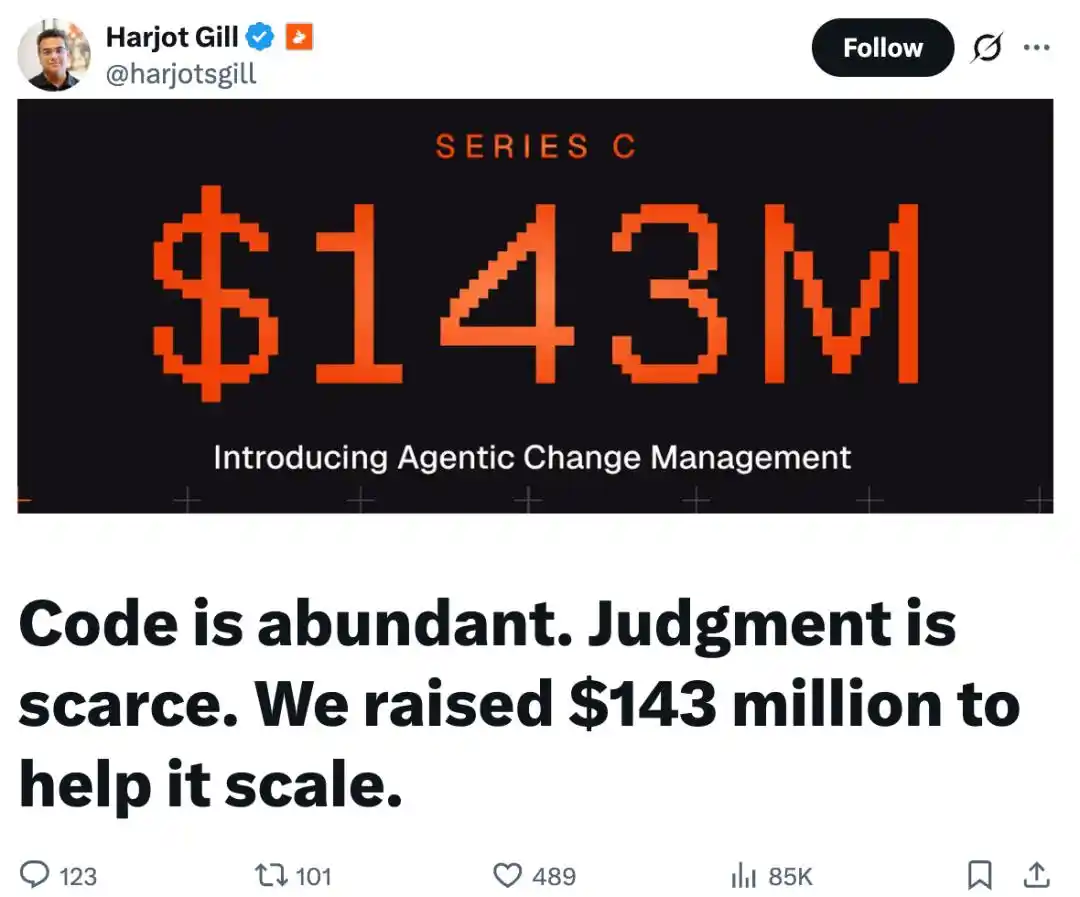
US-based AI code review and management tool provider CodeRabbit has announced the completion of a $143 million (approximately 1.03 billion RMB) Series C funding round.

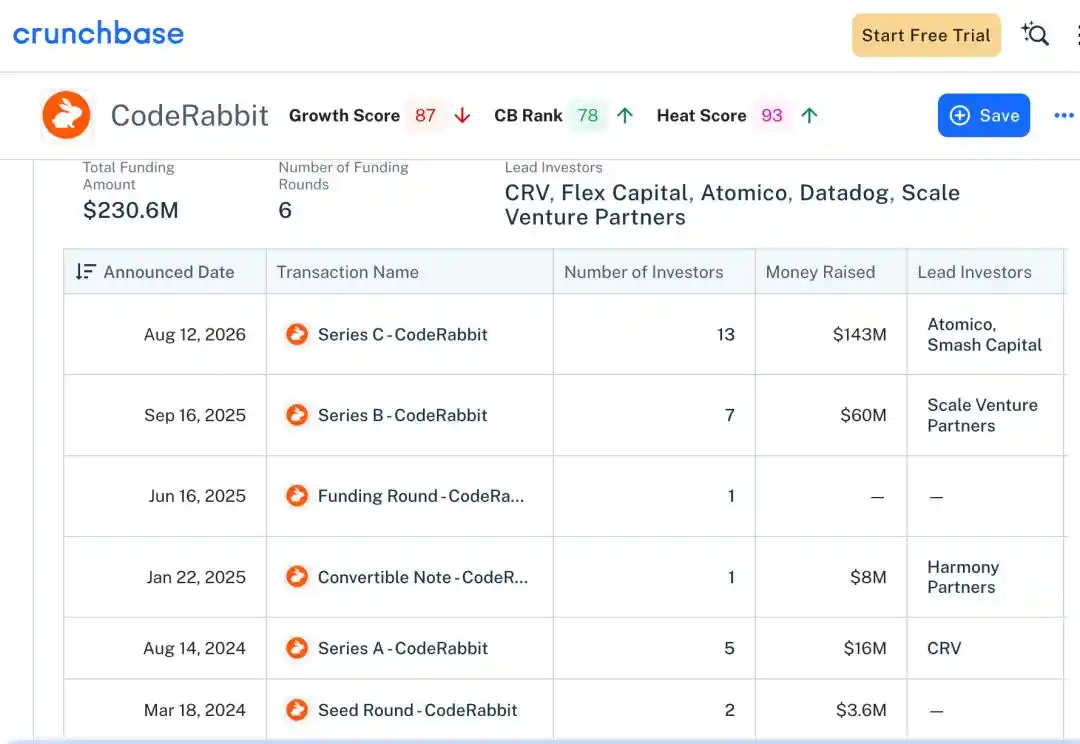
Crunchbase data shows that, as of publication, CodeRabbit has completed a total of 6 funding rounds, with cumulative funding reaching $231 million (approximately 1.66 billion RMB).
Founded in 2023 and headquartered in San Francisco, USA, CodeRabbit targets a critical engineering lifeline for ensuring code quality, preserving technical knowledge, and preventing system risks—code review.

The company's core product, the CodeRabbit AI Code Review Platform, integrates with mainstream code hosting platforms like GitHub and GitLab to automatically analyze PRs with context from the codebase.

When it detects logic, quality, or security issues in the codebase, the platform automatically generates corresponding suggestions for fixes, helping development teams reduce the burden of manual reviews.
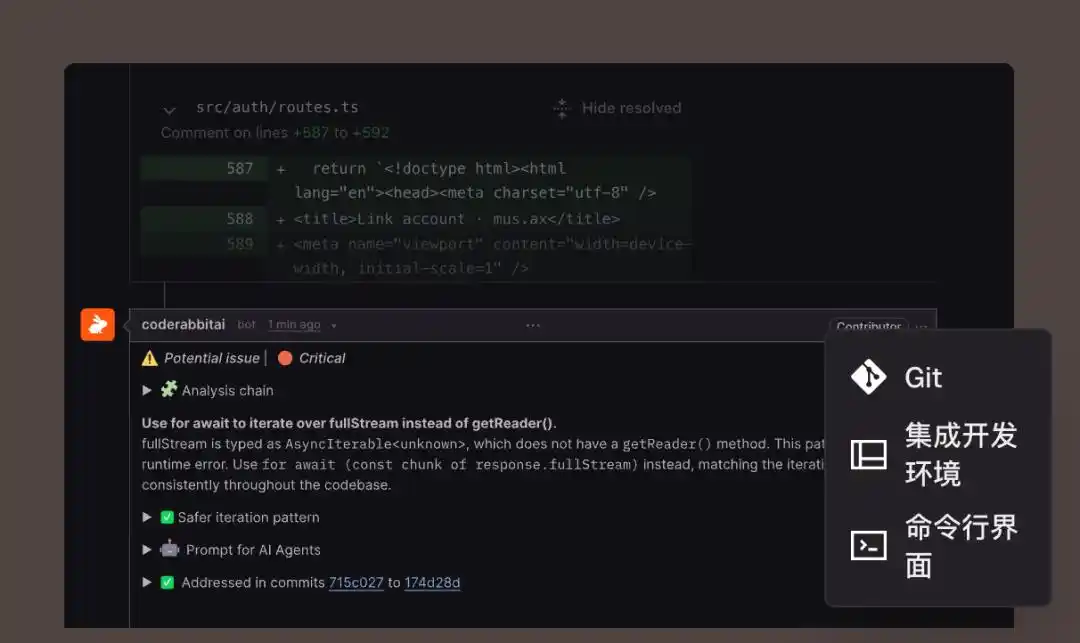
Now, CodeRabbit has launched a new platform—Agentic Change Management.

Harjot Gill, Co-founder and CEO of CodeRabbit, stated that it not only shows significant improvements in reviewing AI code, intelligently triaging massive volumes of AI-generated code, contextual understanding, and continuous security protection;

it also helps maintainers quickly grasp the dynamics and impact of changes within minutes, significantly reducing cognitive load.

So, what is the background for creating this new platform? What core capabilities does it actually possess? And what backgrounds does the R&D team behind it have?

You'll know after reading this.

Why Build Agentic Change Management?

Because code has become unprecedentedly cheap due to the advent of AI Agents.

A product requirement, a work ticket, or even an online alert can now directly summon an AI Agent to start work.

It can work continuously for hours, write thousands of lines of code, and autonomously submit a pull request.

Tasks that used to require a week of engineer scheduling may now land in the code repository before a single meeting ends.

But as speed increases, new troubles follow:

As more code gets written, who decides what's worth deploying?

According to CodeRabbit statistics, the volume of code commits this year is expected to reach 14 times or more that of previous years; in enterprises where coding agent penetration rates are in the top 10% of the industry, 35% of PRs are already generated by autonomous agents.

Furthermore, with the advent of AI, the cost of generating a code fix proposal has become negligible.

In the past, engineer time was precious, and teams had to thoroughly discuss requirements and prioritize tasks before letting engineers start work.

This "plan first, code later" work model was essentially about avoiding wasting human effort on unimportant things.

But now, AI has reversed this sequence.

Product managers, designers, and even marketing personnel may initiate a change. A team might not have had time to judge the value of a requirement before an AI Agent has already written the code and conveniently placed a PR in front of the reviewer.

Thus, the development backlog flows from the ticketing system into the PR queue, and the PR undergoes a qualitative change.

It is no longer just a container waiting for code to be merged after writing; it has become a new node for planning, auditing, and decision-making. Teams must decide here whether a feature is worth deploying, if quality meets standards, if risks are acceptable, and how it will change the entire system.

But the problem is, AI can scale in parallel, but human attention cannot.

When dozens of Agents simultaneously submit massive PRs, reading every line of diff becomes an extremely daunting task.

Thus, as code productivity can expand almost infinitely, the scarcity in the development process is no longer the engineer's typing speed or time, but the team's limited attention and judgment.

Against this backdrop, CodeRabbit launched the intelligent management platform Agentic Change Management.

The team aims to address the urgent need for "code productivity has scaled, judgment must scale too."

What Can Agentic Change Management Do?

In a nutshell, Agentic Change Management is an intelligent control platform integrating "AI Code Review", "Intelligent Triage", "Explaining Changes", and "Continuous Execution Security Protection."

It can not only intelligently route code changes to manual review or automated processes based on risk and complexity; it can help maintainers quickly understand the situation of code changes within minutes, reducing cognitive burden; and it can provide continuous security protection throughout the entire lifecycle of code before and after deployment.

Specifically, the Agentic Change Management platform launches four features: "AI Code Review", "CodeRabbit Triage", "CodeRabbit Change Stack", and "CodeRabbit Security":
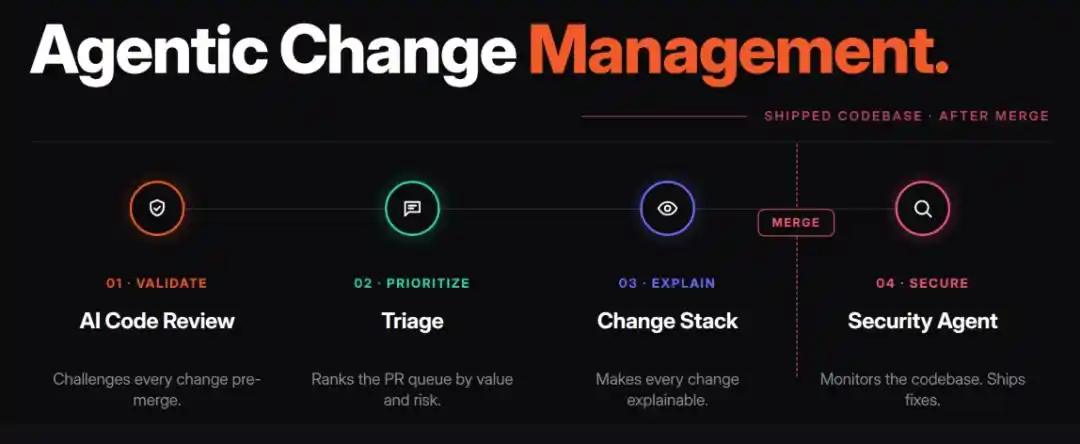
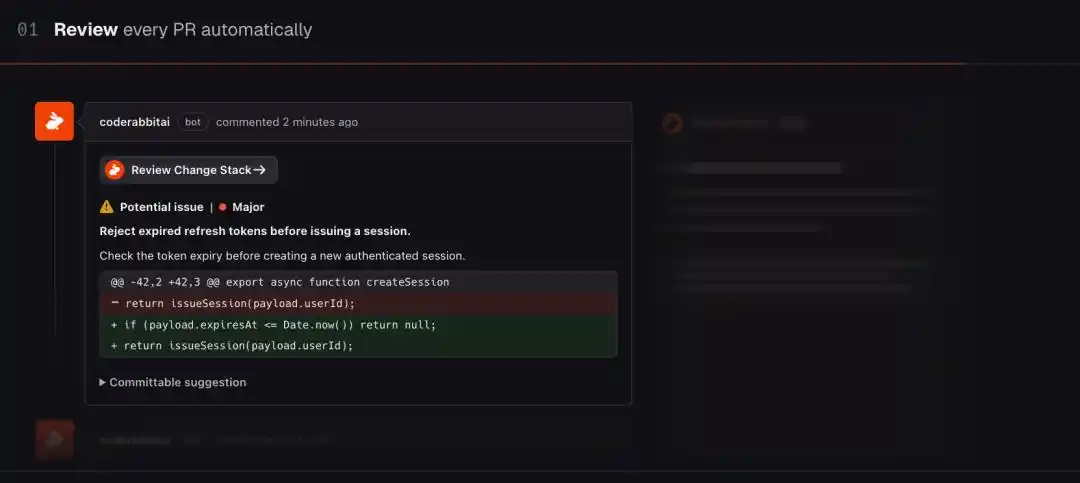
1. AI Code Review: Primarily responsible for strict validation of each change before merging.
2. CodeRabbit Triage: Acts like a "code dispatcher". It can automatically assess the importance, urgency, and risk level of each change, then prioritize and accurately route them. High-risk situations are escalated to human experts for detailed review, while low-risk ones are processed automatically.
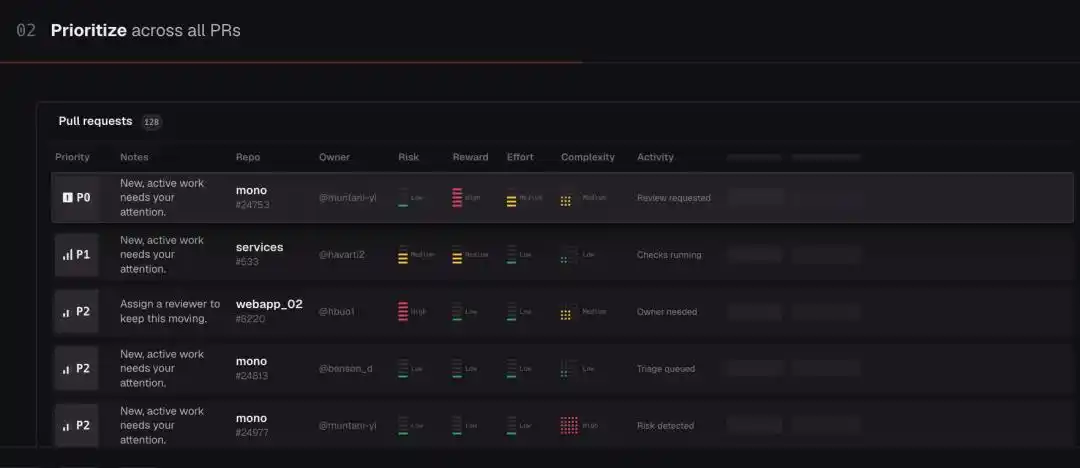
This way, the backlog is sorted by priority and urgency, not just by who submitted first.

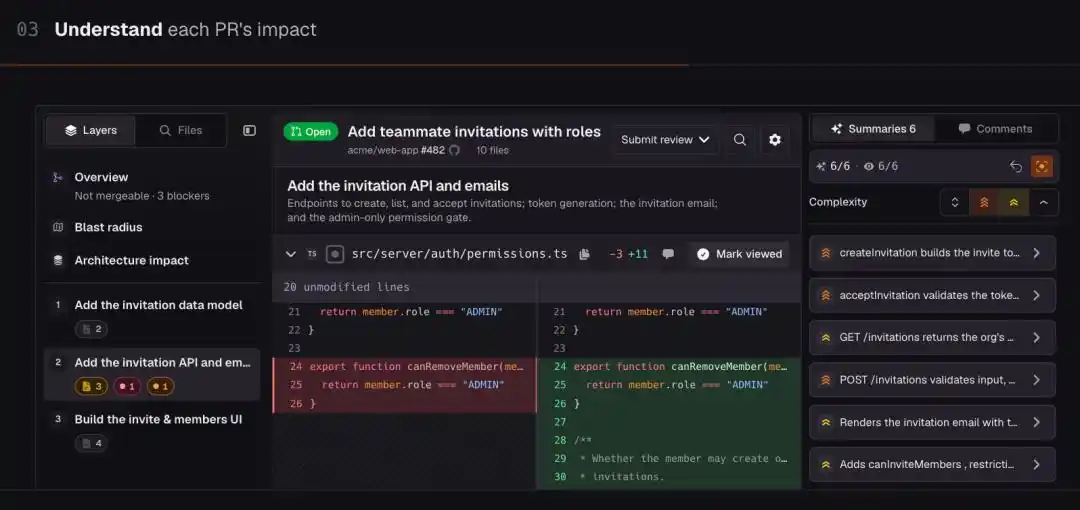
3. CodeRabbit Change Stack: Automatically categorizes and layers messy code changes, helping you make sense of them; enabling you to easily understand what was changed, why, and its impact on the whole system within minutes.
4. CodeRabbit Security: This feature is like giving code "full-course insurance". It can not only check before deployment whether vulnerabilities will actually be triggered, avoiding false positives; after deployment, it continues to monitor the system, preventing new changes from introducing hidden dangers or accumulating technical debt.
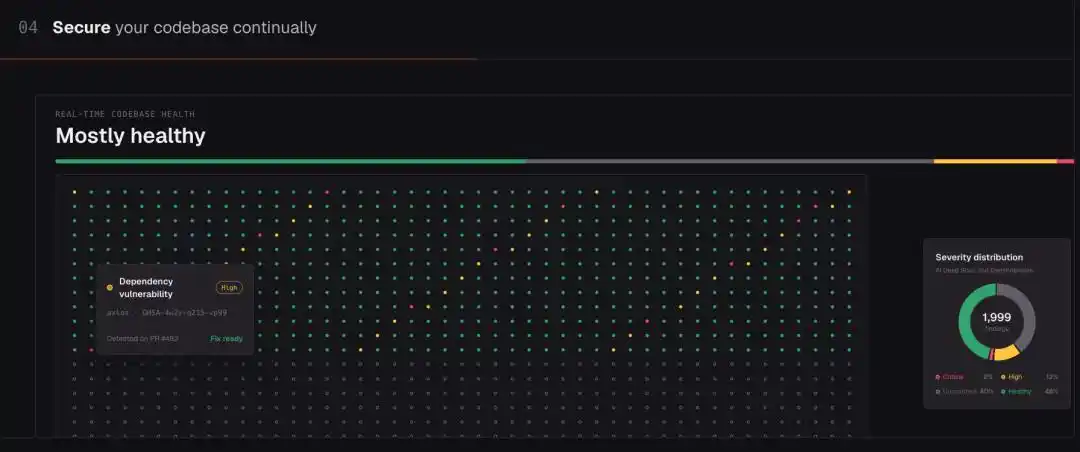
It is the synergy of these four capabilities that makes Agentic Change Management more than just a tool, but an intelligent hub capable of supporting high-frequency, secure delivery.

The CEO is a Serial Entrepreneur

The core team members of CodeRabbit are primarily from universities like the University of Pennsylvania, Punjab Engineering College, and Guru Nanak Dev University in India;

Some team members have also previously worked or founded companies at Nutanix, Netsil, FluxNinja, Alegeus, and Nestlé.

CodeRabbit's Co-founder and CEO is Harjot Gill. He earned his bachelor's degree from Punjab Engineering College, then pursued a Ph.D. and conducted research in the Department of Computer and Information Science at the University of Pennsylvania. His research areas cover computer networks, streaming data analysis, parallel and distributed systems, and declarative programming languages.

He previously commercialized research from UPenn, co-founded the microservices observability company Netsil and served as CEO (acquired by Nutanix in 2018); later, he founded the cloud-native reliability company FluxNinja, serving as Co-founder and CEO.

Harjot Gill stated on X that over the past year, CodeRabbit's revenue has grown fivefold, the platform completes over 2 million code reviews per week, and currently has over 17,000 enterprise customers and 150,000 open-source projects that trust CodeRabbit.

CodeRabbit revealed they plan to invest over $10 million (approximately 72 million RMB) in the next 12 months to continue providing free AI code review services to open-source projects and maintainers, and to open up agent-related features.

Reference links:

[1]https://x.com/harjotsgill/status/2087532414025216348?s=20

[2]https://www.coderabbit.ai/

[3]https://www.crunchbase.com/organization/coderabbit

[4]https://www.coderabbit.ai/blog/introducing-agentic-change-management

This article is from the WeChat public account "QbitAI", author: Following Frontier Technology

Trending Cryptos

Related Questions

QWhat is the current valuation of CodeRabbit and how much did it raise in its Series C round?

ACodeRabbit's current valuation is over $1.5 billion (approximately ¥10.8 billion). It raised $143 million (approximately ¥1.03 billion) in its Series C funding round.

QWhat is the core problem that CodeRabbit's new platform, Agentic Change Management, aims to solve?

AAgentic Change Management aims to solve the problem of scaling human judgment and attention in the face of massively increased code production by AI agents. It addresses the bottleneck where AI can generate code faster than teams can review, prioritize, and make decisions about it.

QName the four key functionalities of the Agentic Change Management platform.

AThe four key functionalities are: 1. AI Code Review, 2. CodeRabbit Triage (intelligent prioritization and routing), 3. CodeRabbit Change Stack (explaining and contextualizing changes), and 4. CodeRabbit Security (continuous security validation).

QWhat is the professional background of CodeRabbit's CEO and co-founder, Harjot Gill?

AHarjot Gill is a serial entrepreneur. He co-founded and was CEO of Netsil, a microservices observability company (acquired by Nutanix in 2018), and later co-founded FluxNinja, a cloud-native reliability company. He holds a PhD from the University of Pennsylvania.

QAccording to the article, what are some of the key metrics demonstrating CodeRabbit's growth?

AKey growth metrics include: revenue growth of 5x over the past year, over 2 million code reviews completed weekly, more than 17,000 enterprise customers, and over 150,000 open-source projects using its service.

Related Reads

Report on the State of the Crypto Industry by 2026, Featuring Sumsub Vice President for North America, Danielle LaBarbera

The cryptocurrency industry is entering an era of regulated maturity, driven by frameworks like the CLARITY Act and the $GENIUS Act in the US. These provide clearer rules but also raise operational standards, requiring platforms to effectively demonstrate compliance. Simultaneously, fraud is evolving into sophisticated, AI-powered, lifecycle-based attacks, moving beyond simple onboarding scams. According to Daniel LaBarbera, VP of Sumsub for North America, companies must shift from one-time KYC checks to continuous, risk-based verification. This involves integrating identity, behavioral, device, and transaction data into a unified risk view. The 2026 State of Crypto Industry report highlights that while 55% of crypto firms faced fraud last year, effective strategies now combine AI-driven detection, continuous monitoring, and behavioral analytics. Key compliance challenges persist, particularly with the Travel Rule. Only 23% of companies are fully compliant, with high implementation costs, data security concerns, and regulatory fragmentation being major hurdles. Meanwhile, stablecoins are gaining traction, accounting for 36% of all crypto transactions in 2025, and evolving from trading tools into financial infrastructure for payments and settlements. The path forward lies in risk-based approaches that balance security, speed, and user experience. This includes adopting documentless verification, reusable KYC, and breaking down silos between compliance functions to create a holistic, lifecycle view of customer risk and trust.

cryptonews.ru11m ago

Report on the State of the Crypto Industry by 2026, Featuring Sumsub Vice President for North America, Danielle LaBarbera

cryptonews.ru11m ago

U.S. National Debt Approaches $40 Trillion in 5 Months, Bitcoin Debate Gains Momentum

The US national debt has surged to nearly $40 trillion in just five months, the fastest trillion-dollar increase on record. The debt's growth has accelerated dramatically over time, from taking 192 years to reach the first $1 trillion in 1981 to adding the latest $1 trillion in only five months. The federal budget deficit for the fiscal year is already over $1.8 trillion, exceeding last year's total, and net interest payments on the debt have surpassed $1 trillion, now exceeding defense or Medicare spending. This rapid debt accumulation is fueling arguments within the cryptocurrency industry that Bitcoin serves as a hedge against government-backed currencies and fiscal irresponsibility. Proponents, including some lawmakers and industry leaders, argue Bitcoin could act as a "hard currency" fiscal control mechanism. Legislation has even been proposed for the Treasury to acquire Bitcoin to help reduce the national debt. The International Monetary Fund has warned that global public debt could hit 100% of world GDP by 2029 if current trends continue, with the US and China as primary drivers. Some analyses suggest a sovereign debt crisis could drive capital into alternative assets like Bitcoin, similar to past regional banking crises. However, skeptics point out that both Bitcoin and gold have fallen in price at times during 2026 despite record debt, indicating the depreciation hedge theory may operate over a much longer timeframe than short-term price action.

cryptonews.ru21m ago

U.S. National Debt Approaches $40 Trillion in 5 Months, Bitcoin Debate Gains Momentum

cryptonews.ru21m ago

Technological Self-Reliance in China: A War from Lithography Machines to ABF Films

"China's Tech Independence: A Battle from Lithography Machines to ABF Film" In August 2026, Japan's Ajinomoto announced a 30% supply cut of ABF film to Chinese mainland clients, causing industry-wide shock and fears of price hikes and shortages in the semiconductor supply chain. That same year, Chinese company Lotus Holdings, known for its MSG business, acquired a small domestic ABF film startup for 103 million yuan, aiming to change this passive situation. ABF film is a core insulating material for advanced CPU, GPU, and AI chip packages. Ajinomoto, originally a food flavoring company, has monopolized over 95% of the global ABF film market for nearly 30 years, deriving its technology from byproducts of monosodium glutamate production. With AI chips consuming 5-10 times more ABF film than traditional chips, the supply-demand gap is widening. Ajinomoto's supply cut to China, where domestic ABF film production accounts for less than 5%, directly threatens the production of domestic high-end AI chips and their substrates. This incident highlights a crucial but often overlooked truth: the vulnerabilities in China's quest for technological self-reliance extend beyond headline areas like lithography machines to critical but seemingly minor components—insulating films, photoresists, electronic specialty gases, etc. The article frames China's tech independence as a multi-front war. While major breakthroughs have been achieved in chip design (e.g., Huawei's HiSilicon), foundry (e.g., SMIC), and memory chips (e.g., YMTC), countless smaller "Ajinomoto-style" chokepoints remain. Lotus Holdings' acquisition represents a significant shift: the battle is no longer fought only by tech giants but has become a collective, industry-wide effort involving companies from diverse backgrounds. Historically, external blockades have often spurred China's technological breakthroughs, as seen with Huawei's Kirin chips and YMTC's 3D NAND flash memory. Ajinomoto's supply cut, while a short-term challenge, may similarly catalyze domestic innovation in ABF film and other critical materials. The path to technological sovereignty is long and arduous, requiring sustained patience and investment to fill every gap in the complex supply chain. Lotus's move is not an immediate solution but a step towards that future, symbolizing a broader, relentless march toward independence.

marsbit41m ago

Technological Self-Reliance in China: A War from Lithography Machines to ABF Films

marsbit41m ago

Trading

Spot

Hot Articles

Discussions

Welcome to the HTX Community. Here, you can stay informed about the latest platform developments and gain access to professional market insights. Users' opinions on the price of AI (AI) are presented below.

活动图片