Illicit Crypto Flows Hit Record $158 Billion In 2025, TRM Says

bitcoinistPublished on 2026-01-30Last updated on 2026-01-30

Abstract

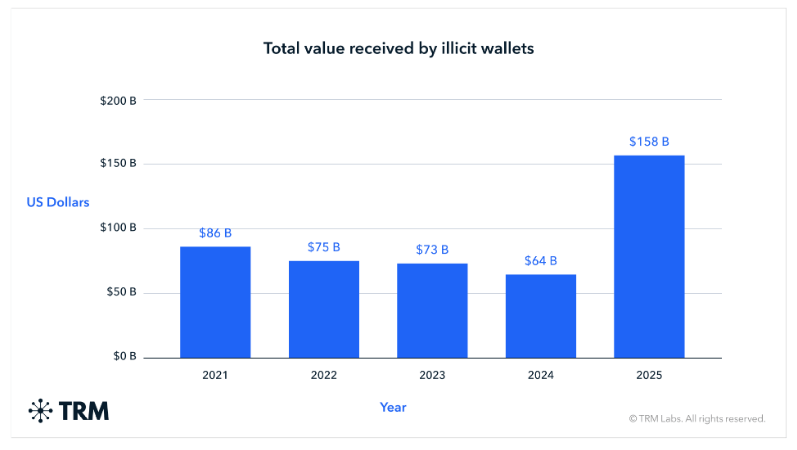
According to TRM Labs, illicit crypto flows reached a record $158 billion in 2025, driven by increasingly sophisticated scams using AI tools. Large language models, deepfakes, and voice cloning were employed to create believable messages and fake personas, helping fraudsters build trust before soliciting money through fake investments or false emergencies. These operations often function like small companies, using phishing kits and AI services to scale their efforts. While scam proceeds slightly decreased to $35 billion, the overall volume of criminal activity rose significantly. Despite improvements in scam-detection technology, the use of AI makes scams harder to identify and more convincing.

Scammers used new tools to widen their reach and to seem more real. According to TRM Labs, the use of large language models in scams jumped fivefold in 2025, helping fraudsters write believable messages, run many conversations at once, and trick people in different languages.

AI Tools Helping Con Artists Build Trust

Reports say AI images, voice cloning, and deepfakes are cutting the cost of making fake people who look and sound legit. These tricks have fed a pattern where criminals first make a target feel safe and then ask for money.

In some cases, a romance angle is used to win trust, and that trust is later turned into fake investment offers or bogus tax demands. This staged approach has let scams run longer and capture bigger sums from fewer victims.
A Rise In Industrial-Scale Fraud

Behind many of these schemes are groups that act like small companies. They hire people, sell tools, and reuse scripts to run campaigns in many places.

Some providers now sell phishing kits or offer AI-as-a-service to automate messages and replies, lowering the bar for new fraudsters and making scams easier to copy and spread.

Deepfake Calls And Targeted Hacks

Reports note that attackers have even used fake video calls to trick crypto workers into installing malware. In several incidents, victims were invited to what looked like normal Zoom meetings, only to find AI-generated faces on the screen.

When the meeting “needed a patch,” victims were urged to install what was actually malicious software. These methods have been linked to North Korea–connected groups and were flagged by security researchers last year.

BTCUSD now trading at $87,971. Chart: TradingView

Crypto Price Action Enters The Story

While the scams became more sophisticated, the market evolved too. Bitcoin was trading in the range of $88,000 to $90,000 in late January 2026 as investors considered macro news and policy developments.

This market context is important: as prices increase, the urgency and authenticity of crypto scams may seem more plausible, and the risks for both victims and law enforcement may be higher.

Scam Proceeds Compared To Illicit Flows Overall

Illicit inflows to crypto assets reached a record high of $158 billion, a substantial increase due to improved monitoring that brought more illicit activity to light.

Meanwhile, scam-related wallets saw a slight decrease in proceeds to around $35 billion in 2025, from $38 billion in the previous year.

However, the total volume of criminal activity increased substantially, even as the portion attributed to scams increased marginally.

It appears that scam-detecting technology is improving, but scams are evolving rapidly. The increasing use of AI-based tools makes generic advice less helpful, as the scams now sound more authentic.

Featured image from Unsplash, chart from TradingView

Related Questions

QWhat was the total value of illicit crypto flows in 2025 according to TRM Labs?

AIllicit crypto flows reached a record high of $158 billion in 2025.

QHow did the use of large language models in scams change in 2025?

AThe use of large language models in scams jumped fivefold in 2025.

QWhat was the approximate trading range of Bitcoin in late January 2026?

ABitcoin was trading in the range of $88,000 to $90,000 in late January 2026.

QHow much did scam-related wallet proceeds amount to in 2025?

AScam-related wallets saw proceeds of around $35 billion in 2025, down from $38 billion the previous year.

QWhat are some specific AI tools mentioned that are being used by scammers to build trust?

AScammers are using AI images, voice cloning, and deepfakes to create fake people who look and sound legitimate to build trust.

Related Reads

MoneyGram: Why Did We Launch Our Own Stablecoin?

MoneyGram, a global leader in cross-border remittances for over 80 years, has launched its own stablecoin, MGUSD. The initiative aims to evolve from single-transaction services to becoming a more integral part of users' financial lives. By allowing customers to hold a stable US dollar balance within the MoneyGram app, MGUSD enables not only remittances but also everyday spending, currency exchange, cash access, and future financial services. Targeting the billions globally who face challenges like currency volatility or lack of bank accounts, MGUSD leverages Stellar blockchain technology with a self-custody wallet architecture. This gives users control over their assets while providing a secure, compliant experience through a trusted brand. The approach focuses on solving existing customer pain points within MoneyGram's established network, rather than competing for broad crypto market liquidity. A key advantage is MoneyGram's hybrid model, combining digital services with the world's largest physical network for crypto-to-cash conversions. The stablecoin also modernizes the company's internal infrastructure, streamlining treasury management and partner settlements, with annual forex volume via stablecoins already reaching $2 billion. The project was delivered in about a year, driven by a reorganization into agile, cross-functional teams that operate with startup-like speed while leveraging decades of institutional expertise. Partners include Stablecoin (issuance), Crossmint (wallet APIs), Fireblocks (enterprise treasury), m0 (smart contracts), and the Stellar network. MoneyGram emphasizes that enhancing direct consumer offerings strengthens its partner ecosystem. The future direction is clear: to provide users worldwide with stable value storage, better financial tools, and greater control over their funds through a trusted, existing network.

Foresight News35m ago

MoneyGram: Why Did We Launch Our Own Stablecoin?

Foresight News35m ago

BIP-110 Controversy Intensifies: Bitcoin May Face Its Most Divisive Hard Fork Battle in Years

Bitcoin is approaching a critical block height of 961,632, which could activate the controversial BIP-110 proposal. This proposal aims to restrict the amount of non-financial data, such as inscriptions and other large data payloads, within Bitcoin transactions. Supporters, including some node operators and Bitcoin purists, argue that BIP-110 is necessary to preserve Bitcoin's core function as a monetary settlement layer by reducing network congestion and node operational burdens caused by non-essential data. They frame it as a correction to keep the network true to its original purpose. However, critics, including prominent figures like Blockstream's Adam Back and developer Jameson Lopp, warn that the proposal's implementation mechanism is dangerously flawed. They highlight that its low 55% miner signaling threshold, coupled with a contentious enforcement mechanism allowing nodes to unilaterally reject non-compliant blocks, significantly increases the risk of a chain split. Opponents argue this sets a dangerous precedent for transaction censorship, undermines Bitcoin's protocol neutrality, and creates excessive uncertainty for developers and businesses, especially since the rule is proposed as a temporary one-year measure. Market analysts, such as those from Bitfinex, suggest a full-scale network split is unlikely due to a lack of broad economic consensus. Major mining pools remain neutral, and adoption of the new rules is minimal. They view the situation more as a governance stress test. The primary risk is operational disruption: if a minority chain persists, major exchanges and custodians may need to temporarily suspend Bitcoin deposits and withdrawals to manage security and liquidity, potentially unsettling newer institutional investors. While BIP-110 is not expected to succeed in overtaking the main chain, its approach has ignited a significant debate about Bitcoin's governance, core values, and resilience.

Foresight News1h ago

BIP-110 Controversy Intensifies: Bitcoin May Face Its Most Divisive Hard Fork Battle in Years

Foresight News1h ago

Crypto Market Makers Are Collectively Seeking Change as Money Becomes Harder to Earn

**Summary: Crypto Market Makers Adapt as Margins Shrink** Leading crypto market maker GSR exemplifies a broader industry shift, moving beyond traditional market-making to become a full-service "Web3 investment bank." Its recent strategic acquisitions—including an SEC-registered broker-dealer, rebranded as GSR Securities—and purchases of token advisory firms aim to create an integrated platform covering token design, fundraising, listing, liquidity provision, and asset management. This includes launching an ETF and investing in tokenization platforms like Libeara, backed by a strategic investment from Standard Chartered's SC Ventures. This transformation is not unique to GSR. Other major players like Keyrock, B2C2, Wintermute, and DWF Labs are also expanding geographically, pursuing regulatory licenses (especially under frameworks like MiCA in the EU), and diversifying into over-the-counter (OTC) trading, asset management, and real-world asset tokenization. The driving force behind this collective pivot is a rapidly changing market. Profits from traditional altcoin market-making are declining due to fewer viable projects, reduced client budgets, increased competition, and smarter, more demanding clients. Simultaneously, regulatory pressures are mounting, making compliance a baseline cost. Extreme market events further expose teams lacking robust risk controls. Consequently, the crypto market-making business model is evolving from one reliant on information asymmetry and volatility to a more institutionalized, regulated, and service-diverse industry. Survival now depends on building systemic capabilities beyond mere liquidity provision.

marsbit2h ago

Crypto Market Makers Are Collectively Seeking Change as Money Becomes Harder to Earn

marsbit2h ago

Trading

Spot
Futures
活动图片