Hyperliquid: Can a $2.3 mln whale buy drive HYPE to $50?

ambcryptoPublished on 2026-04-10Last updated on 2026-04-10

Abstract

Hyperliquid (HYPE) has been trading within an ascending channel, reaching a two-week high of $40.9 and currently priced at $40.4, with 4.7% daily and 14% weekly gains. A newly created whale wallet deposited $5 million into Hyperliquid and purchased 59.2k HYPE worth $2.3 million, with an additional $2.6 million in USDC likely for further purchases. This whale activity and rising long positions, reflected in a Long/Short Ratio of 1.41, indicate strong bullish sentiment. Technical indicators like the RSI at 63 and price holding above key moving averages support continued upward momentum, potentially targeting $50 if resistance at $43 is broken. However, profit-taking has been observed, with $4.9 million in positive netflow, which could trigger a pullback. Key support levels are at $37 and $35.

Hyperliquid [HYPE] has traded within an ascending channel since it held $35 a week ago, touching a two-week high of $40.9. As of this writing, HYPE traded at $40.4, up 4.7% on the daily charts, adding to its 14% weekly gains.

With market conditions turning suitable, whales have taken the opportunity to re-enter the market.

Hyperliquid whale adds $2.3 million worth of HYPE

Whales have continued to accumulate HYPE, especially as it shows strong upside momentum. According to Lookonchain, a newly created wallet deposited $5 million into HyperLiquid and began buying HYPE after it crossed the $40 mark.

So far, the whale has purchased 59.2k HYPE worth $2.3 million. Still, the account holds $2.6 million in USDC, likely to be used for more purchases. With HYPE holding above the entry price, the whale is already up $10k.

Usually, when whales enter the market during an uptrend, it signals confidence and helps defend higher levels.

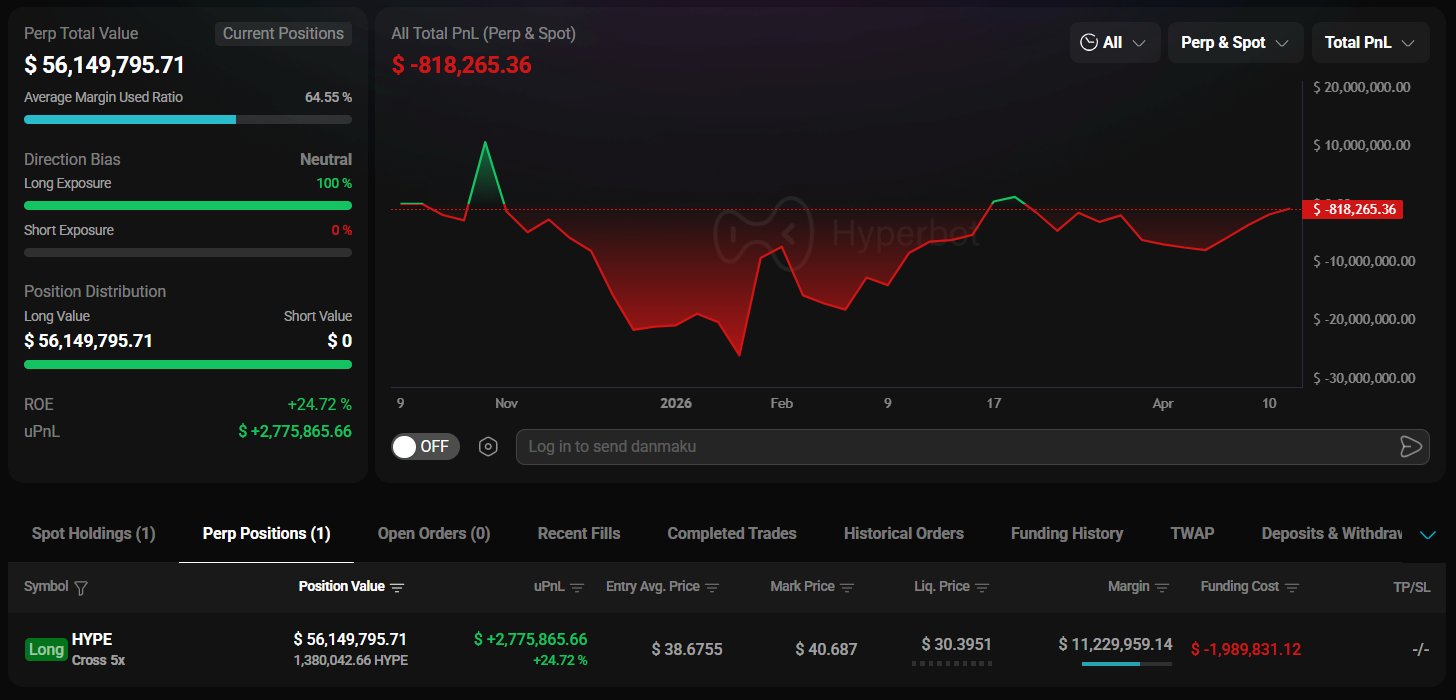
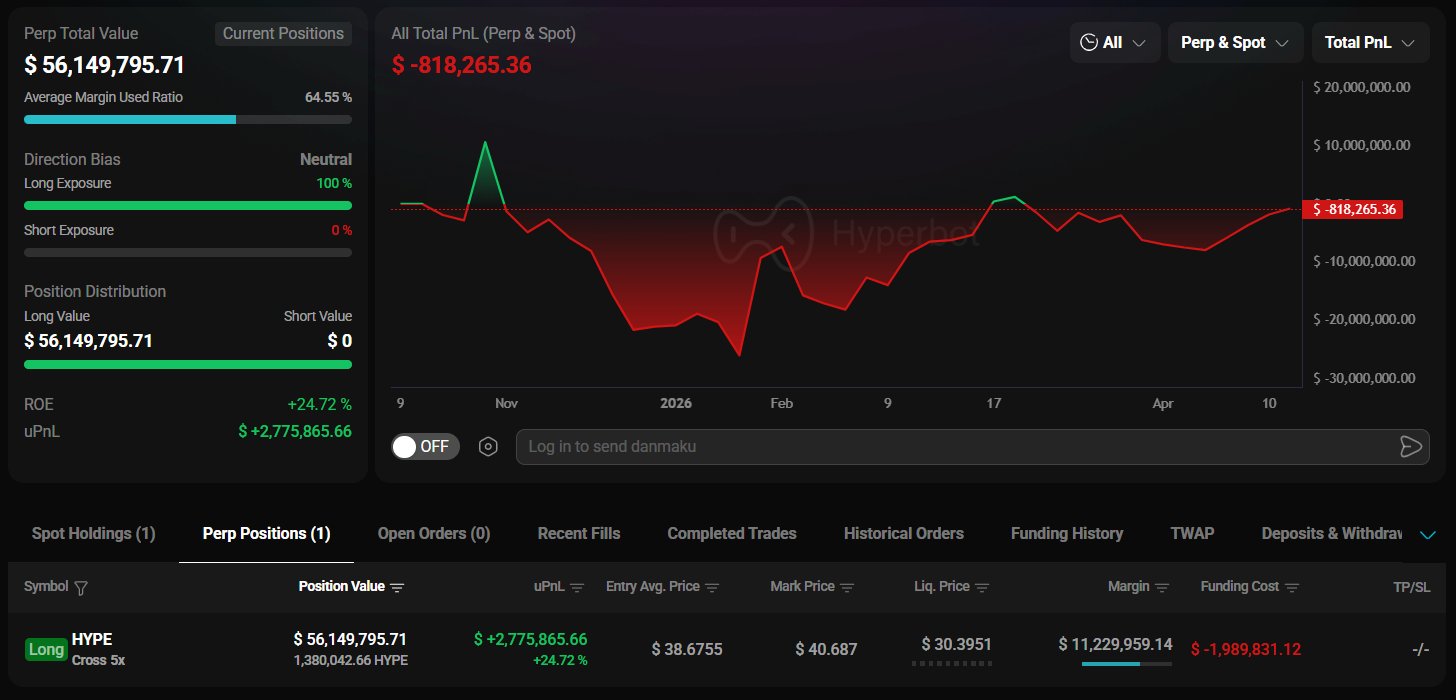
Coupled with that, whales have seen their profit margin surge amid the recent gains. Onchain Lens reported that a whale who held a 5x long position since the 6th of December 2025 is now erasing all losses.
Source: Onchain Lens

After HYPE dropped below $20, this whale saw his position go down by over $26 million. Despite the deep, the whale kept covering his position, losing $1.9 million in funding fees in the process.

However, with HYPE now trading above $40, the whale’s floating profit is over $2.77 million. Such determination to hold a losing position for five months showed confidence in the market.
Source: Coinalyze

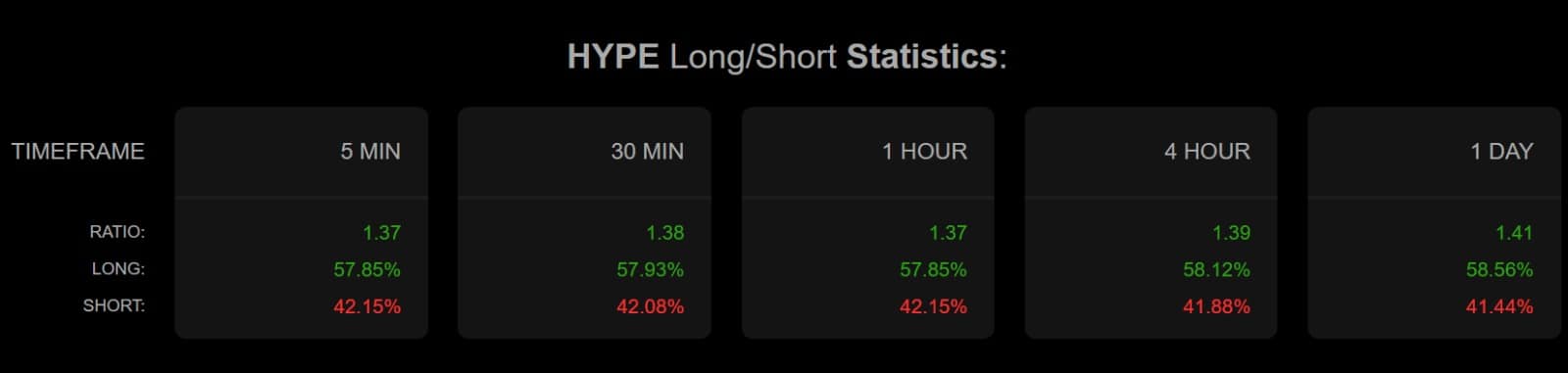
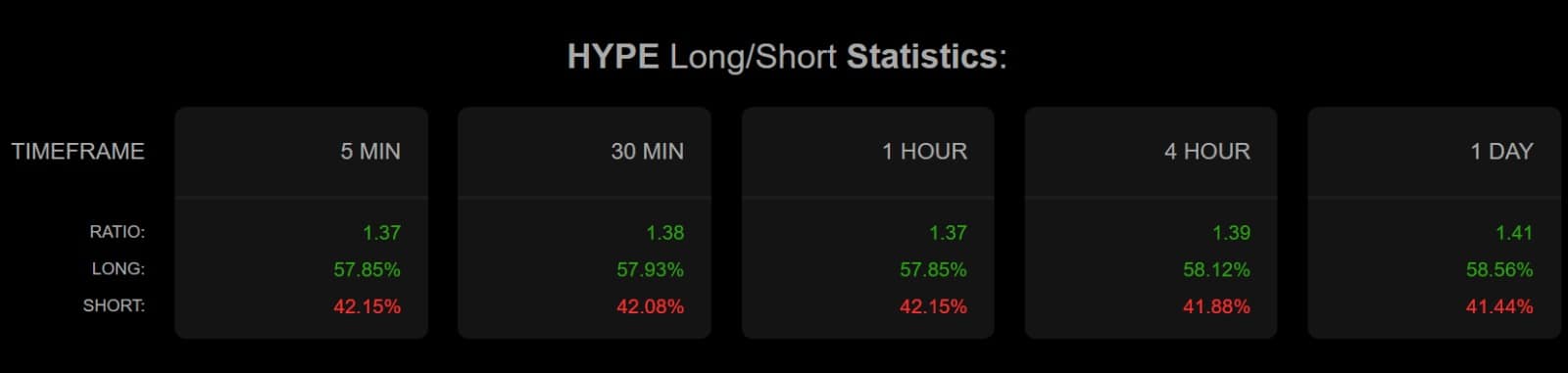
Besides this whale, the market has seen an influx in demand for long positions. Coinalyze data showed that the altcoin’s Long/Short Ratio rose to 1.41, with 58.5% of positions held by longs.

This implied that most market participants flipped bullish and deployed capital, betting on the prevailing trend’s continuation.

Historically, whale buying pressure on the spot and rising profitability in the perpetuals have boosted asset price action.

Is the demand sufficient to boost HYPE?

Hyperliquid showed bullish momentum amid rising market demand, especially driven by whales. The recent demand significantly strengthened the upside momentum.

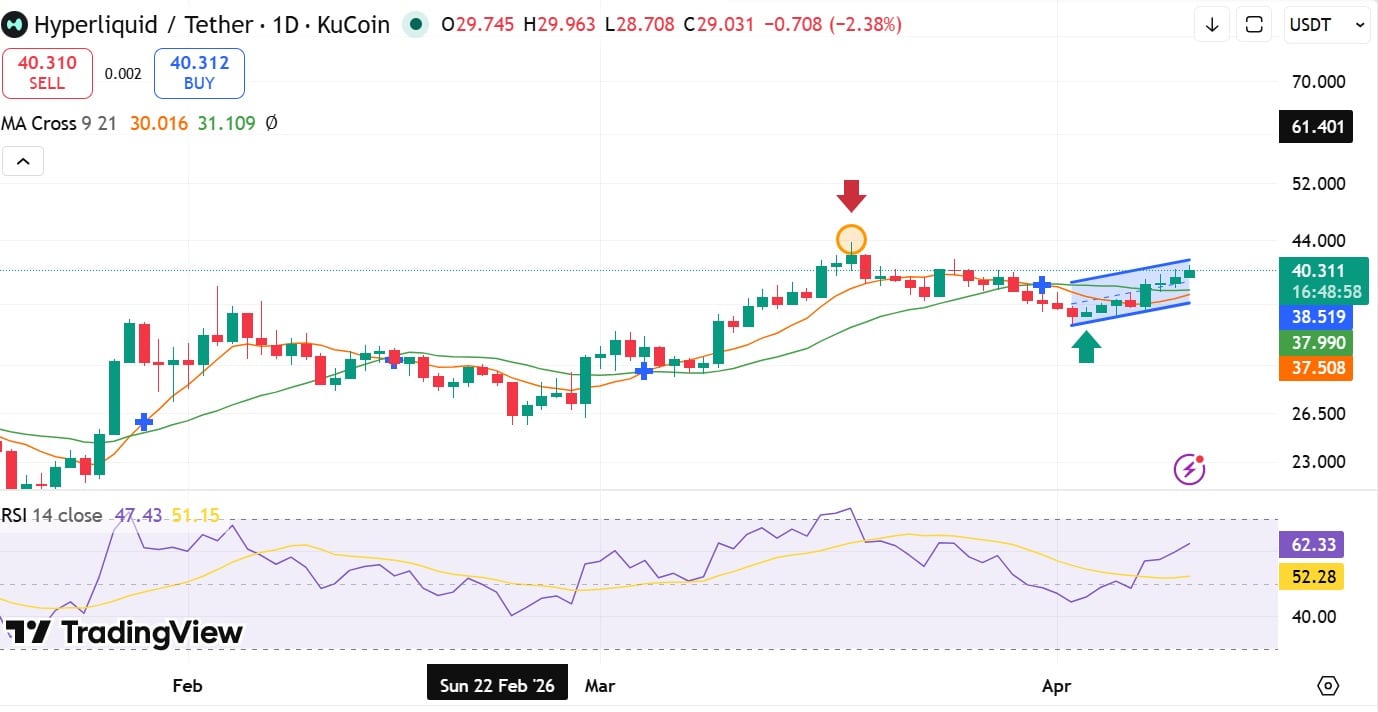
The altcoin’s Relative Strength Index (RSI) climbed to 63, remaining firmly within the bullish zone and indicating strong demand. At the same time, the altcoin held above the 9- and 21-day moving averages, reflecting a sustained upside momentum.
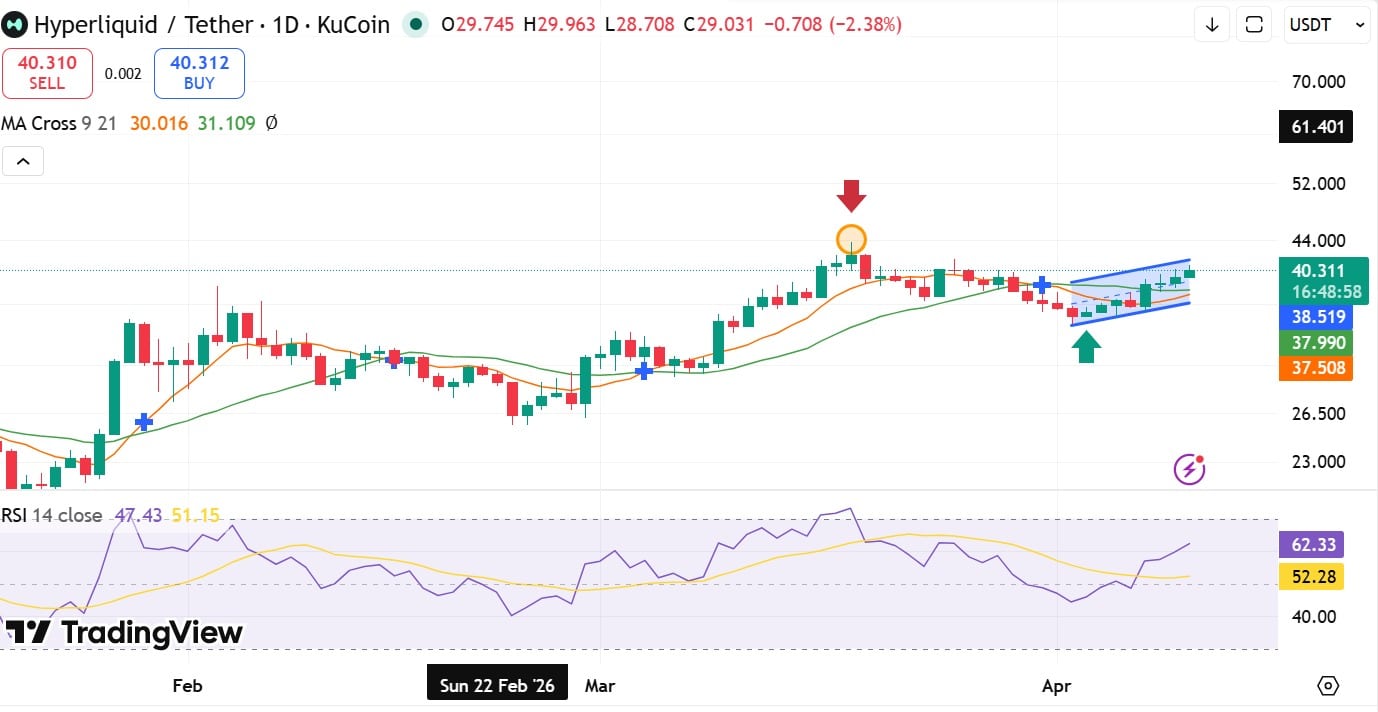
Source: Tradingview

Such market conditions point towards the likelihood of the trend’s continuation. If the momentum holds, HYPE will flip $43 resistance, where the uptrend previously collapsed, setting the ground for a move towards $50.

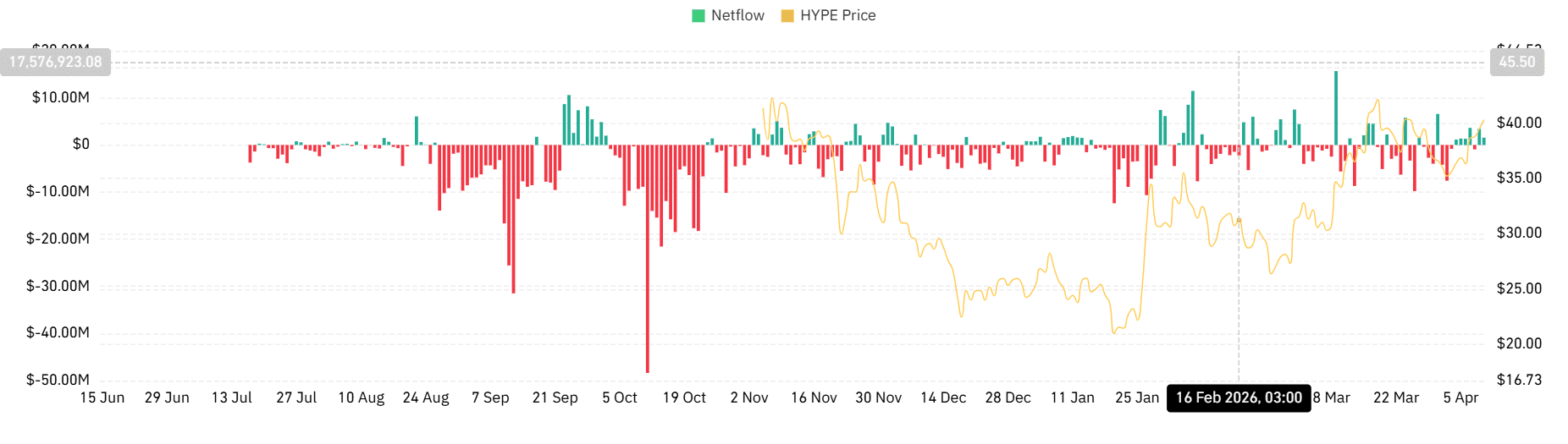
However, as HYPE crossed the $40 mark, investors who had been underwater showed greater determination to cash out at these levels. As such, the altcoin recorded positive Netflow on the 9th and 10th of April, totaling $4.9 million.
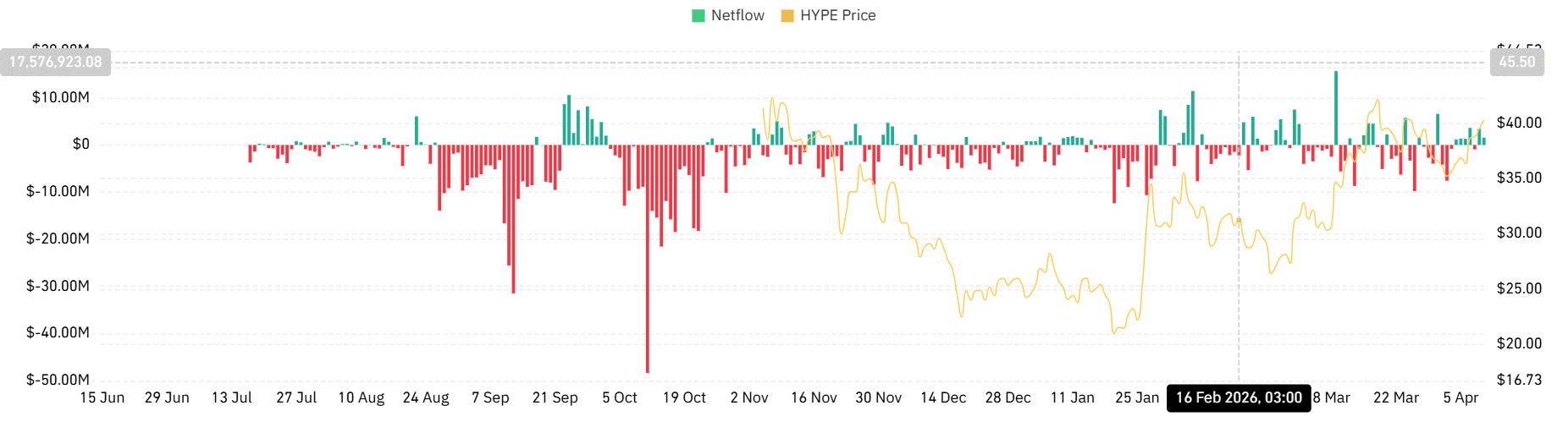
Source: CoinGlass

A positive Netflow suggested more sellers entered exchanges as prices pumped. Such profit-taking could derail the uptrend and trigger a pullback.

If profit-takers overwhelm demand, the 9- and 21-day moving averages at $37 will provide support, with $35 as a critical level.


Final Summary

  • A newly created whale wallet deposited $5 million on Hyperliquid and purchased 59.2k HYPE worth $2.3 million.
  • HYPE has traded within an ascending channel, touching a high of $40.9, but profit-taking could derail the rally.


Related Questions

QWhat significant purchase did a whale make on Hyperliquid according to the article?

AA newly created whale wallet deposited $5 million into Hyperliquid and purchased 59.2k HYPE tokens worth $2.3 million, with an additional $2.6 million in USDC still available for potential future purchases.

QWhat is the current price and key resistance level for HYPE mentioned in the article?

AAs of the writing, HYPE was trading at $40.4. The key resistance level mentioned is $43, which is where the previous uptrend collapsed. A break above this could set the stage for a move towards $50.

QWhat on-chain metric suggests that most market participants are bullish on HYPE?

AThe Long/Short Ratio for HYPE rose to 1.41, with 58.5% of positions held by longs, indicating that a majority of traders are betting on the price increasing.

QWhat potential risk to the current uptrend does the article identify?

AThe article identifies profit-taking as a potential risk. It notes positive netflow of $4.9 million on April 9th and 10th, suggesting more sellers were moving tokens to exchanges to cash out, which could derail the uptrend and trigger a pullback.

QWhat technical indicators support the bullish momentum for HYPE?

AThe Relative Strength Index (RSI) climbed to 63, indicating strong bullish momentum. Additionally, the price was holding above the 9- and 21-day moving averages, further supporting a sustained upside trend.

Related Reads

The Compounding Crisis in an Era of High Valuations: Is the US Stock Market Facing a New 'Lost Decade'?

This article analyzes the long-term structural risks in US equity markets, challenging the assumption that "time in the market" always ensures positive returns. Drawing on 155 years of historical data, it identifies three prolonged periods—1929-1954, 1966-1982, and 2000-2013—where real buy-and-hold returns were near zero or negative. Collectively, these "lost decades" represent roughly 35% of market history since 1871 and cause not just delayed wealth accumulation but permanent damage to compound growth paths due to the mathematics of recovering from significant drawdowns. Crucially, the authors argue that current conditions mirror historical precursors to such phases. Multiple valuation indicators, including the CAPE ratio (near its 99th percentile), the Buffett Indicator, and Tobin's Q, signal extreme overvaluation, historically associated with lower future 10-year real returns (averaging 3.6%). The paper debunks the common objection to tactical management—fear of missing the "best days" in the market—by showing that the vast majority of these top-performing days occur during bear markets and crises, often adjacent to the worst days. Therefore, avoiding major drawdowns inherently means missing these volatile surges. A key framework proposed involves monitoring market breadth (advance/decline data), which tends to deteriorate before major indices peak, providing an early warning signal. Combined with high valuations, breadth analysis offers a more robust risk-assessment tool. The conclusion for investors and advisors is not a forecast of an inevitable downturn, but a call to move from complacency to preparedness. The empirical evidence suggests that the conditions preceding lost decades are identifiable. A disciplined, adaptive strategy focused on valuation and breadth signals, rather than precise timing, can help protect long-term compounding from permanent impairment.

marsbit3m ago

The Compounding Crisis in an Era of High Valuations: Is the US Stock Market Facing a New 'Lost Decade'?

marsbit3m ago

Farewell to Traditional Bull and Bear Markets, Deciphering the Logic of Today's Bubble Rotation

"Farewell to Traditional Bulls and Bears: Understanding Today's Market Logic of Bubble Rotation" The article draws a parallel between modern financial markets and a meteorological chain of thunderstorms, contrasting it with the past's slower-moving, more predictable 'layered cloud' systems of long bull/bear cycles and gradual sector rotations. The author argues that today's market has undergone a permanent structural shift, creating an environment where discrete, intense thematic bubbles (e.g., AI, GLP-1 drugs, crypto, robotics, quantum tech) sequentially form, swell, and burst. These 'storm cells' are triggered when capital fleeing a dying bubble acts like a meteorological 'cold air wedge,' forcing the warm, moist capital of latent interest in a new sector to rapidly rise and condense into the next speculative frenzy. This new 'convective' market regime is driven by eight fundamental changes: 1. Democratization of speculation via zero-commission trading, gamified apps, and heavy retail participation in instruments like 0DTE options. 2. Permanent, price-insensitive buying pressure from defined-contribution retirement plans (e.g., 401(k)s). 3. Passive investing creating inelastic market participants that amplify momentum, especially into mega-cap stocks. 4. The dominance of multi-strategy funds and high-frequency trading (HFT), weakening price discovery and creating fragile microstructure prone to synchronized sell-offs. 5. Artificially suppressed volatility that eventually erupts in violent spikes. 6. A transformed market index heavily weighted toward long-duration, narrative-driven tech companies instead of stable, cyclical industrials. 7. The total elimination of information delay, accelerating fear-of-missing-out (FOMO) and herd behavior. 8. A persistently loose fiscal and monetary policy environment. These structural shifts are deemed irreversible. The article outlines the common lifecycle of these thematic bubbles: latency, catalyzing event, narrative formation, peak divergence, and rupture—with outflowing capital seeding the next bubble. In this environment, two investor archetypes can thrive: deep domain experts who understand underlying technologies and business models, and disciplined trend-followers. The author concludes that while emotionally challenging, recognizing this new "climate" is crucial. The key is to elevate one's perspective above the immediate storm to see the cyclical chain of bubbles, avoiding being swept away by the emotions of any single thematic frenzy.

Foresight News22m ago

Farewell to Traditional Bull and Bear Markets, Deciphering the Logic of Today's Bubble Rotation

Foresight News22m ago

Michael Saylor's Latest Article: Bitcoin Must Find Balance Between Uniqueness and Universal Value

Michael Saylor outlines four key Bitcoin ideologies shaping its future: * **Bitcoin Maximalists** see Bitcoin as the dominant digital monetary network and a breakthrough in economic empowerment, emphasizing its superior property rights and role as a sound money solution. * **Bitcoin Capitalists** focus on integration, believing Bitcoin must embed into the global economy—through institutions, capital markets, and financial products—to reach its full potential as digital capital. * **Bitcoin Technologists** advocate for continuous protocol improvements in scalability, privacy, and security to adapt to evolving needs and threats, while acknowledging the high bar for change. * **Bitcoin Fundamentalists** guard Bitcoin's core principles of self-custody, decentralization, and censorship resistance, warning against dilution from institutions or risky modifications. Saylor argues that a healthy Bitcoin ecosystem requires a balance of these perspectives. Bitcoin's path forward involves disciplined expansion: preserving its immutable core (Fundamentalist insight), recognizing its dominant status (Maximalist view), integrating with the global economy (Capitalist drive), and enabling careful innovation, primarily in higher layers (Technologist role). The challenge is to maintain Bitcoin's unique properties while making it useful for the world, ensuring it remains Bitcoin as it grows.

Foresight News54m ago

Michael Saylor's Latest Article: Bitcoin Must Find Balance Between Uniqueness and Universal Value

Foresight News54m ago

Trading

Spot
Futures

Hot Articles

How to Buy HYPE

Welcome to HTX.com! We've made purchasing Hyperliquid (HYPE) simple and convenient. Follow our step-by-step guide to embark on your crypto journey.Step 1: Create Your HTX AccountUse your email or phone number to sign up for a free account on HTX. Experience a hassle-free registration journey and unlock all features.Get My AccountStep 2: Go to Buy Crypto and Choose Your Payment MethodCredit/Debit Card: Use your Visa or Mastercard to buy Hyperliquid (HYPE) instantly.Balance: Use funds from your HTX account balance to trade seamlessly.Third Parties: We've added popular payment methods such as Google Pay and Apple Pay to enhance convenience.P2P: Trade directly with other users on HTX.Over-the-Counter (OTC): We offer tailor-made services and competitive exchange rates for traders.Step 3: Store Your Hyperliquid (HYPE)After purchasing your Hyperliquid (HYPE), store it in your HTX account. Alternatively, you can send it elsewhere via blockchain transfer or use it to trade other cryptocurrencies.Step 4: Trade Hyperliquid (HYPE)Easily trade Hyperliquid (HYPE) on HTX's spot market. Simply access your account, select your trading pair, execute your trades, and monitor in real-time. We offer a user-friendly experience for both beginners and seasoned traders.

3.2k Total ViewsPublished 2024.03.29Updated 2026.06.02

How to Buy HYPE

Discussions

Welcome to the HTX Community. Here, you can stay informed about the latest platform developments and gain access to professional market insights. Users' opinions on the price of HYPE (HYPE) are presented below.

活动图片