How Will $12 Trillion in Pension Funds Passively Flood into Bitcoin?

marsbitPublished on 2026-04-09Last updated on 2026-04-09

Abstract

A proposed U.S. Department of Labor rule could open the door for cryptocurrency investments, particularly Bitcoin, within the $12 trillion 401(k) pension market. The rule creates a "safe harbor" provision, protecting plan fiduciaries from personal liability if they follow a specific due diligence process covering performance, fees, liquidity, and other factors. This addresses the key legal barrier that had previously discouraged pension managers from including crypto due to litigation risks under the Employee Retirement Income Security Act (ERISA). The primary mechanism for adoption is expected to be through target-date funds, the default investment option for most employees. This means individuals could automatically have 1-3% of their retirement savings allocated to Bitcoin without actively choosing it. Even a small allocation of 0.1% would represent $12 billion, a significant inflow of passive, long-term capital into the crypto asset class. While this regulatory shift is a major milestone, risks remain. The volatility of Bitcoin poses a threat to retirement savings, and the legal safety net provided by the new rule is untested in court. The first lawsuit following a major market downturn will be crucial in determining its ultimate effectiveness. The rule is currently in a public comment period, and full implementation could take years.

Written by: Thejaswini M A

Compiled by: Chopper, Foresight News

Any default option will eventually become the choice for the majority. This is known as the "default effect" in behavioral economics.

The history of the entire U.S. pension system is a history of default options. In the 1980s, the default option shifted from traditional pensions to 401(k) plans, which most employees passively accepted without fully understanding what they were giving up. In the early 2000s, target-date funds became the default option for the vast majority of pension plans, and tens of millions of people ended up holding these funds without ever actively choosing them.

Each shift in the default option involved the transfer of massive amounts of capital and ultimately changed the way a generation retired. Most of those affected didn't realize it until they checked their statements later.

A new default option is set to emerge in the coming years. Right now, it doesn't look like a default option; it looks more like a proposed rule from the Department of Labor, currently undergoing a 60-day public comment period. It is carefully worded, emphasizing fiduciary duty and compliance with the Employee Retirement Income Security Act (ERISA). They often start as options, gradually become popular, and eventually become the default.

On March 30, the U.S. Department of Labor issued a rule that, for the first time, opened the door to cryptocurrencies for the $12 trillion U.S. 401(k) pension market. Indiana had already legislated in March, requiring state pension plans to offer at least one cryptocurrency investment option by July 2027; the Wisconsin pension system already holds $321 million in Bitcoin ETFs; Michigan has allocated $45 million to Bitcoin and Ethereum ETFs. Florida and New Jersey are also advancing similar policies.

First, let's look at how cryptocurrencies were previously kept out.

The Wall Blocking Cryptocurrencies

Before this rule, cryptocurrencies were not explicitly banned by law from entering 401(k) plans. The real barrier was more effective than a ban.

Under the Employee Retirement Income Security Act (ERISA), which regulates pension plans, fiduciaries are personally liable for investment decisions that lose money. It's not the company or the fund that is held accountable, but the individual who made the decision.

Since 2016, there have been over 500 lawsuits alleging ERISA violations; since 2020, related settlements have exceeded $1 billion. Pension plan managers have seen their peers sued over excessive fees, poor index fund choices, and issues with mutual fund share classes. These lawsuits are endless, come from unexpected angles, and target individuals directly.

Consider the incentive structure this creates: You manage a pension plan, you buy Bitcoin, and then Bitcoin crashes 50%. A plaintiff's lawyer sends a letter, and you spend three years defending yourself in discovery.

Conversely, if you don't* add Bitcoin, even if it goes to $200,000, no one will sue you for it.

The rational choice was always: stay away from crypto. And almost everyone did.

The Biden administration's Labor Department in 2022 went further, explicitly stating that fiduciaries must exercise "extreme care" before touching digital assets. That guidance has now been withdrawn and replaced with a six-factor safe harbor rule: as long as a fiduciary follows a written process reviewing performance, fees, liquidity, valuation, benchmarks, and complexity, they will be deemed to have fulfilled their prudent duty under ERISA. As long as the process is compliant, even if the asset price falls, they are protected from personal liability.
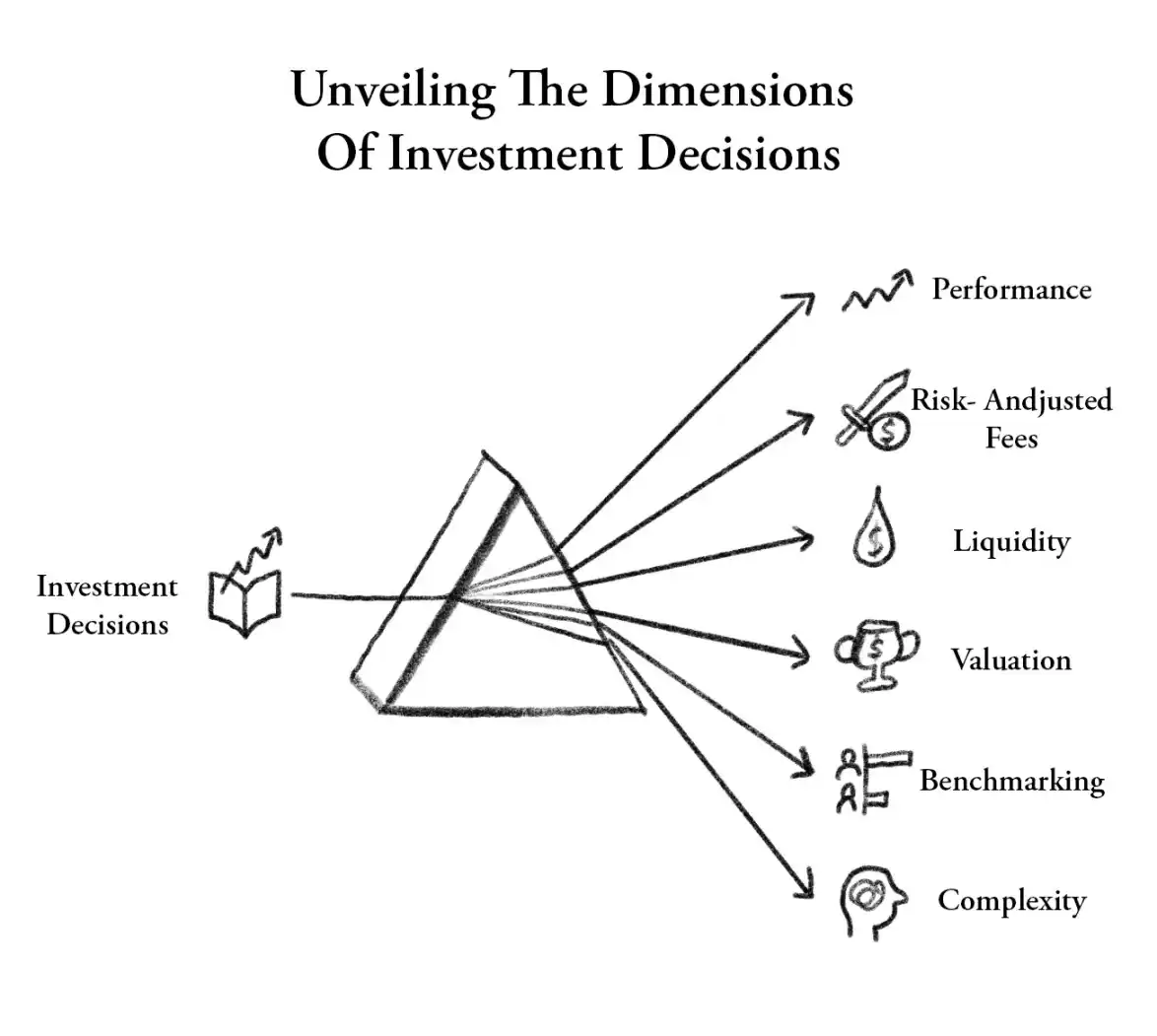
Don't mistake the rule change for a shift in market fundamentals. For the average investor, crypto's volatility remains the same. This rule really protects the fund managers. It corrects the imbalanced legal risk that marginalized crypto for a decade, finally allowing fiduciaries to feel safe saying yes.

The Conduit: Target-Date Funds

The Labor Department itself anticipates that the primary access point will be target-date funds. This is crucial for understanding the practical impact on the average saver.

Most people, upon starting a job, are defaulted into a target-date fund. You just pick the fund closest to your expected retirement year, say the 2045 fund, and it automatically adjusts its stock/bond allocation as you age, becoming more conservative closer to the target date. The vast majority of people who hold these funds never look at them a second time.

If crypto assets are allocated through target-date funds, investors won't actively go out and buy Bitcoin. Their retirement portfolio will automatically allocate 1%–3% to Bitcoin, managed and automatically rebalanced by a professional institution.

Just as many people have gold in their 401(k) without knowing it. That's how gold entered the pension system—through the same vehicle, the same logic, without asking the actual owners of the money.

Fidelity led the charge in 2022, offering plan sponsors the option to include Bitcoin in their investment menu even before the Biden administration's guidance. At the time, Fidelity allowed plan sponsors to include digital asset investments in their portfolio, with participants to invest up to 20% of their account balance in Bitcoin. What has been missing is the legal assurance for plan sponsors to feel comfortable allocating to Bitcoin without assuming personal liability. That assurance is now being formulated.

$12 Trillion

U.S. 401(k) plans hold about $12 trillion. Even a 1% allocation would mean roughly $120 billion flowing into digital assets, more than the total value locked in all of DeFi. Even just 0.1% would be $12 billion, on par with the top five Bitcoin ETFs.

Every previous wave of institutional crypto adoption came from active decisions: ETF buyers actively buying, MicroStrategy actively holding, banks actively building custody products. Those decisions can be reversed: a CFO can sell the treasury position, ETF investors can redeem.

The 401(k) channel is structurally different, something the industry has been waiting for since the spot ETF listings. Pension money is passive money, held for 30-year horizons. It doesn't panic sell on crashes, isn't swayed by the fear and greed index, and doesn't care what oil did last week.

As Morgan Stanley's Amy Oldenburg points out, currently about 80% of crypto ETF trading comes from self-directed investors, not advisor-recommended allocations. The 401(k) market is almost entirely driven by professional advisors. The DOL's new rule opens up a channel that was previously structurally difficult to access because the people controlling the gate bore excessive personal risk.

This has been a point crypto has emphasized for years: the real wave of adoption won't come from traders or tech early adopters, but when the infrastructure of ordinary people's savings systems automatically turns towards crypto. Target-date funds are that infrastructure.

Risks and Concerns

A 50% drop in a trading account is just a bad quarter. A 50% drop in a 55-year-old teacher's retirement account is a different matter entirely.

Bitcoin has drawn down over 80% in past bear markets, around 50% in this cycle, which some interpret as "maturity." But losing half your retirement savings doesn't feel any better because it's called "progress."

TD Cowen's Jaret Seiberg writes that he remains skeptical that fiduciaries will move until courts confirm the safe harbor truly protects against lawsuits. ERISA is a process-based law, but its ultimate interpretation lies with the courts.

The safe harbor might hold on paper, but if a target-date fund with crypto allocation drops 40% in a bear market, triggering the first wave of lawsuits, whether it holds up is an open question.

The comment period for the rule ends on June 1st. The Labor Department can modify the rule, withdraw it, or simply push it forward. Even if the final version is unchanged, moving from a proposed rule to actual money in pension accounts involves compliance teams, investment committees, recordkeeper system integrations, and fiduciary reviews. This will take months, more likely years.

Indiana's July 2027 deadline is a hard mandate, while the federal rule is a soft permission—their implementation timelines will be starkly different.

In the 1980s, stocks entered pensions through mutual fund; in the early 2000s, international stocks entered through target-date funds; followed by REITs, TIPS, commodities. Their arrival wasn't because retirement savers asked for them.
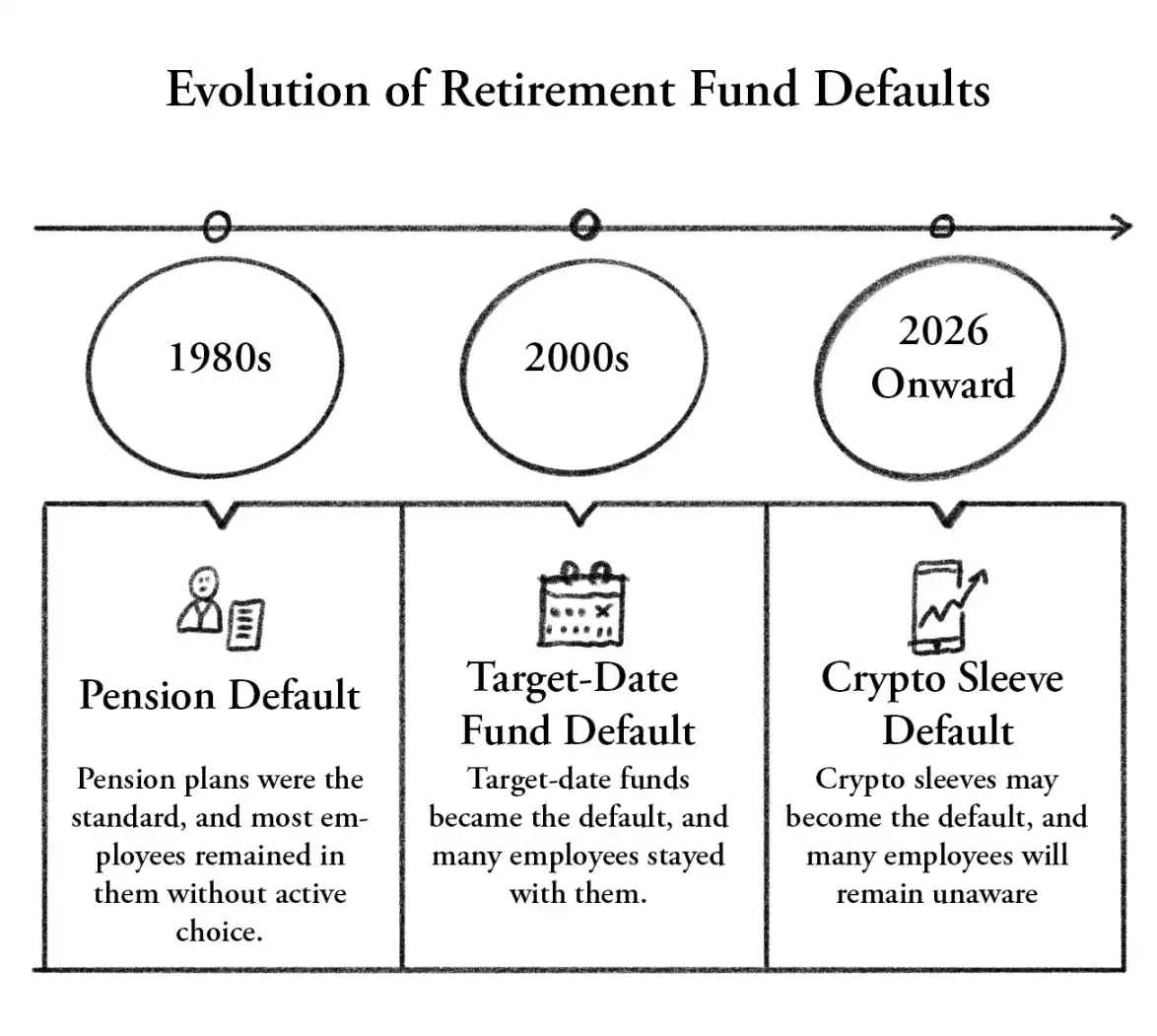
Cryptocurrency is now at that inflection point. Spot ETFs are the product, the DOL rule is the regulatory配套, Fidelity/Schwab/Morgan Stanley are the distribution channels, the CLARITY Act writes the asset classification into statute law, providing the legal basis for prudent examination by fiduciaries.

All the pieces are in place, except the last one.

Someday in the future, a pension plan manager adds Bitcoin to a target-date fund. Bitcoin crashes 60%. A retiree loses a chunk of their savings. Lawyers file a lawsuit.

At that moment, the only question that matters is: Will the judge agree that the safe harbor protected the person who made that decision.

Right now, nobody knows the answer. The Labor Department believes it will. TD Cowen believes it could take years to find out.

Until the first case is heard and adjudicated, every pension plan manager in America is being asked to trust a piece of paper that has never been tested in court.


Related Questions

QWhat is the 'default effect' in behavioral economics and how does it relate to the US pension system?

AThe 'default effect' is a concept in behavioral economics where the default option becomes the choice for the majority of people. The history of the US pension system is a history of default options, such as the shift from traditional pensions to 401(k) plans and then to target-date funds, with most employees passively accepting these changes without fully understanding the implications.

QWhat was the primary legal barrier that previously prevented cryptocurrency from being included in 401(k) plans?

AThe primary barrier was not an explicit legal ban, but the fiduciary liability under the Employee Retirement Income Security Act (ERISA). Plan fiduciaries could be held personally liable for investment losses, creating a strong incentive to avoid volatile assets like cryptocurrency, as they could face lawsuits for poor performance.

QWhat is the new 'six-factor safe harbor' rule proposed by the US Department of Labor, and what does it change?

AThe new 'six-factor safe harbor' rule states that a fiduciary will be deemed to have satisfied their prudence duties under ERISA if they follow a documented process reviewing six factors: expected return, fees, liquidity, valuation, blockchain analytics, and regulatory compliance. This protects them from personal liability if the asset's price falls, as long as the process was followed.

QThrough which primary investment vehicle is cryptocurrency expected to enter the 401(k) market, and what is its significance?

ACryptocurrency is expected to enter primarily through target-date funds. This is significant because most employees are automatically enrolled in these funds and never actively manage them. Investors would not be actively buying bitcoin; their retirement portfolios would be automatically allocated 1-3% in bitcoin, managed and rebalanced by professional institutions.

QWhat is the potential financial impact on the cryptocurrency market if US 401(k) plans begin to allocate a small portion of their assets?

AThe US 401(k) market is worth approximately $12 trillion. An allocation of just 1% would channel about $120 billion into digital assets, which is more than the total value locked in all of DeFi. Even a 0.1% allocation would be $12 billion, equivalent to the size of a top-five Bitcoin ETF, representing a massive influx of passive, long-term capital.

Related Reads

From Madison Square Garden to Kalshi: Prediction Markets Break into the NBA Finals

From Madison Square Garden to Kalshi: Prediction Markets Break into the NBA Finals Prediction markets are playing a significant role in the 2026 NBA Finals, particularly around the New York Knicks' unexpected 2-0 series lead. Platforms like Kalshi and Polymarket have seen massive trading volumes, exceeding hundreds of millions of dollars on championship and related markets. Their influence extends beyond online trading. Kalshi's official partnership with Madison Square Garden has given it prominent physical branding at the arena. Furthermore, local businesses like The Jeffrey bar are using prediction market contracts to hedge the risk of game-result-based promotions, turning potential losses into manageable costs—a concept similar to the famous "Mattress Mack" strategy from traditional sports betting. These markets differentiate themselves by offering a wider, more entertainment-focused range of "event contracts" beyond typical game outcomes, such as predicting celebrity attendance. They also have broader accessibility across the U.S. compared to age- and location-restricted traditional sportsbooks. However, their rapid integration into sports raises regulatory and ethical questions. The NBA is cautiously engaging, discussing integrity frameworks with regulators like the CFTC. While the league permits minor investments like Giannis Antetokounmpo's stake in Kalshi, it advocates for strict rules to prevent insider trading. Many fans express concern on platforms like Reddit, fearing that the close ties between prediction markets, the league, and players could compromise the game's integrity. The NBA Finals has thus become a high-stakes testing ground, showcasing prediction markets' commercial potential while challenging traditional boundaries between financial trading, entertainment, and gambling.

marsbit1h ago

From Madison Square Garden to Kalshi: Prediction Markets Break into the NBA Finals

marsbit1h ago

Recursive Self-Improvement AI Gains Traction, Google Pours Cold Water, While DeepSeek and Others Approach the Fringes

The term "recursive self-improvement" (RSI), where AI improves itself autonomously, is gaining momentum in the AI industry. Startups like Recursive Superintelligence and projects such as Andrej Karpathy's Auto-Research aim to create systems where AI designs, implements, and validates its own research, moving toward superintelligence. While Google CEO Sundar Pichai cautions that such exponential acceleration is not yet a reality, progress is evident. For instance, Anthropic reported its Claude Code writes nearly 100% of the team's code, though it still lacks true self-direction. Analysts frame RSI development in stages: "adequacy" (systems functioning without humans), "parity" (matching human research quality), and "supremacy" (exceeding human-AI collaboration). Reaching parity could trigger rapid, unpredictable advancement due to AI's continuous operation. In China, companies like DeepSeek and Baidu incorporate self-optimization techniques without explicitly branding them as RSI, focusing on algorithmic efficiency and reinforcement learning. However, challenges remain, including "model collapse" from training on AI-generated data and the immense computational and open-collaboration requirements. Ultimately, RSI represents a trend of increasing automation in AI development, potentially reducing human oversight in the creation process itself.

marsbit1h ago

Recursive Self-Improvement AI Gains Traction, Google Pours Cold Water, While DeepSeek and Others Approach the Fringes

marsbit1h ago

Trading

Spot
Futures

Hot Articles

What is $BITCOIN

DIGITAL GOLD ($BITCOIN): A Comprehensive Analysis Introduction to DIGITAL GOLD ($BITCOIN) DIGITAL GOLD ($BITCOIN) is a blockchain-based project operating on the Solana network, which aims to combine the characteristics of traditional precious metals with the innovation of decentralized technologies. While it shares a name with Bitcoin, often referred to as “digital gold” due to its perception as a store of value, DIGITAL GOLD is a separate token designed to create a unique ecosystem within the Web3 landscape. Its goal is to position itself as a viable alternative digital asset, although specifics regarding its applications and functionalities are still developing. What is DIGITAL GOLD ($BITCOIN)? DIGITAL GOLD ($BITCOIN) is a cryptocurrency token explicitly designed for use on the Solana blockchain. In contrast to Bitcoin, which provides a widely recognized value storage role, this token appears to focus on broader applications and characteristics. Notable aspects include: Blockchain Infrastructure: The token is built on the Solana blockchain, known for its capacity to handle high-speed and low-cost transactions. Supply Dynamics: DIGITAL GOLD has a maximum supply capped at 100 quadrillion tokens (100P $BITCOIN), although details regarding its circulating supply are currently undisclosed. Utility: While precise functionalities are not explicitly outlined, there are indications that the token could be utilized for various applications, potentially involving decentralized applications (dApps) or asset tokenization strategies. Who is the Creator of DIGITAL GOLD ($BITCOIN)? At present, the identity of the creators and development team behind DIGITAL GOLD ($BITCOIN) remains unknown. This situation is typical among many innovative projects within the blockchain space, particularly those aligning with decentralized finance and meme coin phenomena. While such anonymity may foster a community-driven culture, it intensifies concerns about governance and accountability. Who are the Investors of DIGITAL GOLD ($BITCOIN)? The available information indicates that DIGITAL GOLD ($BITCOIN) does not have any known institutional backers or prominent venture capital investments. The project seems to operate on a peer-to-peer model focused on community support and adoption rather than traditional funding routes. Its activity and liquidity are primarily situated on decentralized exchanges (DEXs), such as PumpSwap, rather than established centralized trading platforms, further highlighting its grassroots approach. How DIGITAL GOLD ($BITCOIN) Works The operational mechanics of DIGITAL GOLD ($BITCOIN) can be elaborated on based on its blockchain design and network attributes: Consensus Mechanism: By leveraging Solana’s unique proof-of-history (PoH) combined with a proof-of-stake (PoS) model, the project ensures efficient transaction validation contributing to the network's high performance. Tokenomics: While specific deflationary mechanisms have not been extensively detailed, the vast maximum token supply implies that it may cater to microtransactions or niche use cases that are still to be defined. Interoperability: There exists the potential for integration with Solana’s broader ecosystem, including various decentralized finance (DeFi) platforms. However, the details regarding specific integrations remain unspecified. Timeline of Key Events Here is a timeline that highlights significant milestones concerning DIGITAL GOLD ($BITCOIN): 2023: The initial deployment of the token occurs on the Solana blockchain, marked by its contract address. 2024: DIGITAL GOLD gains visibility as it becomes available for trading on decentralized exchanges like PumpSwap, allowing users to trade it against SOL. 2025: The project witnesses sporadic trading activity and potential interest in community-led engagements, although no noteworthy partnerships or technical advancements have been documented as of yet. Critical Analysis Strengths Scalability: The underlying Solana infrastructure supports high transaction volumes, which could enhance the utility of $BITCOIN in various transaction scenarios. Accessibility: The potential low trading price per token could attract retail investors, facilitating wider participation due to fractional ownership opportunities. Risks Lack of Transparency: The absence of publicly known backers, developers, or an audit process may yield skepticism regarding the project's sustainability and trustworthiness. Market Volatility: The trading activity is heavily reliant on speculative behavior, which can result in significant price volatility and uncertainty for investors. Conclusion DIGITAL GOLD ($BITCOIN) emerges as an intriguing yet ambiguous project within the rapidly evolving Solana ecosystem. While it attempts to leverage the “digital gold” narrative, its departure from Bitcoin's established role as a store of value underscores the need for a clearer differentiation of its intended utility and governance structure. Future acceptance and adoption will likely depend on addressing the current opacity and defining its operational and economic strategies more explicitly. Note: This report encompasses synthesised information available as of October 2023, and developments may have transpired beyond the research period.

363 Total ViewsPublished 2025.05.13Updated 2025.05.13

What is $BITCOIN

Discussions

Welcome to the HTX Community. Here, you can stay informed about the latest platform developments and gain access to professional market insights. Users' opinions on the price of BTC (BTC) are presented below.

活动图片