How Much Bitcoin Is Quantum-Vulnerable? Researcher Says 6.9 Million BTC

bitcoinistPublished on 2026-02-11Last updated on 2026-02-11

Abstract

Project Eleven CEO Alex Pruden disputes a CoinShares report estimating only 10,200 BTC are quantum-vulnerable, arguing that approximately 6.9 million BTC—including coins in addresses that have signed transactions at least once—could be at risk if quantum computers advance faster than anticipated. He emphasizes that once a public key is exposed on-chain, any remaining funds in that address become vulnerable to quantum attacks. Pruden specifically highlights Satoshi Nakamoto's estimated 1.1 million BTC as a large vulnerable target. He criticizes the notion that quantum threats are distant, citing evolving research and warning against complacency. The transition to quantum-resistant cryptography would be operationally complex for Bitcoin’s decentralized system, potentially requiring significant downtime and coordinated effort.

Project 11 CEO Alex Pruden is challenging a CoinShares estimate that only 10,200 bitcoin sit in “genuinely” quantum-vulnerable legacy addresses, arguing instead that roughly 6.9 million BTC could be exposed if cryptographically relevant quantum computers arrive sooner than the market expects.

The dispute, amplified by Castle Island partner Nic Carter, goes to the heart of a debate that has started to spill out of academic circles and into investor-facing research: not whether quantum computing would be catastrophic for today’s signature schemes, but how much Bitcoin is already exposed given how keys are used on-chain and how quickly the ecosystem would need to coordinate a migration.

Why ‘Only 10,000’ Bitcoin Are The Wrong Estimate

Pruden’s core objection to the “only 10k BTC” framing is definitional. In his thread, he argues quantum vulnerability extends well beyond old-style pay-to-public-key (P2PK) outputs and includes “any address that has signed a transaction once (and left residual funds there),” because the public key becomes visible on-chain once a spend is signed. In that model, coins left behind in those UTXOs could be vulnerable to an attacker able to derive a private key from a known public key.

He points to a “constantly updated tracker” run by Project Eleven listing 6,910,186 BTC as quantum-vulnerable, and cites Chaincode Labs’ technical report on post-quantum threats to Bitcoin as a cross-reference.

Pruden also singles out Satoshi Nakamoto’s presumed holdings as a large, dormant target surface. “The entity believed to be Satoshi alone holds 1,096,152 BTC across 21,924 addresses. All vulnerable,” he wrote, framing those coins as exposed under his broader definition.

Carter, responding to coverage circulating around the CoinShares number, said: “re that number of ‘only 10k quantum-vulnerable BTC’ you are seeing reported today... as much as I respect Chris and his work at Coinshares, he’s wrong on this one.”

Pruden situates the Bitcoin debate inside a wider shift among large tech companies and security institutions toward post-quantum planning. He cites a Google blog post by Hartmut Neven and Kent Walker that characterizes post-quantum cryptography as an urgent, systemic transition requiring coordinated action and accelerated adoption.

He also references a Google research result suggesting breaking RSA-2048 may require “~1 million noisy qubits,” lower than earlier estimates, and argues this compresses perceived timelines — even if Bitcoin uses ECDSA rather than RSA. To reinforce the uncertainty, Pruden quotes prominent theoretical computer scientist Scott Aaronson warning against complacency around Shor-vulnerable systems:

“On the other hand, if you think Bitcoin, and SSL, and all the other protocols based on Shor-breakable cryptography, are almost certainly safe for the next 5 years ... then I submit that your confidence is also unwarranted. Your confidence might then be like most physicists’ confidence in 1938 that nuclear weapons were decades away, or like my own confidence in 2015 that an AI able to pass a reasonable Turing Test was decades away... The trouble is that sometimes people, y’know, do that.”

Pruden’s conclusion from that framing is less about predicting a date and more about avoiding a planning regime built on “it’ll be slow.”

Pruden argues the CoinShares post underestimates the operational reality of a post-quantum transition for an already-deployed, decentralized system. He highlights the need to migrate “millions of distributed keys,” the lack of a centralized authority, and the fact that asset ownership is enforced purely by digital signatures, with “no fallback.”

He also cites peer-reviewed research claiming “the BTC blockchain would have to shut down for 76 days” to process migration transactions for the existing UTXO set in a best-case scenario — a datapoint meant to stress that even a distant threat can demand near-term engineering and governance work.

Pruden further criticizes what he calls an appeal to authority in citing a hardware-wallet executive as evidence quantum is far away, arguing vendors may have incentives to downplay urgency if quantum-resistant signatures would obsolete existing devices.

At press time, BTC traded at $69,050.
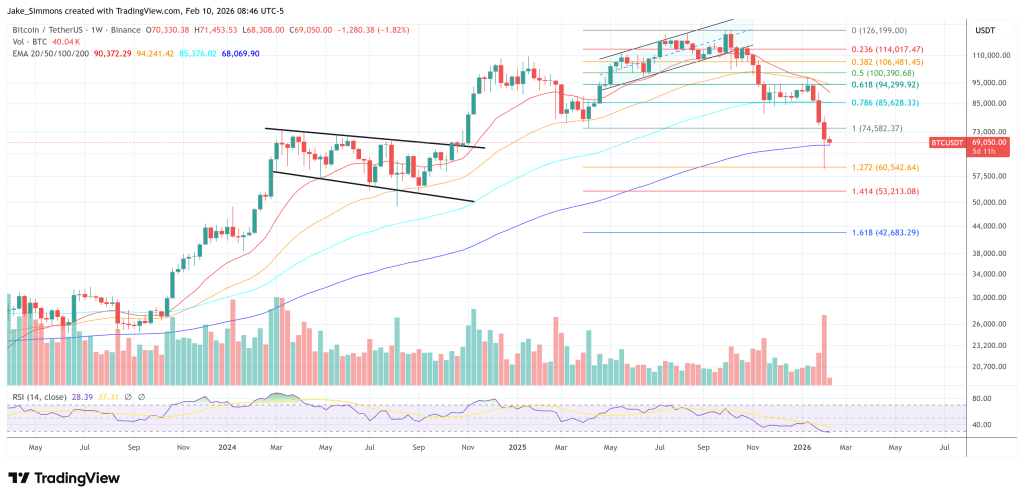
Bitcoin closed the week above the 200-week EMA, 1-week chart | Source: BTCUSDT on TradingView.com

Related Questions

QWhat is the main disagreement between Project 11 CEO Alex Pruden and CoinShares estimate regarding quantum-vulnerable Bitcoin?

AAlex Pruden disputes CoinShares' estimate of only 10,200 quantum-vulnerable BTC, arguing that approximately 6.9 million BTC are exposed due to his broader definition of vulnerability, which includes any address that has signed a transaction and left residual funds, making the public key visible.

QAccording to Pruden, why are Satoshi Nakamoto's presumed holdings particularly vulnerable to quantum attacks?

APruden states that Satoshi Nakamoto's holdings of 1,096,152 BTC across 21,924 addresses are all vulnerable because they are dormant and have exposed public keys, falling under his broader definition of quantum vulnerability.

QWhat does Pruden cite as evidence that the timeline for quantum threats might be shorter than previously expected?

APruden cites a Google research result suggesting breaking RSA-2048 may require only '~1 million noisy qubits,' which is lower than earlier estimates, and argues this compresses perceived timelines for quantum threats, even though Bitcoin uses ECDSA.

QWhat operational challenges does Pruden highlight for a post-quantum transition in Bitcoin?

APruden highlights the need to migrate millions of distributed keys, the lack of a centralized authority, and the fact that asset ownership is enforced purely by digital signatures with no fallback. He also references research claiming the Bitcoin blockchain would need to shut down for 76 days to process migration transactions in a best-case scenario.

QHow does Pruden criticize the appeal to authority in the quantum vulnerability debate?

APruden criticizes citing a hardware-wallet executive as evidence that quantum threats are far away, arguing that vendors may have incentives to downplay urgency if quantum-resistant signatures would make existing devices obsolete.

Related Reads

How Risky is the "Death Spiral" of MSTR and STRC?

Summary: This article explores the perceived "death spiral" risk between MicroStrategy (MSTR), its Bitcoin holdings, and its perpetual preferred stock (STRC), drawing comparisons to the LUNA-UST collapse. While both systems feature price anchors, high yields for holders, and potential feedback loops, their core mechanisms differ fundamentally. The MSTR-STRC structure relies on continuous financing to sustain its high dividend payouts, primarily through stock ATM offerings. A negative feedback cycle could occur: falling MSTR stock price makes raising equity capital harder, increasing pressure to sell Bitcoin, which undermines STRC confidence and further depresses MSTR. However, unlike LUNA-UST's automated, direct linkage, the MSTR-STRC loop is weaker and has brakes: STRC dividends can be deferred or rates lowered, and STRC holders have a $100/share liquidation preference in bankruptcy, providing a price floor. The company's sustainability hinges on its ability to continue financing. Its current ~$900 million USD reserves cover only about 6.3 months of its ~$1.71 billion annual interest/dividend burden. The next six months are critical, aligning with both the potential bottom in Bitcoin's four-year cycle and the depletion timeline of its reserves. While a LUNA-style catastrophic collapse is deemed highly unlikely due to structural differences, the key question is whether MicroStrategy can navigate this period through healthy deleveraging to restart its capital engine.

Foresight News1m ago

How Risky is the "Death Spiral" of MSTR and STRC?

Foresight News1m ago

How Much Debt Does Strategy Really Have? Is There a Risk of Implosion?

MicroStrategy's Debt Risk: A Turning Point in the "Never Sell" Strategy As of June 3, 2026, MicroStrategy holds 843,706 bitcoins (valued at ~$53.1B) but faces significant financial obligations. Its capital structure includes $6.75B in convertible notes and $15.48B in perpetual preferred stock (led by the $8.5B STRC series), creating an annual payout burden of ~$1.71B. With software revenue at only ~$500M, interest and dividend obligations far exceed operating income. A critical shift occurred in late May 2026 when the company sold 32 bitcoins for ~$2.5M to cover dividends, breaking CEO Michael Saylor's long-standing "never sell" pledge. This symbolic move triggered a sharp decline in both Bitcoin's price and MSTR stock, reflecting market fears about cash flow sustainability. The core of the strain is the STRC perpetual preferred stock, designed as a "permanent loan" with no maturity date but requiring high monthly dividends (currently 11.5%). Its business model relies on a three-part cycle: issuing new STRC shares, using proceeds to buy more Bitcoin and fund a USD reserve, and using that reserve to pay dividends. This cycle depends on continuous investor demand for STRC and Bitcoin's price appreciation. Analysis shows Bitcoin needs to appreciate at least 2.3% annually to cover the $1.71B in yearly obligations at current holdings. With Bitcoin price down ~22% from March 2026 highs, this pressure has intensified. The company's $900M USD reserve can only cover about 7 months of payments if STRC issuance stalls. Key risks are not immediate bankruptcy or forced Bitcoin liquidation (as BTC is not collateral), but rather: 1) The erosion of MSTR's premium to its Bitcoin holdings (mNAV), which would cripple its ability to raise cheap capital; 2) A vicious cycle where stagnant Bitcoin prices reduce STRC demand, draining the USD reserve and forcing BTC sales, further depressing prices. The period from February 2027 to September 2028 is a crucial test, with over $5.9B in convertible notes facing put options or maturity. In essence, MicroStrategy has evolved from a simple Bitcoin holder into a complex financial entity acting like a "private Bitcoin bank," leveraging its BTC holdings to create layered financial products. Its survival depends on maintaining Bitcoin's price trend, its stock premium, and market appetite for its preferred shares. The recent token sale marks not a betrayal of its Bitcoin thesis, but an admission that the leveraged strategy must eventually be paid for.

marsbit11m ago

How Much Debt Does Strategy Really Have? Is There a Risk of Implosion?

marsbit11m ago

Anthropic Cries Wolf: Is the AGI Threat Real, or Just an IPO Story?

Anthropic has published an article titled "When AI builds itself," discussing the emerging concept of "recursive self-improvement," where AI begins to actively participate in designing, training, testing, and optimizing its own subsequent versions. The company presents internal data showing that by May 2026, over 80% of code merged into its codebase was written by Claude, its AI model. Claude's capabilities have expanded to handling complex, open-ended engineering tasks, achieving a 76% success rate in such areas, and even contributing to research processes, such as optimizing code performance and conducting AI safety experiments. Anthropic outlines an evolution from human-driven development to AI-assisted workflows, culminating in the current stage where AI agents can autonomously write, run, and delegate code. The company cautions that the path toward a "closed loop," where AI continuously improves itself, is becoming visible. It calls for coordinated global mechanisms to potentially slow or pause frontier AI development to allow safety research and societal structures to catch up. However, the timing of this warning coincides with Anthropic's preparations for an IPO, framing the narrative not just as a safety concern but also as a demonstration of Claude's advanced capabilities and its integral role in accelerating Anthropic's own R&D—creating a potential "flywheel" effect for competitive advantage. This contrasts with OpenAI's recent, more policy-oriented discussion of the same risks, highlighting the competitive dynamics in the AI industry as companies position themselves in both the technological and regulatory landscape.

marsbit1h ago

Anthropic Cries Wolf: Is the AGI Threat Real, or Just an IPO Story?

marsbit1h ago

Trading

Spot
Futures

Hot Articles

What is $BITCOIN

DIGITAL GOLD ($BITCOIN): A Comprehensive Analysis Introduction to DIGITAL GOLD ($BITCOIN) DIGITAL GOLD ($BITCOIN) is a blockchain-based project operating on the Solana network, which aims to combine the characteristics of traditional precious metals with the innovation of decentralized technologies. While it shares a name with Bitcoin, often referred to as “digital gold” due to its perception as a store of value, DIGITAL GOLD is a separate token designed to create a unique ecosystem within the Web3 landscape. Its goal is to position itself as a viable alternative digital asset, although specifics regarding its applications and functionalities are still developing. What is DIGITAL GOLD ($BITCOIN)? DIGITAL GOLD ($BITCOIN) is a cryptocurrency token explicitly designed for use on the Solana blockchain. In contrast to Bitcoin, which provides a widely recognized value storage role, this token appears to focus on broader applications and characteristics. Notable aspects include: Blockchain Infrastructure: The token is built on the Solana blockchain, known for its capacity to handle high-speed and low-cost transactions. Supply Dynamics: DIGITAL GOLD has a maximum supply capped at 100 quadrillion tokens (100P $BITCOIN), although details regarding its circulating supply are currently undisclosed. Utility: While precise functionalities are not explicitly outlined, there are indications that the token could be utilized for various applications, potentially involving decentralized applications (dApps) or asset tokenization strategies. Who is the Creator of DIGITAL GOLD ($BITCOIN)? At present, the identity of the creators and development team behind DIGITAL GOLD ($BITCOIN) remains unknown. This situation is typical among many innovative projects within the blockchain space, particularly those aligning with decentralized finance and meme coin phenomena. While such anonymity may foster a community-driven culture, it intensifies concerns about governance and accountability. Who are the Investors of DIGITAL GOLD ($BITCOIN)? The available information indicates that DIGITAL GOLD ($BITCOIN) does not have any known institutional backers or prominent venture capital investments. The project seems to operate on a peer-to-peer model focused on community support and adoption rather than traditional funding routes. Its activity and liquidity are primarily situated on decentralized exchanges (DEXs), such as PumpSwap, rather than established centralized trading platforms, further highlighting its grassroots approach. How DIGITAL GOLD ($BITCOIN) Works The operational mechanics of DIGITAL GOLD ($BITCOIN) can be elaborated on based on its blockchain design and network attributes: Consensus Mechanism: By leveraging Solana’s unique proof-of-history (PoH) combined with a proof-of-stake (PoS) model, the project ensures efficient transaction validation contributing to the network's high performance. Tokenomics: While specific deflationary mechanisms have not been extensively detailed, the vast maximum token supply implies that it may cater to microtransactions or niche use cases that are still to be defined. Interoperability: There exists the potential for integration with Solana’s broader ecosystem, including various decentralized finance (DeFi) platforms. However, the details regarding specific integrations remain unspecified. Timeline of Key Events Here is a timeline that highlights significant milestones concerning DIGITAL GOLD ($BITCOIN): 2023: The initial deployment of the token occurs on the Solana blockchain, marked by its contract address. 2024: DIGITAL GOLD gains visibility as it becomes available for trading on decentralized exchanges like PumpSwap, allowing users to trade it against SOL. 2025: The project witnesses sporadic trading activity and potential interest in community-led engagements, although no noteworthy partnerships or technical advancements have been documented as of yet. Critical Analysis Strengths Scalability: The underlying Solana infrastructure supports high transaction volumes, which could enhance the utility of $BITCOIN in various transaction scenarios. Accessibility: The potential low trading price per token could attract retail investors, facilitating wider participation due to fractional ownership opportunities. Risks Lack of Transparency: The absence of publicly known backers, developers, or an audit process may yield skepticism regarding the project's sustainability and trustworthiness. Market Volatility: The trading activity is heavily reliant on speculative behavior, which can result in significant price volatility and uncertainty for investors. Conclusion DIGITAL GOLD ($BITCOIN) emerges as an intriguing yet ambiguous project within the rapidly evolving Solana ecosystem. While it attempts to leverage the “digital gold” narrative, its departure from Bitcoin's established role as a store of value underscores the need for a clearer differentiation of its intended utility and governance structure. Future acceptance and adoption will likely depend on addressing the current opacity and defining its operational and economic strategies more explicitly. Note: This report encompasses synthesised information available as of October 2023, and developments may have transpired beyond the research period.

363 Total ViewsPublished 2025.05.13Updated 2025.05.13

What is $BITCOIN

Discussions

Welcome to the HTX Community. Here, you can stay informed about the latest platform developments and gain access to professional market insights. Users' opinions on the price of BTC (BTC) are presented below.

活动图片















