How a Fake SpaceX Engineer Stirred Up the Trillion-Dollar Commercial Space Market?

Odaily星球日报Published on 2026-07-27Last updated on 2026-07-27

Abstract

A self-proclaimed SpaceX engineer recently admitted to fabricating and disseminating false information about the company's launch vehicle strategy, which was subsequently reported by major media outlets and stirred significant discussion in the commercial space market. The individual, Yatharth Mann, claimed to have contacted several prominent news organizations, including Bloomberg, posing as an internal SpaceX engineer. In these communications, Mann fabricated details suggesting SpaceX would phase out its Falcon 9 rocket, refuse commercial launch orders post-2028, and accelerate a transition to its Starship vehicle to focus on deep space exploration. To bolster credibility, Mann's emails included criticisms of Elon Musk and Donald Trump, aligning with perceived internal employee sentiments. These fabricated claims were published as reports citing anonymous "insider" sources, prompting analysts to debate the potential market implications. Some argued a strategic shift could create opportunities for competitors like Rocket Lab. However, Mann later revealed the hoax, even pointing out factual errors in the reporting, such as incorrectly stating SpaceX would reduce production of the expendable second stage rather than the reusable first stage of the Falcon 9. While the involved media outlets have not publicly confirmed or responded to Mann's claims, the incident highlights the potential impact of unverified anonymous sources and the ease with which misinformation can enter ma...

Original | Odaily Planet Daily(@OdailyChina)

Author|Azuma(@azuma_eth)
Last week, several mainstream media outlets including Bloomberg reported on the news that 'SpaceX will gradually phase out the Falcon 9 and fully commit to the Starship'.

These reports indicated, according to an insider, SpaceX has begun refusing dedicated commercial launch orders for its main rocket the 'Falcon 9' scheduled beyond 2028, and has suspended new bookings for its rideshare launch program, in order to accelerate the transition to Starship.

The source also added that SpaceX has halted production of some non-reusable components for the Falcon 9 series but is expected to continue using the rocket for missions for the U.S. Department of Defense and NASA. Should the subsequent development of Starship fall short of expectations, related plans may be adjusted.
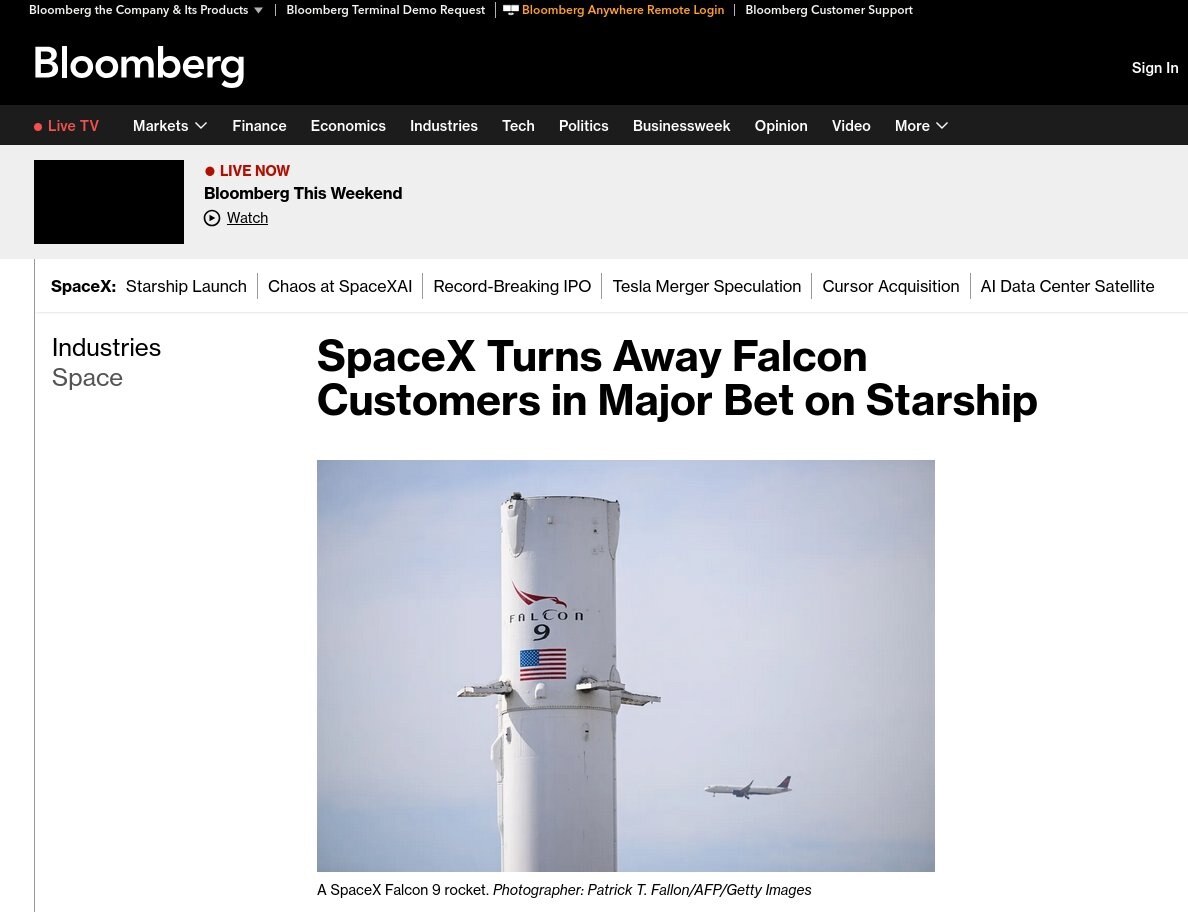
After this news spread, it quickly stirred up the entire commercial space market, with analysts from various fields subsequently launching discussions and analyses.

Some believe that the Falcon 9 has long dominated the global commercial launch market with its high success rate, low cost, and mature reusability, while Starship represents SpaceX's bet on the next-generation super heavy-lift launch vehicle and the deep space exploration market. Therefore, if SpaceX begins actively scaling back its Falcon 9 business, it would signify an acceleration in its commercial strategic shift and could also alter the competitive landscape of the entire commercial space industry chain.

Others argue that SpaceX's overly aggressive bet on the not-yet-mature Starship could present an opportunity for second-tier commercial space companies like Rocket Lab, which might take over some of the market gap left by SpaceX.

However, just as the market was discussing this news, an even more dramatic twist emerged.

On July 25th, a user named Yatharth Mann posted on a social media platform, stating that the 'SpaceX insider' referenced in the above reports actually did not exist, and that he himself was the creator of this 'leak'.

Mann claimed that several months ago, he had sent emails to multiple media outlets, including Bloomberg, The Wall Street Journal, and Reuters, posing as an engineer on SpaceX's Falcon rocket team.
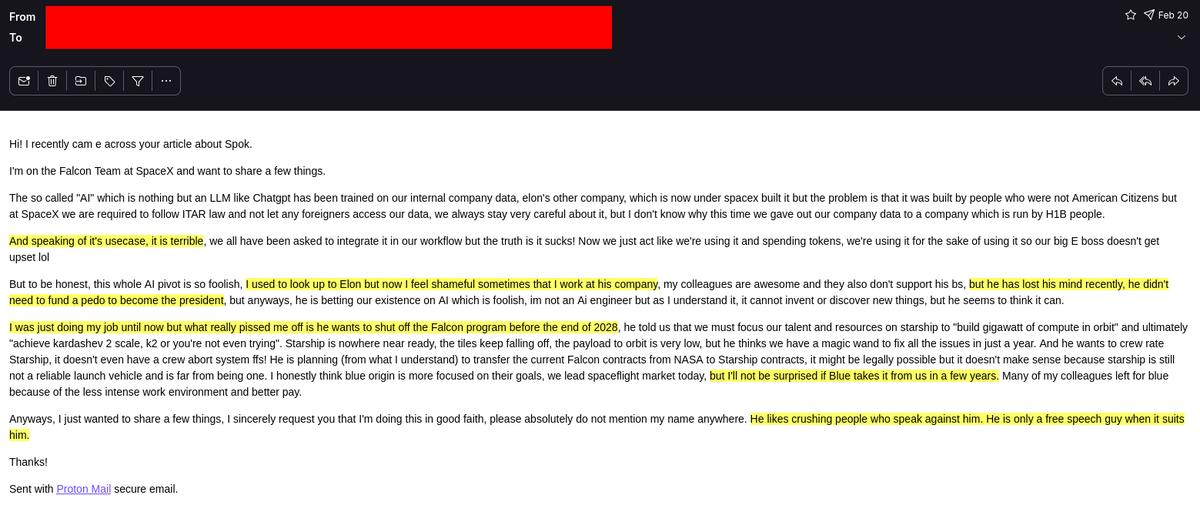
To enhance credibility, Mann not only used a seemingly authentic internal company identity but also deliberately included expressions of dissatisfaction with Elon Musk and Trump in the emails, to align with external expectations regarding the stance of SpaceX employees.
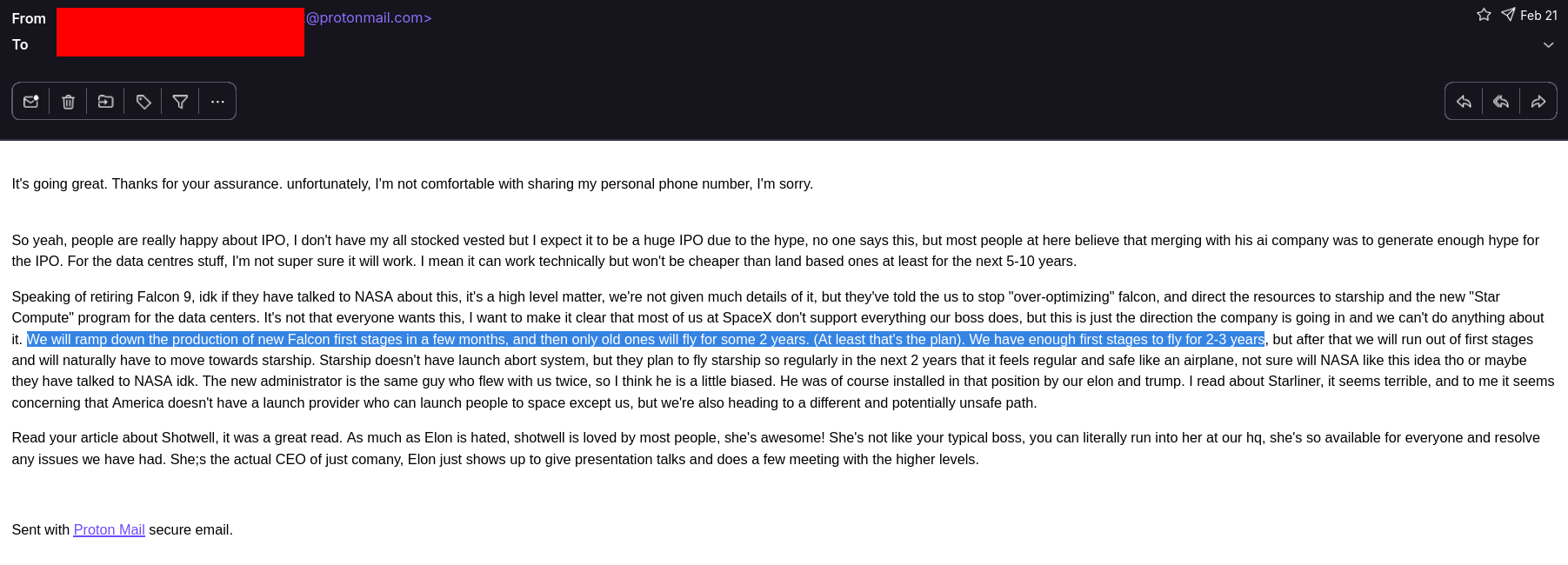
In the emails, Mann fabricated a series of false information about the Falcon 9 business adjustments, including that SpaceX would gradually reduce Falcon 9 component production, retain missions only for NASA and others in the future, and complete the transition by 2028. This information, entirely concocted by Mann, later appeared in media reports, packaged as 'insider revelations'......

Mann also highlighted a specific detail: in his leak, he clearly stated 'SpaceX will gradually reduce production of Falcon 9 first stages,' but Bloomberg and other media reported 'reduce second-stage production.' Mann raised a professional objection to Bloomberg and other media on this point, commenting that 'this makes no sense at all,' because the first stage is the reusable part, while the second stages are single-use. Production for the second stage could never be stockpiled in large quantities like other rockets to meet launch demand.

Currently, Mann's account has not been publicly confirmed by the related media, and the media outlets implicated in the reporting have yet to issue public responses. Regardless, this storm triggered by a 'fake email' has become one of the most dramatic episodes in the commercial space sector recently.

The facts are so absurd and ironic. An ordinary netizen, by forging an identity and sending a few emails, managed to get news about SpaceX's business route adjustments into mainstream media, directly influencing market discussion and secondary market speculation.

Next time you see mentions of 'anonymous sources,' 'sources,' or 'insiders' in media reports, perhaps you should be more cautious.


Related Questions

QAccording to the article, what was the main claim made by 'SpaceX insider' emails reported by multiple media outlets?

AThe emails claimed that SpaceX was beginning to refuse exclusive commercial launch orders for its Falcon 9 rocket scheduled for after 2028, had paused new bookings for its Rideshare program, and was phasing out production of some non-reusable Falcon 9 components to accelerate the transition to its Starship rocket.

QWho did Yatharth Mann claim to be, and what did he reveal about the news reports?

AYatharth Mann claimed to be the source behind the reports. He revealed that he was not a real SpaceX insider, but had fabricated the information and posed as a Falcon rocket team engineer in emails sent to several media outlets, including Bloomberg.

QWhat specific tactic did Mann use in his emails to make his fake identity more believable to journalists?

ATo increase credibility, Mann included expressions of dissatisfaction with Elon Musk and former President Donald Trump in his emails, aligning with external perceptions about potential employee sentiments within SpaceX.

QWhat factual error in the media reports did Mann point out as evidence of their poor verification?

AMann pointed out that while his original fabricated claim stated SpaceX would reduce production of Falcon 9's *first-stage* rockets, Bloomberg's report incorrectly stated it was the *second-stage* rockets. He noted this made no sense because the second stage is expendable and not stockpiled like other components.

QWhat broader implication does this incident highlight about news reporting, according to the article's conclusion?

AThe incident highlights how easily information from unnamed sources like 'anonymous insiders' or 'people familiar with the matter' can enter mainstream media and influence market discussions without proper verification, suggesting readers should be more skeptical of such attributions.

Related Reads

Bank of Korea Reveals Results of Tokenized Deposit Testing

The Bank of Korea has announced the results of its pilot test for tokenized deposits. Involving 28 central banks and international financial organizations, the project saw participation from major South Korean banks including KB Kookmin Bank, NH NongHyup Bank, Shinhan Bank, Woori Bank, and Hana Bank. Transactions, from payment orders to final settlement, were completed in real time, averaging just 80 seconds. The test involved 30 transactions across 17 different scenarios—such as corporate and interbank transfers—and was conducted in six currencies, including the Korean won, US dollar, and euro, with a total transaction value reaching approximately $995,000. The central bank reported that the platform operated stably throughout, despite being only partially connected to the existing banking infrastructure. Settlements using tokenized deposits were executed seamlessly, quickly, and transparently. An internal transfer of 20 million won (about $13,890) between NH NongHyup Bank and Shinhan Bank was also successfully processed via the Project Agora platform, which involved connecting to the Bank of Korea's CBDC test platform, Project Hangang. Additionally, KB Kookmin Bank and Japan's MUFG Bank tested cross-border payments using these deposit tokens—digital certificates issued by commercial banks within the pilot, not directly by the central bank. The Bank of Korea plans to continue testing payments with tokenized deposits. This follows last year's pledge by South Korean authorities to tighten regulations for won-based stablecoins, which will require approval from both the central bank and the Financial Services Commission.

cryptonews.ru1h ago

Bank of Korea Reveals Results of Tokenized Deposit Testing

cryptonews.ru1h ago

Trading

Spot
活动图片