Hoskinson Outlines Cardano Funding Overhaul For 2026

bitcoinistPublished on 2026-03-12Last updated on 2026-03-12

Abstract

Charles Hoskinson, founder of Cardano, has outlined a significant shift in the ecosystem's funding strategy for 2026. He argues that the treasury has historically over-invested in infrastructure (nodes, scaling) while underfunding utility (DApps, DeFi) and user experience (wallets, onboarding, marketing). This imbalance has resulted in many applications struggling with low user activity, TVL, and revenue. Hoskinson's proposed solution is a treasury-backed investment model, replacing grants. The treasury would take ownership stakes in selected projects, requiring strategic alignment, oversight, and partial revenue-sharing in return. This model aims to foster consolidation, as he states the ecosystem cannot sustain numerous similar projects, like 25 DEXs, at current adoption levels. He also emphasized rectifying Cardano's "uncool" public narrative by properly funding content creators and ambassadors. The core message is that Cardano must transition from an "infrastructure game" to a "utility and experience game" with coordinated, strategic intent to drive adoption.

Charles Hoskinson says Cardano’s 2026 budget debate is no longer really about whether the ecosystem should fund itself, but how. In a March 10 video, the Cardano founder argued the network has spent too long overweighting infrastructure while underinvesting in the applications, user experience and narrative needed to turn technical capacity into adoption.

Hoskinson framed the ecosystem as three layers: infrastructure, utility and experience. Infrastructure covers the core rails: nodes, languages and scaling components such as Hydra while utility is the actual DApp and DeFi stack, and experience is the user-facing layer of wallets, onboarding, content and brand. His argument was that Cardano has historically lived too heavily in the first category.

“Historically, Catalyst and the Cardano treasury was over represented here and under represented here,” he said, referring to infrastructure versus utility and experience. “Not enough money for experiences, not enough money for utility [...] there’s not a lot of money for the content creators. There’s not a lot of money for the people actually building the interfaces into Cardano utilities.”

That imbalance, in Hoskinson’s telling, now collides with a harsher reality: many applications are not performing well enough to sustain themselves. He pointed to monthly active users, total value locked, daily transactions and revenue as the relevant scorecard, then delivered a blunt assessment of the current state of the ecosystem.

“All of these on Cardano, they’re not doing well. You’re lying if you say they are,” he said. “There are a lot of DApps and DeFi in the Cardano ecosystem that are losing money. They don’t have a lot of users. They don’t have a lot of TVL.”

Cardano Must Rethink Funding In 2026

His proposed solution is not more grants in the traditional sense, but a treasury-backed investment structure. Rather than handing out what he called “free money,” Hoskinson suggested Cardano create a weighted index of selected ecosystem tokens, with the treasury taking ownership stakes in funded projects. In return, those projects would accept oversight, operating expense reductions, strategic alignment, and partial revenue-sharing back to the treasury through ADA purchases.

“No free money. Sorry, that’s bad behavior,” he said. “It is a strategic investment. You give something, you get something.” He added that the treasury’s goal would be to recoup the initial outlay over time as usage and valuations improve, saying the investment could potentially “pay itself back probably one to three years.”

That model also implies a more politically difficult step: consolidation. Hoskinson argued Cardano cannot support large numbers of similar products at current adoption levels, particularly across DeFi. “We can’t have 25 DEXs at our current adoption level in volume. It’s not sustainable,” he said. “There needs to be a consolidation by category one to three. And that’s what you have when you pick winners and losers.”

Alongside utility, Hoskinson spent significant time on what he described as Cardano’s neglected experience layer. He said the ecosystem has failed to compensate ambassadors, influencers and content creators, leaving Cardano exposed to a hostile public narrative. “Cardano is considered to be the uncool chain,” he said. “Ghost chain. Nobody uses Cardano. Cardano is a dead project [...] Why do you hear it? You hear it because there’s nobody on the other side of the argument.”

He tied that brand problem directly to user growth, arguing that better wallets, simpler onboarding, stronger aggregator channels and more deliberate marketing are prerequisites for turning infrastructure into actual network activity. He also said Cardano should focus its strategic identity on areas where he believes it can differentiate, particularly Bitcoin DeFi and privacy, rather than trying to beat larger rivals on cost, liquidity or raw user count.

The broader message was that the governance system now faces a practical test. Hoskinson said the ecosystem must stop treating every treasury request as a fragmented bidding war and start acting with coordinated intent. “It’s not an infrastructure game anymore,” he said near the end of the broadcast. “It’s a utility and experience game.”

At press time, ADA traded at $0.2590.
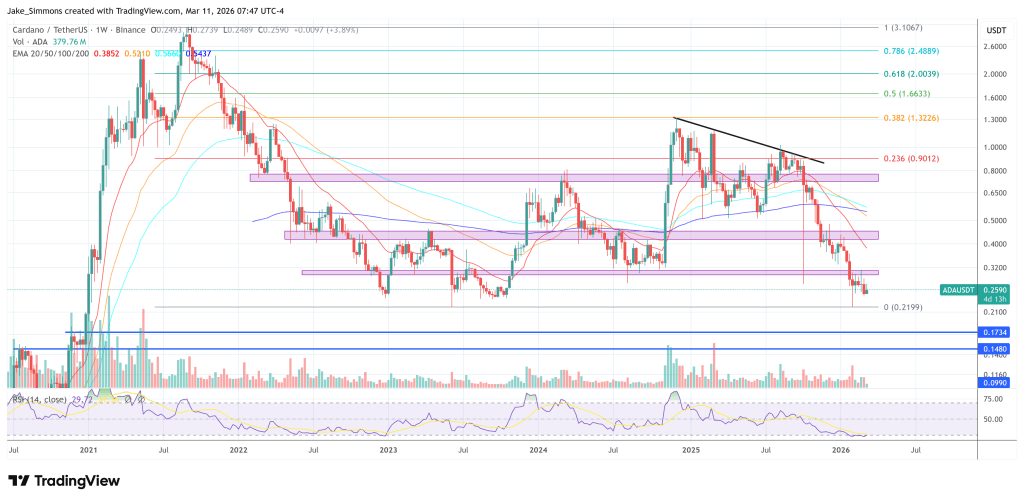
ADA hovers below key resistance, 1-week chart | Source: ADAUSDT on TradingView.com

Related Questions

QWhat are the three layers of the Cardano ecosystem as outlined by Charles Hoskinson?

AThe three layers are infrastructure (core rails like nodes and scaling components), utility (the DApp and DeFi stack), and experience (the user-facing layer of wallets, onboarding, content, and brand).

QAccording to Hoskinson, what is the main problem with the current funding model in Cardano's Catalyst treasury?

AThe treasury has historically been overrepresented in funding infrastructure and severely underrepresented in funding utility and experience, leading to a lack of support for applications, user interfaces, and content creators.

QWhat is Hoskinson's proposed alternative to traditional grants for funding projects in 2026?

AHe proposes a treasury-backed investment structure where the treasury takes ownership stakes in selected projects through a weighted index of ecosystem tokens, requiring oversight, cost reductions, strategic alignment, and partial revenue-sharing in return.

QWhy does Hoskinson believe consolidation is necessary in the Cardano ecosystem, particularly in DeFi?

AHe argues that at current adoption levels, it is unsustainable to support a large number of similar products, such as 25 DEXs, and that the ecosystem needs to consolidate to one to three leaders per category.

QHow does Hoskinson link Cardano's 'brand problem' to its user growth challenges?

AHe states that the ecosystem has failed to compensate ambassadors and content creators, leading to a hostile public narrative that labels Cardano as 'uncool' or a 'ghost chain,' which hinders user adoption. Better marketing and user experience are needed to counter this.

Related Reads

Yao Shunyu's 88 Days

Yao Shunyu, a 27-year-old AI expert with a background from Princeton and OpenAI, joined Tencent in September 2025. Within 88 days, he led a major overhaul of Tencent’s AI strategy and organization, resulting in the release of Hunyuan Hy3 preview—a MoE model with 295B total parameters and 21B active parameters, supporting up to 256K context length. The launch came after Tencent leadership, including CEO Ma Huateng and President Martin Lau, openly criticized Hunyuan's earlier underperformance—citing slow development, over-reliance on superficial benchmark optimization, and poor generalization in real-world applications. Internal adoption was low, with key business units like WeChat and gaming seeking external AI solutions. Yao reshaped Tencent’s AI approach by integrating previously siloed teams, dissolving the ten-year-old Tencent AI Lab, and establishing new units focused on AI infrastructure and data. Hy3 preview was developed using co-design principles, closely aligned with product teams to ensure practical usability from the start. It has already been integrated into core products like Yuanbao, QQ, and enterprise tools. The release signals a shift from chasing rankings to building usable, scalable AI grounded in Tencent’s ecosystem. While external partnerships (like with DeepSeek and OpenClaw) helped retain users temporarily, the focus is now on making Hunyuan a reliable internal foundation. The real test lies in sustaining this new organizational momentum amid fierce competition from Alibaba, DeepSeek, and others.

marsbit1h ago

Yao Shunyu's 88 Days

marsbit1h ago

Trading

Spot
Futures

Hot Articles

Discussions

Welcome to the HTX Community. Here, you can stay informed about the latest platform developments and gain access to professional market insights. Users' opinions on the price of S (S) are presented below.

活动图片