Hong Kong Issues First Stablecoin Licenses To HSBC, Standard Chartered JV

bitcoinistPublished on 2026-04-11Last updated on 2026-04-11

Abstract

The Hong Kong Monetary Authority (HKMA) has issued its first stablecoin licenses to The Hongkong and Shanghai Banking Corporation Limited (HSBC) and Anchorpoint Financial Limited, a joint venture between Standard Chartered, Animoca Brands, and Hong Kong Telecom. This follows the implementation of Hong Kong’s Stablecoins Ordinance in August 2025, which established a licensing framework for fiat-backed cryptocurrency issuers. The HKMA received 36 applications but approved only two in this initial phase, as anticipated by Chief Executive Eddie Yue. Amid a broader downturn in digital assets, the stablecoin market has remained resilient, with its combined market cap holding near all-time highs since Q4 2025. Meanwhile, Bitcoin has declined over 42% in the same period. At the time of writing, Bitcoin was trading around $72,200, up more than 8% over the past week.

The Hong Kong Monetary Authority (HKMA) has handed out its first stablecoin licenses, and the winners are Standard Chartered’s JV and HSBC.

HKMA Has Released First Stablecoin Licenses After A Delay

According to HKMA’s website, two entities have now become registered stablecoin issuers in Hong Kong: Anchorpoint Financial Limited and The Hongkong and Shanghai Banking Corporation Limited.

Hong Kong launched its stablecoin bill called the Stablecoins Ordinance back in August 2025, establishing a licensing regime for stablecoin issuers. Under this law, parties interested in issuing fiat-tied cryptocurrencies in the Chinese city have to first obtain a license from the HKMA.

Major names quickly lined up to apply for a license. This included HSBC and Anchorpoint Financial Limited. The latter is a joint venture (JV) created by Standard Chartered, Animoca Brands, and Hong Kong Telecom. In total, the HKMA ended up receiving applications from 36 entities. Despite the high interest, though, Eddie Yue, the financial regulator’s chief executive, said in February that a “very small number” of licenses would be granted in the first wave.

Yue also said that these licenses would arrive in March, but in the end, no licenses were issued during that month, suggesting a delay from the HKMA. However, today, on April 10th, the first batch has finally gone out.

With just two licenses being handed out, Yue indeed set up the correct expectations. As mentioned earlier, Standard Chartered’s JV and HSBC are the applicants who have received the first approval. Thus, these banks have a head start over the rest when it comes to stablecoins in the region.

Hong Kong’s stablecoins advance is just one example of positive regulation that these fiat-tied tokens have seen the world over in the past year. One of the most important wins for the sector has been the GENIUS Act signed into law by United States President Donald Trump last year.

Because of all the regulatory momentum and adoption, the stablecoins sector has performed relatively well amid the wider downturn in the digital assets market. As data from DefiLlama shows, stablecoins have seen their combined market cap move sideways at all-time highs (ATHs) since Q4 2025. In the same period as this flat phase in these fiat-tied tokens, Bitcoin has gone down by more than 42%.
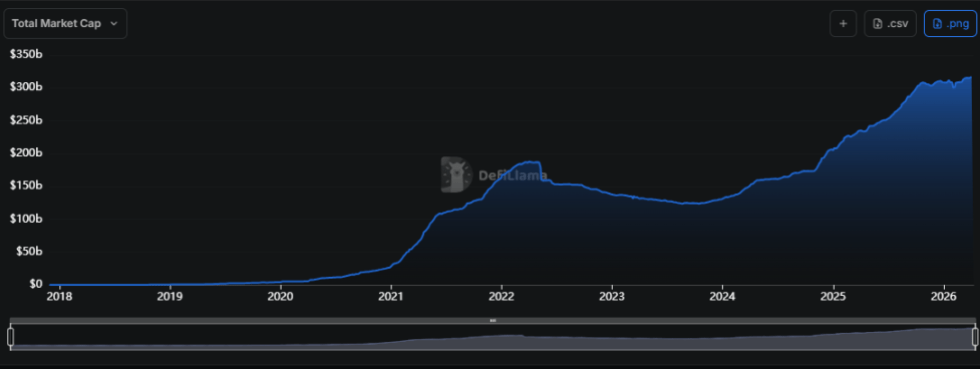
The trend in the market cap of the stablecoins over the years | Source: DefiLlama

While the stablecoin market cap is significant in size, the vast majority of it is covered by just two assets pegged to the US Dollar: USDT and USDC. Moves like the euro-pegged token from a consortium of major European banks could shake up this dominance, but it only remains to be seen how the landscape will evolve.

Bitcoin Price

At the time of writing, Bitcoin is floating around $72,200, up more than 8% in the last seven days.

Looks like the price of the coin has surged recently | Source: BTCUSDT on TradingView

Related Questions

QWhich two entities received the first stablecoin licenses from the Hong Kong Monetary Authority?

AAnchorpoint Financial Limited and The Hongkong and Shanghai Banking Corporation Limited (HSBC).

QWhat is the name of the stablecoin bill that established the licensing regime in Hong Kong and when was it launched?

AThe Stablecoins Ordinance, launched in August 2025.

QHow many entities applied for a stablecoin license from the HKMA, and how many were granted in this first wave?

A36 entities applied, and 2 licenses were granted in the first wave.

QAccording to the data from DefiLlama, how has the stablecoin market cap performed compared to Bitcoin since Q4 2025?

AThe stablecoin market cap has moved sideways at all-time highs, while Bitcoin has declined by more than 42% in the same period.

QWhat is the current price of Bitcoin mentioned in the article and its 7-day performance?

ABitcoin is floating around $72,200, up more than 8% in the last seven days.

Related Reads

AAOI Defies Trend with Over 10% Surge, 'New Stock God' Serenity Predicts Potential to Double Again

On June 4th, despite a significant sell-off in the broader AI and semiconductor sector triggered by Broadcom's disappointing guidance, Applied Optoelectronics (AAOI) surged over 11%, showcasing a sharp divergence in market sentiment. Broadcom's warning about potential supply chain diversification by key customer Google and a weaker-than-expected outlook punctured the high-flying AI valuation narrative. This led to heavy selling in names like Broadcom (-12.6%) and Micron (-7%), with funds rotating into traditional industrial stocks. AAOI defied this trend. The stock has experienced high volatility recently, driven by bullish analyst coverage, notably from Rosenblatt which raised its price target to $220. Key catalysts include initial 800G optical module revenue from Amazon, potential certification from Oracle, and strong demand across its product portfolio. The company has reported cumulative orders for 800G/1.6T modules exceeding $324 million and is aggressively expanding manufacturing capacity in Texas, targeting an annualized run-rate of $1.4 billion for its module business by Q3 2027. However, AAOI's fundamentals present a mixed picture. Its Q1 2026 results missed expectations, showing a GAAP net loss, and Q2 guidance points to merely breakeven adjusted EPS. Risks include a delayed 800G production ramp to the second half of the year and high dependence on a few key cloud customers. Recent stock sales by company executives near price highs also noted. The article suggests AAOI's rally reflects a market beginning to differentiate within the AI ecosystem. While Broadcom's issues prompted a reassessment of custom ASIC and customer concentration risks, funds flowing into AAOI indicate a belief that the "physical bottleneck" narrative for optical connectivity—where supply remains tight—remains intact and is somewhat decoupled from the current sector weakness. The sustainability of AAOI's premium valuation now hinges on the successful execution of its production plans and upcoming quarterly results.

marsbit12m ago

AAOI Defies Trend with Over 10% Surge, 'New Stock God' Serenity Predicts Potential to Double Again

marsbit12m ago

Worried about AI's Self-Evolution, Anthropic Intends to Stop Training?

In early 2026, Anthropic signaled a significant shift in its public narrative regarding AI development timelines and safety. In June, its Anthropic Institute published a detailed article, "When AI builds itself," presenting internal data suggesting accelerating AI self-improvement. Key figures included over 80% of merged code being written by Claude and a 52x speedup in certain optimization tasks. The article outlined three future scenarios, with the most speculative being full recursive self-improvement (RSI), where AI autonomously builds better successors. Anthropic stated RSI is "possible" and may arrive faster than most institutions are prepared for. This narrative pivot followed a series of strategic moves. In January, CEO Dario Amodei wrote about a powerful self-improvement feedback loop. In February, Anthropic revised its Responsible Scaling Policy, removing a core commitment to pause training if capabilities outstripped safety controls, citing the risk of falling behind competitors. This change coincided with reported pressure from the US Department of Defense. By May, Anthropic's valuation had soared to $965 billion. Anthropic's stance was mirrored by other industry leaders. DeepMind CEO Demis Hassabis adjusted his AGI timeline to "by 2029" and admitted to using provocative language like "foothills of the singularity" to create urgency. OpenAI also released a model claiming a key role in its own creation process. The article's carefully calibrated tone—presenting dramatic data alongside qualifying footnotes—exemplifies a balancing act between signaling technological acceleration and managing commercial, regulatory, and safety imperatives. External experts offered contrasting interpretations of the same data, from warnings of catastrophic risk akin to Chernobyl to skepticism that current automation merely handles "grunt work," not genius. The coordinated narrative shift among top labs highlights the complex interplay between perceived technical inflection points and strategic communication aimed at investors, regulators, and the public.

marsbit14m ago

Worried about AI's Self-Evolution, Anthropic Intends to Stop Training?

marsbit14m ago

Trading

Spot
Futures
活动图片