The Bitcoin price has been in a prolonged downtrend but saw a slight reprieve this week, rising a bit by 2%. Despite the minor gain, the cryptocurrency remains in a broader bear market, and as of today, its price is still in the red and could continue to decline if momentum does not improve. A major driver behind BTC’s weakness is the recent outflows from its Spot Exchange-Traded Funds (ETFs). Even as institutional demand declines, the market remains under bearish pressure and faces heightened volatility amid ongoing geopolitical tensions in the Middle East.
Bitcoin Price Crash Continues As ETFs Record Outflows
Since debuting in 2024, Spot Bitcoin ETFs have played a significant role in driving BTC prices, with the volume and consistency of net daily flows often influencing the market’s direction. When these ETFs record major outflows, it typically suggests that institutional investors are reducing their exposure, likely due to profit-taking, risk management, or shifting market sentiment. Regardless of the reason, the reduced demand tends to place downward pressure on the Bitcoin price.
Notably, data from SoSoValue indicates that Spot Bitcoin ETFs recorded more outflows than inflows last week, a trend that has noticeably affected prices. On March 18 and 20, these ETFs saw total outflows of $305 million, followed by a modest influx of capital the next day.
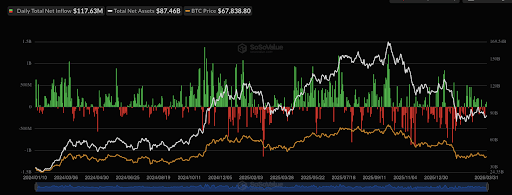
The most recent outflows, which appear to be contributing to Bitcoin’s ongoing downtrend, occurred on March 26 and 27. On Thursday, withdrawals from Spot Bitcoin ETFs reached $171.22 million, further exacerbated by an additional $225.48 million outflow the following day.
According to SoSoValue, the bulk of these outflows came from BlackRock’s IBIT, which alone saw $41.92 million exit on Thursday and a staggering $201.5 million outflow on Friday. Other funds, including Fidelity’s FBTC and Grayscale’s GBTC, also recorded outflows during the same period.
As of now, Spot Bitcoin ETFs have returned to net positive territory, with cumulative inflows totaling $56.12 billion after ending its two-day outflow streak and receiving over $187 million over the last two days. Despite renewed demand, Bitcoin’s price is down, recording a year-to-date decline of roughly 40%. The cryptocurrency is also trading below the $70,000 level, hovering just above $68,000, at the time of writing.
Other Factors Influencing Price
In addition to the earlier decline in ETF demand, ongoing geopolitical tensions appear to be significantly influencing investor sentiment, further pressuring BTC’s price. The latest update regarding the US-Iran war reveals that no formal peace agreement has yet been reached, even as President Donald Trump’s April 6 deadline to resume strikes on Iran’s energy infrastructure approaches rapidly.
As of now, Market watchers continue to monitor changes in oil prices, ETF inflows, and any diplomatic developments that could impact the prices of Bitcoin and other cryptocurrencies.