Here’s How Many Transactions XRP Must Process To Reach A $2,000 Price Tag

bitcoinistPublished on 2025-12-24Last updated on 2025-12-24

Abstract

Crypto analyst Rob Cunningham outlines the conditions for XRP to reach a $2,000 valuation, emphasizing it would need to process sovereign-scale settlement volumes. He states XRP must handle $200 trillion in value and up to $2 quadrillion in daily transactions at that price, effectively eliminating liquidity stress and making the cost of capital near zero. Cunningham explains that beyond the $1,500–$3,000 range, XRP would be valued based on functional utility rather than conventional pricing, repricing rapidly like infrastructure. He predicts a three-phase acceleration pattern driven by regulatory clarity, future value compression, and institutional adoption, comparing XRP’s potential rise to historic economic shifts such as oil discoveries.

Crypto analyst Rob Cunningham has detailed the conditions and how many transactions XRP would need to handle to reach a $2,000 valuation. He explained that the token must process sovereign-scale settlement volumes and eliminate liquidity stress to achieve its full potential.

The Transaction Threshold For A $2,000 XRP

In a rather lengthy X post this Monday, Cunningham outlined a new framework for understanding XRP’s potential price trajectory. He emphasized that the most important question for cryptocurrency is the price at which it eliminates pre-funding, slippage, and liquidity stress for sovereign-scale settlement. The analyst evaluated this using metrics such as global settlement volume, order-book depth, central-bank-scale transaction sizing, and the need to avoid balance-sheet drag.

According to his analysis, the minimum clean operating range for XRP lies between $1,500 and $3,000 per coin. At a $2,000 valuation, XRP’s network would need to hold $200 trillion in value and process up to $2 quadrillion in daily transactions with a tenfold velocity.

Cunningham described XRP at the $2,000 level as a rail, a reserve, and a unit of account bridge. He stated that if the cryptocurrency could achieve this valuation, liquidity would effectively become invisible, and the cost of capital could approach zero, making XRP function more like energy than conventional money.

The analyst also asserted that beyond the $1,500 to $3,000 range, XRP ceases to be “priced” in conventional terms and is instead evaluated based on its functional utility. He declared that XRP would reprice faster than any other asset in history. Unlike most cryptocurrencies, which usually move based on earnings, narratives, or market cycles, XRP would be repriced like infrastructure—fast, violent, and discolored.

Analyst Compares XRP Move To Oil Discovery And Predicts Explosive Rally

In his analysis, Cunningham also predicted that XRP’s price will eventually be driven by its structural role rather than typical market factors. He explained that once the market recognizes Ripple Labs and the XRP Ledger (XRPL) as essential to global settlements, three key dynamics could kick in simultaneously.

First, it could optionally collapse as XRP stops being one of many cryptocurrencies and becomes a required input. Second, the future value could exceed the present value. Third, the “float” becomes functionally illiquid, as long-term holders remain firm and institutions must acquire XRP regardless of price. The analyst has compared this rare combination of factors to oil discoveries, wars, shifts in reserve currency, or recognition of monopoly infrastructure.

The analyst also outlined a three-phase acceleration pattern for XRP, emphasizing that the token’s growth would occur in leaps, with rapid bursts of 3X to 10X. The first phase, Recognition Shock, could last weeks to three months, triggered by clear regulatory finality and treasury-level integration. The second phase, Future Value Compression, may last three to twelve months as the market prices XRP to prevent scarcity. The final phase, Infrastructure Pricing, could span one to three years, with XRP no longer priced but managed.

XRP trading at $1.89 on the 1D chart | Source: XRPUSDT on Tradingview.com

Related Questions

QWhat is the minimum clean operating range for XRP's price according to Rob Cunningham's analysis?

AThe minimum clean operating range for XRP lies between $1,500 and $3,000 per coin.

QAt a $2,000 valuation, what scale of daily volume must the XRP network process?

AAt a $2,000 valuation, the XRP network would need to process up to $2 quadrillion in daily transactions.

QWhat three key dynamics could kick in once the market recognizes Ripple and the XRPL as essential to global settlements?

AThe three key dynamics are: 1) optionality could collapse as XRP becomes a required input, 2) the future value could exceed the present value, and 3) the 'float' becomes functionally illiquid as long-term holders remain firm and institutions must acquire XRP regardless of price.

QHow does the analyst describe the nature of XRP's price repricing compared to other assets?

AThe analyst states that XRP would be repriced like infrastructure—fast, violent, and discolored—rather than like most cryptocurrencies, which move based on earnings, narratives, or market cycles.

QWhat are the three phases of the acceleration pattern outlined for XRP's growth?

AThe three phases are: 1) Recognition Shock (weeks to three months), 2) Future Value Compression (three to twelve months), and 3) Infrastructure Pricing (one to three years).

Related Reads

Bitroot Public Chain Invited to Attend Tencent Cloud Singapore AI Conference, Discussing the Future Alongside Solana

On May 19, Bitroot, an emerging Layer 1 blockchain, participated in the Tencent Cloud AI Summit in Singapore alongside key industry players like Solana Foundation. The event explored the intersection of AI infrastructure, enterprise applications, AI Agents, and Web3. Bitroot's invitation, despite being pre-mainnet, highlights industry interest in its focus on high-performance, AI-native architecture tailored for future AI Agent execution and verifiable on-chain automation. Bitroot CEO Juan Jose emphasized that AI competition is shifting from model performance to data, real-world application scenarios, and trust infrastructure. He argued that for AI Agents to evolve from assistants to autonomous executors managing transactions and assets, they require low-latency, low-cost, and high-throughput blockchain environments. Bitroot aims to address this through its EVM-compatible design, optimistic parallel execution, and a consensus mechanism targeting high scalability. Currently in its Testnet 5.0 phase, Bitroot reports metrics like over 50,000 peak TPS and sub-0.3 second average block time. Its narrative positions it within a growing landscape where next-generation Layer 1s like Monad and Aptos also compete on performance, while Bitroot differentiates by integrating AI computational capabilities natively across its stack. The summit underscored that the fusion of AI and Web3 is moving from concept to infrastructure competition, where networks balancing performance, security, and verifiability will be crucial for enabling scalable AI-driven applications.

marsbit7m ago

Bitroot Public Chain Invited to Attend Tencent Cloud Singapore AI Conference, Discussing the Future Alongside Solana

marsbit7m ago

Hedge Fund Q1 Interpretation: Everyone Is Selling Software, Buying Chips

Hedge Funds and Mutual Funds Aligned in Q1: Dumping Software, Buying Chips A clear consensus emerged among major U.S. hedge funds and mutual funds in Q1: they were simultaneously selling software stocks and pouring capital into the semiconductor sector. This aggressive rotation pushed semiconductor exposure in hedge fund long portfolios to a record high. Hedge funds delivered a 7% return year-to-date, while only 30% of large-cap active mutual funds outperformed their benchmarks. The average short interest for S&P 500 constituents rose to 3% of market cap, the highest since 2011. Within technology, the structural shift was stark. Hedge funds' semiconductor weighting hit an all-time high, while software fell to its lowest since 2019. Excluding Microsoft, mutual funds' relative overexposure to semis vs. software was the largest since 2012. Microsoft was among the most net-sold stocks by both groups. Hedge funds net purchased semiconductor names like LRCX and AMAT. Strategies diverged on leverage and cash. Hedge funds increased their net exposure to near a one-year high after an initial cut. Mutual funds raised their cash allocation, though it remains historically low at 1.4%. Sector alignment was high in Industrials (both overweight) but divergent in Tech: hedge funds increased their Tech net tilt by a record 853 basis points, while mutual funds reduced theirs. Clear splits also appeared in Financials and Consumer Discretionary. Four stocks appeared on both Goldman's hedge fund VIP and mutual fund overweight lists: BA, MA, MRVL, and V. This "shared favorites" basket has returned 10% YTD, outperforming the equal-weight S&P 500. Notably, all "Magnificent Seven" stocks are on the hedge fund VIP list but are uniformly underweighted by mutual funds.

marsbit17m ago

Hedge Fund Q1 Interpretation: Everyone Is Selling Software, Buying Chips

marsbit17m ago

The Evolution Path of Physical Bitcoin

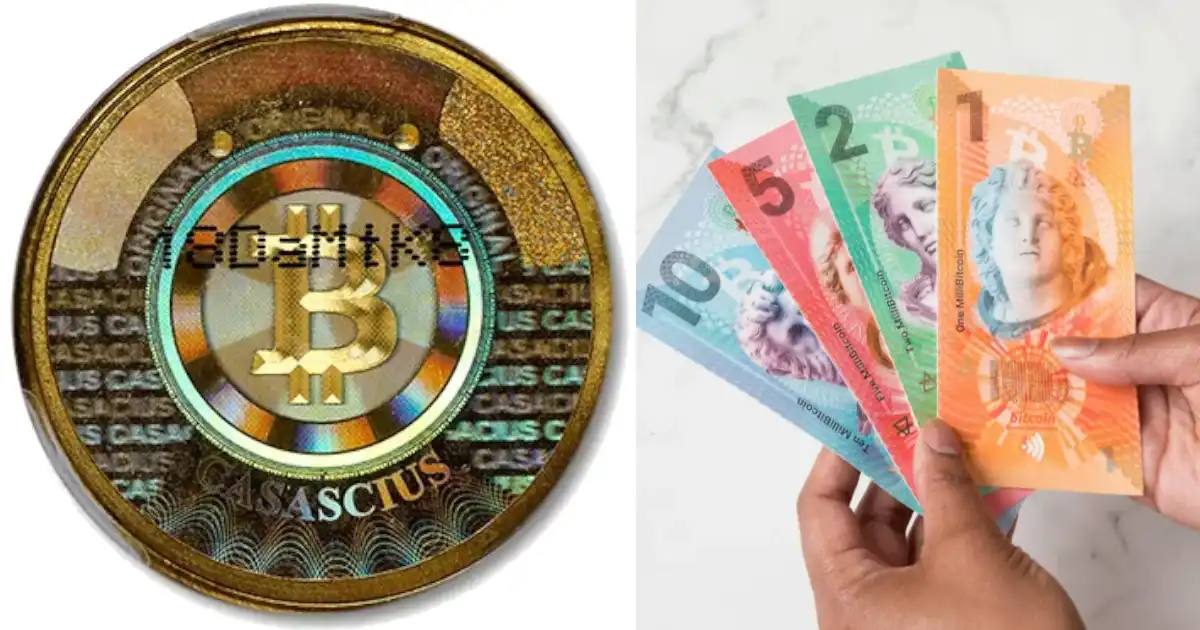
The Evolution of Physical Bitcoin Bitcoin's digital nature is its core strength, enabling self-custody and rapid global transfers. However, its intangibility also hinders mainstream adoption. For over a decade, creators have attempted to materialize Bitcoin while preserving its cash-like properties, yielding notable results. Casascius Coins, launched in 2011, were the first and most iconic physical Bitcoin. Creator Mike Caldwell generated private keys offline, printed them on coins, and sealed them with tamper-evident holograms. This model relied on user trust in the centralized issuer. Production ceased in 2013 due to regulatory pressure from FinCEN. RavenBit Coins emerged in 2014 aiming to decentralize minting by letting users generate and apply their own keys. However, this led to trust issues with numerous untrusted minters and insecure key generation methods. In 2016, Coinkite introduced Opendimes—a breakthrough in bearer asset technology. These USB-shaped devices generate and store keys internally. Funds can be received by checking the public key, but spending requires physically breaking the device to extract the private key. While innovative and open-source, its cost (~$20) and form factor limit its use for small, everyday transactions. Satochip's Satodime, a card-shaped device using similar secure chip technology, followed. It supports NFC interaction and comes in various forms. While potentially cheaper in bulk (~13€), it remains a high-security hardware wallet, not a low-cost cash substitute. A fundamental cost barrier exists. For physical Bitcoin to achieve widespread commercial use, hardware costs must drop below $1 to match the production cost of fiat banknotes. Current secure chips capable of running Bitcoin's cryptographic algorithms (like secp256k1) are too expensive. Chips like NXP's NTAG X DNA (~$3) show cost-reduction potential but lack native Bitcoin curve support. Projects like OfflineCash embed chips in banknote-like paper, but face challenges with durability, the need for custom Bitcoin-enabled chips, and the inherent requirement for users to verify balances online—which conflicts with Bitcoin's trustless ideal. Coinkite's Tapsigner, a ~$20 card with a proprietary Bitcoin NFC chip, is seen as a more practical step forward. It functions as a reloadable hardware wallet for contactless payments, solving the "change" problem and focusing on real-world retail integration, a direction also pursued by companies like Cash App and Square. In summary, the journey to physical Bitcoin has progressed from trusted centralized mints (Casascius) to user-generated keys (RavenBit) and finally to self-contained secure hardware (Opendimes, Satodime, Tapsigner). The core challenge remains developing a sufficiently low-cost, durable, and truly trustless physical bearer asset that can function like cash in daily transactions. Current solutions are either too expensive or introduce new trust assumptions, keeping the ideal of ubiquitous physical Bitcoin just out of reach for now.

marsbit1h ago

The Evolution Path of Physical Bitcoin

marsbit1h ago

Trading

Spot
Futures

Hot Articles

Discussions

Welcome to the HTX Community. Here, you can stay informed about the latest platform developments and gain access to professional market insights. Users' opinions on the price of S (S) are presented below.

活动图片