In the article published on August 13th, we concluded:
| The market consolidation is nearing its end, and a reversal only needs a reason to rise. |
A week later, that reason arrived.
The U.S. Treasury announced a bond buyback plan. BTC subsequently surged, quickly breaking through the short-term holder cost line and the 200-day moving average, and once challenged $80,000. The entire market rose sharply in sync, with technical indicators re-establishing a "bull market trend."
The market began discussing it – the bull market is back.
Following the script of the last cycle, the plot ahead seems predictable: institutional funds continue to increase holdings, ETFs see sustained net inflows, BTC leads the rally first, and then capital gradually spreads to ETH and other assets.
But we believe, this time might be different.
Just as the rally began, the market has already shown some signals diverging from the last cycle.
While BTC rebounded sharply, ETH, which was persistently bearish last cycle, actually led the gains significantly, with the ETH/BTC exchange rate rising over 10% in a single day; assets like BNB and HYPE also performed brilliantly, posting gains of approximately 20% and 42% respectively.
This differs markedly from the previous cycle's pattern where BTC stood alone.
| This time, BTC will still rise, but it might not be the biggest winner of this bull market. |
Because the industry's growth logic is shifting:
| The last bull market was about capital entering Crypto; the next bull market might be about assets entering Crypto. |
I. The last was "Capital On-chain," this round might be "Assets On-chain"
Over the past few years, the most significant change in Crypto has been the entry of traditional capital into this market.
BTC ETFs, corporate treasuries like DAT, institutional allocations... these essentially address one problem: how to get traditional capital into Crypto.
But now, another trend is unfolding.
Stablecoins, credit assets, bonds, funds, stocks... more and more traditional financial assets are being tokenized.
And recently, a concentrated release of policy signals has further fueled this trend.
The SEC's proposed Regulation Crypto establishes a clearer compliant path for token issuance and financing. As regulatory uncertainty diminishes, more capital can enter, driving project and asset creation, and further unlocking growth space on the Crypto supply side.
This has also been a key catalyst for the recent market surge.
However, a point the market easily overlooks is that Regulation Crypto is not an isolated system but should be understood within the context of "Project Crypto" promoted by SEC Chairman Paul Atkins.
Regulation Crypto primarily addresses asset issuance and financing under the Project Crypto framework; simultaneously, Project Crypto is advancing the rule-making for key on-chain market segments like trading, custody, and settlement, aiming to establish a regulatory framework better suited to the on-chain financial system, laying the institutional groundwork for the migration of traditional capital and assets on-chain.
On another front, the CLARITY Act progressing in Congress complements the digital asset classification, regulatory boundaries, and market structure from a higher level, building a clearer legal foundation for the long-term operation of on-chain markets.
Both lines are advancing simultaneously, gradually forming a genuine institutional foundation supporting on-chain capital market operations.
"Everything On-chain" is also moving from imagination to reality.
It used to be: TradFi capital → Crypto
Now it is: TradFi assets → On-chain
The two trends hold entirely different implications for the market.
If it's only capital entering Crypto, BTC is the most direct beneficiary.
But if it's a massive influx of assets into Crypto, then the real beneficiaries will become the financial infrastructure: issuance, trading, settlement, custody, lending.
This is also our core judgment for the next cycle.
II. After the Explosion in Asset Supply, Who Will Bear These Assets?
This moment is like that moment in the past.
A bull market driven by asset supply is not new to Crypto; the 2017 ICO wave was the most classic example.
What truly changed the market then was the explosion in on-chain asset supply.
Ethereum significantly lowered the barrier to on-chain asset issuance. A large number of new projects and tokens emerged, attracting users and capital to continuously enter, driving the rapid expansion of the entire Crypto market.
As the infrastructure carrying all of this at the time, ETH also became one of the most outstanding performing assets, rising 27 times, significantly outperforming BTC's 13 times during the same period.
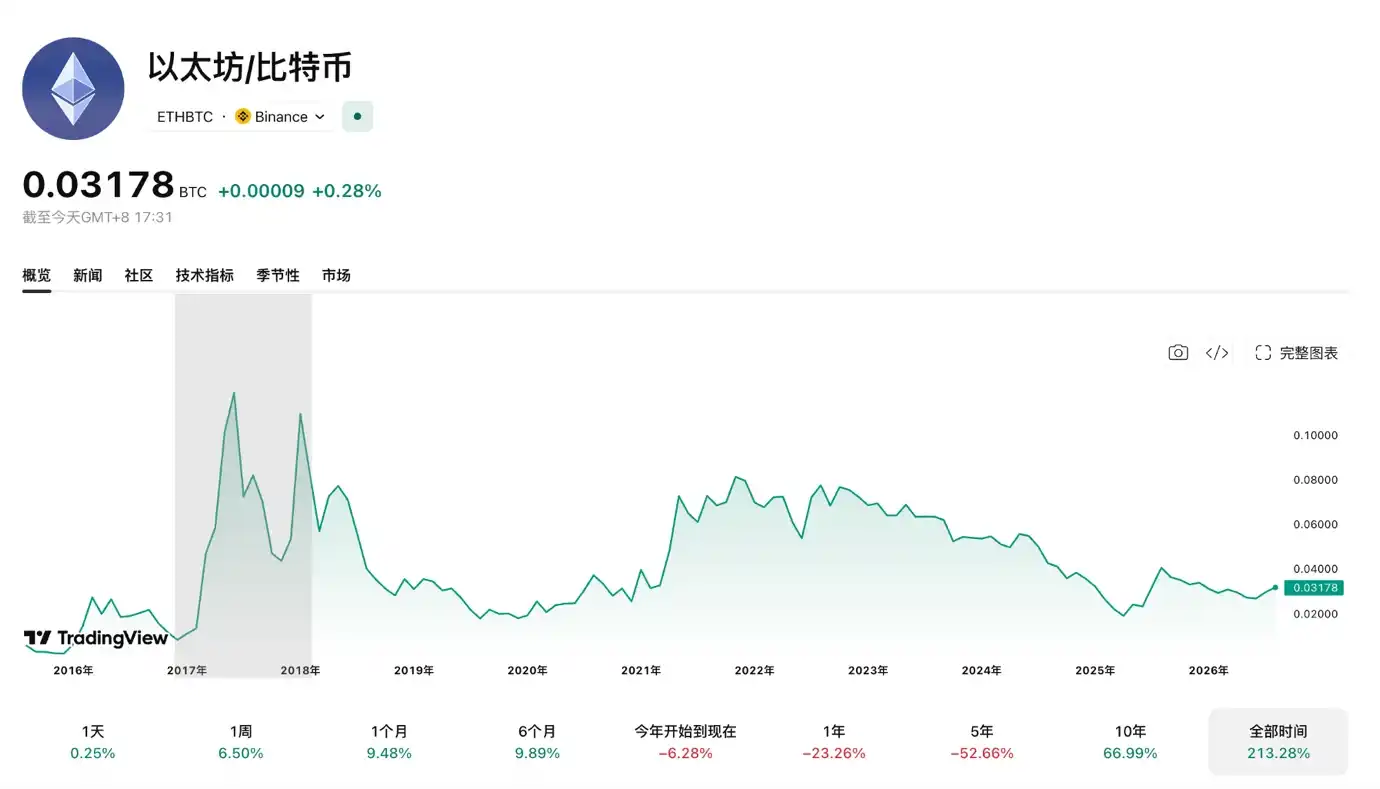
Comparison of ETH and BTC gains during the 2017 ICO cycle
Today, similar growth is re-emerging, but Everything-on-chain represents an upgrade of the ICO logic:
| The asset scale is larger, asset quality is higher, and the institutional foundation is more mature. |
This time, what's moving on-chain are no longer ICO projects of varying quality, but stocks, funds, and bonds backed by real value and demand.
Thus, the question becomes:
If trillions of dollars in assets truly come on-chain in the future, who will bear them?
This might be the most noteworthy structural opportunity in the next Crypto bull market.
Meanwhile, the industry consolidation in Crypto over the past few years has also made this competition quite different from the ICO era.
Early, fragmented infrastructure is gradually consolidating. A large number of public chains, protocols, and projects have exited the market, leaving behind only a few top ecosystems that have already established user bases, liquidity, and network effects.
So, a very interesting phenomenon might occur this time:
| Assets are increasing, but infrastructure is becoming more concentrated. |
Once demand picks up, the new flow might not be evenly distributed but is more likely to directly flow to the top-tier, battle-tested infrastructure.
III. So, Why Are We Bullish on ETH and BNB?
— ETH — Certainty
ETH remains the most mature decentralized financial infrastructure currently.
Our bullish view on ETH has only one core logic:
| If asset supply starts to explode, the most mature on-chain financial infrastructure will naturally capture the largest incremental demand. |
Ethereum hosts over 50% of global tokenized RWAs and also covers nearly half of the global stablecoin supply; its DeFi TVL exceeds $40 billion, accounting for about 44% of the entire market, eight times larger than the second-tier public chains.
More importantly, the most mature DeFi protocols like Uniswap, Aave, Lido, and Sky are also highly concentrated in the Ethereum ecosystem, meaning Ethereum still possesses the most extensive liquidity and ecosystem moat.
So, what's truly worth betting on with ETH is not a new narrative, but: a decade-old infrastructure about to welcome a new demand cycle.
— BNB — Growth Upside
If ETH represents certainty, then BNB represents growth upside.
Compared to competing in the public chain race, the BNB ecosystem has taken another path – building the most complete financial network.
If traditional financial assets truly start migrating on-chain en masse in the future, the competition focus won't just be "whose chain is better," but more importantly, who can truly connect assets, users, trading, and liquidity.
Gathering users and liquidity via a leading exchange, hosting DeFi infrastructure via a high-performance public chain, and connecting top-tier institutions through branding and ecosystem resources. Over the past two years, BNB has become one of the fastest-growing ecosystems for RWAs. Its RWA asset scale grew from about $3.6 million in early 2025 to over $5.8 billion today, becoming the largest RWA ecosystem outside of Ethereum; the number of RWA holders exceeds 1.15 million, ranking first among all ecosystems.
This year, this Web3 financial network has further extended into TradFi, with related businesses growing rapidly and ranking among the industry's top.
And these positive changes have yet to be priced in by the market.
| ETH is the certainty of on-chain financial infrastructure. BNB is the growth upside of an on-chain financial super network. |
One is ETH, long suppressed last cycle but with its core status unchanged; the other is BNB, with fundamentals continuously improving yet not fully priced in.
We believe in the new cycle, both these types of value will return to the spotlight.
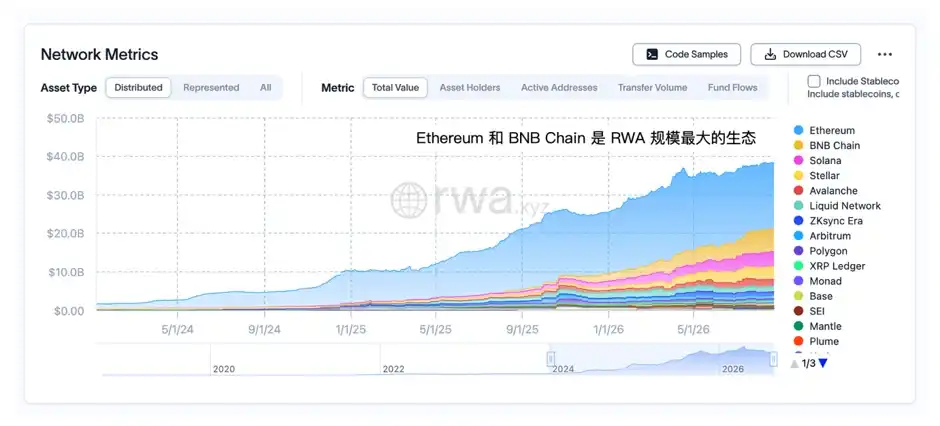
BNB Ecosystem RWA Growth Trend
IV. Robinhood is the Mirror Image of BNB in the Traditional Financial World
If "Everything On-chain" still sounds somewhat distant, look at Robinhood.
Robinhood is the most direct expression of Everything-on-chain in the traditional financial world.
It started as an internet brokerage.
Then it ventured into Crypto, explored Tokenized Stocks, and further built its own on-chain infrastructure.
What it's doing essentially is moving traditional financial assets step-by-step onto the chain.
Robinhood moves from TradFi towards on-chain; BNB moves from Crypto, extending into TradFi.
They seem to come from two entirely different worlds, but they are betting on the same underlying trend:
| Traditional finance and on-chain finance will eventually converge. |
This is why we are not only bullish on ETH and BNB but also very optimistic about Robinhood's explosive growth potential in this cycle.
V. BTC Opens the Door, Infrastructure Will Be the Destination
In this cycle, BTC will still be the most important core asset in Crypto and the most direct entry point for institutions into Crypto.
But if what truly happens in the new cycle is:
| More and more assets moving on-chain. |
Then the market's value capture method will change.
More assets mean more transactions, greater liquidity needs, and consequently, greater demand for financial infrastructure.
And after the full consolidation of the last cycle, market share across various businesses has also tended to concentrate.
Therefore, this round, we are more focused on:
ETH – Certainty
BNB – Upside
Robinhood – Representative of traditional finance moving on-chain
Our core judgment is also very clear:
| In the last round, BTC brought Crypto into traditional finance. In the next round, we look forward to traditional finance bringing the entire world of assets into Crypto. |
BTC is still important.
But in the next round, infrastructure might be the protagonist.