Trump's Bank Arrives: 49% Goes to Middle East Royalty, 38% Belongs to President's Family

marsbitPublished on 2026-08-28Last updated on 2026-08-28

Abstract

The U.S. Office of the Comptroller of the Currency (OCC) has granted preliminary conditional approval to World Liberty Financial to establish a national trust bank for its USD1 stablecoin. Major ownership of the bank's holding company reveals Sheikh Tahnoon bin Zayed al Nahyan, a senior UAE official and national security advisor, holds 49% through an investment vehicle, while entities linked to the Trump family hold 38%. This mirrors a prior $500 million investment by the sheikh into World Liberty, which reportedly channeled $263 million to Trump-linked entities. The bank would allow World Liberty to directly custody USD1's dollar reserves (currently $4 billion) and keep all interest income, estimated at $150 million annually, rather than sharing it with a third-party custodian. This move was enabled by the 2025 "Genius Act," signed by the president, which permits approved stablecoin issuers to self-custody reserves. The approval process, overseen by a Trump-appointed OCC head, has drawn scrutiny due to the unprecedented foreign and presidential family stakes in a federally chartered bank poised to manage significant U.S. Treasury investments.

Earlier this month, the U.S. Office of the Comptroller of the Currency (OCC) granted World Liberty Financial preliminary conditional approval to establish a federally chartered national trust bank to issue, redeem, and custody USD1, the dollar-backed stablecoin it launched last year.

The Wall Street Journal disclosed the ownership structure behind this bank on Thursday.
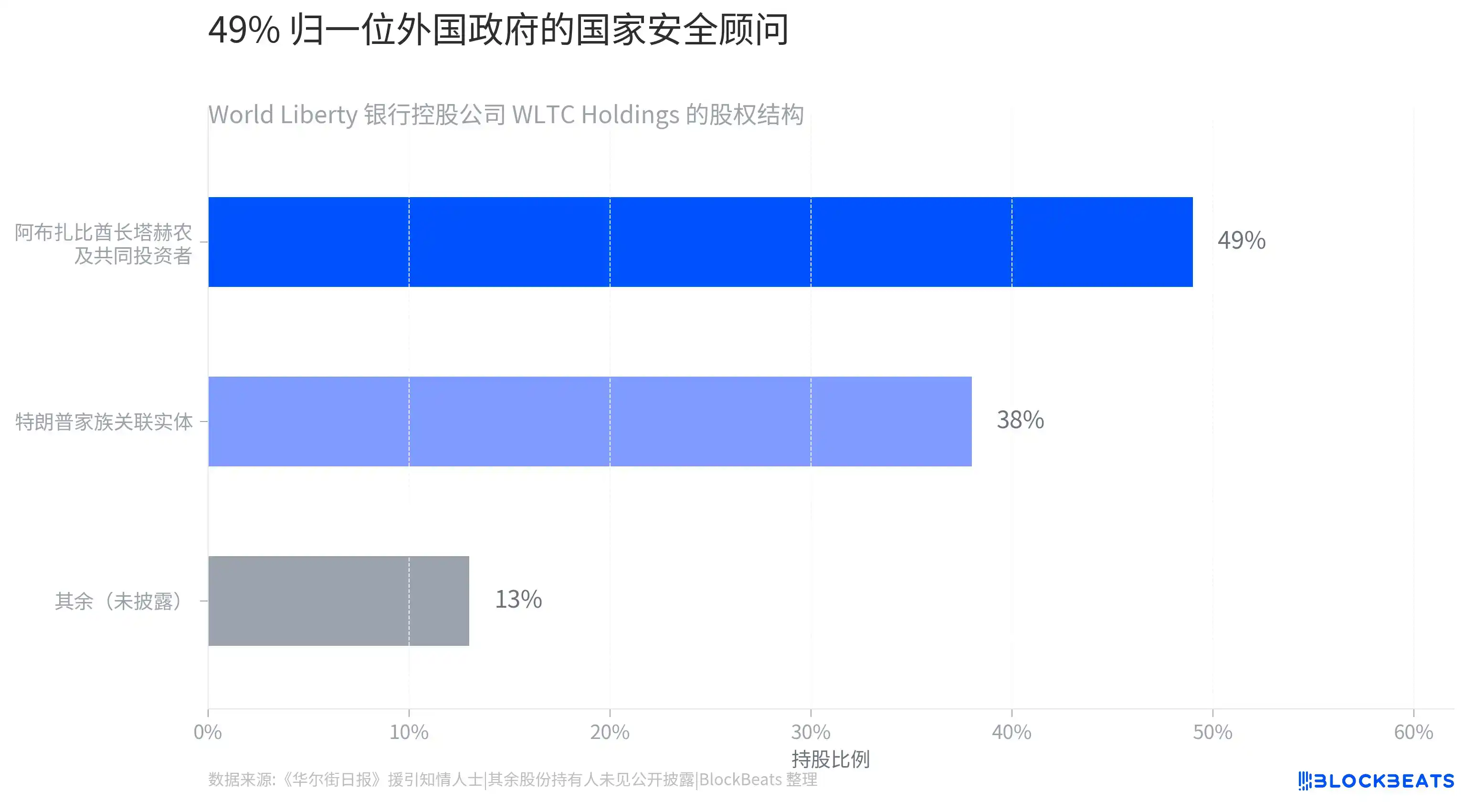
The largest shareholder is Sheikh Tahnoon bin Zayed al Nahyan, a member of the Abu Dhabi royal family, and his co-investors. Through an entity called StringZ Holding RSC, they hold 49% of the bank's holding company, WLTC Holdings.

Entities linked to the Trump family hold 38%.

Who is Tahnoon? He is the National Security Advisor of the United Arab Emirates and a brother of the country's President. He oversees a financial empire exceeding $1.3 trillion, with funds coming from both his personal wealth and state coffers. In Western media reports, he is sometimes referred to as the "Spy Sheikh."

This Isn't His First Appearance on This Chain

In January 2025, four days before Trump's inauguration, Tahnoon and co-investors invested $500 million into World Liberty Financial through an entity called Aryam Investment 1, acquiring a 49% stake in the company. That deal was not disclosed at the time and was only exposed by The Wall Street Journal this January.

According to the President's latest financial disclosure, $263 million of that money flowed to Trump family entities.

Democratic lawmakers and legal experts criticized it directly at the time: a senior foreign government official holding significant ownership in a company belonging to a U.S. President-elect was unprecedented.

Now, the same 49% appears in an institution about to receive a U.S. federal bank charter. The shareholder structure of the bank holding company is the same as that of World Liberty itself, except Tahnoon's side uses a different entity to hold the shares.

What Exactly Will This Bank Do?

It is not a traditional bank; a trust charter generally does not allow taking deposits or making loans. What it can do is: hold assets for clients nationwide and facilitate faster payment settlements.

Specifically for World Liberty, this charter allows it to issue USD1 directly and custody the dollar assets backing the stablecoin itself. These two tasks are currently handled by partner BitGo, an independent trust bank that holds USD1's reserves and keeps a portion of the interest.

This is the core of the business.

USD1 currently has a market capitalization of $4 billion. World Liberty states that the dollars backing it are invested in U.S. Treasury bonds and other cash equivalents, generating an estimated $150 million in interest annually.

Previously, this interest had to be shared with BitGo. With its own bank, it won't.

And the logic is self-reinforcing: the more USD1 in circulation, the larger the reserves, the greater the interest income. Therefore, World Liberty says the mission of this trust bank is to drive the "mainstream adoption" of USD1 while offering new services to customers, such as charging fees to custody their cryptocurrency.

After the OCC approval, World Liberty CEO Zach Witkoff said the company's ambition is "to build the most trusted and widely used digital dollar in the world." He is the son of Steve Witkoff, the U.S. Middle East envoy.

The Legal Gateway for This Charter Was Signed by the President Himself

World Liberty only began the process of setting up the bank after July 2025, the month the President signed the Genius Act.

This law did one key thing: it allowed approved stablecoin companies to directly hold the reserve assets backing their tokens.

Before this, World Liberty had to rely on a third party like BitGo. After this, it can do it itself, as long as it obtains a federal charter. It applied in January of this year and received preliminary conditional approval on August 14.

The Genius Act also stipulates that U.S.-issued dollar-pegged stablecoins must be backed by specific assets, including U.S. Treasury securities maturing in 93 days or less. Treasury Secretary Besant previously cited a prediction that stablecoins could grow into a market approaching $4 trillion and has written that "this could lower the government's borrowing costs."

In other words, the stablecoin track has clear fiscal significance for this administration; it creates new buyers for U.S. Treasury debt. And one of the companies running furthest ahead on this track belongs to the President's family.

The Same Regulator, Several Other Decisions This Summer

The OCC has approved a series of national bank charters for crypto companies in recent months, with Ripple and Circle both receiving preliminary approvals. The current Comptroller, Jonathan Gould, was appointed by Trump last year.

But there were also rejections.

In early August, the OCC rejected Dutch fintech company Bunq's application for a national bank charter, citing significant regulatory and compliance concerns. In mid-August, Zerohash, which provides crypto infrastructure for Morgan Stanley's E*Trade, had its trust bank application returned, citing material deficiencies; it subsequently resubmitted with a narrower business scope, with a public comment period ending September 17.

Regarding World Liberty's application, the OCC's letter stated: "This preliminary conditional approval is based on a comprehensive evaluation of all information available to the OCC, including statements and commitments made in the application and by representatives of the bank." Final approval is contingent on meeting a series of "pre-opening requirements" and passing a final examination.

A World Liberty spokesperson said OCC career staff reviewed the application "for compliance with statutory, regulatory, and policy requirements and factors governing bank approvals." The company did not comment on the shareholder structure behind its bank.

An OCC official said application reviews are handled by career staff and that the agency "consulted with multiple experienced career government ethics officials" to ensure the process "complies with all government ethics standards and policies."

There's Another Sum of Money

Tahnoon's $500 million is not the only controversial funding entering this company.

Earlier this month, The New York Times reported that a businessman named Guren "Bobby" Zhou invested a total of $100 million into World Liberty through a new company called Aqua 1, becoming one of the largest buyers of the company's tokens.

Two years ago, he was a failed hardwood flooring retailer in the UK, under investigation for money laundering there, and presided over the collapse of a small crypto startup.

Under World Liberty's policy, up to $75 million of that money was allocated to a company controlled by the President and his three sons, while also benefiting the Witkoff family.

On July 19, the day of the World Cup final, Zhou and Zach Witkoff sat together in a luxury box at the stadium in New Jersey.

What Remains to Be Seen

The bank has not yet opened. It must first meet the conditions set by the OCC and pass a final examination.

What is already certain is: if it opens, an institution 49% owned by a senior foreign government official and 38% owned by the President's family will hold the full reserves of a dollar stablecoin, invest them into U.S. Treasury bonds, and take all the interest.

Trending Cryptos

Related Questions

QWhat is the primary function of the federal trust bank charter granted to World Liberty Financial, and what key business advantage does it provide?

AThe primary function is to allow World Liberty Financial to directly issue, redeem, and custody its USD1 stablecoin. The key business advantage is that it allows the company to hold the reserve assets backing the stablecoin itself, eliminating the need to share the interest income from those reserves with a third-party custodian like BitGo.

QWho are the major owners of the bank holding company (WLTC Holdings) behind World Liberty Financial, and what percentage does each control?

ASheikh Tahnoon bin Zayed al Nahyan of Abu Dhabi and his co-investors, through StringZ Holding RSC, own 49% of WLTC Holdings. Entities linked to the Trump family own 38%.

QHow did the 'Genius Act,' signed by President Trump, create a legal pathway for World Liberty Financial to establish its own trust bank?

AThe Genius Act, signed in July 2025, allowed approved stablecoin companies to directly hold the reserve assets backing their tokens. This removed the legal requirement for a third-party custodian, enabling World Liberty to seek its own federal trust bank charter to perform this function in-house.

QWhat controversy surrounded the initial $500 million investment in World Liberty Financial by Sheikh Tahnoon bin Zayed al Nahyan in January 2025?

AThe controversy centered on the unprecedented nature of a senior foreign government official holding significant ownership in a company controlled by an incoming U.S. President (then President-elect Trump). Critics argued it created a major conflict of interest, with $263 million of that investment flowing to Trump-family entities.

QWhat is one additional source of controversial funding mentioned in the article that flowed into World Liberty Financial, and who benefited from it?

ABusinessman Guren 'Bobby' Zhou invested $100 million through Aqua 1. Up to $75 million of that was allocated to a company controlled by the then President and his three sons, and also benefited the Witkoff family (the CEO's family).

Related Reads

Not Just Trading and Meme: These 5 Projects on Base Are Exploring New On-Chain Use Cases

Beyond Trading and Memes: 5 Projects Exploring New On-Chain Use Cases on Base While much of the crypto space is dominated by speculation, Base—Coinbase's Ethereum Layer 2 with over $5B TVL—is fostering innovative projects beyond the usual categories. Here are five notable examples: 1. **Hydrex**: A MetaDEX/AMM aggregator that pools native and external liquidity (e.g., from Uniswap, Morpho) to offer optimal swap rates. It features a ve(3,3)-style incentive model and single-signature transactions. 2. **SwapRoyale**: A fantasy trading competition app where users pay a fixed entry fee to trade with a virtual $100k portfolio in real-time contests. It gamifies trading with various tournament formats and has already distributed over $100k in prizes. 3. **BlockRun**: A permissionless AI gateway and payment layer for the on-chain agent economy. It allows autonomous systems to discover, pay for, and execute services using USDC on Base via the x402 micropayment standard, enabling pay-per-use AI. 4. **PixieChess**: A play-to-earn digital chess game where each piece is a collectible NFT with unique abilities that alter classic rules. Value is kept within the ecosystem, with a treasury funding real ETH prizes for winners. 5. **Tokensto**: A platform that lets users sell their unused AI API credits (e.g., from OpenRouter) for cash. It automatically prices credits and facilitates direct payouts to crypto wallets. These projects demonstrate that builders on Base are actively experimenting with consumer experiences, the agent economy, and novel gaming mechanics, suggesting the surface area for meaningful on-chain activity is broader than current narratives imply.

marsbit12m ago

Not Just Trading and Meme: These 5 Projects on Base Are Exploring New On-Chain Use Cases

marsbit12m ago

Trading

Spot

Hot Articles

What is $BANK

Bank AI: A Revolutionary Step in the Future of Banking Introduction In an era marked by rapid advancements in technology, Bank AI stands at the intersection of artificial intelligence (AI) and banking services. This innovative project seeks to redefine the financial landscape, enhancing operational efficiency, security measures, and customer experiences through the power of AI. As we embark on this exploration of Bank AI, we will delve into what the project entails, its operational dynamics, its historical context, and significant milestones. What is Bank AI? At its core, Bank AI represents a transformative initiative aimed at integrating artificial intelligence into various banking operations. This project harnesses the capabilities of AI to automate processes, improve risk management protocols, and enhance customer interaction through personalized services. The primary objectives of Bank AI include: Automation of Banking Functions: By leveraging AI technologies, Bank AI aims to automate routine tasks, reducing the burden on human resources and enhancing efficiency. Enhanced Risk Management: The project utilises AI algorithms to predict and identify risks, thereby fortifying security measures against fraud and other threats. Personalization of Banking Services: Bank AI focuses on offering tailored financial products and services by analysing customer data and behaviours. Improving Customer Experience: The implementation of AI-driven solutions, such as chatbots and virtual assistants, aims to provide users with more human-like interactions, revolutionising the way customers engage with banks. With these goals, Bank AI positions itself as a crucial player in rendering banking more efficient, secure, and user-centric. Who is the Creator of Bank AI? Details regarding the creator of Bank AI remain unknown. As such, no specific individual or organisation has been identified in the available information. The anonymity surrounding the project's inception raises questions but does not detract from its ambitious vision and objectives. Who are the Investors of Bank AI? Similar to the project's creator, specific information regarding the investors or supporting organisations of Bank AI has not been disclosed. Without this information, it is challenging to outline the financial backing and institutional support that might be propelling the project forward. Nevertheless, the importance of having a robust investment foundation is pivotal for sustaining development in such an innovative field. How Does Bank AI Work? Bank AI operates on several innovative fronts, focusing on unique factors that differentiate it from traditional banking frameworks. Below are key operational features: Automation: By applying machine learning algorithms, Bank AI automates various manual processes within banks. This results in reduced operational costs and allows human workers to redirect their efforts towards more strategic activities. Advanced Risk Management: The integration of AI into risk management practices equips banks with tools to accurately predict potential threats such as fraud, ensuring that customer information and assets remain secure. Tailored Financial Recommendations: Through continuous learning from customer interactions, the AI systems develop a nuanced understanding of user needs, enabling them to offer tailored advice on financial decisions. Enhanced Customer Interactions: Utilizing chatbots and virtual assistants powered by AI, Bank AI enables a more engaging customer experience, allowing users to have their queries resolved quickly, thus reducing wait times and improving satisfaction levels. Together, these operational features position Bank AI as a pioneer in the banking sector, establishing new benchmarks for service delivery and operational excellence. Timeline of Bank AI Understanding the trajectory of Bank AI requires a look at its historical context. Below is a timeline highlighting important milestones and developments: Early 2010s: The conceptualization of AI integration into banking services began to gain attention as banking institutions recognised the potential benefits. 2018: A marked increase in the implementation of AI technologies occurred when banks started using AI tools like chatbots for basic customer service and risk management systems for improved security handling. 2023: The sophistication of AI continued to advance, with generative AI being introduced for more complex tasks such as document processing and real-time investment analysis. This year marked a significant leap in the capabilities afforded to banks by AI technology. 2024-Current Status: As of this year, Bank AI is on an upward trajectory, with ongoing research and developments poised to further enhance capabilities in banking operations. Continued exploration of AI applications hints at exciting developments yet to come. Key Points About Bank AI Integration of AI in Banking: Bank AI focuses on adopting artificial intelligence to streamline banking processes and improve user experiences. Automation and Risk Management Focus: The project strongly emphasizes these areas, aiming to shift the burden of routine tasks while enhancing security frameworks through predictive analytics. Personalized Banking Solutions: By harnessing customer data, Bank AI enables tailored banking services that cater to individual user needs. Commitment to Development: Bank AI remains committed to ongoing research and development efforts, ensuring its adaptability and ongoing relevance as technology continues to evolve. Conclusion In summary, Bank AI exemplifies a crucial step forward in the banking industry, leveraging artificial intelligence to reshape operational paradigms, enhance security, and promote customer satisfaction. Despite gaps in information surrounding the creator and investors, the clear objectives and functional mechanisms of Bank AI provide a strong foundation for its ongoing evolution. As AI technology continues to advance and merge with the banking sector, Bank AI is well-positioned to significantly impact the future of financial services, enhancing the way we understand and interact with banking.

1.9k Total ViewsPublished 2024.04.05Updated 2024.12.03

What is $BANK

How to Buy BANK

Welcome to HTX.com! We've made purchasing Lorenzo Protocol (BANK) simple and convenient. Follow our step-by-step guide to embark on your crypto journey.Step 1: Create Your HTX AccountUse your email or phone number to sign up for a free account on HTX. Experience a hassle-free registration journey and unlock all features.Get My AccountStep 2: Go to Buy Crypto and Choose Your Payment MethodCredit/Debit Card: Use your Visa or Mastercard to buy Lorenzo Protocol (BANK) instantly.Balance: Use funds from your HTX account balance to trade seamlessly.Third Parties: We've added popular payment methods such as Google Pay and Apple Pay to enhance convenience.P2P: Trade directly with other users on HTX.Over-the-Counter (OTC): We offer tailor-made services and competitive exchange rates for traders.Step 3: Store Your Lorenzo Protocol (BANK)After purchasing your Lorenzo Protocol (BANK), store it in your HTX account. Alternatively, you can send it elsewhere via blockchain transfer or use it to trade other cryptocurrencies.Step 4: Trade Lorenzo Protocol (BANK)Easily trade Lorenzo Protocol (BANK) on HTX's spot market. Simply access your account, select your trading pair, execute your trades, and monitor in real-time. We offer a user-friendly experience for both beginners and seasoned traders.

7.0k Total ViewsPublished 2025.05.09Updated 2026.06.02

How to Buy BANK

Discussions

Welcome to the HTX Community. Here, you can stay informed about the latest platform developments and gain access to professional market insights. Users' opinions on the price of BANK (BANK) are presented below.

活动图片