Has Wall Street Co-Opted Bitcoin? Bloomberg Expert Sparks Heated Debate

bitcoinistPublished on 2026-02-24Last updated on 2026-02-24

Abstract

Bloomberg ETF analyst Eric Balchunas sparked a debate on whether Bitcoin's core value as "debasement-resistant and censorship-resistant money" remains valid despite institutional adoption and high volatility. He argued that Bitcoin’s fundamental properties haven’t changed—only the intermediaries have improved. Critics, including Oliver Renick, countered that Bitcoin’s extreme volatility makes it impractical as sound money, effectively causing repeated "debasement events." Balchunas acknowledged volatility as a sign of youth but emphasized long-term dilution resistance. The discussion highlighted a key divide: whether institutional involvement undermines Bitcoin’s original ethos or simply provides safer access.

A thread sparked by Bloomberg ETF analyst Eric Balchunas reignited one of crypto’s oldest arguments: whether Bitcoin’s core value proposition has been diluted as institutional intermediaries take center stage. What began as a reflection on crypto’s real-world utility quickly turned into a pointed dispute over whether BTC can credibly be called “debasement-resistant” while it remains wildly volatile.

Bitcoin Identity Debate Explodes on X

Balchunas weighed in after Cooper Turley, founder of Coop Records, posted that crypto feels “in the weirdest spot” since 2017 and that beyond speculation it’s “hard to see how it adds meaningful value to people’s lives.” Balchunas’ response framed Bitcoin’s novelty less as a product category and more as a monetary property set.

“Seeing this a lot. My two cents: the novel value of bitcoin is that it is user-run money that is both censorship and debasement-resistant,” Balchunas wrote. “Far as I can tell nothing has changed about that. However bc the current admin is so on board with it, the censorship part may seem less valuable, but just wait a few yrs, that could come in handy (it already does in many emerging/frontier mkt countries).. and debasement is alive and well, even dogs know that ain’t ever stopping.”

He argued that Bitcoin’s “youth” is a major driver of volatility, and that market price tends to hijack the narrative. “Price is a smoke screen that the most successful investors have learned to see through/ignore,” he added, extending the critique to traditional markets as well.

The “co-opted” question surfaced explicitly when Balchunas addressed long-time holders uneasy with BTC being increasingly accessed through Wall Street wrappers. His take: the asset didn’t change; the gatekeepers did.

“And for the OGs feeling like the establishment has co-opted their ‘outsider’ money.. all that really happened was the intermediaries got upgraded,” Balchunas wrote. “You went from paying high fees to SBF only for him to ‘lose’ your money to Larry Fink et al, who do same thing (outsourced your btc) but in a way that’s much cheaper and safer. Underlying btc hasn’t changed at all the whole time.”

Is Bitcoin Still A Debasement-Trade?

That framing didn’t satisfy critics who see Bitcoin’s volatility as fatal to the “debasement-resistant” label. Host of Chicago Future of Finance Oliver Renick pushed back sharply, arguing that a money that can swing the way Bitcoin does is effectively experiencing repeated “debasement events” by any practical standard.

“Debasement-resistant is biggest error here IMO,” Renick wrote. “If the dollar were down as much as btc can do on any given week, the world would go nuts, i.e, bitcoins volatility goes thru a debasement event like 3 times a year compared to the dollar where a 2% is a big deal. It’s rly bad money.”

Balchunas conceded the point partially on timeframe: “I think more longer term but it’s a fair point” but the exchange escalated when Renick questioned Bitcoin’s staying power. “And there it gets crushed again versus dollar and gold. Bitcoin may not make it to its 20th birthday, who knows,” he wrote.

Balchunas responded by pointing to recent performance as evidence that Bitcoin has “banked” substantial gains, citing “2023 and 2024” and “450%.” Renick’s rebuttal remained categorical: “Again , volatility intolerable of money.” Balchunas agreed Bitcoin is “too volatile rn to be widespread currency” and needs to “mature and settle down,” but rejected the conclusion that this reduces Bitcoin to censorship resistance alone.

“So that leaves you with just censorship resistance,” Renick wrote, suggesting that value might be far lower — “maybe $10k a coin” — before Balchunas returned to first principles: “It is debasement resistant, govt can’t dilute it- that’s true even if it is volatile.”

Balchunas closed by challenging the idea that shorter windows are dispositive, contrasting gold’s “20%” rise in “2023 + 2024” with Bitcoin’s “450%” move, and returning to the “young asset” thesis: it “gets ahead of itself then falls.”

The thread leaves a familiar fault line exposed. For Balchunas, institutional plumbing doesn’t change Bitcoin’s properties, and volatility is a maturity problem that can coexist with long-term dilution resistance. For critics, volatility isn’t a side effect, it’s the disqualifier, collapsing the “money” narrative and forcing a narrower censorship-resistance-only valuation debate.

At press time, BTC traded at $66,207.
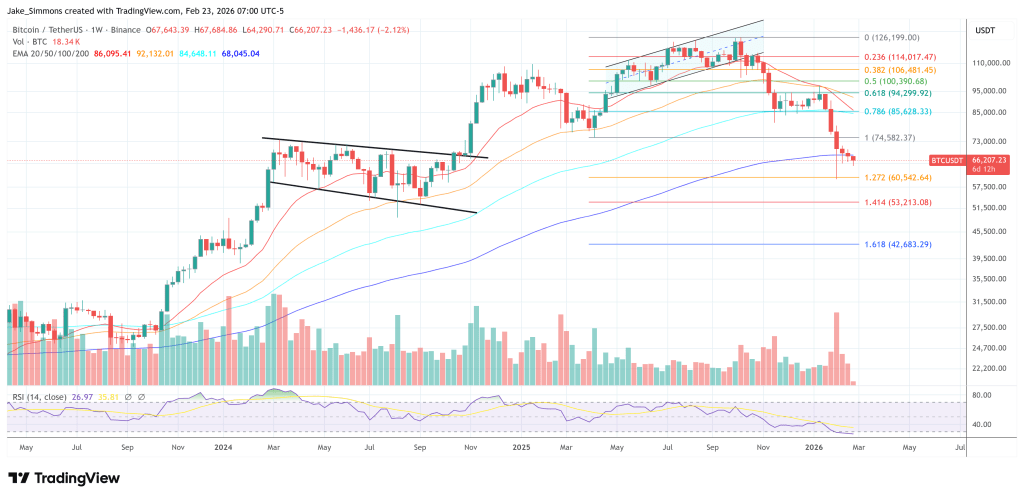
BTC must reclaim the 200-week EMA, 1-week chart | Source: BTCUSDT on TradingView.com

Related Questions

QWhat core Bitcoin value proposition did Eric Balchunas emphasize in the debate?

AEric Balchunas emphasized that Bitcoin's core value proposition is being user-run money that is both censorship-resistant and debasement-resistant.

QAccording to the article, what is the main criticism Oliver Renick raised against Bitcoin being 'debasement-resistant'?

AOliver Renick argued that Bitcoin's extreme volatility means it effectively experiences repeated 'debasement events,' making it intolerable as money compared to stable currencies like the US dollar.

QHow did Balchunas justify Bitcoin's volatility in the context of its long-term value?

ABalchunas attributed Bitcoin's volatility to its 'youth' as an asset class, stating it's a maturity problem that doesn't negate its long-term debasement resistance, and pointed to its substantial gains (e.g., 450% in 2023-2024) as evidence of value.

QWhat was Balchunas' perspective on institutional involvement (like Wall Street ETFs) changing Bitcoin's fundamental nature?

ABalchunas argued that institutional involvement only changed the intermediaries (e.g., from risky entities like SBF to safer, cheaper options like Larry Fink's BlackRock), but the underlying properties of Bitcoin itself remained unchanged.

QWhat key fault line in the Bitcoin debate does the article highlight between Balchunas and his critics?

AThe fault line is whether Bitcoin's volatility disqualifies it as 'debasement-resistant money' (critics' view) or whether volatility is merely a temporary maturity issue coexisting with long-term dilution resistance (Balchunas' view).

Related Reads

Agents Take Over Traffic Distribution Power: What Are Tencent, ByteDance, and Alibaba Competing For?

In the race to dominate the AI era's entry point, China's tech giants—Tencent, ByteDance, and Alibaba—are aggressively deploying AI Agents to control the future of traffic distribution. Alibaba is pursuing a dual-track "closed loop + openness" strategy. Its Qianwen app is evolving into a super-Agent integrated across its ecosystem (Taobao, Alipay, etc.) to handle complex tasks like travel planning. Concurrently, it is opening its platform to external brands (Luckin Coffee, KFC) and has launched a B2B Agent platform, "Wukong," targeting enterprise automation. Its other flagship, Quark, aims to be an "AI super search box" for information and tasks. ByteDance is executing an omnipresent "sprawl strategy." Its Doubao app boasts over 300 million monthly active users and is evolving into a default AI entry point for daily life, with plans for paid versions and e-commerce integration. Its core weapon is the Kouzi platform, a visual "AI assembly factory" for developers to build custom Agents. ByteDance is also pushing hardware integration, collaborating on AI phones and developing smart glasses to embed Doubao everywhere. Tencent is playing its long-held "ultimate card" by quietly embedding an AI Agent directly into WeChat. This Agent, accessible via a swipe, can understand user commands and automatically execute tasks by calling upon WeChat's millions of mini-programs (e.g., finding and ordering coffee). This leverages WeChat's unparalleled 1.4-billion-user ecosystem to position the app as an AI-powered "service operating system," a move that could dramatically reshape the competitive landscape. The core battleground is shifting from competing for "user screen time" to competing to be the "default execution layer" for user intent. The business model is evolving from an "attention economy" to an "intent economy," where the Agent that can most efficiently fulfill a user's need gains control over service access and token flow. This represents a fundamental change in how users connect with digital services, making the fight for the Agent入口 (entry point) a pivotal moment for redefining industry leadership in the AI age.

marsbit13m ago

Agents Take Over Traffic Distribution Power: What Are Tencent, ByteDance, and Alibaba Competing For?

marsbit13m ago

From Banning Doubao to Embracing Honor: Why Did WeChat Suddenly 'Change Its Face'?

The article explores the sudden shift in WeChat's strategy towards AI assistants from mobile phone manufacturers, transitioning from strict opposition to active collaboration. For over a year, WeChat fiercely resisted attempts by phone AI assistants (like ByteDance's Doubao in late 2025) to control its features via GUI automation ("simulated clicking"), citing security and data control concerns. This stance created a significant barrier for system-level AI integration. Now, Tencent has initiated A2A (Agent-to-Agent) partnerships with major phone brands like Honor, Xiaomi, OPPO, and vivo. This model allows a phone's system AI (e.g., Honor's YOYO) to parse a user's voice command and send a structured request directly to WeChat's own internal AI agent via secure APIs. WeChat then executes the action (e.g., sending a message) and returns the result. The article attributes Tencent's "change of face" to strategic pressure. While leading in social app usage, Tencent trails rivals like ByteDance and Alibaba in standalone AI app popularity. WeChat, with its vast mini-program ecosystem, is Tencent's key asset for an AI comeback. The upcoming WeChat AI agent aims to handle tasks like booking and payments within the app. However, phone system assistants remain the primary AI entry point for most users. The A2A collaboration allows Tencent to extend WeChat's AI reach to this crucial system layer while maintaining control over its core functions and data. For phone manufacturers, embracing A2A is a pragmatic move. The GUI route proved unviable due to WeChat's blocks. A2A offers a compliant path to integrate a vital service, enhancing their AI assistants' usefulness. It allows them to focus on developing their own AI ecosystems for other services while cooperating on WeChat access. The collaboration is framed as a mutual, strategic necessity: Tencent gains a distribution channel, and manufacturers gain a key functionality. The partnership relies on a "dual authorization" mechanism for security, requiring both user and app consent for each action. While questions about long-term data privacy practices remain, experts note A2A is more secure and compliant than GUI automation. Ultimately, this cooperation is seen as a tentative, calculated truce. Tencent's long-term goal is to make WeChat an AI-powered "service OS." Phone manufacturers aim to make their system AI the central user interface. Their paths may converge or clash in the future, but for now, the A2A deal represents the opening chapter in the battle for the AI-era user入口, driven by necessity and strategic calculus on both sides.

marsbit1h ago

From Banning Doubao to Embracing Honor: Why Did WeChat Suddenly 'Change Its Face'?

marsbit1h ago

On-Chain Figures on the Eve of Kickoff: 1.6 Billion Traded Before the World Cup Even Begins

"On-Chain Numbers on the Eve of the World Cup: $1.6 Billion Traded Before Kick-off" Analysis of on-chain markets before the 2026 FIFA World Cup reveals significant crypto integration into football. The most striking figure is the approximately **$1.6 billion** in total trading volume on the single "World Cup Winner" contract on the Polymarket prediction market platform, accumulated before a single match was played. This represents explosive growth for a sector whose annual volume surged from ~$16B in 2024 to ~$64B in 2025. The ecosystem is maturing beyond speculation. Key developments include: 1) **Infrastructure upgrades** like Polymarket's migration to native, regulated USDC stablecoin for settlements; 2) **Reliable data oracles**, such as Chainlink, being used to resolve real-world match outcomes on-chain; and 3) **Official recognition**, with FIFA appointing its first-ever "Prediction Markets" partner. Over 100 contracts now cover everything from the outright winner to individual match results and even non-sporting risks like venue relocation. This evolution marks a fundamental shift. While crypto firms are absent from FIFA's top-tier sponsor list, the technology has deeply penetrated the tournament's financial and predictive infrastructure through regulated stablecoin settlements, decentralized oracles, and new official partnership categories. The regulatory landscape remains complex and varies by jurisdiction, but on-chain markets for the World Cup are already a multi-billion-dollar reality.

marsbit2h ago

On-Chain Figures on the Eve of Kickoff: 1.6 Billion Traded Before the World Cup Even Begins

marsbit2h ago

Trading

Spot
Futures

Hot Articles

What is $BITCOIN

DIGITAL GOLD ($BITCOIN): A Comprehensive Analysis Introduction to DIGITAL GOLD ($BITCOIN) DIGITAL GOLD ($BITCOIN) is a blockchain-based project operating on the Solana network, which aims to combine the characteristics of traditional precious metals with the innovation of decentralized technologies. While it shares a name with Bitcoin, often referred to as “digital gold” due to its perception as a store of value, DIGITAL GOLD is a separate token designed to create a unique ecosystem within the Web3 landscape. Its goal is to position itself as a viable alternative digital asset, although specifics regarding its applications and functionalities are still developing. What is DIGITAL GOLD ($BITCOIN)? DIGITAL GOLD ($BITCOIN) is a cryptocurrency token explicitly designed for use on the Solana blockchain. In contrast to Bitcoin, which provides a widely recognized value storage role, this token appears to focus on broader applications and characteristics. Notable aspects include: Blockchain Infrastructure: The token is built on the Solana blockchain, known for its capacity to handle high-speed and low-cost transactions. Supply Dynamics: DIGITAL GOLD has a maximum supply capped at 100 quadrillion tokens (100P $BITCOIN), although details regarding its circulating supply are currently undisclosed. Utility: While precise functionalities are not explicitly outlined, there are indications that the token could be utilized for various applications, potentially involving decentralized applications (dApps) or asset tokenization strategies. Who is the Creator of DIGITAL GOLD ($BITCOIN)? At present, the identity of the creators and development team behind DIGITAL GOLD ($BITCOIN) remains unknown. This situation is typical among many innovative projects within the blockchain space, particularly those aligning with decentralized finance and meme coin phenomena. While such anonymity may foster a community-driven culture, it intensifies concerns about governance and accountability. Who are the Investors of DIGITAL GOLD ($BITCOIN)? The available information indicates that DIGITAL GOLD ($BITCOIN) does not have any known institutional backers or prominent venture capital investments. The project seems to operate on a peer-to-peer model focused on community support and adoption rather than traditional funding routes. Its activity and liquidity are primarily situated on decentralized exchanges (DEXs), such as PumpSwap, rather than established centralized trading platforms, further highlighting its grassroots approach. How DIGITAL GOLD ($BITCOIN) Works The operational mechanics of DIGITAL GOLD ($BITCOIN) can be elaborated on based on its blockchain design and network attributes: Consensus Mechanism: By leveraging Solana’s unique proof-of-history (PoH) combined with a proof-of-stake (PoS) model, the project ensures efficient transaction validation contributing to the network's high performance. Tokenomics: While specific deflationary mechanisms have not been extensively detailed, the vast maximum token supply implies that it may cater to microtransactions or niche use cases that are still to be defined. Interoperability: There exists the potential for integration with Solana’s broader ecosystem, including various decentralized finance (DeFi) platforms. However, the details regarding specific integrations remain unspecified. Timeline of Key Events Here is a timeline that highlights significant milestones concerning DIGITAL GOLD ($BITCOIN): 2023: The initial deployment of the token occurs on the Solana blockchain, marked by its contract address. 2024: DIGITAL GOLD gains visibility as it becomes available for trading on decentralized exchanges like PumpSwap, allowing users to trade it against SOL. 2025: The project witnesses sporadic trading activity and potential interest in community-led engagements, although no noteworthy partnerships or technical advancements have been documented as of yet. Critical Analysis Strengths Scalability: The underlying Solana infrastructure supports high transaction volumes, which could enhance the utility of $BITCOIN in various transaction scenarios. Accessibility: The potential low trading price per token could attract retail investors, facilitating wider participation due to fractional ownership opportunities. Risks Lack of Transparency: The absence of publicly known backers, developers, or an audit process may yield skepticism regarding the project's sustainability and trustworthiness. Market Volatility: The trading activity is heavily reliant on speculative behavior, which can result in significant price volatility and uncertainty for investors. Conclusion DIGITAL GOLD ($BITCOIN) emerges as an intriguing yet ambiguous project within the rapidly evolving Solana ecosystem. While it attempts to leverage the “digital gold” narrative, its departure from Bitcoin's established role as a store of value underscores the need for a clearer differentiation of its intended utility and governance structure. Future acceptance and adoption will likely depend on addressing the current opacity and defining its operational and economic strategies more explicitly. Note: This report encompasses synthesised information available as of October 2023, and developments may have transpired beyond the research period.

363 Total ViewsPublished 2025.05.13Updated 2025.05.13

What is $BITCOIN

Discussions

Welcome to the HTX Community. Here, you can stay informed about the latest platform developments and gain access to professional market insights. Users' opinions on the price of BTC (BTC) are presented below.

活动图片