Grayscale: Ethereum's Staking Model Needs a Revamp

marsbitPublished on 2026-05-13Last updated on 2026-05-13

Abstract

The article discusses potential changes to Ethereum's staking reward model, highlighting two structural issues. First, the shift of activity to Layer 2 networks is reducing transaction fees and token burns on the mainnet, leading to an increase in ETH's net issuance. Second, with withdrawals enabled and the rise of liquid staking tokens (LSTs) and exchange-traded products (ETPs), the friction cost for staking has nearly vanished. This could eventually lead to almost all ETH being staked, which may cause unnecessary dilution and centralization risks. To address this, the Ethereum community is considering a model that caps rewards beyond a certain staking threshold, discouraging excessive staking. Grayscale argues this change would be beneficial for ETH's long-term price by controlling inflation, reducing tail risks, and strengthening ETH's narrative as a store of value. It notes that ETH's price volatility has a much greater impact on returns than staking yields, which are currently around 3% annually.

Author: Zach Pandl, Head of Research, Grayscale

Compiled by: Deep Tide TechFlow

Deep Tide Guide: Zach Pandl, Head of Research at Grayscale, writes that Ethereum's current staking reward model faces two structural problems: L2 scaling is reducing token burn and increasing net issuance; staking friction is approaching zero, potentially locking nearly all ETH into staking. The community is discussing implementing a cap on staking rewards, which Grayscale believes would be beneficial for ETH's price in the long term.

The Ethereum community is considering revising the network's staking reward model, with the core idea being to only incentivize staking up to a certain ratio, with no additional rewards beyond that. If implemented, nominal returns for stakers would decrease. However, Grayscale argues this would be positive for ETH's price long-term for two reasons: controlling ETH inflation and strengthening ETH's narrative as a store-of-value asset.

The discussion for this reform is driven by two overlapping issues.

Diminished Token Burn, Rising Net Issuance

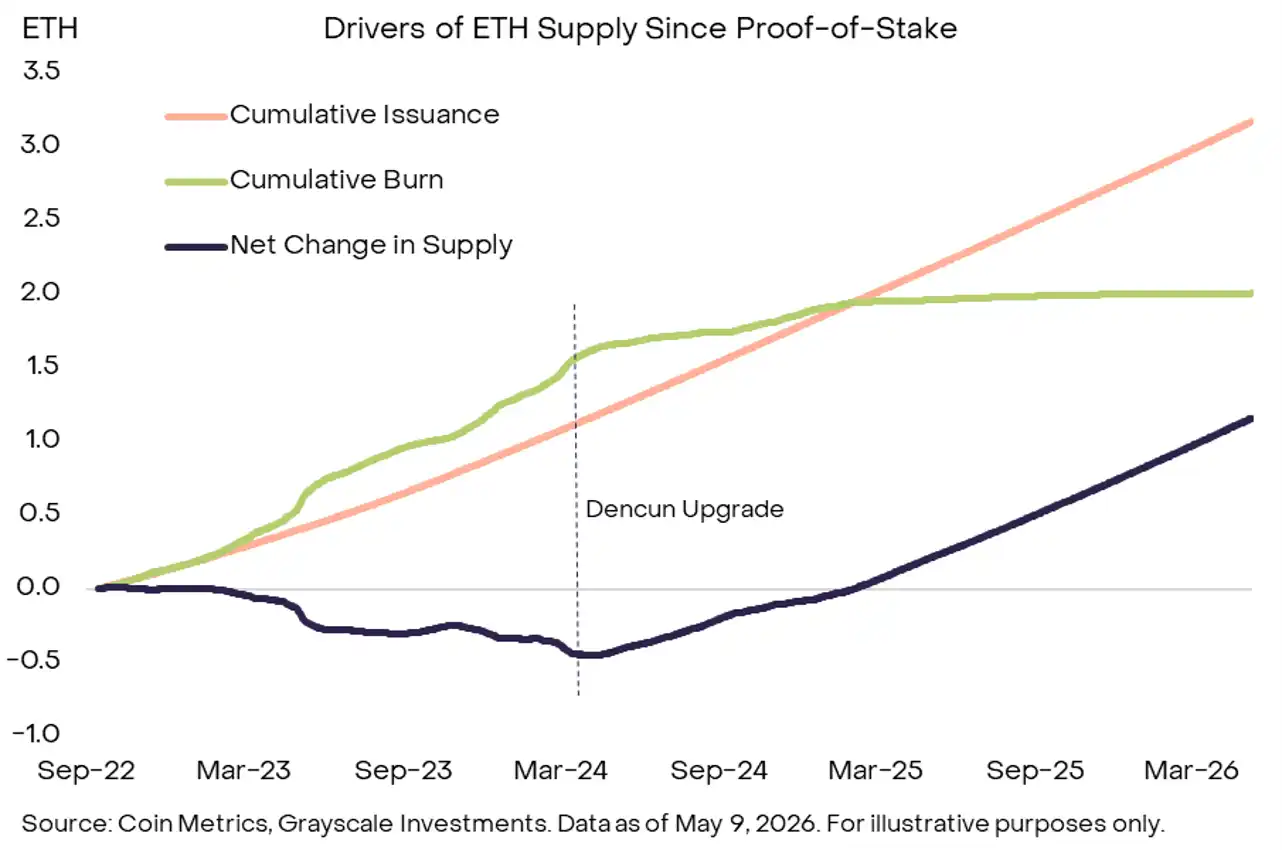
ETH's supply depends on the difference between new issuance and token burn. Currently, Ethereum L1 burns all base transaction fees. High fees mean more ETH is burned, suppressing supply growth.

Changes over the past few years have disrupted this balance. As more activity migrates to L2 networks, L1 transaction fees and token burns decrease, leading to a rise in net issuance.

Caption: Exhibit 1 – Drivers of ETH supply changes since PoS. After the Dencun upgrade, cumulative burn (green line) flattened, while cumulative issuance (orange line) continued to rise, causing ETH's net supply change (dark line) to turn positive from negative. Source: Coin Metrics, Grayscale Investments, data as of May 9, 2026

Compounding this issue, Ethereum L1 is now actively choosing to scale to compete with high-throughput chains like Solana. Pandl states directly: L1 transaction fees are likely to remain low for the foreseeable future, token burns will continue to decline, and net supply growth will expand further.

Staking Friction Costs Are Almost Zero

When Ethereum first launched staking, users could not withdraw assets; staked ETH was locked, illiquid, and thus carried a risk premium. Now that withdrawals are enabled, liquidity has greatly improved, and that risk premium has evaporated.

More critically, Liquid Staking Tokens (LSTs), Exchange-Traded Products (ETPs), and corporate ETH treasuries have entered the staking arena. The marginal cost of staking ETH is now close to zero. As long as the network continues to provide marginal rewards to stakers, nearly all ETH could eventually end up staked.

Staking is a necessary condition for the Ethereum protocol to function properly, but an excessively high staking ratio can be counterproductive.

Two risks. First, unnecessary dilution. Rising net issuance without substantially improving network security is like a country overspending on defense with no benefit to national security. Second, the tail risk of centralization where a few institutions dominate staking activity. This possibility exists due to network effects among service providers.

Implementing a Capped Staking Reward Curve

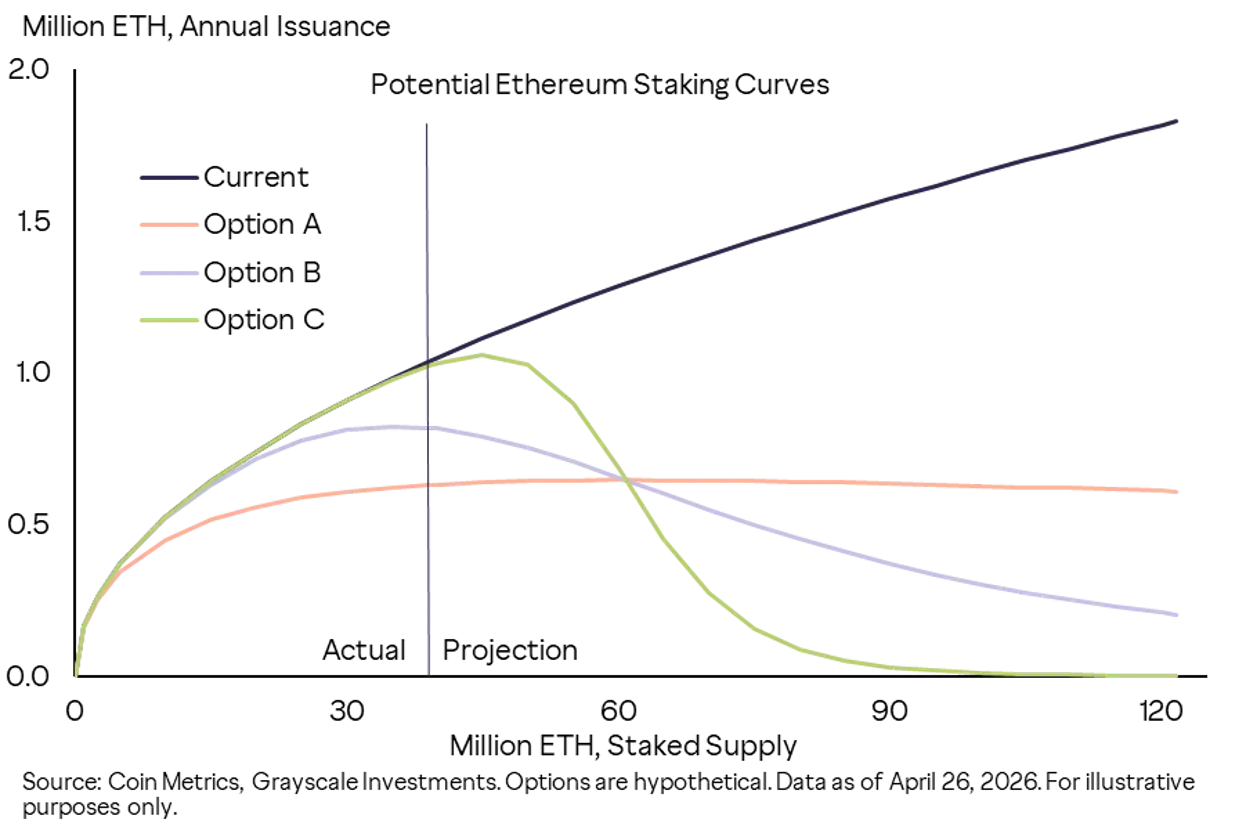
One proposed solution is to transition to a reward model that only incentivizes staking up to a certain level.

Caption: Exhibit 2 – Potential alternative staking reward curves for Ethereum. Under the current model (dark line), annualized issuance grows linearly with stake; Options A/B/C set caps or inflection points at different staking levels, causing issuance to flatten or even decline after the staking ratio exceeds a certain threshold. Source: Coin Metrics, Grayscale Investments, data as of April 26, 2026, options are hypothetical.

Grayscale believes such a change would be favorable for ETH's market value in the long term. ETH is a functionally useful commodity, not a financial claim like stocks or bonds, and should not be priced based solely on cash flows. Updating the staking reward model would reduce supply growth and enhance ETH's scarcity. For commodities, production cuts are price-positive; the same logic applies to ETH.

Reducing network tail risks, controlling long-term inflation, and it could also boost demand for unstaked ETH as a digital store-of-value asset.

There's another easily overlooked perspective: the impact of ETH's price volatility on investment returns far outweighs staking rewards. The current ~3% annualized staking yield is roughly equivalent to ETH's daily price volatility (annualized volatility over the past 360 days is ~60%, implying a daily volatility of ~3%).

Conclusion: Ethereum may revise its staking reward model to control long-term supply growth and reduce specific tail risks. If implemented, Grayscale believes this would be bullish for ETH's price.

Trending Cryptos

Related Questions

QWhat are the two structural issues with Ethereum's current staking reward model mentioned in the Grayscale article?

AThe two structural issues are: 1) The migration of activity to L2 networks has led to lower L1 transaction fees and token burns, resulting in rising net issuance of ETH. 2) The friction cost for staking has dropped to nearly zero, as withdrawals are now enabled and services like LSTs and ETPs have emerged, which could eventually lead to almost all ETH being staked.

QAccording to the article, what solution is the Ethereum community considering to address the high staking ratio and rising net issuance?

AThe Ethereum community is considering modifying the staking reward model to implement a reward curve with an upper limit or inflection point, which would only incentivize staking up to a certain level. Beyond that threshold, additional staking would not earn extra rewards, thereby controlling long-term supply growth.

QHow does Grayscale view the potential impact of changing Ethereum's staking reward model on the price of ETH?

AGrayscale believes that implementing a capped staking reward curve would be a long-term positive for ETH's price. This is because it would reduce supply growth, enhance ETH's scarcity, and reinforce its narrative as a digital store of value, similar to how reduced production benefits commodity prices.

QWhy has the net issuance of ETH been rising post-Dencun upgrade, according to the article?

AFollowing the Dencun upgrade, net issuance has been rising because L1 transaction fees (which are burned) have declined as more activity migrates to L2 networks. This results in lower token burns while staking issuance continues, causing the cumulative net supply change to turn positive.

QWhat are the two risks associated with an extremely high percentage of ETH being staked, as outlined in the article?

AThe two risks are: 1) Unnecessary dilution of the ETH supply, where increased issuance does not meaningfully enhance network security. 2) A tail risk of centralization, where a few large institutional service providers could dominate the staking activity due to network effects.

Related Reads

Why Do We Need an AI Content Perspective Today?

The article "Why Do We Need an AI Content Perspective Today?" explores the complex and often contentious integration of AI into the cultural and creative industries, particularly film and television. It begins with the cancellation of Amazon's AI-generated animation "Punky Duck," highlighting the ethical debates surrounding AI content. AI's rapid advancement is transforming video production, enabling cost-effective, full-length AI films (e.g., "RAPHAEL," "Dreams of Violets") while sparking industry resistance over issues like "synthetic actors." The core debate has shifted from whether to use AI to how to use it responsibly. The article analyzes why AI's entry into film is uniquely unsettling. It distinguishes between "cultural fast food" (short-form, fast-paced content like micro-dramas) and "cultural main courses" (traditional, long-form film/TV). AI currently excels at the former, matching its fragmented narratives, shallow emotional needs, and free-to-consumer models. However, venturing into the latter challenges the human-centric essence of storytelling—creativity, emotional depth, and the unique value of human labor and experience. While AI can generate massive volumes of content and lower costs, it risks devaluing human creativity, leading to homogenized output, and creating unfair competition through potential intellectual property infringement. Its efficiency also amplifies content safety risks, making preemptive governance crucial. To counter these risks, the article proposes establishing clear boundaries guided by a human-centered AI content perspective. It outlines four principles: 1) Amplify, rather than displace, human creative space; 2) Respect and protect human creative output; 3) Ensure human creative control and responsibility remain paramount; and 4) Guarantee transparency and traceability in AI creation. The conclusion emphasizes that humans must act as the "helmsmen" of technology, steering AI development to enhance, not replace, the core human values at the heart of cultural expression.

marsbit4m ago

Why Do We Need an AI Content Perspective Today?

marsbit4m ago

Planck Retracted? The Father of Quantum Tripped by an Algorithm

The recent discovery that two articles (published in 1940 and 1942) by Max Planck, the Nobel laureate and founder of quantum theory, are marked as "retracted" on Springer's digital platform highlights a curious clash between historical publishing practices and modern automated systems. An investigation suggests these retractions are algorithmic errors, not due to fraud or misconduct. The papers, philosophical reflections on science published in *Die Naturwissenschaften*, were likely flagged by the platform's systems. One article, a republished lecture, may have been mistaken for duplicate publication. Another, sharing a title with a prior article by a different author (a common practice for continuing debates at the time), may have triggered a similar automated check. The digital versions have even been replaced with blank pages, contrary to normal practice of preserving retracted texts. This incident underscores how contemporary digital infrastructure, built around concepts like "self-plagiarism" and strict copyright, can misclassify and obscure legitimate historical scholarly communication. It serves as a warning that digital archives are not neutral mirrors of the past but are filtered by platform rules, potentially distorting the scientific record. As AI systems increasingly rely on such databases, such erroneous metadata could propagate, affecting how future tools interpret and access historical knowledge.

marsbit8m ago

Planck Retracted? The Father of Quantum Tripped by an Algorithm

marsbit8m ago

Refunds! Claude 4.8 Sees Overnight Major 'Dumb-Down', GPT-5.6's Computational Power Reportedly 'Halved'

The AI community is currently alarmed by widespread reports of significant performance degradation in two leading models. This article details a "mass self-testing frenzy" triggered by a mysterious prompt designed to detect a hidden "Juice" value, representing a model's reasoning compute budget. On OpenAI's side, users suspect a covert, limited test of a "GPT-5.6-sol" model is underway. When using a specific XML prompt on the Codex platform, a normal "gpt-5.5 xhigh" model reportedly returns a Juice value of 768. However, some users routed to the suspected GPT-5.6 test receive a drastically reduced value of 128—a six-fold decrease. This has sparked debate on whether it signifies a major efficiency leap or a "watered-down, low-cost version" achieved by slashing reasoning depth to save computational expenses. Simultaneously, Anthropic's Claude models, particularly the flagship Opus 4.8 Max, are facing intense user backlash for a perceived "physical brain cut." Users on platforms like Reddit report a dramatic decline in the model's once-impressive reasoning, with complaints of it becoming "absurdly" weakened, performing worse than older, lighter models like Haiku. Specific criticisms include: losing long-context memory, refusing to think deeply even in high-reasoning modes, providing instant incorrect answers, and engaging in unhelpful, argumentative, or "gaslighting" behavior where it contradicts users unnecessarily. The article speculates these "stealth downgrades" might be a calculated corporate strategy. Companies could initially release models with temporarily boosted compute to create an illusion of a major breakthrough, then silently scale back parameters later to manage unsustainable inference costs. A proposed underlying cause is a tightened funding environment, potentially exacerbated by SpaceX's massive IPO soaking up market liquidity, which could delay AI company IPOs and force cost-cutting measures like model "nerfing." The core issue highlighted is the asymmetry of information: subscribers pay for a service that can be silently and fundamentally altered without notification or explanation. The viral "Juice test" resonates because it represents users' desire for transparency about what they are actually paying for.

marsbit44m ago

Refunds! Claude 4.8 Sees Overnight Major 'Dumb-Down', GPT-5.6's Computational Power Reportedly 'Halved'

marsbit44m ago

Trading

Spot

Hot Articles

Discussions

Welcome to the HTX Community. Here, you can stay informed about the latest platform developments and gain access to professional market insights. Users' opinions on the price of S (S) are presented below.

活动图片