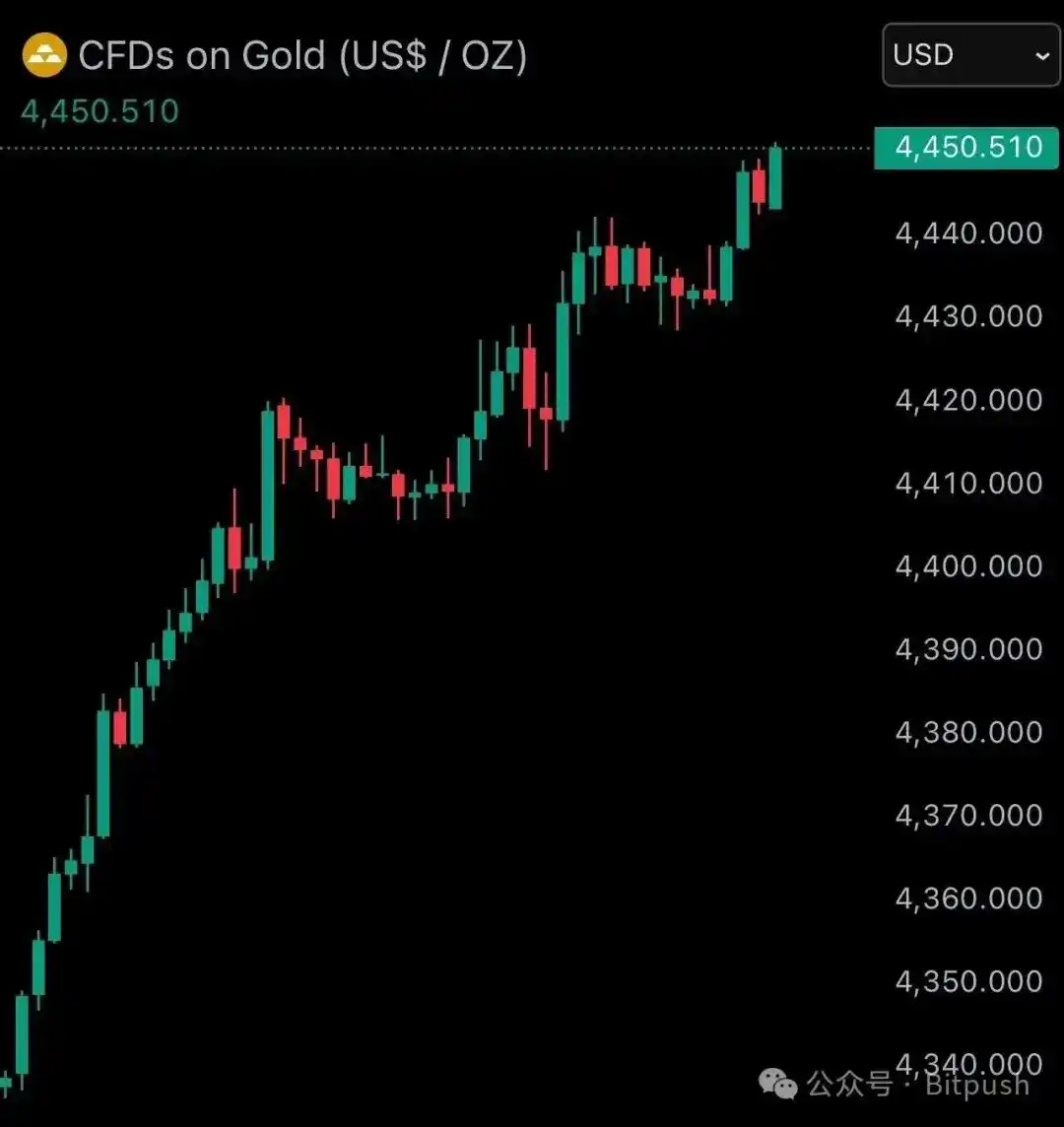
Entering Christmas week, the global market's initial answer did not belong to the crypto market. Against the backdrop of a weakening US dollar and falling US Treasury yields, risk-aversion sentiment quickly heated up. Gold and silver took the lead, with prices successively刷新历史高位 (hitting new historical highs), becoming the hottest destination for funds.
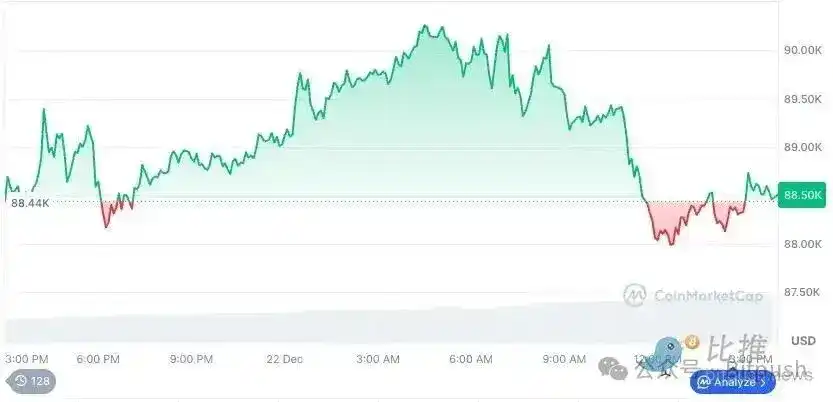
In contrast, the crypto market appears unusually quiet. Bitcoin did not take off with the macroeconomic tailwinds but continues to linger in the $88,000-$89,000 fluctuation range, lacking the offensive posture expected before the holiday.
It is precisely against this反差 (contrast) that the question of "whether Bitcoin will usher in a Santa Rally" has once again become a topic of反复讨论 (repeated discussion) in the market. The so-called Santa Rally, originally a seasonal phenomenon in traditional financial markets, refers to a阶段性上涨 (phased rise) in risk assets around Christmas, driven by improved sentiment and changes in liquidity. However, in the crypto market, this规律 (pattern) has never been stable. Whether this year's Bitcoin is "lagging behind" amidst rising risk-aversion sentiment or quietly building momentum within a high range still requires looking for answers in its real price action and fund structure.
Macro Environment in 'Awaiting Verification', Funds Flow Out of Risk Assets
Gabriel Selby, Research Head at CF Benchmarks, pointed out that before the Federal Reserve obtains data for several consecutive months that clearly points to持续回落 (sustained decline) in inflation, market participants are unlikely to truly increase their allocation to risk assets like Bitcoin. In his view, the current macro environment is still in an "awaiting verification" stage.
This cautious sentiment is closely related to investors' high attention to a series of upcoming US economic data. The Q3 GDP data will be released soon, with market expectations for the annualized growth rate around 3.5%, slightly lower than Q2's 3.8%. Meanwhile, indicators like the Consumer Confidence Index and weekly initial jobless claims will provide more clues about the labor market conditions. The results of these data will directly affect the market's judgment on the Fed's policy path and further influence overall risk appetite.
Looking at other macro factors, a weakening US dollar and falling US Treasury yields do provide a theoretical tailwind environment for risk assets. However, the actual choices of funds have given a completely different answer.
According to statistics from SoSoValue, there has been明显的分化 (obvious divergence) at the ETF level recently: Bitcoin ETFs recorded a net outflow of approximately $158.3 million, and Ethereum ETFs saw an outflow of about $76 million. In contrast, XRP and Solana ETFs recorded small inflows of about $13 million and $4 million respectively, showing that funds are also undergoing结构性调整 (structural adjustment) within the crypto market, rather than a overall回流 (return flow).
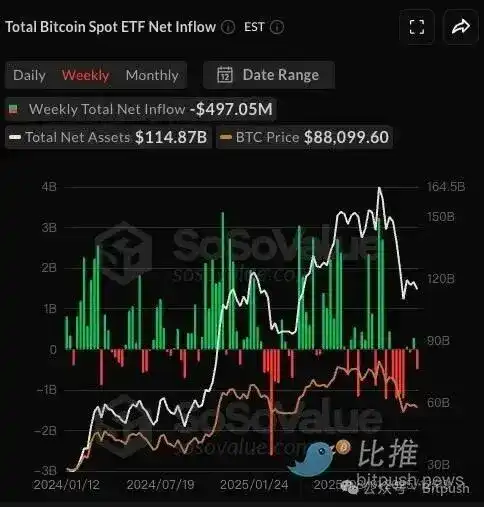
From the perspective of broader digital asset investment products, CoinShares pointed out in its latest weekly fund flow report that digital asset investment products collectively experienced a net outflow of approximately $952 million last week. This is the first net redemption after four consecutive weeks of inflows. CoinShares attributed this capital outflow partly to the regulatory uncertainty caused by the slowed推进节奏 (pace of advancement) of the US Clarity Act, leading institutional investors to倾向于 (tend to) reduce risk exposure in the short term.
Technical Structure: Dominated by Sideways Movement
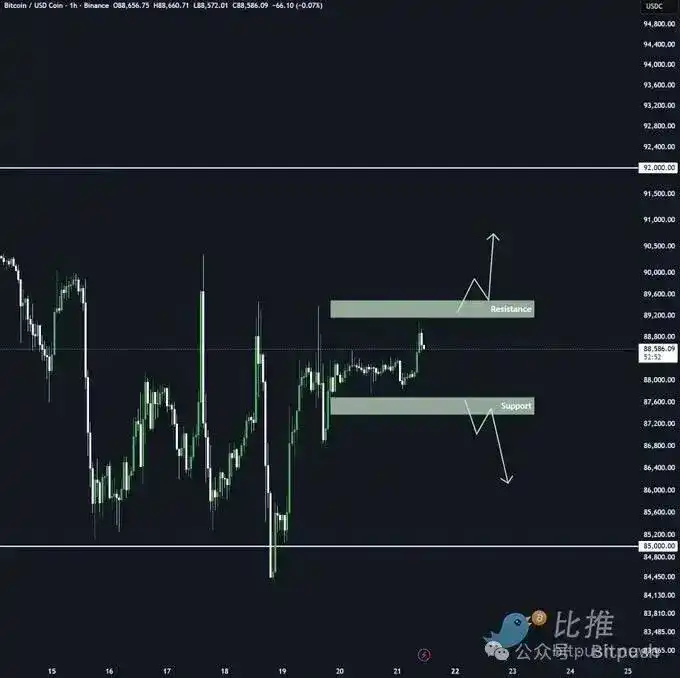
From a technical structure perspective, Bitcoin's current trend is not明显偏空 (obviously bearish), but it can hardly be called strong either. The $88,000 to $89,000 range has become the core fluctuation zone repeatedly tested in the short term, while the area above, from $93,000 to $95,000, constitutes a key resistance that the bulls must break through.
Several traders pointed out that if Bitcoin fails to effectively break through this resistance range during Christmas week, even if there is a short-term rebound, it is more likely to be seen as a technical repair rather than a trend reversal. Conversely, if the price continues to maintain a high-level sideways movement, it means the market is waiting for new driving factors rather than actively choosing a direction.
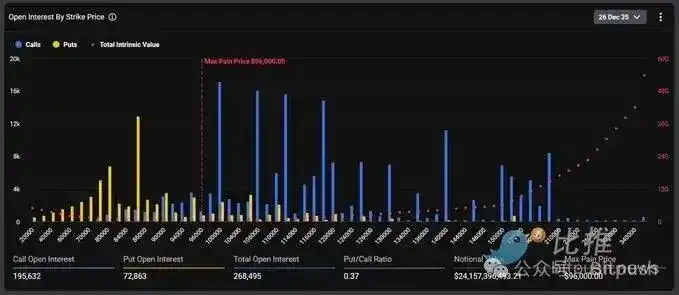
The structure of the derivatives market also explains to some extent why Bitcoin appears particularly restrained during Christmas week. This Friday, the Bitcoin market will witness the largest options expiration in history, with a total value of up to $24 billion. Currently, bulls and bears are engaged in fierce博弈 (game) at key price levels:
- Bulls: Betting that BTC will break through the $100,000 mark;
- Bears: Defending the $85,000关口 (level) with all their might;
- 胜负手 (Decisive factor): $96,000 is seen as the分水岭 (watershed) for this round's trend. Holding above this level maintains the rebound momentum; otherwise, the market will continue to be under pressure.
What Do Analysts Think?
Several market observers pointed out that this year's Christmas week is more like a "structure test" rather than a window for sentiment-driven unilateral行情 (market movement).
Gabriel Selby, Research Head at CF Benchmarks, stated bluntly in a recent interview that Bitcoin's current price action does not conform to the typical characteristics of a Santa Rally. In his view, a real holiday rally is often accompanied by持续占优 (sustained dominance) of buying and trend continuation, rather than反复拉锯 (repeated tug-of-war) within a high range. "What we are seeing now seems more like the market digesting previous gains, rather than building momentum for the next rise." This judgment is also corroborated by the reality of持续偏低 (persistently low) trading volume.
Cryptocurrency analyst DrBullZeus stated that BTC continues to fluctuate between the same support and resistance levels, with no clear breakout yet. Until a clear breakout occurs, the price will remain in a range-bound trend. Breaking above resistance would open the door to the $92,000 level, while breaking below support could lead to a pullback to the $85,000 area.
>
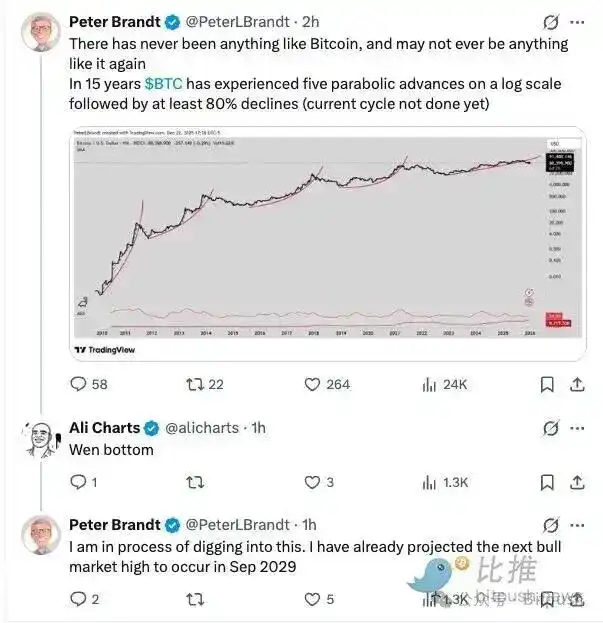
Legendary trader Peter Brandt最新复盘 (recently reviewed) and pointed out that Bitcoin has experienced 5 cycles of "parabolic growth followed by an 80% retracement" in 15 years, and the adjustment in this cycle has not yet bottomed out. Despite the冷酷短期规律 (harsh short-term规律 pattern), through cycle deduction, he predicts the next bull market peak will arrive in September 2029.
Brandt emphasized that the asset属性 (attributes) of something like BTC注定 (destine) it to move towards new highs through extreme洗盘 (shakeouts).
Overall, Bitcoin's "Santa Rally" has always been elusive. Looking back at history, there have been both dazzling performances like surges of 33% and 46% during the holiday period in 2012 and 2016, as well as平淡 (flat) or even declining years. Statistically, since 2011, Bitcoin's average gain during the Christmas period is about 7.9%.
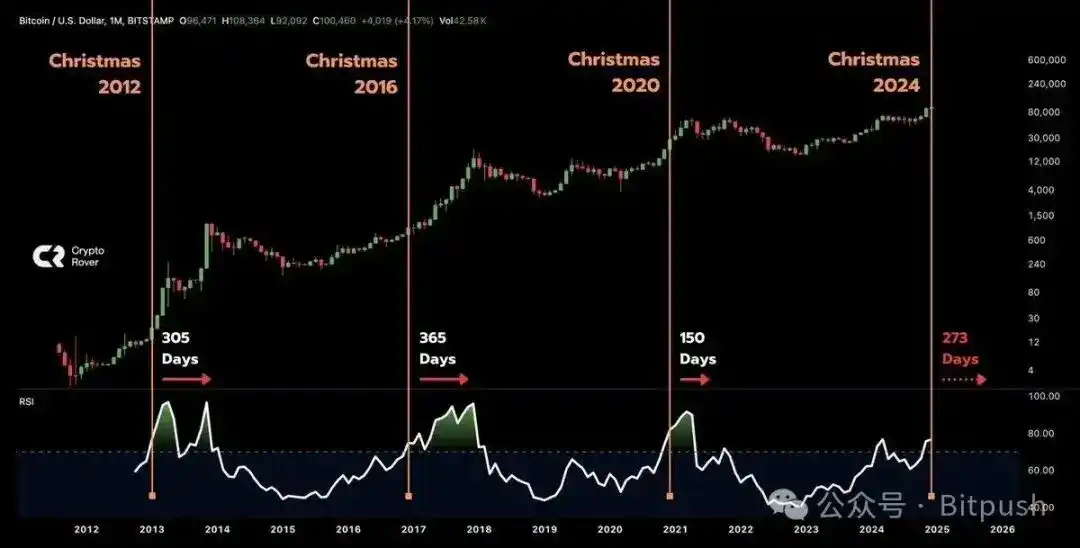
However, judging from the current market structure, it seems difficult to reproduce a typical "Santa Claus rally" this year. The strength of gold and silver reflects more the集中释放 (concentrated release) of market risk-aversion sentiment. In contrast, Bitcoin's relative "calmness" once again highlights that it is still widely regarded as a risk asset in the current stage of global asset allocation.
Therefore, rather than simply attributing Bitcoin's current performance to "lagging behind," it is better to say that it is at a critical and微妙 (subtle) position: on the one hand, it lacks sufficient macroeconomic tailwinds to directly send it on a new upward trajectory; on the other hand, there are no clear signals of a breakdown and weakness yet.
What truly determines whether Bitcoin can走出独立行情 (stage an independent rally) at the end of the year is not the "Christmas" time label, but whether market funds are willing to place bets again at the current position. Until this point is clearly confirmed,窄幅震荡 (narrow-range fluctuation) will likely remain the主旋律 (main theme) of this Christmas week.