Galaxy Digital makes a major bet on AI, creating a 500-acre campus in Texas, while GLXY stock plunged 17%

cryptonews.ruPublished on 2026-07-28Last updated on 2026-07-28

Abstract

Galaxy Digital is making a major AI and high-performance computing bet with a new 500-acre campus in McGregor, Texas. The development agreement, which brought the city roughly $7.5 million, expands Galaxy's data center footprint from its existing 1.6-gigawatt Helios campus. The McGregor site is planned to start operations in 2028, initially targeting 74 megawatts with potential to scale to hundreds of megawatts by 2030. The project will use a water-saving closed-loop cooling system. Galaxy will fund its own private electrical substation and pay full taxes from the start, estimated to add at least $130 million to the local tax base and create hundreds of construction and permanent jobs. Despite this long-term strategic move, Galaxy's stock (GLXY) has been volatile, falling 17% over the past month and 27% over the past year, reflecting its high correlation to crypto market sentiment. The company ties the investment to a structural, not cyclical, demand shift for AI computing power.

The deal, concluded as part of a development agreement with the city of McGregor, provides for the creation of an artificial intelligence and high-performance computing campus on the site of the McGregor industrial park. The land sale brought the city revenue of approximately $7.5 million.

Galaxy is expanding its 1.6-gigawatt Helios campus in Dickens County, West Texas, where the company states it is already the largest employer and taxpayer.

"McGregor is the next step in our strategy of building a disciplined, multi-campus data center business," Galaxy Founder and CEO Mike Novogratz noted on Tuesday. He characterized the demand for computing power as a structural shift, not a temporary cycle.

What Galaxy intends to build

The company has signed a preliminary agreement with the local energy company to begin construction of interconnection facilities. The first phase of development aims to achieve a capacity of 74 megawatts.

Galaxy plans to coordinate with the energy company to push the project over the 75 MW threshold, which ERCOT classifies as a "large load." The company expects the McGregor facility to begin receiving power in 2028, with subsequent expansion of operations. Galaxy believes that by 2030, the complex could become a facility with a capacity of several hundred megawatts, depending on the development of new power transmission infrastructure.

The project will operate on a closed-loop cooling system—the same water-saving design used at the Helios facility, which ensures water is recirculated within the system rather than constantly drawn from the local water supply.

Tax base and jobs

Under the agreement, Galaxy will fund and build its own private electrical substation—a move intended to avoid shifting infrastructure costs onto local taxpayers. The company will also fulfill its full tax obligations from the outset, which is estimated to add at least $130 million to McGregor's tax base, intended to fund schools and emergency services.

The construction is expected to provide several hundred trade and construction jobs, followed by permanent operational jobs with, the company states, competitive wages.

What this means for GLXY investors

Galaxy Digital stock trades on the Nasdaq under the ticker GLXY. As of the close on July 27, the share price was $22.70, up $0.02 (0.09%) from the previous day in pre-market trading.

Short-term stock performance is unfavorable. Over five days, GLXY shares have declined by 7.01%, over the past month by 17.48%, and over six months by 32.23%. Since the beginning of the year, shares are down 0.83%, and over the past year, they are down 27.73%.
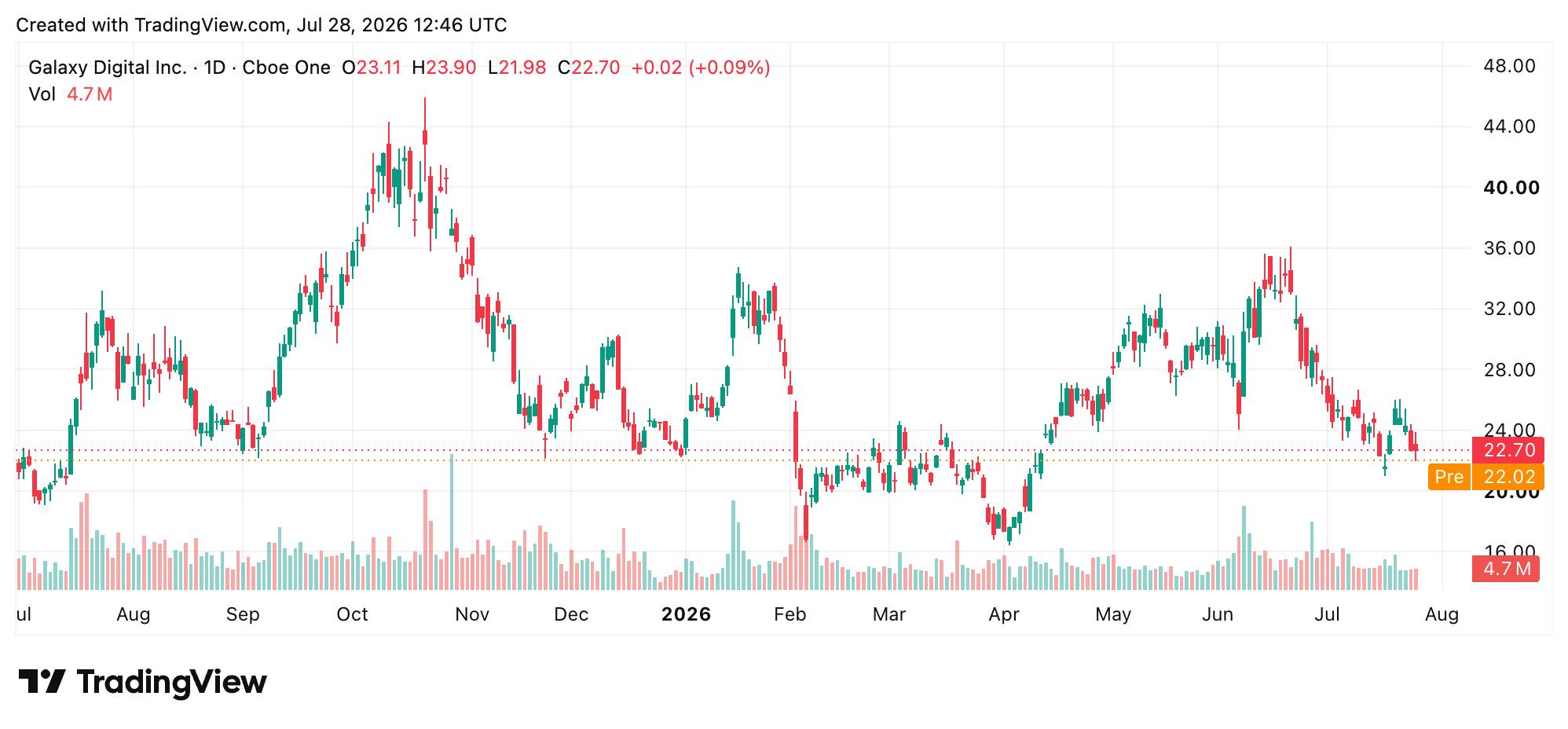
Galaxy Digital stock on Tradingview.

This volatility reflects the stock's high beta relative to the overall sentiment in the cryptocurrency market. Earlier this year, Galaxy placed priority secured bonds worth about $3.5 billion, tied to data center operations, and on August 5, the company will release its earnings report.

The McGregor deal provides Galaxy with a second concrete facility as part of what the company describes as a "multi-campus" strategy, built on long-term demand for AI computing power, regardless of stock price fluctuations.

end-content

Trending Cryptos

Related Questions

QWhat major investment is Galaxy Digital making, and where will it be located?

AGalaxy Digital is making a major bet on AI by creating a 500-acre AI and high-performance computing campus in McGregor, Texas.

QWhy has the stock price of Galaxy Digital (GLXY) been declining recently?

AGalaxy Digital's stock (GLXY) has been declining due to high volatility and sensitivity to the overall cryptocurrency market sentiment. In the past month, shares fell 17.48%, and over six months, they are down 32.23%.

QWhat are the power and infrastructure details for the first phase of the new McGregor campus?

AThe first phase of the McGregor campus aims to achieve a capacity of 74 megawatts. Galaxy plans to coordinate with a local energy company to exceed the 75 MW threshold, classified as a 'Large Load' by ERCOT, and expects the facility to start receiving power in 2028.

QHow does Galaxy Digital's project benefit the local community of McGregor, Texas?

AThe project benefits McGregor by providing the city with approximately $7.5 million from the land sale, adding at least $130 million to the local tax base for funding schools and emergency services, creating hundreds of construction and permanent operational jobs, and financing its own private electrical substation to avoid burdening local taxpayers.

QWhat is the long-term strategic vision behind Galaxy Digital's multi-campus data center business?

AGalaxy Digital's long-term strategic vision is to build a disciplined, multi-campus data center business based on the structural, long-term demand for computing power for artificial intelligence, independent of short-term stock price fluctuations.

Related Reads

Solana Price Forecast for August 2026: Can $19 Million from Morgan Stanley and 330,000 Korean Merchants Break SOL's Triangle?

**Solana Price Forecast for August 2026: Key Catalysts and Technical Setup** As of July 31, Solana (SOL) trades at $73.59, consolidating within a triangle pattern formed between its May peak (~$98) and June low (~$60.29). A decisive breakout from this pattern is anticipated. Key resistance levels are clustered around $74.79 (0.382 Fib), $75.33 (20-day EMA), $76.01 (50-day EMA), and a critical zone near $79 (0.5 Fib & 100-day EMA). Support lies at $73.42, $69.25 (0.236 Fib), and the June low of $60.29. Two major institutional catalysts emerged recently: 1. **Morgan Stanley's MSOL ETF:** Launched July 28, it saw $19.06 million in inflows on its second day—the largest single-day inflow for any US SOL ETF since mid-May. 2. **KSNET Partnership:** The Solana Foundation signed an MoU with South Korean payment processor KSNET (serving 330,000 merchants) to explore integrating Solana Pay for domestic and AI-powered transactions. Historically, August has been volatile for SOL, marked by extreme gains in 2020 and 2021 but otherwise weak performance. The forecast for August 2026 is bifurcated: * **Bullish Case:** An upside triangle breakout, sustained MSOL inflows, and positive momentum from the KSNET news could propel SOL toward the $79 resistance cluster, especially if the CLARITY Act is passed by August 8. * **Bearish Case:** A downside break below $73.42, fading excitement around the new ETF, and stalled regulatory progress could see SOL retest support near $69.25, exacerbated by macro risks.

cryptonews.ru12m ago

Solana Price Forecast for August 2026: Can $19 Million from Morgan Stanley and 330,000 Korean Merchants Break SOL's Triangle?

cryptonews.ru12m ago

AFX Trade Promises to Present "Goodwill Plan" on August 3 Following $24 Million Loss Incident

AFX Trade, a cryptocurrency platform, announced it will present a "goodwill plan" on August 3rd, following a security incident on July 22nd that resulted in a loss of $24.15 million. The company's brief update offered no specific details on compensation for affected users, investors, and employees, only urging calm while the team formulates next steps. The theft occurred from a USDC custody account on Arbitrum, with the stolen funds converted to Ethereum. Blockchain analysts traced the funds to a single wallet. AFX Trade and Arbitrum clarified the exploit targeted a third-party bridge, not Arbitrum's native bridge. An investigation revealed the attack began on July 9th with a social engineering scheme targeting a developer. The attacker then deployed malicious code within AFX's internal JFrog repository and infrastructure, eventually compromising bridge validators to authorize the fraudulent withdrawal. The company stated the exploit leveraged a "trust vulnerability," not a smart contract bug. AFX Trade's head of business development made an offer to the attacker, proposing they keep 30% of the funds as a white hat bounty if 70% is returned. The incident fits a 2026 trend identified by TRM Labs: while the number of crypto hacks hit a record, total losses decreased. However, infrastructure and operational breaches, though fewer, accounted for the majority of financial losses. The AFX breach is classified as an infrastructure incident involving private key compromise.

cryptonews.ru22m ago

AFX Trade Promises to Present "Goodwill Plan" on August 3 Following $24 Million Loss Incident

cryptonews.ru22m ago

Trading

Spot

Hot Articles

Discussions

Welcome to the HTX Community. Here, you can stay informed about the latest platform developments and gain access to professional market insights. Users' opinions on the price of AI (AI) are presented below.

活动图片