From 'World's First Stock' to Delisting Warning: How Canaan Technology Fell into a Value Dilemma

比推Published on 2026-01-27Last updated on 2026-01-27

Abstract

Canaan Inc., once hailed as the "world's first blockchain IPO," has received a delisting warning from Nasdaq due to its stock trading below $1 for 30 consecutive business days. The company has until July 13, 2026, to regain compliance, potentially through a reverse stock split. This marks the second such warning in less than a year. While a previous warning in May 2025 was resolved thanks to rising Bitcoin prices, recent crypto market weakness has driven Canaan’s stock down nearly 30%. As a major Bitcoin mining machine manufacturer, Canaan has faced intense competition, falling to third place in market share behind Bitmain and MicroBT. Its financials have deteriorated significantly, turning from a $300M+ net profit in 2021 to a $250M loss in 2024. Factors include inventory write-downs, high R&D costs, and shrinking demand. The company also attempted to pivot to AI chips, launching several products over six years. However, with only $900,000 in AI-related revenue in 2024 and high operating costs, it discontinued non-core AI operations in mid-2025 to refocus on crypto mining hardware and the North American market. Despite recent challenges, Canaan secured a major 4.5 MV order and raised $72 million in financing in late 2025, indicating some investor confidence remains. Nevertheless, the company must find a new growth narrative to escape its current valuation困境.

Author: Eric, Foresight News

Original Title: World's First Blockchain Stock Receives Another Delisting Warning, 'Selling Shovels' Is No Longer Appealing


On January 16, 2026, Canaan Technology announced that it had received a notice from the Nasdaq Exchange on January 14. The notice stated that Canaan's stock price had been below $1 for the past 30 consecutive trading days, triggering a warning. According to Nasdaq listing rules, if Canaan cannot bring its stock price back to $1 or above within 180 days (by July 13, 2026), it may face delisting.

Canaan Technology stated that, if necessary, the company will implement a reverse stock split to meet the requirement. A reverse stock split involves consolidating existing outstanding shares to reduce the total number of shares and increase the price per share. The author contacted Canaan Technology regarding the warning but had not received a response by the time of publication.

This is the second delisting warning Canaan has received in the past year. The first was in May 2025, after which the stock price rose above $1 due to an increase in Bitcoin's price, temporarily averting the crisis. However, the overall downturn in the cryptocurrency market in recent months has caused Canaan's stock price to fall nearly 30% over the past 30 trading days.

On December 13, 2025, Bitcoin treasury company Kindly MD received a warning for the same reason, while BNB treasury company Windtree Therapeutics was delisted in August 2025. Unlike cryptocurrency treasury companies, Canaan, as one of the leading players in the Bitcoin mining machine manufacturing sector, finds its current situation somewhat lamentable.

Canaan Technology went public on the Nasdaq in November 2019, becoming the world's first pure blockchain concept company to complete an IPO. After listing, Canaan's stock price remained below the offering price for over a year. However, with the arrival of the cryptocurrency bull market, its stock price began to recover steadily from late 2020, reaching a historical high of nearly $40 in March 2021, with a market capitalization exceeding $5 billion.
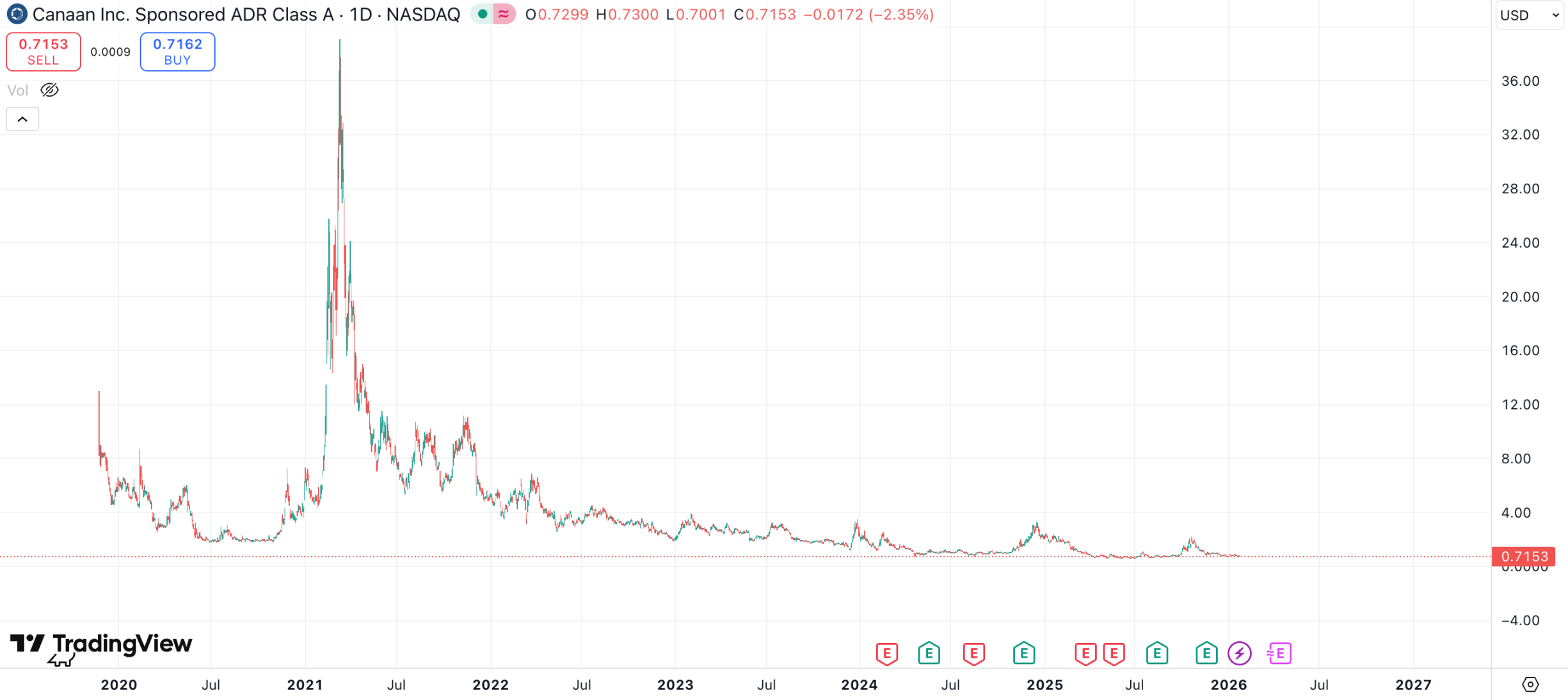
The good times did not last long. With the issuance of China's mining ban and the bear market that persisted throughout 2022, Canaan's stock price continued to decline, returning to pre-bull market levels. In the current cycle, although Bitcoin's price reached new highs, even nearly doubling the 2021 peak at one point, Canaan's stock price not only failed to rise but instead fell, dropping below $1 for the first time in April 2024.

Aside from objective market conditions, the industry and Canaan itself are also contributing factors to its poor performance in the capital market.

In the Bitcoin mining machine market, Bitmain is the absolute leader. Canaan held a steady second place until 2021, but after that, MicroBT rapidly rose with higher power efficiency, pushing Canaan to third place. According to a report released by Intel Market Research in December 2025, MicroBT's market share is 15% to 20%, while Canaan's is 10% to 15%.

Canaan Technology's annual reports from 2021 to 2024 show a continuous decline in net profit over the four years, from a net profit of over $300 million in 2021 to a loss of nearly $250 million in 2024. The reasons include, on one hand, the bear market in 2022 leading to continuous impairment charges for Canaan's accumulated inventory, affecting profits; on the other hand, fierce competition has kept R&D expenses and operating costs high without a significant increase in market share.

Amid these multiple challenges, a sharp drop in demand became the final straw. According to analysis by MSX researcher Frank, the overhyped expectations of Bitcoin mining narratives and visibly intensifying competition have led many Bitcoin mining companies to transition to AI computing infrastructure. Although 'selling shovels' has always been a good business model, in the current capital market, Bitcoin's story is clearly not as certain as AI's, and capital has naturally voted with its feet, shifting towards AI-related companies.

In fact, Canaan Technology began developing AI chips nearly a decade ago. In 2018, it launched its first commercial edge AI chip based on the RISC-V architecture, Kendryte K210, primarily used for edge computing and supporting AI vision and audio processing. Over the next six years, Canaan released three more chips, each with significant innovations built upon the previous generation.

Although Canaan's chips had technical highlights and got an 'early start,' compared to giants like NVIDIA and Intel, Canaan lacked ecosystem support and large-scale demand. In 2024, its AI-related business revenue was only about $900,000, while operating expenses accounted for 15% of the entire company. In June 2025, Canaan Technology announced it would discontinue non-core AI semiconductor business and shut down its AI chip department. The related announcement stated that the company had been exploring the sale of its AI business since March 2022 but failed to find a buyer, ultimately deciding to abandon it to focus on crypto mining machines and the North American market.

Canaan Technology is a microcosm of the 'physical business' in the Web3 industry. Another listed Bitcoin mining machine manufacturer, Ebang International, has seen its stock price fall from nearly $450 at its 2020 peak to around $3, a drop of over 99%. For hardware manufacturers, there is a mature and fixed valuation model. If the industry they are in shows no clear growth prospects, it is easy to fall into a vicious cycle.

On the bright side, in late 2025, Canaan Technology first signed a large order for 4.5 MV in October, followed by completing a $72 million financing round in November. Clearly, some in the market still believe that the former 'Pumpkin Zhang' can overcome the difficulties. But to break free from the predicament, Canaan Technology may need a new story.


Twitter:https://twitter.com/BitpushNewsCN

Bitpush TG Discussion Group:https://t.me/BitPushCommunity

Bitpush TG Subscription: https://t.me/bitpush

Original Link:https://www.bitpush.news/articles/7606399

Related Questions

QWhy did Canaan Creative receive a delisting warning from Nasdaq in January 2026?

ACanaan Creative received the delisting warning because its stock price had been below $1 for 30 consecutive trading days, violating Nasdaq's listing rules.

QWhat was Canaan Creative's market position in the Bitcoin mining machine industry by the end of 2025?

ABy the end of 2025, Canaan Creative was the third-largest player in the Bitcoin mining machine market, with a market share of 10% to 15%, behind MicroBT and Bitmain.

QHow did Canaan Creative's financial performance change from 2021 to 2024?

ACanaan Creative's net profit declined significantly from over $300 million in 2021 to a loss of nearly $250 million in 2024, due to inventory write-downs, high R&D costs, and intense competition.

QWhat was the outcome of Canaan Creative's AI chip business, and why did the company decide to shut it down?

ACanaan Creative's AI chip business generated only about $900,000 in revenue in 2024 while accounting for 15% of operating expenses. The company shut down the non-core AI semiconductor business in June 2025 due to lack of ecosystem support, large-scale demand, and a buyer for the division.

QWhat recent developments in late 2025 provided some positive momentum for Canaan Creative?

AIn late 2025, Canaan Creative signed a large order for 4.5 MV and completed a $72 million financing round, indicating continued investor confidence in the company's potential recovery.

Related Reads

Has the 'Digital Gold' Narrative for BTC Failed?

**Title: Has the "Digital Gold" Narrative for Bitcoin Failed?** The article argues that Bitcoin's "digital gold" narrative remains valid despite a recent sharp price decline (from a peak near $126k in Oct 2025 to briefly under $61k in Feb 2026). It presents a long-term investment framework based on three core points: **1. Viewing Bitcoin as an Asset:** Bitcoin is presented as a superior potential store of value compared to gold. Key arguments are its absolute scarcity (21 million cap), superior portability, and transparent auditability via its public ledger. While acknowledging its current use in early, volatile stages (~3-4% global adoption), the author draws parallels to the early, disruptive phases of the internet and e-commerce. **2. Understanding the Recent Downturn:** The current ~50% correction is framed as a predictable, consensus-driven cycle following its post-halving peak (the 2024 halving preceded the Oct 2025 high). A crucial factor is a historic "changing of hands": the influx of new institutional buyers via ETFs allowed early, low-cost holders (miners, OG believers) to take profits. The author notes that while severe, Bitcoin's historical drawdowns (e.g., 93% in 2011, 77% in 2021-22) have been progressively smaller, suggesting maturing holder structure and decreasing volatility over time. **3. The Long-Term Perspective:** The long-term thesis hinges on Bitcoin capturing a portion of gold's market value. With Bitcoin's market cap at ~$1.4 trillion (at $70k) versus gold's ~$20 trillion, significant upside potential exists if the "digital gold" narrative is partially realized. However, the author strongly cautions that short-term risks remain, the bottom is unpredictable, and high volatility is inherent. The real risk is not Bitcoin failing but poor personal position management (over-leverage, wrong capital) and a lack of deep understanding, which can force investors out during severe downturns. The conclusion uses Amazon's 95% crash post-2000 dot-com bubble and subsequent 42x recovery as an analogy. The ultimate question is not if Bitcoin's price will rise, but if an investor's strategy and conviction can withstand the volatility to see the long-term play out. The recent divergence (gold up, Bitcoin down) is posed not as a narrative failure, but as potential evidence of this ongoing, painful transition from a speculative asset to a mainstream allocation.

marsbit5h ago

Has the 'Digital Gold' Narrative for BTC Failed?

marsbit5h ago

Has BTC's 'Digital Gold' Narrative Failed?

The article discusses Bitcoin's "digital gold" narrative, its recent price drop, and long-term outlook through the perspective of "Jason". It argues the narrative is not a failure but that Bitcoin represents a superior, new asset class due to its fixed supply (21 million), portability, and auditability. The piece compares its current ~3-4% global adoption rate to early internet/e-commerce, suggesting significant growth potential. Regarding the 2025-2026 price decline (from ~$126k to briefly under $61k), the author views it as a predictable, consensus-driven sell-off within Bitcoin's ~4-year cycle post-halving, exacerbated by a major "handover" from early, low-cost holders to new institutional buyers via ETFs. A key observation is that historical peak-to-trough drawdowns have lessened over time (e.g., 93% in 2011 to ~50% in 2026), indicating maturing volatility as holder structure changes. For the long term, the author uses a simple framework: Bitcoin's total market cap (~$1.4T at $70k) is only about 7% of gold's (~$20T). Even capturing 30-50% of gold's value would imply substantial upside. However, the article strongly cautions against viewing this as investment advice, emphasizing extreme volatility and the critical importance of risk management, position sizing, and deep fundamental understanding to survive severe drawdowns. It concludes by drawing a parallel to Amazon's 95% crash in 2000 and subsequent 42x recovery, stressing that the key is surviving market cycles to realize long-term potential.

链捕手5h ago

Has BTC's 'Digital Gold' Narrative Failed?

链捕手5h ago

From Code to Cognition: A Ten-Thousand-Word Guide to the Evolution of the Robot Brain

"From Code to Cognition: The Evolution of Robot Brains" The journey of robotic intelligence has shifted dramatically from manually coded systems to AI-driven brains. For decades, robots relied on layered software stacks—perception, state estimation, planning, control—each handcrafted. While predictable, they lacked adaptability. The 2010s saw deep learning revolutionize perception (e.g., object detection) and control (via reinforcement learning), but learned skills remained narrow. The arrival of Large Language Models (LLMs) marked a turning point. LLMs acted as high-level planners, interpreting natural language instructions and generating sequences of actions for traditional robotic systems to execute. However, true integration came with Visual-Language-Action (VLA) models, which fused vision, language, and motion prediction into a single network. Pioneered by models like RT-2 and open-source projects like OpenVLA, VLAs enable robots to reason and act directly from visual input and commands. The most advanced humanoid robots now employ a "dual-brain" architecture: a slow-thinking, large VLA (System 2) for reasoning and planning, and a fast-reacting, small network (System 1) for high-frequency motion control, sometimes with an even lower-level System 0 for balance. This split balances cognition with the physics of real-time movement. Computation is split between onboard hardware (e.g., NVIDIA Jetson) for safety-critical control loops and cloud/edge servers for non-critical tasks like learning and interfaces. A crucial driver is the open-source ecosystem—models like GR00T and OpenVLA allow startups to build upon pre-trained brains and fine-tune them with their own data, accelerating development. Despite progress, current systems struggle with recovery from errors, sample inefficiency, and long-horizon tasks. This has spurred the rise of **World Models**—neural networks that predict the consequences of actions. By simulating possible futures before acting (like NVIDIA Cosmos or Meta V-JEPA), robots can plan, recover, and generalize better. This represents the next frontier: shifting intelligence from learned reactions to an internal model of physics and cause-and-effect. The field is rapidly evolving. While not yet at its "ChatGPT moment," the convergence of cheaper hardware, scalable simulation, and world models points toward robots that are increasingly capable, adaptive, and useful. The question is shifting from "what can robots do?" to "what *should* they do?"

marsbit5h ago

From Code to Cognition: A Ten-Thousand-Word Guide to the Evolution of the Robot Brain

marsbit5h ago

Trading

Spot
Futures

Hot Articles

Discussions

Welcome to the HTX Community. Here, you can stay informed about the latest platform developments and gain access to professional market insights. Users' opinions on the price of S (S) are presented below.

活动图片















