Author: @BlazingKevin_, the Researcher at Movemaker
Introduction: A Historic Regulatory Turning Point
The cryptocurrency industry witnessed a historic turning point in the U.S. regulatory environment in 2025. After a prolonged period of "regulation by enforcement" that created significant legal uncertainty, the new SEC Chairman Paul Atkins launched the "Crypto Project" initiative in July 2025, aiming to modernize securities regulation and support the administration's vision of positioning the U.S. as the "global capital center for crypto."
A core initiative of this new regulatory paradigm is the introduction of the Innovation Exemption policy. Designed as a time-limited regulatory relief, this exemption aims to allow nascent crypto technologies and products to enter the market quickly while mitigating initial compliance burdens, pending the SEC's finalization of permanent rules for digital assets. Atkins has confirmed that the exemption rule is expected to take effect officially in January 2026. The release of this policy signal marks a shift by U.S. regulators from reactive responses to proactive construction, seeking a more resilient balance between investor protection and industry innovation.
This article will provide an in-depth analysis of the core mechanisms of the SEC's Innovation Exemption, its strategic positioning within the overall U.S. crypto regulatory framework, assess the controversies and opportunities it has sparked in the market, and place it in a global context, particularly comparing it with the EU's MiCA regulation, to offer strategic advice for industry participants.
1. Core Mechanisms and Objectives of the Innovation Exemption
The core of the SEC's Innovation Exemption lies in providing a temporary "safe harbor" channel, allowing digital asset companies to operate without immediately bearing the full registration and disclosure burdens of traditional securities laws.
1.1 Scope and Duration of the Exemption
The Innovation Exemption has a broad scope of application; any entity developing or operating a business related to crypto assets can apply, including trading platforms, DeFi protocols, stablecoin issuers, and even DAOs.
- Timeframe Design: The exemption period is typically set for 12 to 24 months, intended to provide project teams with a sufficient "incubation period" to encourage their networks to achieve "maturity" or "sufficient decentralization."
- Simplified Registration: During the exemption period, projects only need to submit simplified information disclosures without completing complex and time-consuming S-1 registration documents. This mechanism is similar to the "on-ramp" design in the pending Congressional CLARITY Act, which would allow startups to raise up to $75 million annually from the public without fully complying with SEC registration requirements, provided they meet disclosure obligations.
1.2 Principles-Based Compliance Conditions
Atkins emphasized that this exemption will be principles-based rather than relying on rigid rules. Companies utilizing the exemption must still meet basic compliance standards and investor protection measures, such as:
- Periodic Reporting and Review: Possibly requiring the submission of quarterly operational reports and undergoing periodic reviews by the SEC.
- Investor Protection: For projects targeting retail investors, risk warnings and investment limits must be established.
- Technical Standards: Conditions may include requiring projects to use whitelists or certified participant pools, or even adhere to standards-based restrictions like ERC-3643.
1.3 Token Classification and the "Decentralization" Test
The operation of the Innovation Exemption relies on the SEC's emerging token classification system, designed to determine which digital assets constitute securities based on the principles of the Howey Test.
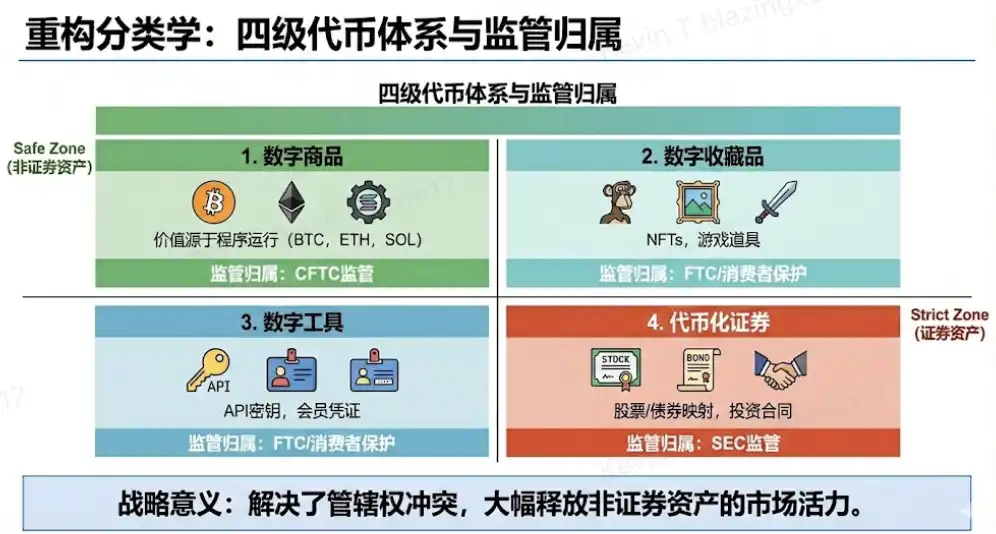
- Classification System: The SEC categorizes digital assets into four main types: Commodity/Network Tokens (e.g., BTC), Utility Tokens, Collectibles (NFTs), and Tokenized Securities.
- Exit Path: If the first three types of assets meet the conditions for "sufficient decentralization" or "functional completeness," they can exit the securities regulatory framework. Once the investment contract is deemed "terminated," even if a token was issued as a security initially, its subsequent trading is not automatically considered a "securities transaction." This model of control transfer provides a clear regulatory exit path for projects.
- Significance of the Exemption: Under this framework, the SEC has been directed to clarify when digital assets constitute securities, emphasizing that most crypto assets are not securities, and even if they are, regulation should encourage, not hinder, their development.
2. Strategic Context of the Innovation Exemption: Synergy with Congressional Legislation
The SEC's Innovation Exemption is not an isolated administrative action; it forms part of the new U.S. crypto regulatory system alongside the two major legislative pillars advancing in Congress: the CLARITY Act and the GENIUS Act.
2.1 Clarifying Jurisdiction: Complementing the CLARITY Act
The CLARITY Act aims to resolve the long-standing jurisdictional conflict between the SEC and the Commodity Futures Trading Commission (CFTC).
- Core Division: The CLARITY Act places primary issuance/fundraising activities under the SEC's jurisdiction, while explicitly granting regulatory authority over spot trading of digital commodities to the CFTC.
- Mature Blockchain Test: The CLARITY Act introduces a "mature blockchain" test to determine when a project has achieved sufficient decentralization to qualify for lighter regulatory treatment (i.e., being treated as a digital commodity). This test includes criteria such as dispersed token ownership, governance participation, and functional independence from any single controlling group.
- Exemption Coordination: The Innovation Exemption provides a temporary transitional period for those startup projects in an "intending to mature" state. It allows these projects to conduct limited fundraising and product testing through simplified disclosures while working towards full decentralization. This means the administrative exemption and the legislative draft's boundary划分 (demarcation) are highly synergistic: the exemption is a temporary administrative "pilot" permit, while the CLARITY Act provides a permanent legislative "graduation" standard.
2.2 Isolating the Stablecoin Framework: The Enactment of the GENIUS Act
The GENIUS Act was signed into law in July 2025, becoming the first comprehensive federal digital asset legislation in the U.S.
- Status of Stablecoins: The GENIUS Act explicitly excludes payment stablecoins from the definitions of "security" or "commodity" under federal securities and commodity exchange laws, placing them under the supervision of banking regulators (like the OCC).
- Issuance Requirements: The Act requires approved stablecoin issuers to maintain reserves in high-liquidity assets (only including U.S. dollars, Treasury bills, etc.) at a 1:1 ratio and prohibits paying interest or yields.
- Regulatory Impact: Since the GENIUS Act has already clarified the regulatory framework and issuer qualifications for payment stablecoins, the SEC's Innovation Exemption will primarily focus on more innovative areas beyond stablecoins, such as DeFi protocols and novel network tokens, avoiding duplicate or conflicting regulations in the stablecoin space.
2.3 Inter-Agency Cooperation and Market Supervision
The SEC and CFTC announced they would enhance regulatory coordination through joint statements and joint roundtable discussions to address cross-agency jurisdictional uncertainties.
- Spot Trading: A joint statement clarified that exchanges registered with both the SEC and CFTC are permitted to facilitate trading of certain spot crypto asset products, reflecting the regulators' willingness to encourage market participants' freedom to choose trading venues.
- Exemption Coordination: One of the topics for discussion in the joint roundtables is the "Innovation Exemption" and DeFi regulation. This coordination is crucial for reducing compliance gaps for market participants.
3. The Risk of DeFi's "Traditionalization"
The introduction of the SEC's Innovation Exemption has sparked strong polarized reactions within the crypto industry.
3.1 Opportunities for Innovators and Compliant Actors
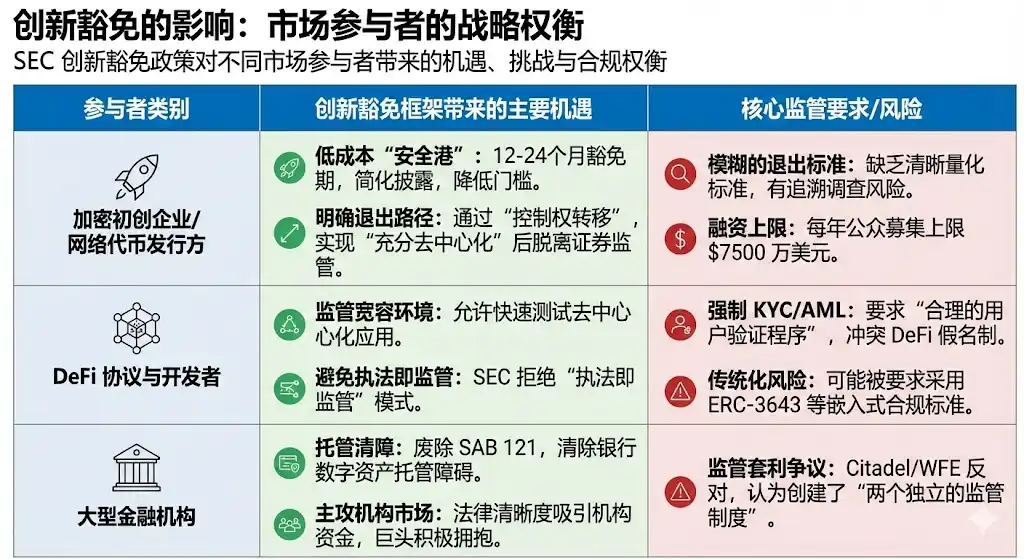
For startups and existing platforms seeking to operate compliantly within the U.S., the Innovation Exemption offers tangible benefits:
- Reduced Entry Costs: Previously, a crypto project aiming for compliant operation in the U.S. could incur millions of dollars in legal fees and take over a year. The Innovation Exemption significantly lowers the compliance threshold and time cost for startup teams through simplified disclosure procedures and a clear transitional framework.
- Attracting Venture Capital: Clear regulatory pathways will make projects that previously chose to "leave" or base themselves overseas due to regulatory ambiguity reconsider the U.S. market. Policy certainty helps attract institutional investors and venture capital, who value the ability to invest within a clear framework.
- Promoting Product Innovation: The exemption period allows a range of new crypto concepts to be tested under the new framework, especially emerging DeFi and Web3 ecosystems. For instance, companies like ConsenSys can thrive in an environment of regulatory tolerance, enabling rapid testing of decentralized applications.
- Beneficial for Large Institutions: Traditional financial giants (e.g., JPMorgan, Morgan Stanley) are actively embracing digital assets. The SEC's rescission of SAB 121 (an accounting standard that forced custodians to record clients' crypto assets as on-balance-sheet liabilities) removed a major obstacle for banks and trust companies to provide digital asset custody services at scale. Coupled with the administrative flexibility offered by the Innovation Exemption, these institutions can enter the crypto space with lower regulatory capital costs and a more defined legal path.
3.2 DeFi Community Concerns and "Traditionalization" Risks
The core controversy of the exemption policy lies in its impact on the ideals of decentralization:
- Mandatory User Verification (KYC/AML): The new rules require all projects utilizing the exemption to implement "reasonable user verification procedures," meaning DeFi protocols need to implement KYC/AML procedures.
- Protocol Splitting and Control: To comply, DeFi protocols might need to split liquidity pools into "permissioned pools" and "public pools," and be required to adopt compliant token standards like ERC-3643. ERC-3643 aims to embed identity verification and transfer restrictions into smart contracts. If every transaction requires a whitelist check and tokens can be frozen by a centralized entity, questions arise about whether DeFi remains truly DeFi. Industry leaders like the founder of Uniswap argue that regulating software developers as financial intermediaries will harm U.S. competitiveness and stifle innovation.
3.3 Opposition from Traditional Financial Institutions
The traditional financial industry has also expressed opposition to the "Innovation Exemption," fearing it creates "regulatory arbitrage."
- Same Asset, Different Rules: The World Federation of Exchanges (WFE) and companies like Citadel Securities have written to the SEC urging it to abandon the "Innovation Exemption" plan, arguing that providing broad exemptions for tokenized securities creates two separate regulatory regimes for the same asset.
- Insisting on Traditional Protections: The Securities Industry and Financial Markets Association (SIFMA) emphasized that tokenized securities must adhere to the same fundamental investor protection rules as traditional financial assets. They argue that relaxing regulations increases market risk and fraud.
4. Global Regulatory Comparison: Strategic Divergence Between U.S. and EU Models
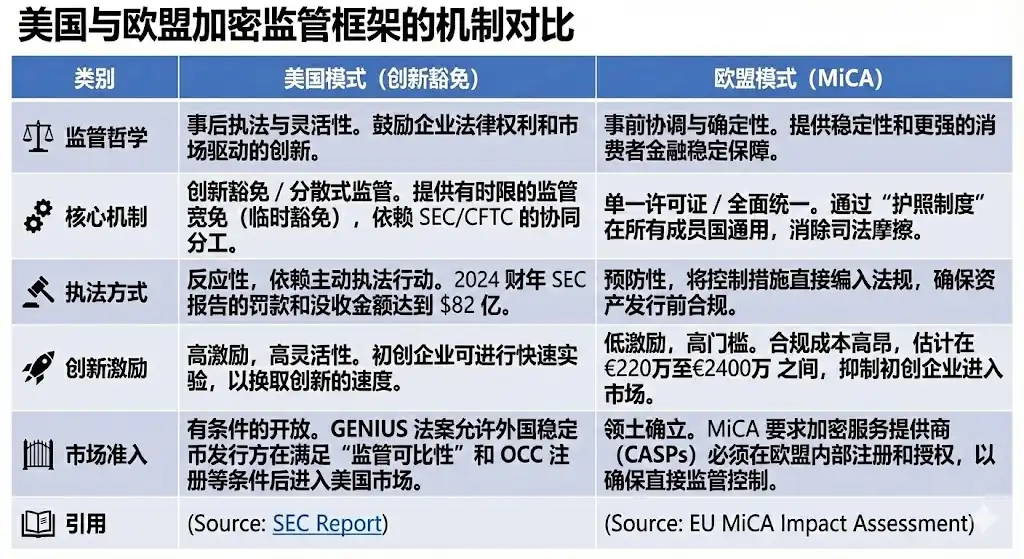
The SEC's Innovation Exemption and the more flexible U.S. model form one pole of global digital asset regulation, contrasting sharply with the ex-ante coordinated and unified model represented by the EU's MiCA (Markets in Crypto-Assets Regulation), with significant philosophical and operational differences between the two.
The "control transfer" philosophy of the U.S. Innovation Exemption and CLARITY Act stands in stark contrast to MiCA's "ex-ante authorization" model. The U.S. model tolerates initial uncertainty and higher risk exposure in exchange for speed and flexibility in innovation, which is most attractive to small and medium-sized fintech companies and startups. MiCA, conversely, provides large, established financial institutions (like JPMorgan) with a stable, predictable market across the EU through structural safeguards and uniform rules.
This regulatory divergence forces global companies to adopt a "market-by-market" dual compliance strategy to cope with the different classifications and operational requirements for the same product (e.g., a USD-pegged stablecoin) in the two major jurisdictions.
5. Market Outlook and Conclusion
The formal implementation of the SEC's Innovation Exemption policy is a critical step towards the maturation of the U.S. crypto regulatory system. It not only provides an administrative "safe harbor" but also profoundly influences the geographical flow of global digital asset innovation in the coming years, marking 2026 as the inaugural year of "compliant innovation." Armed with the unprecedented legal certainty granted by the Innovation Exemption and the CLARITY Act, the U.S. crypto industry will attract substantial institutional capital, accelerating the transformation of crypto assets from the fringes of traditional finance into a "structured asset class."
For industry participants eager to seize this policy红利 (dividend), the strategic focus must be clear: Startups should view the exemption period (12-24 months) as a window for low-cost, rapid entry into the U.S. market, but must treat "sufficient decentralization" as the ultimate operational goal. This means teams must design clear decentralization roadmaps based on "control," rather than relying on vague "ongoing efforts" standards. Projects failing to achieve verifiable decentralization on time will face high retrospective compliance risks. Furthermore, given the ongoing controversy surrounding the requirement for DeFi protocols to implement KYC/AML under the exemption policy, projects that cannot achieve full technical decentralization and are unwilling to adopt standards like ERC-3643 may need to consider exiting the U.S. retail market after the exemption period.
Despite breakthroughs at the administrative and legislative levels in the U.S., the challenge of global regulatory fragmentation remains severe. The divergence between the flexible U.S. model and the EU's strict, ex-ante MiCA model will continue to lead companies to engage in "regulatory arbitrage" globally. To create a level playing field and ensure consumer protection is not dependent on geography, the future development of the industry urgently requires international coordination. In the long term, a plausible prediction is that by 2030, major jurisdictions might converge towards adopting a common baseline framework, including unified AML/KYC standards and stablecoin reserve requirements, which would foster interoperability and institutional adoption worldwide.
The SEC's Innovation Exemption policy is a milestone in the U.S. regulatory system's shift from "vague suppression" to "clear regulation." It attempts to use administrative flexibility to compensate for legislative lag, providing a transitional path for digital assets to move towards compliance while maintaining vitality. For the crypto industry, the opening of this door for exploration means the era of wild growth has ended, and "compliant innovation" will become the core competency for navigating cycles. The next phase of crypto will no longer be built solely on code but will rely more heavily on clear asset classification and regulatory frameworks. The key to corporate success lies in the ability to steadfastly move towards verifiable decentralization and robust compliance baselines while enjoying the speed advantages brought by the exemption, thereby transforming regulatory complexity into a competitive advantage in the global market.