From 'Hardcore' to 'Weak': Who is the Real Hardliner When Bitcoin Falls?

marsbitPublished on 2026-02-06Last updated on 2026-02-06

Abstract

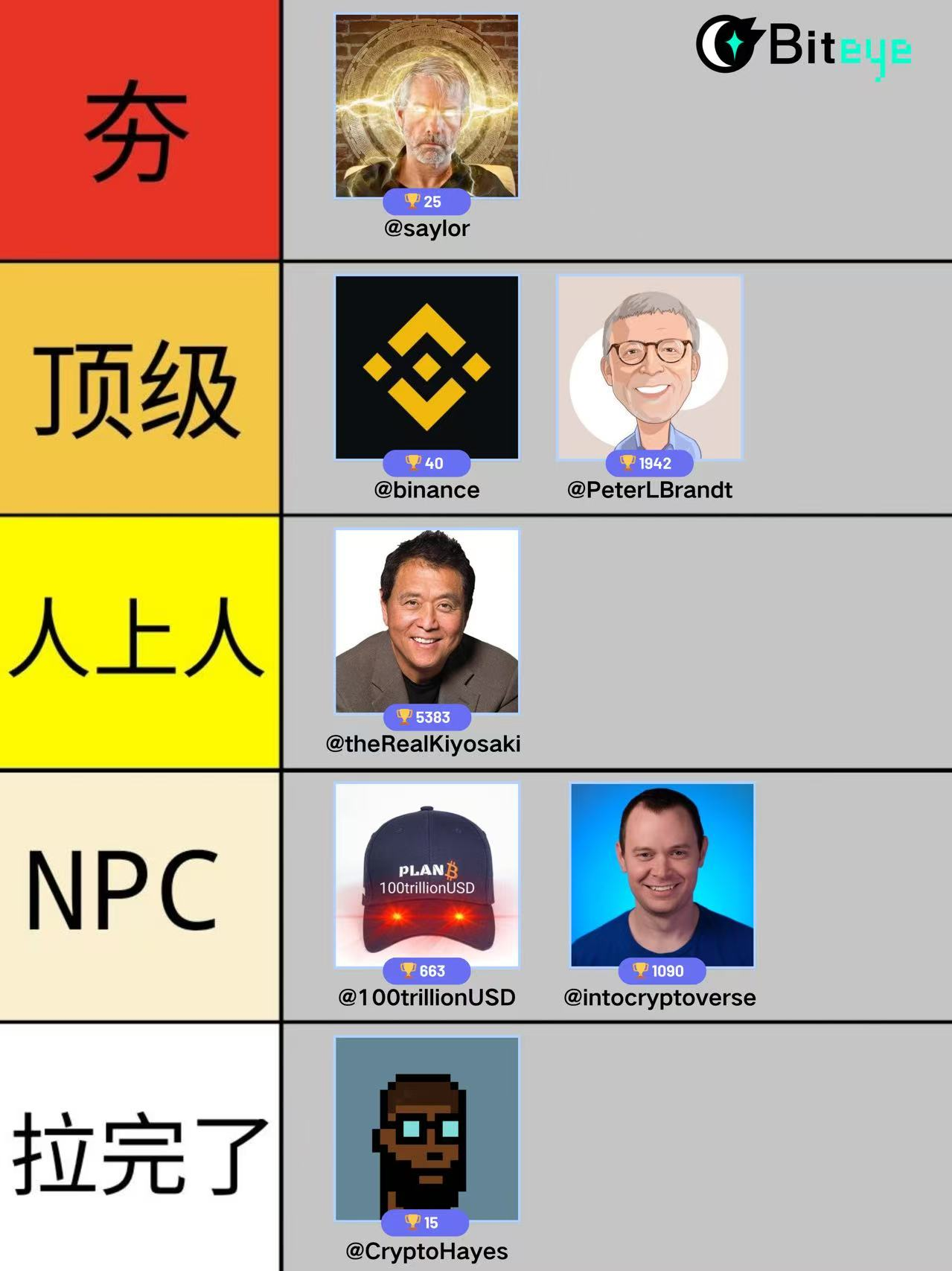
An article titled "From 'Solid' to 'Weak': Who is the Real Hardliner When Bitcoin Falls?" analyzes the behavior of prominent crypto figures and institutions during a sharp Bitcoin price decline in February 2026, when BTC dropped from its $120,000 high to briefly under $60,000. The piece rates key players based on their public statements and on-chain actions during the crash. Michael Saylor and his company MicroStrategy are hailed as the "true hardliner" for their "suicidal" buying spree, purchasing billions of dollars worth of BTC at prices between $87,974 and $91,519, despite now holding at a loss. Their rating: "Solid (walking the talk, the one true god)." Binance is praised for its "top-tier" action of converting $1 billion of its SAFU fund into Bitcoin. Veteran trader Peter Brandt is also rated "top-tier" as an "honest bear" for consistently warning of a 50% correction since the market peak and sticking to his technical analysis. Author Robert Kiyosaki is rated "theoretical" for his constant anti-fiat rhetoric but slow action, waiting for extreme prices to buy. Model-based analysts PlanB and Benjamin Cowen are heavily criticized and rated "NPC (for entertainment only)" for their failed predictions and major shifts in narrative. Former "pump king" Arthur Hayes is rated the worst ("Weak") for going silent on Bitcoin after his lofty price predictions, instead discussing macroeconomics without stating his position. The conclusion states that only two types of people are w...

Author: Biteye

Bull markets mass-produce "prophets"; bear markets are the "lie detectors".

As of February 6, 2026, Bitcoin has plummeted from last year's high of $120,000, and early this morning it even broke through the $60,000 mark, with futures briefly touching the "$50,000s". Most of those voices from six months ago shouting "eternal bull market" and "$250,000 by 2026" are now fallen silent, saying nothing.

We tracked the public statements and on-chain actions of six major KOLs and institutions during this round of sharp decline. Data doesn't lie; it brutally reveals who the true believers are and who are just fair-weather followers.

The Only "Real Hardliner": Michael Saylor's Madness and Purity

If there's only one person in the crypto circle who truly practices "walking the talk," it has to be @saylor.

At the peak in October 2025, he shilled; during the crash in January-February 2026, he bought.

When the market panicked over falling below $80,000, MicroStrategy's buying records were nothing short of a "suicidal" hardliner's declaration:

  • January 12: Invested $1.25 billion at an average price of $91,519
  • January 26: Added $264 million at an average price of $90,061
  • February 2: Bought another $75.3 million at an average price of $87,974

In just one month, he increased his holdings by tens of thousands of BTC against the trend, raising his total cost basis to around $76,000. This means that at the current price of $64,500, Saylor is sitting on massive paper losses. But he didn't wait for "bottom confirmation" like the technical analysts, nor did he worry about "recession risks" like the macro analysts.

For Saylor, a drop means only one thing: it's on sale, keep all-in.

Rating: Hardcore (Walks the talk, the one true god)

Putting Money Where Mouth Is: Binance; The Honest "Big Short": Peter Brandt

Binance @binance announced at the end of January that it would convert its $1 billion SAFU fund into Bitcoin and completed the first batch of purchases (about $100 million) on February 2. Fighting off trolls and rumors while putting real money into Bitcoin—this is the responsibility a top exchange should shoulder.

Rating: Top Tier (Protecting the market with real money)

As a bull you might not like him, but @PeterLBrandt has earned respect with his views. Back in the frenzy of October 2025, he poured cold water, warning of a "50% correction risk." Now, he's not being wise after the event; instead, he consistently reinforces his bearish view based on his logic. He might not be buying (and might even be shorting), but his loyalty to his trading system is extremely high.

Compared to those who only turn bearish after the drop, this kind of "die-hard" based on technical logic deserves respect.

Rating: Top Tier (Logically consistent, honest bear)

Theoretical "Theorist": Robert Kiyosaki

Robert Kiyosaki @theRealKiyosaki is still tirelessly promoting his "anti-fiat" philosophy. Although the logic remains, his actions are too slow.

He talks about "Rich Dad" thinking but holds cash, fantasizing about buying the bottom at extreme points like gold at $4,000 and silver at $74. In this highly volatile market, excessive waiting often means missing out or being forced to act. Full marks for theory, zero for execution.

Rating: All Talk (Valid views, too slow to act)

The Fallen "Modelists": PlanB and Benjamin Cowen

This round of decline marks another failure of "model superstition."

PlanB @100trillionUSD's S2F model has been disproven by the market once again. That confident "BTC will never fall below $100,000" promise has now become a joke. His recent tweets have started discussing a "shallow bear" and "bull market fatigue," but there's no evidence of personal buying.

Benjamin Cowen @intocryptoverse also underwent a drastic logical shift. From expecting "new highs" in Q4 last year to suddenly confirming a "bear market has arrived" in February this year, with a bearish target down to the 200-week moving average (around $58,000). This massive directional correction has left many investors following his cycle analysis unprepared.

Rating: NPC (Predictions collapsed, for entertainment only)

"Brotherhood is in the heart, but the phone is off when needed": Arthur Hayes

The former "shilling king" Arthur Hayes @CryptoHayes, after calling for a "$1 million" target, has recently fallen into a strange state.

He hasn't been buying like Saylor, nor has he been bearish like Brandt. Instead, he's been beating around the bush, talking extensively about macroeconomics, JPY exchange rates, and Fed money printing, but remaining completely silent on whether he's buying the dip himself.

Rating: Weak (Bro, say something, stop playing dead)

In Conclusion

The rating is over, and the conclusion is brutal: in this market, only two types of people are worth paying attention to.

1. Those like Saylor, who dare to publicize their wallet addresses and keep buying the dip even with billions in paper losses—the madmen.

2. Those like Brandt, who ignore emotions and strictly execute their discipline—the traders.

As for other predictions, models, and macro analyses? In the face of the $65,000 price chart, they are nothing but noise.

The current price is still below Saylor's cost basis. Do you choose to believe the KOLs who changed their tune, or the on-chain evidence of real money being put to work?
Related Questions

QWho is rated as the 'True Hardcore' in the article and why?

AMichael Saylor is rated as the 'True Hardcore' because he consistently bought Bitcoin during the price drop, demonstrating a 'say and do' approach by purchasing billions of dollars worth of BTC at high prices despite facing significant paper losses.

QWhat action did Binance take during the article's described market decline?

ABinance announced it would convert its $1 billion SAFU fund into Bitcoin and completed the first purchase of approximately $100 million, showing a commitment to supporting the market with real capital.

QHow does the article evaluate Peter Brandt's performance during the Bitcoin crash?

AThe article rates Peter Brandt as a 'Top-Tier Honest Bear' because he consistently maintained his bearish view based on technical logic, warning of a 50% correction risk during the market peak and sticking to his trading system without changing his stance after the drop.

QWhich two analysts were described as having their models 'shattered' by the market crash?

APlanB and Benjamin Cowen were described as having their models 'shattered.' PlanB's S2F model failed as BTC fell below $100,000, and Cowen shifted from expecting new highs to suddenly declaring a bear market, causing confusion among followers.

QWhat is the article's overall conclusion about who is worth paying attention to in the market?

AThe article concludes that only two types of people are worth attention: those like Michael Saylor, who buy aggressively despite losses, and those like Peter Brandt, who execute trades with strict discipline, ignoring market emotions.

Related Reads

Trading

Spot
Futures

Hot Articles

What is $BITCOIN

DIGITAL GOLD ($BITCOIN): A Comprehensive Analysis Introduction to DIGITAL GOLD ($BITCOIN) DIGITAL GOLD ($BITCOIN) is a blockchain-based project operating on the Solana network, which aims to combine the characteristics of traditional precious metals with the innovation of decentralized technologies. While it shares a name with Bitcoin, often referred to as “digital gold” due to its perception as a store of value, DIGITAL GOLD is a separate token designed to create a unique ecosystem within the Web3 landscape. Its goal is to position itself as a viable alternative digital asset, although specifics regarding its applications and functionalities are still developing. What is DIGITAL GOLD ($BITCOIN)? DIGITAL GOLD ($BITCOIN) is a cryptocurrency token explicitly designed for use on the Solana blockchain. In contrast to Bitcoin, which provides a widely recognized value storage role, this token appears to focus on broader applications and characteristics. Notable aspects include: Blockchain Infrastructure: The token is built on the Solana blockchain, known for its capacity to handle high-speed and low-cost transactions. Supply Dynamics: DIGITAL GOLD has a maximum supply capped at 100 quadrillion tokens (100P $BITCOIN), although details regarding its circulating supply are currently undisclosed. Utility: While precise functionalities are not explicitly outlined, there are indications that the token could be utilized for various applications, potentially involving decentralized applications (dApps) or asset tokenization strategies. Who is the Creator of DIGITAL GOLD ($BITCOIN)? At present, the identity of the creators and development team behind DIGITAL GOLD ($BITCOIN) remains unknown. This situation is typical among many innovative projects within the blockchain space, particularly those aligning with decentralized finance and meme coin phenomena. While such anonymity may foster a community-driven culture, it intensifies concerns about governance and accountability. Who are the Investors of DIGITAL GOLD ($BITCOIN)? The available information indicates that DIGITAL GOLD ($BITCOIN) does not have any known institutional backers or prominent venture capital investments. The project seems to operate on a peer-to-peer model focused on community support and adoption rather than traditional funding routes. Its activity and liquidity are primarily situated on decentralized exchanges (DEXs), such as PumpSwap, rather than established centralized trading platforms, further highlighting its grassroots approach. How DIGITAL GOLD ($BITCOIN) Works The operational mechanics of DIGITAL GOLD ($BITCOIN) can be elaborated on based on its blockchain design and network attributes: Consensus Mechanism: By leveraging Solana’s unique proof-of-history (PoH) combined with a proof-of-stake (PoS) model, the project ensures efficient transaction validation contributing to the network's high performance. Tokenomics: While specific deflationary mechanisms have not been extensively detailed, the vast maximum token supply implies that it may cater to microtransactions or niche use cases that are still to be defined. Interoperability: There exists the potential for integration with Solana’s broader ecosystem, including various decentralized finance (DeFi) platforms. However, the details regarding specific integrations remain unspecified. Timeline of Key Events Here is a timeline that highlights significant milestones concerning DIGITAL GOLD ($BITCOIN): 2023: The initial deployment of the token occurs on the Solana blockchain, marked by its contract address. 2024: DIGITAL GOLD gains visibility as it becomes available for trading on decentralized exchanges like PumpSwap, allowing users to trade it against SOL. 2025: The project witnesses sporadic trading activity and potential interest in community-led engagements, although no noteworthy partnerships or technical advancements have been documented as of yet. Critical Analysis Strengths Scalability: The underlying Solana infrastructure supports high transaction volumes, which could enhance the utility of $BITCOIN in various transaction scenarios. Accessibility: The potential low trading price per token could attract retail investors, facilitating wider participation due to fractional ownership opportunities. Risks Lack of Transparency: The absence of publicly known backers, developers, or an audit process may yield skepticism regarding the project's sustainability and trustworthiness. Market Volatility: The trading activity is heavily reliant on speculative behavior, which can result in significant price volatility and uncertainty for investors. Conclusion DIGITAL GOLD ($BITCOIN) emerges as an intriguing yet ambiguous project within the rapidly evolving Solana ecosystem. While it attempts to leverage the “digital gold” narrative, its departure from Bitcoin's established role as a store of value underscores the need for a clearer differentiation of its intended utility and governance structure. Future acceptance and adoption will likely depend on addressing the current opacity and defining its operational and economic strategies more explicitly. Note: This report encompasses synthesised information available as of October 2023, and developments may have transpired beyond the research period.

363 Total ViewsPublished 2025.05.13Updated 2025.05.13

What is $BITCOIN

Discussions

Welcome to the HTX Community. Here, you can stay informed about the latest platform developments and gain access to professional market insights. Users' opinions on the price of BTC (BTC) are presented below.

活动图片