From Aave to Ether.fi: Who Captures the Most Value in the On-Chain Credit System?

marsbitPublished on 2025-12-24Last updated on 2025-12-24

Abstract

In the DeFi lending ecosystem, lending protocols like Aave and SparkLend capture more value than the vaults and asset issuers built on top of them, despite the narrative that distribution is king. Analysis shows that major vaults, including Ether.fi, Fluid, and Mellow, pay more in interest fees to lending protocols than they earn in platform revenue. For example, Ether.fi’s ETH vault pays Aave ~$4.5M annually in interest while earning only ~$1.07M in fees. Even when combining vault strategy revenue and issuer fees (e.g., Lido), lending layer value capture remains higher. Lending protocol income is tied to borrowing scale and remains stable, whereas vault earnings depend heavily on fee structures. The true moat in on-chain credit lies with lending protocols, not distribution or asset issuance.

Author | @SilvioBusonero

Compiled by | Odaily Planet Daily (@OdailyChina)

Translated by | DingDang (@XiaMiPP)

As the market share of Vaults and Curators continues to grow in the DeFi world, the market has begun to question: Are lending protocols having their profit margins constantly squeezed? Is lending no longer a good business?

But if we shift our perspective back to the entire on-chain credit value chain, the conclusion is quite the opposite. Lending protocols still occupy the most solid moat in this value chain. We can quantify this with data.

On Aave and SparkLend, the interest fees paid by Vaults to lending protocols actually exceed the revenue generated by the Vaults themselves. This fact directly challenges the mainstream narrative that "distribution is king".
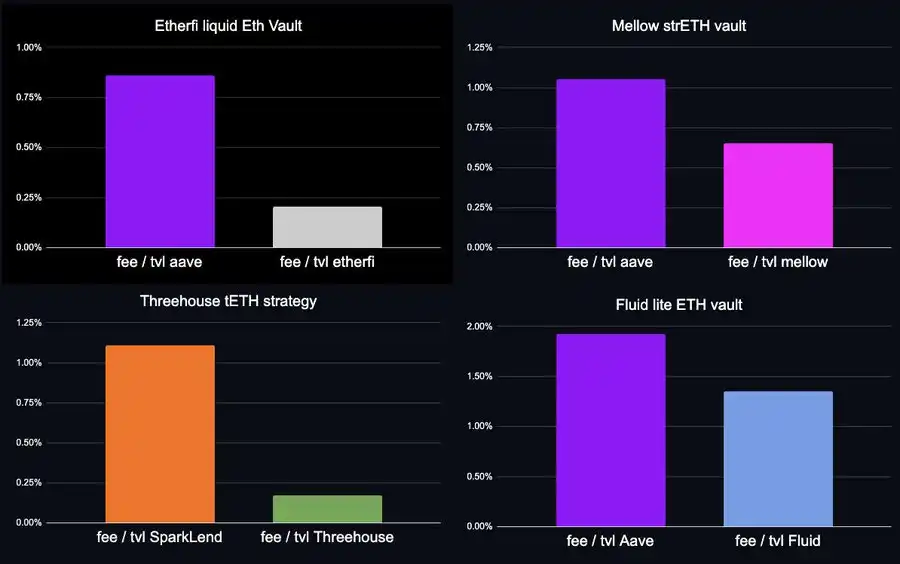
At least in the lending space, distribution is not king.

Simply put: Aave not only earns more than the various Vaults built on top of it, but also more than the issuers of the assets used for lending, such as Lido and Ether.fi.

To understand why, we need to deconstruct the complete value chain of DeFi lending and re-examine the value capture capabilities of various roles by following the flow of funds and fees.

Deconstructing the Lending Value Chain
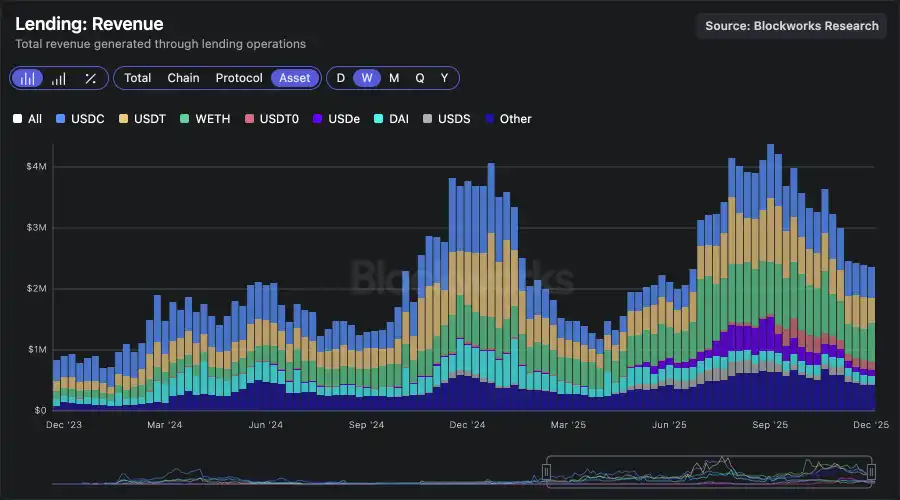
The annualized revenue scale of the entire lending market has exceeded $100 million. This value is not generated by a single link but is composed of a complex stack: the underlying settlement blockchain, asset issuers, capital lenders, the lending protocol itself, and the Vaults responsible for distribution and strategy execution.

As mentioned in previous articles, a large number of use cases in the current lending market originate from basis trading and liquidity mining opportunities, and we have deconstructed the main strategy logic.

So, who actually "demands" the capital in the lending market?

I analyzed the top 50 wallet addresses on Aave and SparkLend and labeled the main borrowers.
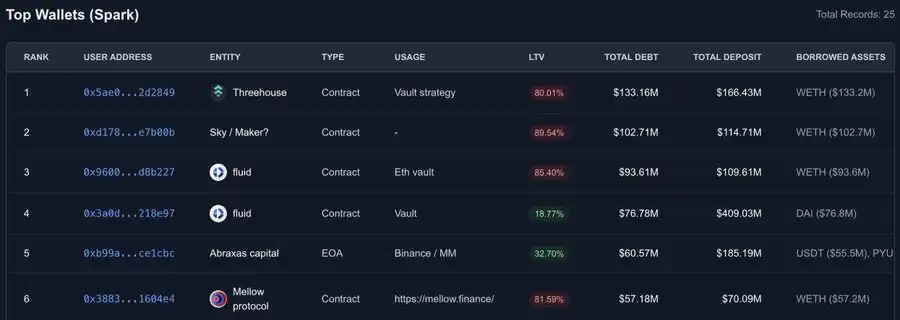
  1. The largest borrowers are various Vaults and strategy platforms like Fluid, Treehouse, Mellow, Ether.fi, Lido (who are also asset issuers). They control the distribution capability to end-users, helping users obtain higher yields without having to manage complex loops and risks themselves.
  2. There are also large institutional capital providers, such as Abraxas Capital, which deploy external capital into similar strategies. Their economic model is essentially very similar to that of Vaults.
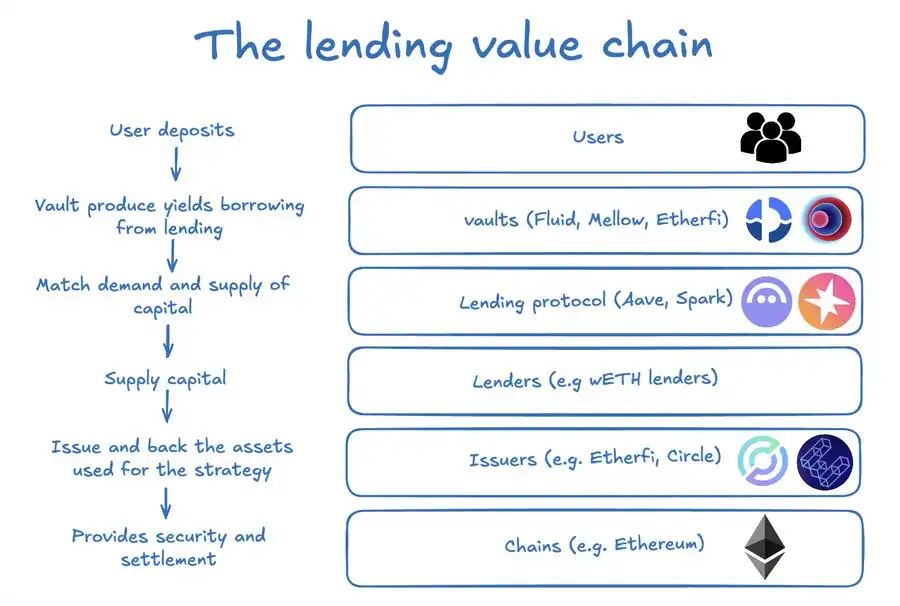
But Vaults are not the whole story. This chain involves at least the following participants:

  • Users: Deposit assets, hoping to obtain additional yield through Vaults or strategy managers.
  • Lending Protocols: Provide infrastructure and liquidity matching, generating protocol revenue by charging interest to the borrowing side and taking a cut.
  • Lenders: Capital suppliers, who can be either ordinary users or other Vaults.
  • Asset Issuers: Most on-chain lending assets have underlying collateral assets that themselves generate yield, part of which is captured by the issuer.
  • Blockchain Network: The underlying "rail" where all activity takes place.

Lending Protocols Earn More Than Downstream Vaults

Take Ether.fi's ETH liquid staking vault as an example. It is the second-largest borrower on Aave, with an outstanding loan size of approximately $1.5 billion. The strategy itself is very typical:

  • Deposit weETH (approx. +2.9%)
  • Borrow wETH (approx. –2%)
  • The vault charges a 0.5% platform management fee on TVL.

Out of Ether.fi's total TVL, approximately $215 million is the net liquidity actually deployed on Aave. This portion of TVL generates about $1.07 million in annual platform fee revenue for the vault.

However, simultaneously, this strategy pays Aave approximately $4.5 million in annual interest fees (calculated as: $1.5B borrowed × 2% borrow APY × 15% reserve factor).

Even for one of the largest and most successful loop strategies in DeFi, the value captured by the lending protocol is still multiples of that captured by the vault.
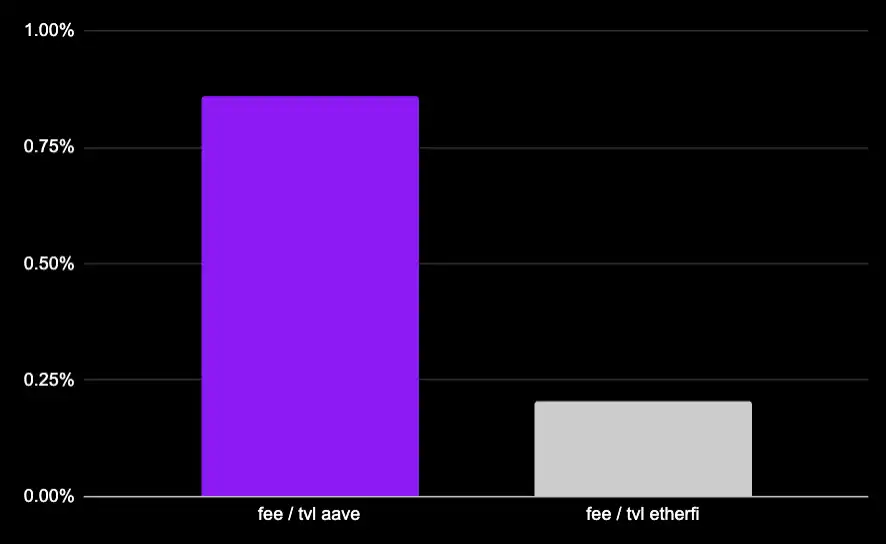
Of course, Ether.fi is also the issuer of weETH, and this vault itself directly creates demand for weETH.
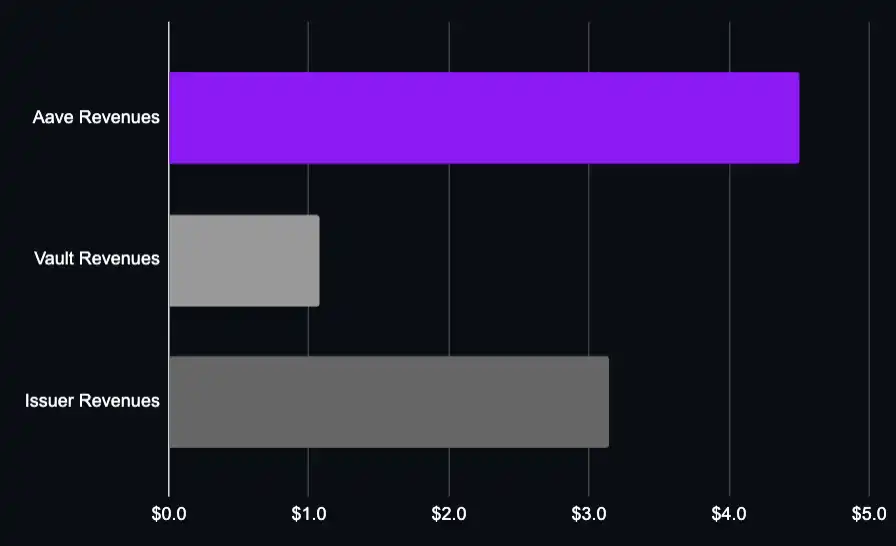
But even considering the vault strategy revenue + asset issuer revenue together, the economic value created by the lending layer (Aave) is still higher.

In other words, the lending protocol is the link in the entire stack that creates the most incremental value.

We can perform the same analysis on other commonly used vaults:

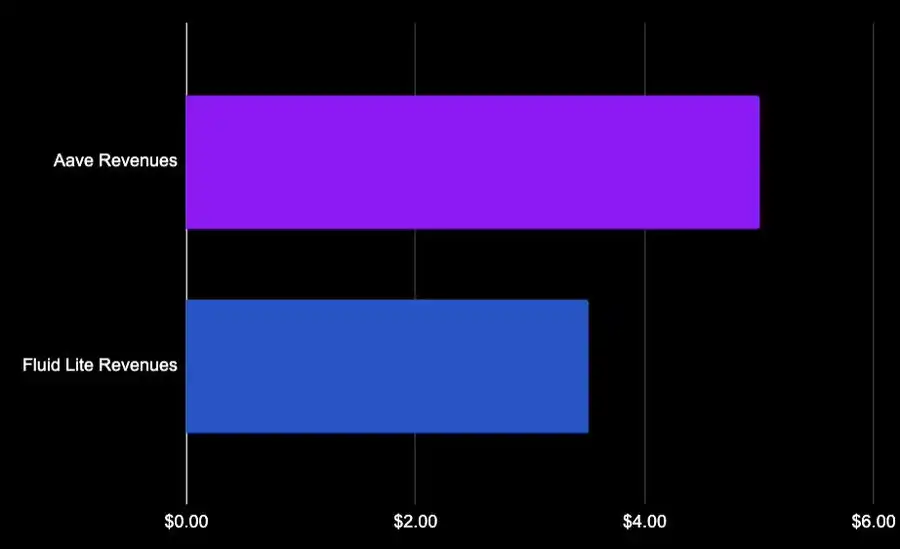
Fluid Lite ETH: 20% performance fee + 0.05% exit fee, no platform management fee. Borrows $1.7B wETH from Aave, paying ~$33M in interest, of which ~$5M goes to Aave. Fluid's own revenue is close to $4M.
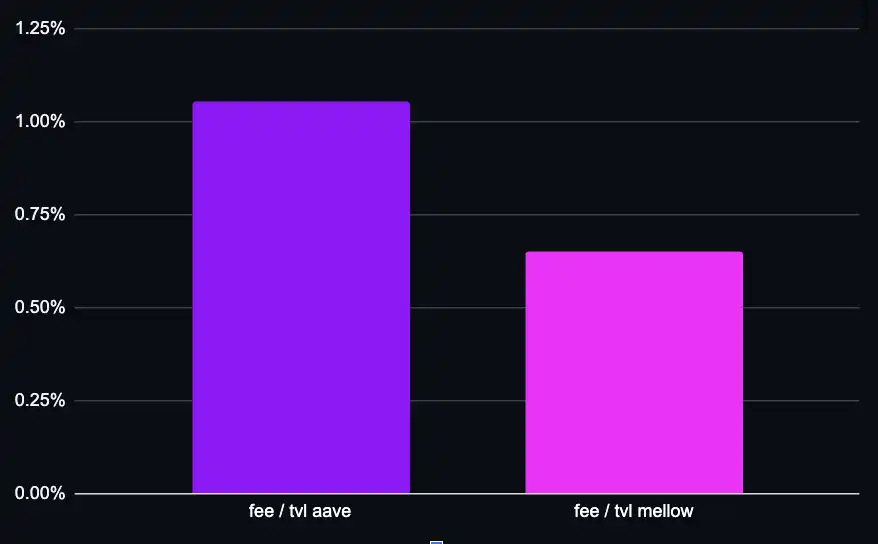
Mellow Protocol strETH charges a 10% performance fee, with a borrow size of $165M and a TVL of only ~$37M. Again, we see that on a TVL basis, Aave captures more value than the vault itself.
Let's look at another example. On SparkLend, the second-largest lending protocol on Ethereum, Treehouse is a key participant, operating an ETH loop strategy:
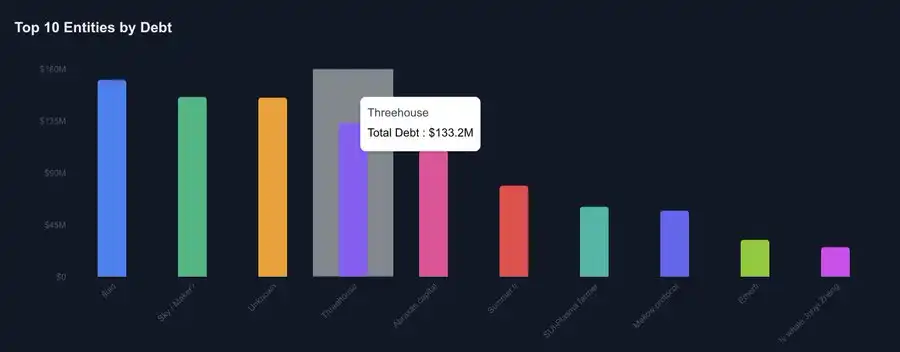
  • TVL ~$34M
  • Borrows $133M
  • Charges performance fee only on marginal yield above 2.6%
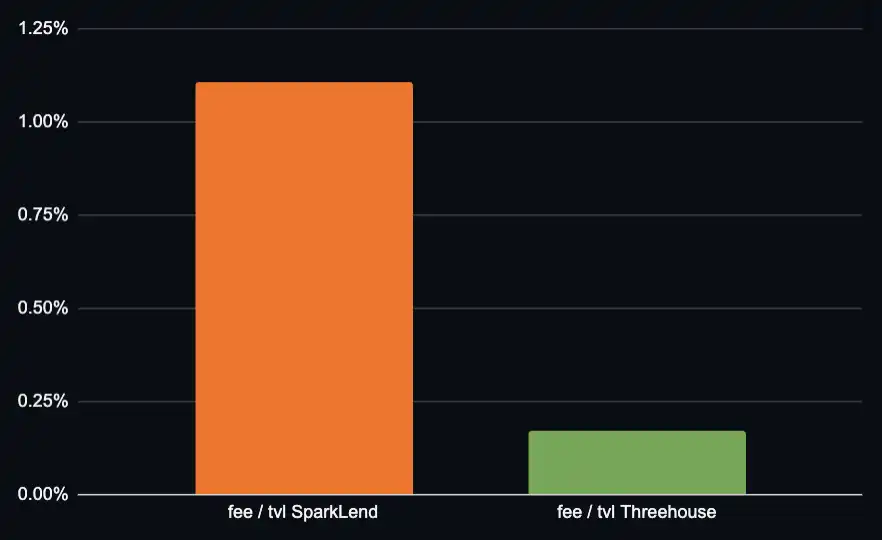
SparkLend, as a lending protocol, captures more value on a TVL basis than the vault.

The pricing structure of a vault greatly influences its own capturable value; but for lending protocols, their revenue depends more on the nominal size of borrowing, which is relatively stable.

Even shifting to USD-denominated strategies, which have lower leverage, the higher interest rates often offset this effect. I don't believe the conclusion would fundamentally change.

In relatively closed markets, more value might flow to curators, such as Stakehouse Prime Vault (26% performance fee, incentives provided by Morpho). But this is not the end state of Morpho's pricing mechanism, and curators themselves also partner with other platforms for distribution.

Lending Protocol vs. Asset Issuer

So the question arises: Is it better to be Aave or Lido?

This question is more complex than comparing vaults because staking assets not only generate yield themselves but also indirectly create stablecoin interest income for the protocol through the lending market. We can only make an approximate estimate.

Lido has approximately $4.42 billion in assets in the core Ethereum market used to support lending positions, generating annualized performance fee revenue of approximately $11 million.

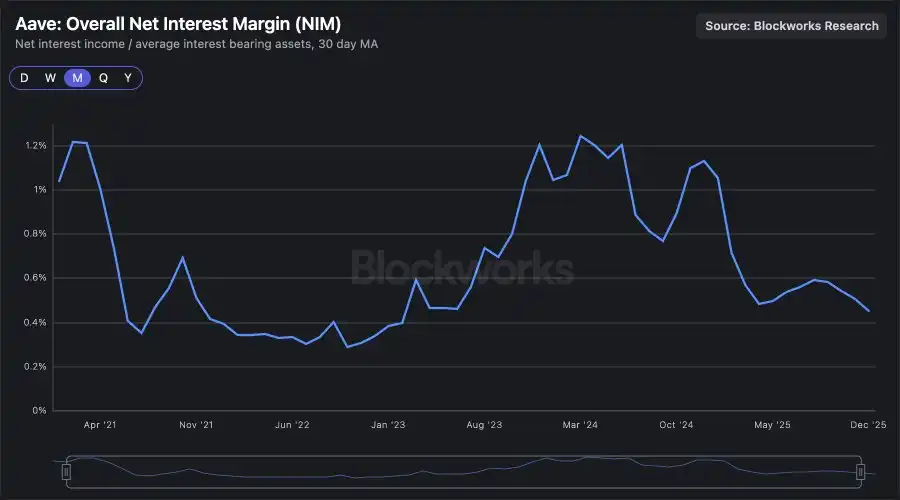
These positions roughly equally support ETH and stablecoin borrowing. At the current net interest margin (NIM) of ~0.4%, the corresponding lending yield is about $17 million, already significantly higher than Lido's direct revenue (and this is at a historically low NIM level).
The True Moat of Lending Protocols

If we only use the traditional financial deposit profitability model for comparison, DeFi lending protocols seem to be a low-margin industry. But this comparison ignores where the real moat lies.

In the on-chain credit system, the value captured by lending protocols exceeds that of the distribution layer downstream and, overall, exceeds that of the upstream asset issuers.

Viewed in isolation, lending seems like a thin-margin business; but placed within the complete credit stack, it is the layer with the strongest value capture capability relative to all other participants—vaults, issuers, distribution channels.

Related Questions

QAccording to the article, which layer in the DeFi lending value chain captures the most value?

AThe lending protocol layer, such as Aave and SparkLend, captures the most value in the entire on-chain credit value chain, even more than the downstream vaults/curators and the upstream asset issuers.

QWhat is the main reason that lending protocols can capture more value than the yield strategies (vaults) built on top of them?

AThe lending protocol's revenue is primarily determined by the nominal size of the loans, which is stable and large. In contrast, a vault's income depends heavily on its specific fee structure (e.g., performance fees) and is often a smaller portion of the total value flow, with a significant portion paid as interest to the lending protocol.

QUsing the Ether.fi vault as an example, how much more value did Aave capture compared to the vault itself?

AThe Ether.fi vault paid approximately $4.5 million in annual interest fees to Aave, while the vault itself only generated about $1.07 million in platform fee revenue from its TVL, meaning Aave captured over 4 times more value.

QBesides vaults, who are the other major borrowers in the DeFi lending market mentioned in the analysis?

AOther major borrowers include large institutional capital providers, such as Abraxas Capital, which deploy external capital into yield strategies that are economically similar to vaults.

QWhat is the key takeaway about the business of DeFi lending protocols when viewed within the entire credit stack?

AWhile lending may appear to be a low-margin business when viewed in isolation through a traditional deposit profitability lens, it actually has the strongest and most defensible moat in the entire on-chain credit value stack, capturing more value than any other participant, including distributors and asset issuers.

Related Reads

Bitroot Public Chain Invited to Attend Tencent Cloud Singapore AI Conference, Discussing the Future Alongside Solana

On May 19, Bitroot, an emerging Layer 1 blockchain, participated in the Tencent Cloud AI Summit in Singapore alongside key industry players like Solana Foundation. The event explored the intersection of AI infrastructure, enterprise applications, AI Agents, and Web3. Bitroot's invitation, despite being pre-mainnet, highlights industry interest in its focus on high-performance, AI-native architecture tailored for future AI Agent execution and verifiable on-chain automation. Bitroot CEO Juan Jose emphasized that AI competition is shifting from model performance to data, real-world application scenarios, and trust infrastructure. He argued that for AI Agents to evolve from assistants to autonomous executors managing transactions and assets, they require low-latency, low-cost, and high-throughput blockchain environments. Bitroot aims to address this through its EVM-compatible design, optimistic parallel execution, and a consensus mechanism targeting high scalability. Currently in its Testnet 5.0 phase, Bitroot reports metrics like over 50,000 peak TPS and sub-0.3 second average block time. Its narrative positions it within a growing landscape where next-generation Layer 1s like Monad and Aptos also compete on performance, while Bitroot differentiates by integrating AI computational capabilities natively across its stack. The summit underscored that the fusion of AI and Web3 is moving from concept to infrastructure competition, where networks balancing performance, security, and verifiability will be crucial for enabling scalable AI-driven applications.

marsbit7m ago

Bitroot Public Chain Invited to Attend Tencent Cloud Singapore AI Conference, Discussing the Future Alongside Solana

marsbit7m ago

Hedge Fund Q1 Interpretation: Everyone Is Selling Software, Buying Chips

Hedge Funds and Mutual Funds Aligned in Q1: Dumping Software, Buying Chips A clear consensus emerged among major U.S. hedge funds and mutual funds in Q1: they were simultaneously selling software stocks and pouring capital into the semiconductor sector. This aggressive rotation pushed semiconductor exposure in hedge fund long portfolios to a record high. Hedge funds delivered a 7% return year-to-date, while only 30% of large-cap active mutual funds outperformed their benchmarks. The average short interest for S&P 500 constituents rose to 3% of market cap, the highest since 2011. Within technology, the structural shift was stark. Hedge funds' semiconductor weighting hit an all-time high, while software fell to its lowest since 2019. Excluding Microsoft, mutual funds' relative overexposure to semis vs. software was the largest since 2012. Microsoft was among the most net-sold stocks by both groups. Hedge funds net purchased semiconductor names like LRCX and AMAT. Strategies diverged on leverage and cash. Hedge funds increased their net exposure to near a one-year high after an initial cut. Mutual funds raised their cash allocation, though it remains historically low at 1.4%. Sector alignment was high in Industrials (both overweight) but divergent in Tech: hedge funds increased their Tech net tilt by a record 853 basis points, while mutual funds reduced theirs. Clear splits also appeared in Financials and Consumer Discretionary. Four stocks appeared on both Goldman's hedge fund VIP and mutual fund overweight lists: BA, MA, MRVL, and V. This "shared favorites" basket has returned 10% YTD, outperforming the equal-weight S&P 500. Notably, all "Magnificent Seven" stocks are on the hedge fund VIP list but are uniformly underweighted by mutual funds.

marsbit17m ago

Hedge Fund Q1 Interpretation: Everyone Is Selling Software, Buying Chips

marsbit17m ago

The Evolution Path of Physical Bitcoin

The Evolution of Physical Bitcoin Bitcoin's digital nature is its core strength, enabling self-custody and rapid global transfers. However, its intangibility also hinders mainstream adoption. For over a decade, creators have attempted to materialize Bitcoin while preserving its cash-like properties, yielding notable results. Casascius Coins, launched in 2011, were the first and most iconic physical Bitcoin. Creator Mike Caldwell generated private keys offline, printed them on coins, and sealed them with tamper-evident holograms. This model relied on user trust in the centralized issuer. Production ceased in 2013 due to regulatory pressure from FinCEN. RavenBit Coins emerged in 2014 aiming to decentralize minting by letting users generate and apply their own keys. However, this led to trust issues with numerous untrusted minters and insecure key generation methods. In 2016, Coinkite introduced Opendimes—a breakthrough in bearer asset technology. These USB-shaped devices generate and store keys internally. Funds can be received by checking the public key, but spending requires physically breaking the device to extract the private key. While innovative and open-source, its cost (~$20) and form factor limit its use for small, everyday transactions. Satochip's Satodime, a card-shaped device using similar secure chip technology, followed. It supports NFC interaction and comes in various forms. While potentially cheaper in bulk (~13€), it remains a high-security hardware wallet, not a low-cost cash substitute. A fundamental cost barrier exists. For physical Bitcoin to achieve widespread commercial use, hardware costs must drop below $1 to match the production cost of fiat banknotes. Current secure chips capable of running Bitcoin's cryptographic algorithms (like secp256k1) are too expensive. Chips like NXP's NTAG X DNA (~$3) show cost-reduction potential but lack native Bitcoin curve support. Projects like OfflineCash embed chips in banknote-like paper, but face challenges with durability, the need for custom Bitcoin-enabled chips, and the inherent requirement for users to verify balances online—which conflicts with Bitcoin's trustless ideal. Coinkite's Tapsigner, a ~$20 card with a proprietary Bitcoin NFC chip, is seen as a more practical step forward. It functions as a reloadable hardware wallet for contactless payments, solving the "change" problem and focusing on real-world retail integration, a direction also pursued by companies like Cash App and Square. In summary, the journey to physical Bitcoin has progressed from trusted centralized mints (Casascius) to user-generated keys (RavenBit) and finally to self-contained secure hardware (Opendimes, Satodime, Tapsigner). The core challenge remains developing a sufficiently low-cost, durable, and truly trustless physical bearer asset that can function like cash in daily transactions. Current solutions are either too expensive or introduce new trust assumptions, keeping the ideal of ubiquitous physical Bitcoin just out of reach for now.

marsbit1h ago

The Evolution Path of Physical Bitcoin

marsbit1h ago

Trading

Spot
Futures

Hot Articles

How to Buy AAVE

Welcome to HTX.com! We've made purchasing Aave Protocol (AAVE) simple and convenient. Follow our step-by-step guide to embark on your crypto journey.Step 1: Create Your HTX AccountUse your email or phone number to sign up for a free account on HTX. Experience a hassle-free registration journey and unlock all features.Get My AccountStep 2: Go to Buy Crypto and Choose Your Payment MethodCredit/Debit Card: Use your Visa or Mastercard to buy Aave Protocol (AAVE) instantly.Balance: Use funds from your HTX account balance to trade seamlessly.Third Parties: We've added popular payment methods such as Google Pay and Apple Pay to enhance convenience.P2P: Trade directly with other users on HTX.Over-the-Counter (OTC): We offer tailor-made services and competitive exchange rates for traders.Step 3: Store Your Aave Protocol (AAVE)After purchasing your Aave Protocol (AAVE), store it in your HTX account. Alternatively, you can send it elsewhere via blockchain transfer or use it to trade other cryptocurrencies.Step 4: Trade Aave Protocol (AAVE)Easily trade Aave Protocol (AAVE) on HTX's spot market. Simply access your account, select your trading pair, execute your trades, and monitor in real-time. We offer a user-friendly experience for both beginners and seasoned traders.

5.2k Total ViewsPublished 2024.03.29Updated 2025.05.06

How to Buy AAVE

Discussions

Welcome to the HTX Community. Here, you can stay informed about the latest platform developments and gain access to professional market insights. Users' opinions on the price of AAVE (AAVE) are presented below.

活动图片