Fortune Exclusive: a16z Crypto Fund AUM Plummets 40%, Multicoin Halved, Top Crypto VCs Shrink Collectively

marsbitPublished on 2026-04-17Last updated on 2026-04-17

Abstract

According to exclusive SEC filings obtained by Fortune, leading crypto venture capital firms, including a16z crypto, Multicoin Capital, Pantera Capital, and Paradigm, experienced significant declines in their assets under management (AUM) in 2025. a16z crypto's AUM dropped nearly 40% to $9.5 billion, partly due to strategic distributions to LPs at market highs, with its first fund achieving a 5.4x DPI. Multicoin’s AUM was halved to approximately $2.7 billion, impacted by market volatility and crypto price corrections. Pantera also saw AUM shrink, though this was partly attributed to successful exits, including five portfolio company IPOs. In contrast, Haun Ventures grew its AUM by over 30% to nearly $2.5 billion, driven by a successful exit in the stablecoin sector and new fundraising. Despite the downturn, several firms are raising new funds, with a16z targeting up to $2 billion and Paradigm seeking up to $1.5 billion, indicating continued long-term confidence in the crypto market's cyclical nature.

Author: Ben Weiss

Compiled by: Deep Tide TechFlow

Deep Tide Guide: Fortune reporters obtained previously undisclosed financial disclosure documents of crypto VCs from the SEC. The data shows that the assets under management (AUM) of leading institutions such as Paradigm, Pantera, a16z crypto, and Multicoin have shrunk across the board in 2025. However, the shrinkage is not all bad news—a16z crypto returned money to LPs at the market peak, with the first fund's DPI reaching 5.4x. The only one that grew against the trend was Haun Ventures, which hit the stablecoin track by betting on BVNK's acquisition by Mastercard.

Top crypto VC players failed to escape the market crash of 2025.

Fortune reporter Ben Weiss obtained a batch of previously undisclosed investment advisor financial disclosure documents from the U.S. Securities and Exchange Commission (SEC). The data is straightforward: the AUM of top institutions like Paradigm and Pantera Capital collectively shrunk in 2025.
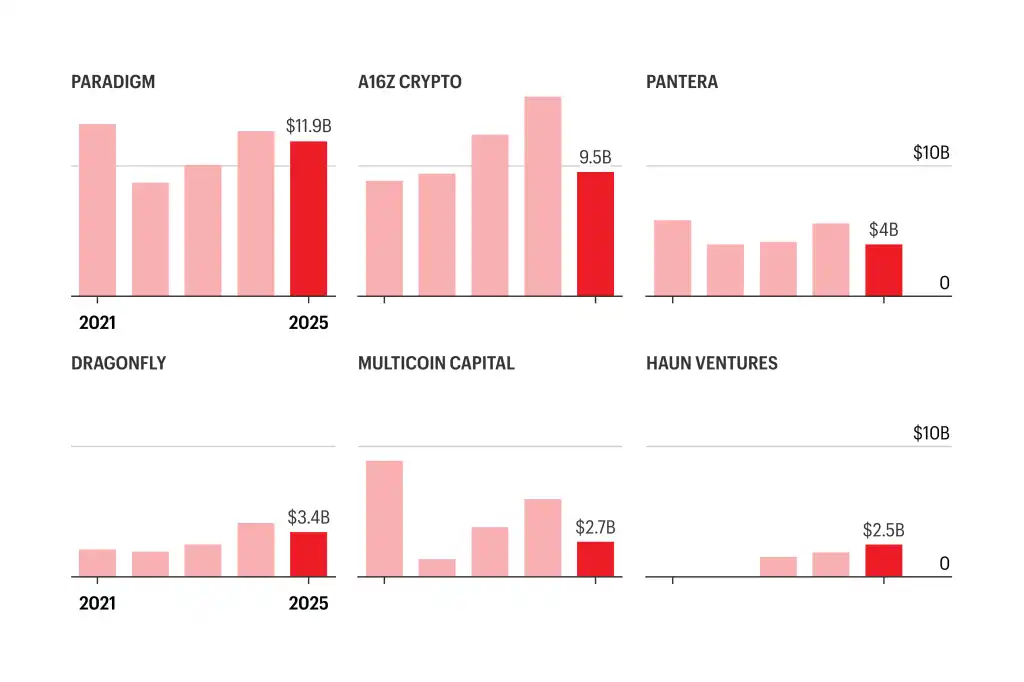
Caption: Changes in AUM of top crypto VCs from 2021 to 2025

Chart by: Ben Weiss / Fortune

But before listing the numbers, there's a premise to clarify: AUM is not a good indicator of VC success or failure. It does not reflect new rounds of financing, LP exit distributions, or capital calls. Crypto asset prices themselves are highly volatile—a tweet from a moody man can send prices on a roller coaster (Elon Musk, Donald Trump, Changpeng Zhao, take your pick). Veteran crypto VCs have experienced asset surges during the 2021 NFT frenzy and subsequent portfolio plunges during the "crypto winter."

Original author Ben Weiss also emphasized: Truly top investors ultimately return money to LPs. Short-term AUM changes do not equal performance quality.

With that premise clear, let's look at the specific data.

a16z crypto: AUM shrunk nearly 40%, but money returned to LPs

The combined AUM of a16z crypto's four crypto funds plummeted nearly 40% from 2024, dropping to $9.5 billion. During the same period, the parent company Andreessen Horowitz's assets under management swelled to over $100 billion.

Part of the reason for the shrinkage is that the institution began distributing returns from the first three funds back to LPs. According to informed sources, a16z crypto intentionally chose to make distributions at the 2025 crypto market peak.

How effective was it? According to Newcomer data, a16z's first crypto fund achieved a net DPI (Distributed to Paid-In capital ratio) of 5.4x. Compared to other VC funds raised in the same period in 2018 on the Carta platform, this return rate is quite impressive.

In other words, the AUM shrinkage for a16z crypto is more a result of "making money and returning it to LPs" rather than "plummeting holdings."

Multicoin: AUM halved to $2.7 billion

Multicoin Capital's fate is deeply tied to the crypto market. During the 2021 crypto frenzy, its AUM nearly tripled in a year, approaching $9 billion. After FTX collapsed, it plummeted directly, then gradually rebounded over the next two years.

But the 2025 downturn hit it again. From 2024 to 2025, Multicoin's AUM shrunk by more than half, falling to approximately $2.7 billion. Since BTC began its dive in October 2025, crypto assets have retreated across the board, and Multicoin's structure—which operates both hedge funds and VC funds—was hit hardest.

Additional context: Multicoin co-founder Kyle Samani left the company in February this year, turning to invest in other areas of technology.

Pantera: Five portfolio companies IPO, capital returned to LPs

Pantera Capital's AUM also shrunk, but similar to a16z, part of the reason is active distributions to LPs.

According to informed sources, Pantera had five portfolio companies go public in 2025, including Circle and BitGo. These exits brought significant cash returns.

Haun Ventures: The only one growing against the trend, AUM up over 30%

Amid the widespread shrinkage, Haun Ventures is the only exception.

The institution, founded by former a16z crypto partner Katie Haun, saw its AUM increase by over 30% year-on-year, approaching $2.5 billion. This is partly due to betting on the right track—its investment in stablecoin company BVNK was acquired by Mastercard for up to $1.8 billion. Additionally, Haun Ventures itself raised a new $1 billion fund in 2025.

New fundraising rounds have begun

Although AUM has shrunk, top institutions have not stopped:

Paradigm is raising a new fund of up to $1.5 billion. a16z crypto is raising up to $2 billion. Dragonfly just closed its $650 million fourth fund. Post-publication correction by Fortune: A Dragonfly spokesperson actually responded, confirming the data is "accurate" and stating, "We are actively deploying capital."

Spokespersons for Paradigm, Pantera, a16z crypto, Multicoin, and Haun Ventures all declined to comment.

The cyclical fate of crypto VCs

The original article ends here, but a few background points are worth adding.

Crypto VCs are fundamentally different from traditional tech VCs. Traditional VCs invest in equity, exiting through IPOs or M&A. Many crypto startups have their own tokens, and VCs' holdings are directly exposed to token price fluctuations.

Multicoin is the most extreme case: According to a previous Fortune report, its assets increased by 20,287% from 2017 to 2021, then retreated 90% in 2022. This magnitude is unimaginable in the traditional VC field.

According to Pantera Capital's outlook report earlier this year, the total crypto market cap excluding BTC (also excluding ETH and stablecoins) fell about 44% from the end of 2024 highs. But according to historical patterns, bear markets are also windows for bottom-fishing. The intensive fundraising efforts by several leading institutions at this moment are betting on the next cycle.

According to a previous Fortune exclusive report, a16z crypto's fifth fund is planned to complete fundraising in the first half of 2026, led by Chris Dixon, and will continue to fully bet on the blockchain direction. Paradigm's new fund, according to The Wall Street Journal, will expand into AI and robotics technology. The strategic divergence is clear: a16z continues all-in on crypto, while Paradigm chooses cross-sector hedging.


Related Questions

QAccording to the article, which major crypto VC firm saw its AUM decrease by nearly 40% in 2025?

Aa16z crypto saw its AUM decrease by nearly 40% in 2025.

QWhat was the primary reason for the AUM decline at a16z crypto, as explained in the article?

AThe primary reason for the AUM at a16z crypto was that the firm chose to distribute returns from its first three funds back to its LPs during the 2025 crypto market peak.

QWhich crypto VC was the only one mentioned to experience AUM growth in 2025, and what was a key reason for this growth?

AHaun Ventures was the only crypto VC to experience AUM growth, increasing by over 30%. A key reason was its successful investment in the stablecoin company BVNK, which was acquired by Mastercard for up to $1.8 billion.

QWhat significant event involving five of its portfolio companies contributed to Pantera Capital's AUM decrease?

APantera Capital's AUM decrease was partly due to it distributing capital back to its LPs following the successful IPOs of five of its portfolio companies, including Circle and BitGo.

QHow does the article describe the fundamental difference between crypto VC and traditional tech VC regarding their investments?

AThe article states that traditional VCs invest in equity and exit via IPOs or acquisitions, while many crypto startups have their own tokens, meaning a crypto VC's holdings are directly exposed to the volatility of token prices.

Related Reads

You Bet on the News, the Pros Read the Rules: The True Cognitive Gap in Losing Money on Polymarket

The article explains that the key to profiting on Polymarket, a prediction market platform, lies not just predicting real-world events correctly, but in meticulously understanding the specific rules that govern how each market will be resolved. It illustrates this with examples, such as a market on Venezuela's 2026 leader, where the official rules defining "officially holds" the office overruled the intuitive answer of who was in practical control. Other examples include debates over the definition of a "token" or what constitutes an "agreement." The core argument is that a "reality vs. rules" gap creates pricing discrepancies that savvy traders ("车头" or "whales") exploit. The platform has a formal dispute resolution process managed by UMA token holders to settle ambiguous outcomes. This process involves proposal submission, a challenge window, a discussion period, and a final vote. However, the article highlights a critical flaw in this system compared to a traditional court: the lack of separation between the arbiters (UMA voters) and the interested parties (traders with financial stakes in the outcome). This conflict of interest undermines the discussion phase, leads to herd mentality, and results in opaque final decisions without explanatory rulings. Consequently, the system lacks a body of precedent, making it difficult for users to learn from past disputes. The ultimate takeaway is that success on Polymarket requires a lawyer-like scrutiny of the rules to identify and capitalize on the cognitive gap between how events appear and how they are contractually defined for settlement.

marsbit46m ago

You Bet on the News, the Pros Read the Rules: The True Cognitive Gap in Losing Money on Polymarket

marsbit46m ago

Will the Fed Still Cut Interest Rates? Tonight's Data Is Crucial

The core debate surrounding the Federal Reserve's potential interest rate cuts is intensifying amid geopolitical conflict and rebounding inflation. The key question is whether high energy prices will cause persistent inflation or weaken consumer demand enough to force the Fed to cut rates. Citigroup presents a bullish case for cuts, arguing that oil supply disruptions from the Strait of Hormuz are temporary and will not lead to lasting inflationary pressure. They point to receding bond yields and oil prices as evidence the market is pricing in a short-lived shock. Citi's data also shows tightening financial conditions, a stabilizing labor market, and healthy tax returns, supporting their view that the path to lower rates remains open. Conversely, Deutsche Bank offers a starkly contrasting, more hawkish outlook. They argue the Fed's current policy is already neutral and expect rates to remain unchanged indefinitely. Their view is based on stalled disinflation progress and a shift toward more hawkish rhetoric from key Fed officials like Waller, who cited risks from prolonged Middle East conflict and tariffs. Other officials, including Williams and Hammack, signaled rates would likely stay on hold for a "considerable time." The market pricing has shifted dramatically, now forecasting zero cuts in 2026. The imminent release of the March retail sales "control group" data is highlighted as a critical test. This metric, which excludes gas station sales, will reveal if high gasoline prices are eroding consumer spending in other areas. A weak reading could support the case for imminent rate cuts, while a strong one would bolster the argument for the Fed to hold steady. This data is pivotal for determining the near-term policy path.

marsbit1h ago

Will the Fed Still Cut Interest Rates? Tonight's Data Is Crucial

marsbit1h ago

Trading

Spot
Futures
活动图片




