Former UK Prime Minister Calls Bitcoin A ‘Giant Ponzi Scheme’, Strategy’s Saylor Replies

bitcoinistPublished on 2026-03-15Last updated on 2026-03-15

Abstract

Former UK Prime Minister Boris Johnson labeled Bitcoin a "giant Ponzi scheme" in a Daily Mail column, arguing it lacks intrinsic value and real-world utility, operates on the "greater fool" theory, and is riskier than traditional assets like gold or even Pokémon cards. He also expressed concerns about crypto fraud impacting ordinary investors. In response, MicroStrategy’s Michael Saylor refuted the claim, stating Bitcoin has no central operator or promised returns, distinguishing it from a Ponzi scheme. He described Bitcoin as a decentralized network driven by code and market demand. BTC was trading around $70,590 at the time of writing.

Former Prime Minister of the United Kingdom, Boris Johnson, said he has always feared that Bitcoin is a “giant Ponzi scheme,” with the latest stories around the cryptocurrency appearing to prove him right.

Former Prime Minister Johnson Calls Pokémon Cards A Better Bet Than BTC

In a March 13 Daily Mail column, former UK Prime Minister Boris Johnson shared his thoughts about Bitcoin, the world’s largest cryptocurrency by market capitalization. According to the former political leader, Bitcoin and other crypto assets are a Ponzi scheme because they lack intrinsic value and sufficient real-world uses.

Johnson argued that Bitcoin relies on the “greater fool” theory and is sustained by the collective belief that endless new buyers will emerge. Sharing the story of an aggrieved local investor, the former UK leader warned that ordinary people are increasingly falling victim to crypto-related fraud.

Johnson compared the flagship cryptocurrency to traditional stores of value, such as gold and fiat currency, while claiming that Pokémon cards are a safer long-term bet than the world’s largest cryptocurrency. While noting the historic allure of gold and the sentimental value of vintage Pikachu cards, the former Prime Minister called Bitcoin “strings of numbers” with no central authority or accountability.

In fact, Johnson argued that decentralization, a unique selling point of cryptocurrencies, is their greatest weakness. In his Daily Mail column, the former Mayor of London predicted that the eroding confidence — especially among regular people — will be the cause of Bitcoin’s end.

Interestingly, contrary to his latest comments in his Daily Mail column, Johnson’s own administration was quite instrumental in opening the UK’s doors to the digital asset industry. In April 2022, the then-Chancellor of the Exchequer, Rishi Sunak, unveiled a significant initiative to make the United Kingdom a “global hub for cryptoasset technology and investment.”

Bitcoin Is Not A Ponzi Scheme: Michael Saylor

Expectedly, Johnson’s comments about the premier cryptocurrency sparked interesting reactions from different corners of the crypto community. Strategy’s founder and chairman, Michael Saylor, produced one of the loudest rebuttals to the former Prime Minister’s claims.

Saylor, in a reply on X (formerly Twitter), said that Bitcoin is not a Ponzi scheme. Using the definition of a Ponzi scheme, the Strategy chairman reiterated that the flagship cryptocurrency has no “central operator promising returns and paying early investors with funds from later ones,’ as often required by Ponzi schemes.

Saylor wrote:

Bitcoin has no issuer, no promoter, and no guaranteed return—just an open, decentralized monetary network driven by code and market demand.

Saylor has been one of the most vocal supporters of Bitcoin, with his company’s steady acquisition a proof of his belief in Bitcoin’s long-term promise. As of this writing, the price of BTC stands at around $70,590, reflecting a 1.4% decline in the past 24 hours.

The price of BTC on the daily timeframe | Source: BTCUSDT chart on TradingView

Related Questions

QWhat did former UK Prime Minister Boris Johnson call Bitcoin in his Daily Mail column?

ABoris Johnson called Bitcoin a 'giant Ponzi scheme'.

QAccording to Johnson, what is a safer long-term bet than Bitcoin?

AJohnson claimed that Pokémon cards are a safer long-term bet than Bitcoin.

QWhat did Michael Saylor say is required for a Ponzi scheme that Bitcoin does not have?

AMichael Saylor stated that a Ponzi scheme requires a central operator promising returns and paying early investors with funds from later ones, which Bitcoin does not have.

QWhat did Saylor describe Bitcoin as instead of a Ponzi scheme?

ASaylor described Bitcoin as 'an open, decentralized monetary network driven by code and market demand'.

QWhat significant initiative did Rishi Sunak unveil in April 2022 regarding the UK and crypto?

AIn April 2022, Rishi Sunak unveiled an initiative to make the United Kingdom a 'global hub for cryptoasset technology and investment'.

Related Reads

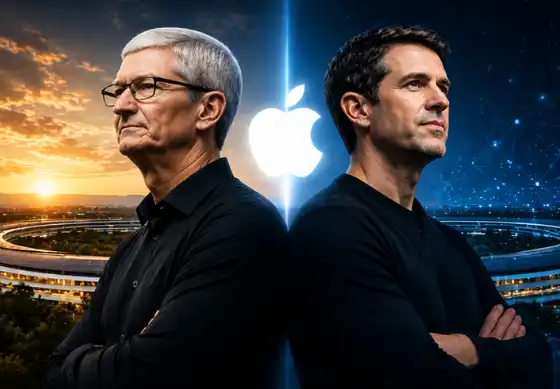
Cook's Curtain Call and Ternus Takes the Helm: The Disruption and Reboot of Apple's 4 Trillion Dollar Empire

Tim Cook has officially announced he will step down as CEO of Apple in September, transitioning to executive chairman after a 15-year tenure during which he grew the company’s market value from around $350 billion to nearly $4 trillion. He will be succeeded by John Ternus, a 50-year-old hardware engineering veteran who has been groomed for the role through increasing public visibility and internal responsibility. Ternus’s appointment signals a strategic shift toward hardware and engineering leadership, with Johny Srouji—head of Apple Silicon—taking on an expanded role as Chief Hardware Officer. This consolidation aims to strengthen Apple’s core technological capabilities. However, Cook’s departure highlights a significant unresolved issue: Apple’s delayed and fragmented approach to artificial intelligence. Despite early efforts, such as hiring John Giannandrea from Google in 2018, Apple’s AI initiatives—particularly around Siri—have struggled with internal restructuring and reliance on external partnerships, including with Google. The transition comes at a critical moment as Apple faces paradigm shifts with the rise of artificial general intelligence (ASI). The company’s closed ecosystem of hardware, software, and services—once a major advantage—now presents challenges in adapting to an AI-centric world where intelligence may matter more than the device itself. Ternus must quickly articulate a clear AI strategy, possibly starting at WWDC, to reassure markets and redefine Apple’s role in a new technological era. His task is not only to maintain Apple’s operational excellence but also to reinvigorate its capacity to innovate and lead in the age of AI.

marsbit46m ago

Cook's Curtain Call and Ternus Takes the Helm: The Disruption and Reboot of Apple's 4 Trillion Dollar Empire

marsbit46m ago

Trading

Spot
Futures
活动图片