First Primary Battle: How Is the Crypto Industry Heavily Betting on the Continuation of Trump's Agenda?

比推Published on 2026-03-04Last updated on 2026-03-04

Abstract

The 2026 US midterm primary season begins, with crypto industry super PACs like Fairshake deploying over $288 million to influence key races in Texas, North Carolina, and Arkansas. Their goal is to elect pro-crypto candidates and secure a "pro-crypto Congress" to pass the stalled CLARITY Act, which aims to clarify SEC/CFTC regulatory roles and allow institutional crypto adoption. In Texas, PACs are targeting anti-crypto Democrat Al Green while supporting opponents like Christian Menefee. Similar efforts are underway in North Carolina to unseat incumbents seen as obstacles. The industry is heavily aligned with Trump’s pro-crypto agenda, following his signing of the GENIUS Act for stablecoins in 2025. With the CLARITY Act stuck in the Senate due to partisan disputes and election-year politics, crypto groups are spending heavily in primaries to ensure legislative support. The outcome could determine whether Trump’s crypto policies, like Bitcoin reserves and DeFi deregulation, move forward or face further delays.

Author: Sanqing, Foresight News

Original Title: U.S. Midterm Elections Kick Off, Crypto Industry Heavily Backs Trump's Pro-Crypto Agenda


March 3 (Eastern Time) marked the official start of the 2026 U.S. midterm election primary season. Voters in Texas, North Carolina, and Arkansas were the first to cast their votes, deciding the nominees for several congressional Senate and House seats. This early battle, seen as a bellwether for the continuation of the "Trump era," not only impacts the power dynamics in Congress but also directly relates to the long-awaited process of regulatory clarity for the crypto industry.

The crypto industry's involvement this time is earlier and heavier than in the 2024 cycle. Fairshake and its affiliated super political action committees (PACs, including Protect Progress, Defend American Jobs, etc.) started the year with nearly $200 million in cash on hand, with total industry contributions exceeding $288 million. Their goal is to secure a "pro-crypto Congress," push through remaining legislation like the "CLARITY Act" (Digital Asset Market Clarity Act), and avoid permanent setbacks due to election-year delays.

Three-State Primaries: Crypto PACs' Precise "Sniping" and "Escort"

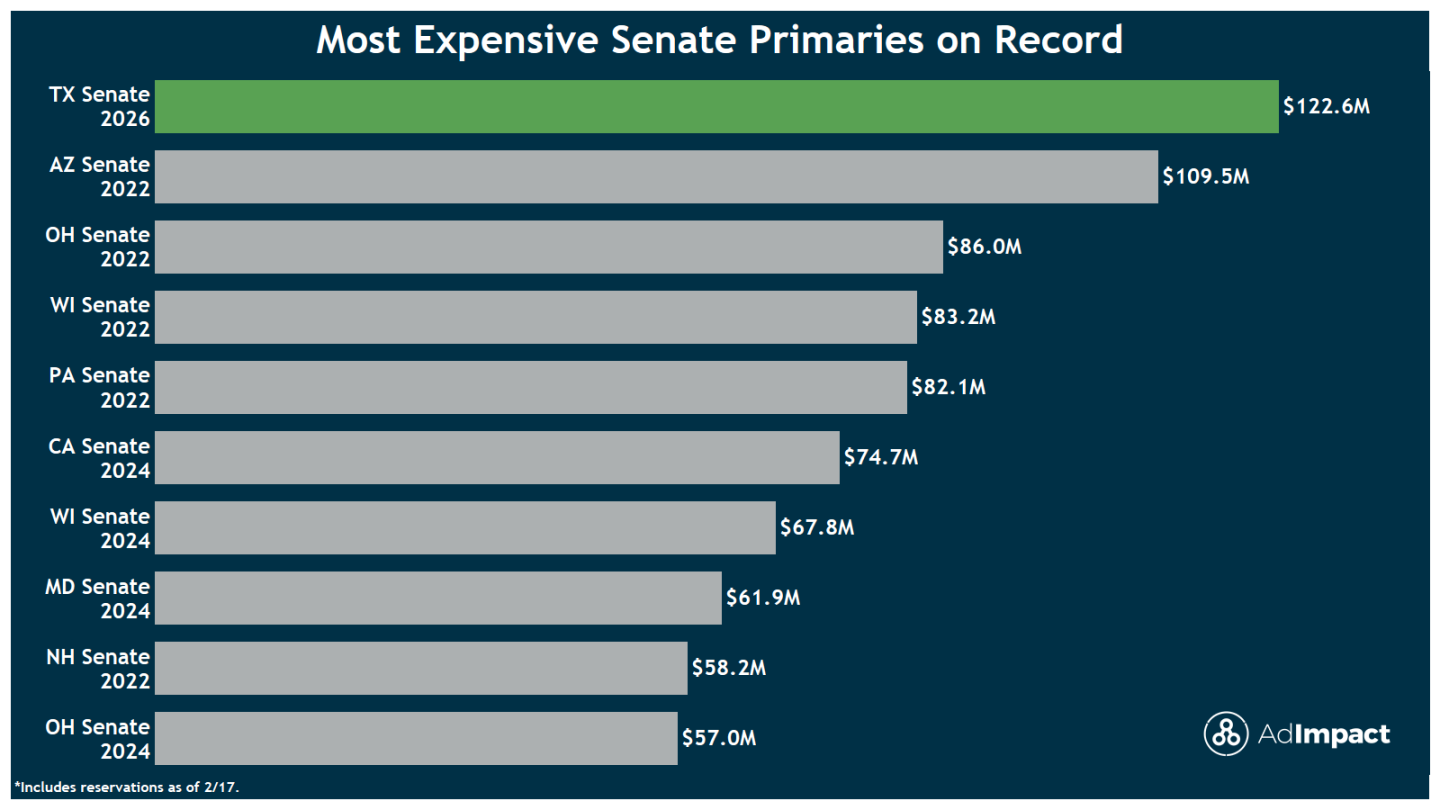
According to data from political ad tracking platform AdImpact, ad spending related to the Texas Senate primary alone has exceeded $122 million, making it the most expensive Senate primary in history.

Image Source: AdImpact Blogs | Data as of February 27

The crypto industry's political strategy has become highly sophisticated: adhering to the principle of "pro-crypto in, anti-crypto out," no longer blindly aligning with a single party.

Texas has become one of the crypto industry's most significant battlegrounds. Protect Progress has announced a $1.5 million ad buy to publicly oppose Democratic Representative Al Green.

Green previously voted against the "GENIUS Act" signed by Trump and has consistently obstructed the "CLARITY Act," earning a "strongly anti-crypto" rating from Stand With Crypto. His opponent, Christian Menefee, is rated "strongly pro-crypto."

Crypto PACs like Web3 Forward have also funneled indirect support worth millions of dollars to Democratic Senate candidate Jasmine Crockett through media ads and other means.

Crockett previously voted for the "GENIUS Act" and FIT21 (a precursor to the "CLARITY Act") but explicitly opposed the final version of the "CLARITY Act."

North Carolina is also seeing intense action. Crypto funds have injected $500,000 to support Republican challenger Laurie Buckhout in her bid to unseat Democratic incumbent Representative Don Davis (NC-01 district). Davis narrowly defeated Buckhout in 2024; with the district now leaning more Republican after redistricting, the crypto industry hopes to capitalize on this opportunity for a change.

Meanwhile, Democratic incumbent Representative Valerie Foushee in the NC-04 district primary is facing an intra-party challenge from progressive candidate Nida Allam. Foushee accepted crypto-related donations in 2022, but the primary focus this year has shifted to data center and AI issues. The crypto industry clearly hopes to use this opportunity to further ensure key positions, like those on the House Financial Services Committee, are held by more steadfast allies.

While Arkansas hasn't seen massive single investments, as one of the Senate seat races, its primary outcome will affect the Republican Party's slim majority in the Senate—a core variable in the "CLARITY Act" being stalled there.

Trump Term Effect: From "Candidate Promise" to "Presidential Push"

At the start of his second term, Trump designated crypto as a national strategic priority. He publicly declared his intention to make the U.S. the "global crypto capital" and directly called out Wall Street banks on social media, stating they "must make a good deal with the crypto industry," otherwise the "CLARITY Act" would go to China.

White House Crypto Policy Advisor Patrick Witt更是直言, regulatory clarity would unlock "trillions of dollars" in institutional funds waiting on the sidelines.

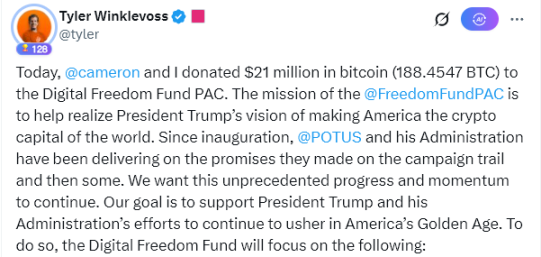
Because of this, the crypto industry's "loyalty" to Trump is unprecedentedly high. Some founders have shifted to explicitly pro-Trump PACs like the Digital Freedom Fund, with Gemini exchange co-founders Cameron and Tyler Winklevoss contributing a single donation of $21 million in Bitcoin.

Image Source: Tyler's Tweet

The industry is no longer satisfied with "bipartisan balance" but is instead全力巩固 (working全力 to consolidate) the Republican majority, ensuring Trump's executive orders and legislative agenda proceed seamlessly.

If the primary results in these three states favor pro-crypto candidates, Trump's ability to execute crypto policies within 2026 is expected to significantly increase.

Conversely, if anti-crypto or neutral candidates break through, Trump's visions like the national Bitcoin reserve plan and DeFi regulatory loosening will face resistance.

Crypto Bill Progress: GENIUS Enacted, CLARITY Becomes an "Election Year Gamble"

Currently, crypto legislation has achieved a阶段性胜利 (phased victory). The "GENIUS Act" was signed into law by Trump in 2025, providing a clear path for dollar stablecoins like USDT and USDC, greatly boosting confidence in the RWA sector.

But the "CLARITY Act" remains stuck in the Senate. The House passed it in July 2025. The bill aims to clarify the regulatory分工 (division of labor) between the SEC and CFTC, define the nature of mature blockchain assets, and open channels for institutional entry.

However, the Senate Banking Committee has repeatedly delayed review due to controversies over "stablecoin收益权" (profit rights for stablecoins), "DeFi treatment," and "Trump family conflict of interest clauses."

Trump personally intervened, and the White House has多次召集 (convened multiple) closed-door meetings with bank and crypto executives, but the election-year reality looms: after July, Congress enters "campaign mode," leaving a very narrow window for the "CLARITY Act."

If Democrats regain the House majority in the midterms, or if Republicans face internal分裂 (splits), the "CLARITY Act" could be completely scrapped,甚至迎来监管反弹 (or even face a regulatory backlash).

The hundreds of millions from Fairshake and other PACs are essentially "buying insurance" for this scenario. They aim to "purge" opponents through the primaries, paving the way for the final Senate vote.

Results from the various districts in the three states will be announced today.


Twitter:https://twitter.com/BitpushNewsCN

Bitpush TG Discussion Group:https://t.me/BitPushCommunity

Bitpush TG Subscription: https://t.me/bitpush

Original Link:https://www.bitpush.news/articles/7616715

Related Questions

QWhat is the main goal of the crypto industry's significant financial investment in the 2026 U.S. midterm elections?

AThe crypto industry aims to secure a 'pro-crypto Congress' to advance regulatory clarity, particularly by pushing for the passage of the CLARITY Act and preventing election-year delays that could lead to permanent setbacks.

QWhich states are highlighted as key battlegrounds in the primary elections for crypto industry influence?

ATexas, North Carolina, and Arkansas are the key states where the crypto industry is heavily investing to influence primary election outcomes in favor of pro-crypto candidates.

QHow much money has the crypto industry allocated through Fairshake and its associated super PACs for the elections?

AFairshake and its associated super PACs, including Protect Progress and Defend American Jobs, have nearly $200 million in cash at the beginning of the year, with total industry contributions exceeding $288 million.

QWhat major crypto legislation has already been signed into law during Trump's second term, and what does it achieve?

AThe GENIUS Act was signed into law in 2025, providing a clear regulatory path for dollar stablecoins like USDT and USDC, which has significantly boosted confidence in the RWA (Real World Assets) sector.

QWhy is the CLARITY Act currently stalled in the Senate, and what are the risks if it is not passed?

AThe CLARITY Act is stalled in the Senate due to controversies over stablecoin profit rights, DeFi treatment, and clauses related to Trump family conflicts of interest. If not passed, it risks being completely abandoned, especially if Democrats regain the House majority or if Republican unity fractures, potentially leading to regulatory backlash.

Related Reads

Cook's Curtain Call and Ternus Takes the Helm: The Disruption and Reboot of Apple's 4 Trillion Dollar Empire

Tim Cook has officially announced he will step down as CEO of Apple in September, transitioning to executive chairman after a 15-year tenure during which he grew the company’s market value from around $350 billion to nearly $4 trillion. He will be succeeded by John Ternus, a 50-year-old hardware engineering veteran who has been groomed for the role through increasing public visibility and internal responsibility. Ternus’s appointment signals a strategic shift toward hardware and engineering leadership, with Johny Srouji—head of Apple Silicon—taking on an expanded role as Chief Hardware Officer. This consolidation aims to strengthen Apple’s core technological capabilities. However, Cook’s departure highlights a significant unresolved issue: Apple’s delayed and fragmented approach to artificial intelligence. Despite early efforts, such as hiring John Giannandrea from Google in 2018, Apple’s AI initiatives—particularly around Siri—have struggled with internal restructuring and reliance on external partnerships, including with Google. The transition comes at a critical moment as Apple faces paradigm shifts with the rise of artificial general intelligence (ASI). The company’s closed ecosystem of hardware, software, and services—once a major advantage—now presents challenges in adapting to an AI-centric world where intelligence may matter more than the device itself. Ternus must quickly articulate a clear AI strategy, possibly starting at WWDC, to reassure markets and redefine Apple’s role in a new technological era. His task is not only to maintain Apple’s operational excellence but also to reinvigorate its capacity to innovate and lead in the age of AI.

marsbit9m ago

Cook's Curtain Call and Ternus Takes the Helm: The Disruption and Reboot of Apple's 4 Trillion Dollar Empire

marsbit9m ago

Trading

Spot
Futures

Hot Articles

Discussions

Welcome to the HTX Community. Here, you can stay informed about the latest platform developments and gain access to professional market insights. Users' opinions on the price of S (S) are presented below.

活动图片