Ethereum whales scoop up ETH worth $74M – Any effect on the price?

ambcryptoPublished on 2026-01-23Last updated on 2026-01-23

Abstract

Ethereum's price has declined, hovering around $2,944, down 2.2% daily and 11% weekly. Despite the bearish pressure, whales have been actively accumulating ETH. One whale purchased 20,013 ETH worth $59 million, while another bought 5,099 ETH worth $15.14 million after three months of inactivity. In total, whales acquired 25,112 ETH valued at $74.14 million, indicating strong demand in the $2.9k to $3.1k range. However, this whale activity has not offset the overall market selling pressure. Bearish momentum persists, and if it continues, ETH could drop to $2.5k before a potential rise to $3.4k in early February.

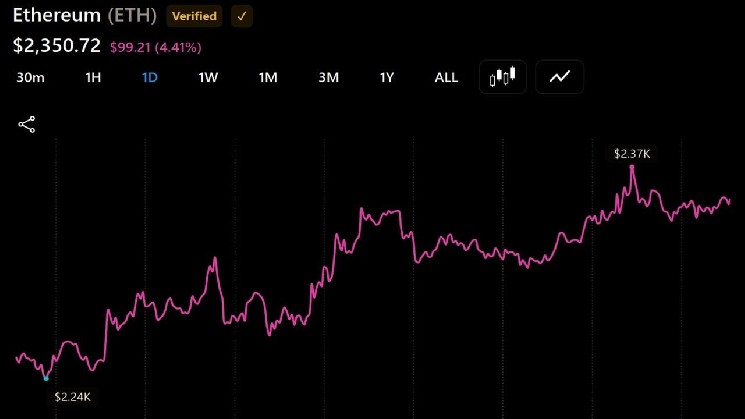
Since Ethereum’s price breached its $3k support level, it has hovered around $2.9k. At the time of writing, the altcoin was valued at $2,944, down 2.2% on the daily charts and 11% on the weekly charts.

Its sustained decline is indicative of intense bearish pressure. However, with ETH showing upside weakness, investors, especially whales, have grabbed the chance to accumulate ETH lately.

Whale continue to ‘buy the dip’

With ETH hovering below $3,000, whales have been on an accumulation spree. According to Onchain Lens, a whale bought 20,013 ETH worth approximately $59 million from FalconX.

Just a week ago, this whale bought 10,000 ETH for $28.9 million and sent $58 million to Wintermute for future purchases. After the latest purchase, the whale now holds 80,115 $ETH worth $236.55M.

Additionally, another whale purchased 5,099 ETH worth $15.14 million from Kraken after being dormant for 3 months. In total, the two whales scooped up 25,112 ETH worth $74.14 million.

Here, it’s worth pointing out that these two whales are not isolated cases either. Looking at the Spot Average Order Size, a hike in whale participation has been evident throughout January so far.

The metric showed large whale orders dominated between the price ranges of $2.9k and $3.1k – Signaling aggressive whale demand.

Often, a hike in whale participation could mean either buying or selling. In this case, the altcoin’s Spot Taker CVD has remained positive throughout this period. A positive CVD implies that buy orders are dominant. Hence, in this particular case, whales have been active on the demand side of the market.

Often, an increase in whale buying activity during a downturn is also indicative of confidence in the market. Especially if they believe another leg up might be inevitable.

Can whales lift ETH’s price?

While whales have aggressively accumulated ETH, their buying pressure has failed to offset market pressure so far.

In fact, a look at the DMI Stochastic Momentum Index (DMI-SMI) revealed that the bearish momentum has accelerated, not stabilized.

To put it simply, markets have settled into a bearish regime, and retail traders have sold at every bounce, making the whales’ attempts insignificant so far.

Such a momentum configuration is a sign of bearish trend continuation or sideways chop, before the market attempts another leg up. Therefore, if whales continue to accumulate while reducing downside pressure, Ethereum will remain stuck between $2.8k and $3.1k.

However, if the bearish momentum accelerates further and overwhelms whale demand, ETH is likely to breach its lower boundary.

Based on the altcoin’s Future Grand Trend, ETH could breach $2.8k and drop to $2.5k, before rising to $3.4k in early February.


Final Thoughts

  • Ethereum whales have been buying the dip, scooping up 25,112 ETH worth $74.14 million.
  • Ethereum [ETH] continues to face intense bearish pressure, making whale activity inadequate for another leg up.


Related Questions

QWhat is the current price of Ethereum and how has it performed recently?

AAt the time of writing, Ethereum (ETH) was valued at $2,944, down 2.2% on the daily charts and 11% on the weekly charts.

QHow much ETH did the two whales mentioned in the article accumulate and what was its total value?

AThe two whales scooped up a total of 25,112 ETH, which was worth approximately $74.14 million.

QAccording to the article, what does a positive Spot Taker CVD indicate about whale activity?

AA positive Spot Taker CVD implies that buy orders are dominant, indicating that whales have been active on the demand side of the market.

QDespite the whale accumulation, why has the price of ETH continued to face downward pressure?

AThe bearish momentum has accelerated, and retail traders have been selling at every bounce, making the whales' buying pressure inadequate to offset the overall market selling pressure so far.

QWhat are the two potential price scenarios for Ethereum outlined in the article's forecast?

AOne scenario is that ETH remains stuck between $2.8k and $3.1k if whales continue to accumulate. The other is that if bearish momentum accelerates, ETH could breach $2.8k and drop to $2.5k before potentially rising to $3.4k in early February.

Related Reads

From Theft to Re-entry: How Was $292 Million "Laundered"?

A sophisticated crypto laundering operation was executed following the $292 million hack of Kelp DAO on April 18. The attack, attributed to the North Korean Lazarus group, began with anonymous infrastructure preparation using Tornado Cash to fund wallets untraceably. The hacker exploited a vulnerability in Kelp’s cross-chain bridge, stealing 116,500 rsETH. To avoid crashing the market, the attacker used Aave and Compound as laundering tools—depositing the stolen rsETH as collateral to borrow $190 million in clean, liquid ETH. This move triggered a bank run on Aave, causing an $8 billion drop in TVL. After consolidating funds, the attacker fragmented them across hundreds of wallets to evade detection. A major breakpoint was THORChain, where over $460 million in volume—30 times its usual activity—was processed in 24 hours, converting ETH into Bitcoin. This shift to Bitcoin’s UTXO model exponentially increased tracing complexity by shattering funds into countless untraceable fragments. The final destination was Tron-based USDT, the primary channel for illicit crypto flows. From there, funds were cashed out via OTC brokers in China and Southeast Asia, using unlicensed underground banks and UnionPay networks outside Western sanctions scope. Ultimately, the laundered money supports North Korea’s weapons programs, which rely heavily on crypto hacking for foreign currency. The incident underscores structural challenges in DeFi: its openness, composability, and lack of central control make such laundering not just possible, but inherently difficult to prevent.

marsbit9m ago

From Theft to Re-entry: How Was $292 Million "Laundered"?

marsbit9m ago

Google and Amazon Simultaneously Invest Heavily in a Competitor: The Most Absurd Business Logic of the AI Era Is Becoming Reality

In a span of four days, Amazon announced an additional $25 billion investment, and Google pledged up to $40 billion—both direct competitors pouring over $65 billion into the same AI startup, Anthropic. Rather than a typical venture capital move, this signals the latest escalation in the cloud wars. The core of the deal is not equity but compute pre-orders: Anthropic must spend the majority of these funds on AWS and Google Cloud services and chips, effectively locking in massive future compute consumption. This reflects a shift in cloud market dynamics—enterprises now choose cloud providers based on which hosts the best AI models, not just price or stability. With OpenAI deeply tied to Microsoft, Anthropic’s Claude has become the only viable strategic asset for Google and Amazon to remain competitive. Anthropic’s annualized revenue has surged to $30 billion, and it is expanding into verticals like biotech, positioning itself as a cross-industry AI infrastructure layer. However, this funding comes with constraints: Anthropic’s independence is challenged as it balances two rival investors, its safety-first narrative faces pressure from regulatory scrutiny, and its path to IPO introduces new financial pressures. Globally, this accelerates a "tri-polar" closed-loop structure in AI infrastructure, with Microsoft-OpenAI, Google-Anthropic, and Amazon-Anthropic forming exclusive model-cloud alliances. In contrast, China’s landscape differs—investments like Alibaba and Tencent backing open-source model firm DeepSeek reflect a more decoupled approach, though closed-source models from major cloud providers still dominate. The $65 billion bet is ultimately about securing a seat at the table in an AI-defined future—where missing the model layer means losing the cloud war.

marsbit6h ago

Google and Amazon Simultaneously Invest Heavily in a Competitor: The Most Absurd Business Logic of the AI Era Is Becoming Reality

marsbit6h ago

Trading

Spot
Futures

Hot Articles

Discussions

Welcome to the HTX Community. Here, you can stay informed about the latest platform developments and gain access to professional market insights. Users' opinions on the price of ETH (ETH) are presented below.

活动图片