Ethereum whales add $850mln in 2 days as ETH stalls – Here’s why!

ambcryptoPublished on 2025-12-28Last updated on 2025-12-28

Abstract

While Ethereum's price has remained relatively flat, trading around $2,940 and struggling below key resistance levels, large holders (whales) have significantly increased their holdings. According to Santiment data, these whales added nearly 300,000 ETH (worth approximately $850 million) over a few days, bringing their total holdings from about 100.48 million to 100.8 million ETH. This accumulation occurred during a low-volatility phase, suggesting confidence in Ethereum's long-term prospects rather than short-term price movements. Meanwhile, Ethereum's underlying on-chain economy continues to expand robustly. The Total Value Locked (TVL) stands at $330.7 billion, with a fully diluted market cap of around $353.2 billion, resulting in a valuation multiple of about 1.1x. This indicates that ETH's price is closely aligned with the growing ecosystem of DeFi, stablecoins, and real-world assets (RWAs) built on the network, which reinforces demand for ETH and limits downside pressure. Despite the steady economic growth, technical indicators show hesitation among traders. The RSI reflects weak bullish momentum, and the MACD suggests fading upside pressure. For a significant price move to occur, a resurgence in trading volume and market acceleration is likely needed. Ultimately, whale accumulation during consolidation phases, combined with a strong on-chain economy, points to potential preparation for a larger market move ahead.

What are the Ethereum whales seeing that we’re not?
Big holders seem to be moving early, while Ethereum’s on-chain activity is steadily strengthening its long-term value. The signs may not be easily visible yet, but they’re starting to add up.

Whales add as price holds steady

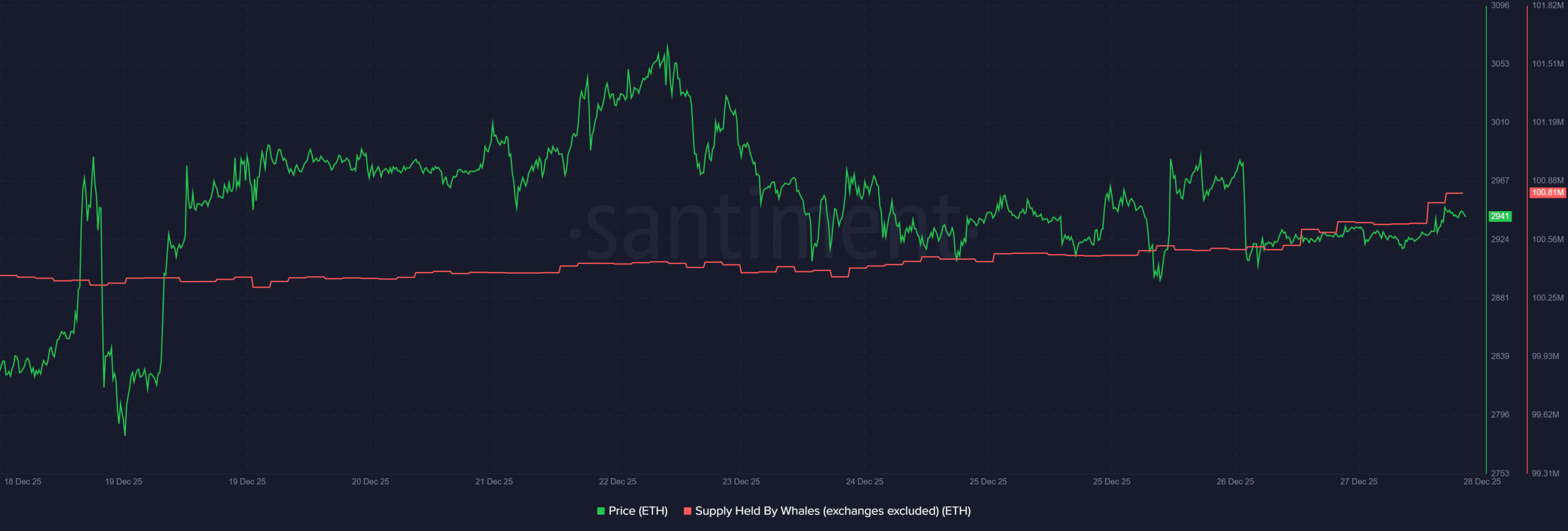
Since the 26th of December, wallets holding large amounts of ETH have steadily increased their balance.

Supply Held by Whales has risen from roughly 100.48 million ETH to about 100.8 million ETH per Santiment data; this is an addition of nearly 300,000 ETH. At current prices near $2,940, that translates to over $850 million flowing into large wallets in just a few days.

Source: Santiment

This buying has happened while price action remained relatively flat; whales are positioning. They typically build exposure during low-volatility phases, so they believe in Ethereum’s longer-term setup instead of being phased by its short-term downside.

Ethereum’s economy does the heavy lifting

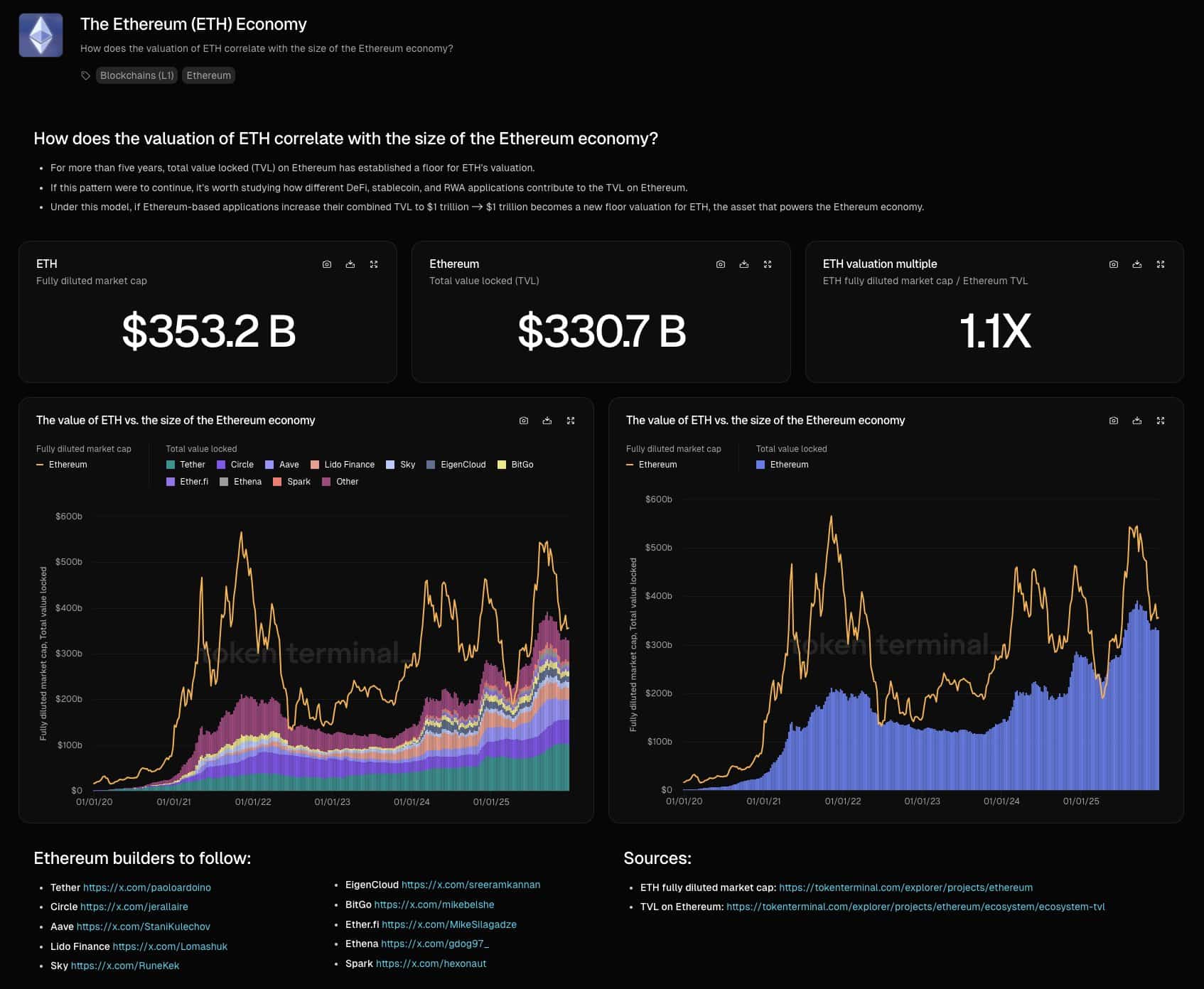
The underlying economy continues to expand, and that’s what we should be seeing. At press time, Token Terminal data showed Ethereum’s Total Value Locked (TVL) at $330.7 billion, while its Fully Diluted Market Cap at around $353.2 billion, putting the valuation multiple near 1.1x.

Source: X

In simple terms, ETH’s price is closely tracking the size of the economy built on top of it.
This relationship has so far acted as a valuation anchor. As DeFi, stablecoins, and RWAs grow on Ethereum, they reinforce demand for ETH itself.

Price stalls below resistance

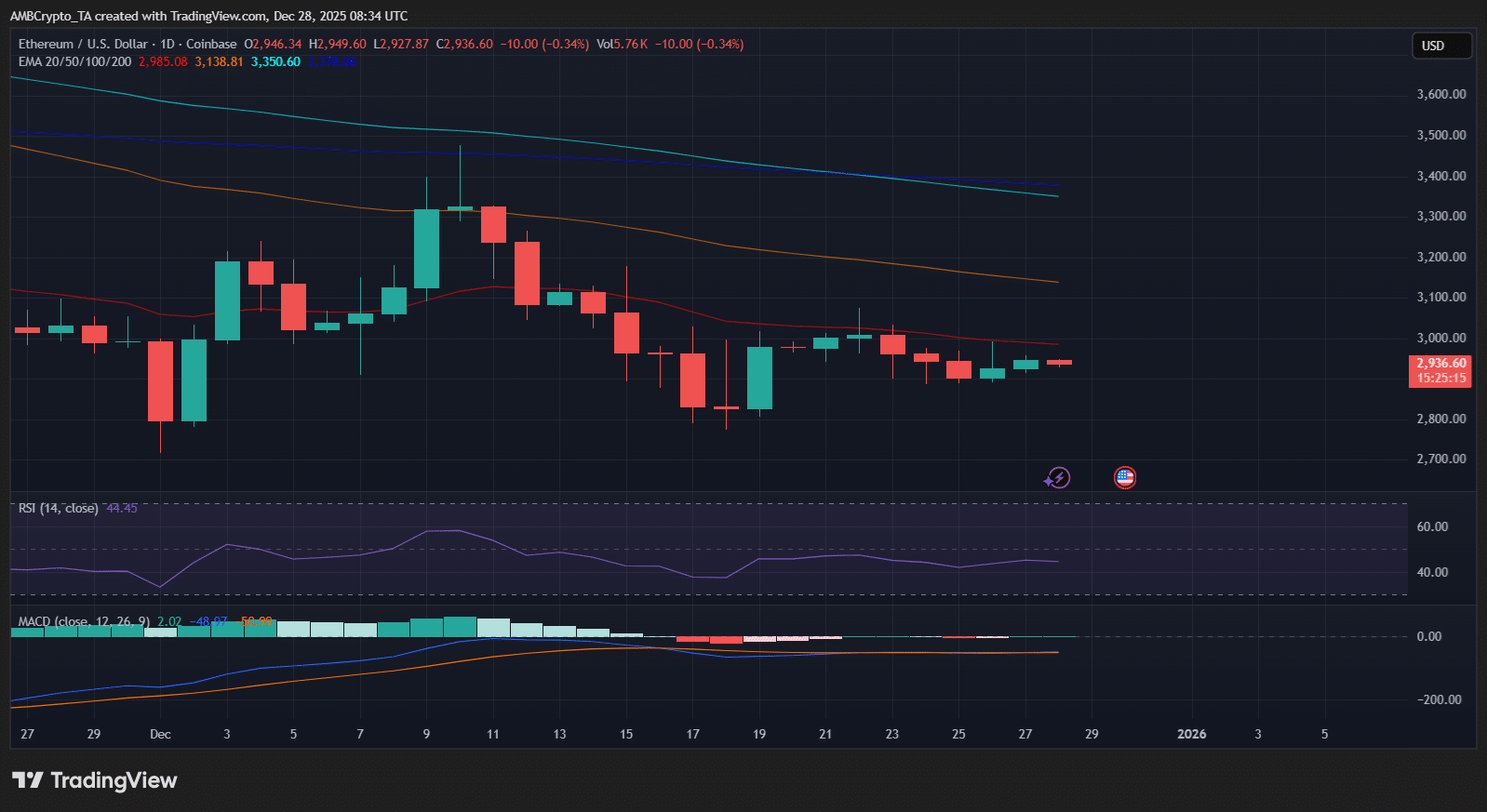
Ethereum’s daily chart showed price struggling to regain pace after slipping below key moving averages (MAs).

At press time, ETH was trading around $2,940, still capped beneath the 50, 100, and 200-day EMAs, which acted as overhead resistance between $3,100-$3,380. Momentum indicators also show that traders are a bit hesitant.

RSI showed weak bullish strength, while the MACD made it clear that upside pressure is fading.
Source: TradingView

Sellers haven’t forced a breakdown, but buyers also lack confidence. For now, ETH is stuck in consolidation. A big move is likely only if volume and acceleration return in force.


Final Thoughts

  • With whales adding $850M+ in ETH while price stays flat, whales are prepping ahead of a larger move.
  • As long as Ethereum’s $330B+ on-chain economy holds steady, downside pressure looks limited.
Next: Uniswap’s $591mln burn sparks a deflation loop – UNI at $7.2 ONLY IF…
Share
  • Share
  • Tweet

Related Questions

QHow much Ethereum (in both ETH and USD value) did whales add over the two-day period mentioned in the article?

AWhales added nearly 300,000 ETH, which is equivalent to over $850 million at the price of $2,940 per ETH.

QAccording to the data from Santiment, what was the change in the 'Supply Held by Whales' metric between December 26th and the time of writing?

AThe Supply Held by Whales increased from approximately 100.48 million ETH to about 100.8 million ETH.

QWhat key on-chain metric does the article cite as a 'valuation anchor' for Ethereum's price, and what was its value?

AThe article cites Ethereum's Total Value Locked (TVL) as a key valuation anchor. Its value was $330.7 billion at the time of writing.

QWhat technical indicators and price levels were acting as overhead resistance for ETH's price according to the charts?

AThe 50, 100, and 200-day Exponential Moving Averages (EMAs), which were positioned between the price levels of $3,100 and $3,380, were acting as overhead resistance.

QWhat two specific momentum indicators were mentioned as showing weakness and a lack of bullish pressure?

AThe Relative Strength Index (RSI) showed weak bullish strength, and the Moving Average Convergence Divergence (MACD) indicated that upside pressure was fading.

Related Reads

When AI Begins to Audit the World: From Claude Discovering the ZEC Vulnerability, Watching the Encryption Industry Enter the 'Recursive Security Era'

**When AI Audits the World: From Claude's Discovery of a ZEC Vulnerability, Viewing the Crypto Industry Entering a "Recursive Security Era"** This article examines a pivotal shift in the blockchain security landscape, triggered by the convergence of two events: Anthropic's research on AI's "Recursive Self-Improvement" and Claude Opus 4.8's discovery of a critical vulnerability in Zcash's code. Traditionally, crypto security has relied on human experts and automated tools for periodic audits. However, the article argues AI is transitioning from a mere tool to an active participant in understanding and analyzing complex systems. Claude's ability to identify a subtle flaw in Zcash's zero-knowledge proof system demonstrates AI's potential to dramatically lower the cost and time required for risk discovery. This goes beyond finding a single bug; it signals a change in the very mechanism of how vulnerabilities are found. The core thesis introduces the concept of "Recursive Security," drawing a parallel to Anthropic's "Recursive Self-Improvement." Just as AI can accelerate its own development through feedback loops, security systems are evolving towards a continuous cycle of analysis, risk identification, remediation, and re-analysis. Security is becoming a persistent, evolving capability integrated into a system's lifecycle, rather than a one-time pre-launch audit. This shift is particularly urgent for the crypto industry, where system complexity from Layer-2 networks, modular architectures, and ZK-proofs is growing faster than human analysis capacity. AI excels at the pattern recognition and contextual understanding needed to navigate this complexity. Importantly, the article cautions that AI augments both defenders and potential attackers, accelerating the entire threat landscape. The future competitive advantage may not lie in having zero vulnerabilities, but in having the fastest risk discovery, validation, and response capabilities. The Claude-Zcash incident is thus an early signal of an era where AI-driven, recursive security systems become essential for managing risk in an increasingly complex digital world.

marsbit2h ago

When AI Begins to Audit the World: From Claude Discovering the ZEC Vulnerability, Watching the Encryption Industry Enter the 'Recursive Security Era'

marsbit2h ago

Trading

Spot
Futures

Hot Articles

Discussions

Welcome to the HTX Community. Here, you can stay informed about the latest platform developments and gain access to professional market insights. Users' opinions on the price of S (S) are presented below.

活动图片