Ethereum To Hit $15,000 In 2026 As ‘Wall Street’s Default Chain’: Vivek Raman

bitcoinistPublished on 2026-01-06Last updated on 2026-01-06

Abstract

Ethereum could reach $15,000 by 2026 as it becomes Wall Street's preferred blockchain for tokenization, stablecoins, and institutional adoption, according to Vivek Raman of Etherealize. He argues that Ethereum will transition into a commercial deployment era, driven by regulatory clarity, mature infrastructure, and growing institutional use cases. Key factors include the expansion of tokenized assets to nearly $100 billion (with 66% on Ethereum and its L2s), the stablecoin market cap growing to $1.5 trillion, and ETH emerging as a productive store of value. Raman highlights institutional activity from firms like JPMorgan, BlackRock, and Deutsche Bank, alongside the rise of Ethereum Layer 2 networks for customized, high-margin business models.

Ethereum could reprice to $15,000 in 2026 as traditional finance accelerates into tokenization, stablecoins, and bespoke Layer 2 blockchains built on Ethereum, according to Vivek Raman, CEO and co-founder of Etherealize.

In a Jan. 5 guest post, Raman framed 2026 as the point where ETH shifts from a decade-long credibility build to a commercial deployment era, arguing that “from 2026 onward – Ethereum will become the best place to do business,” as regulatory posture, institutional precedent, and infrastructure maturity converge.

Institutions Will Tokenize On Ethereum

Raman’s core claim is that tokenization is moving from proof-of-concept into scaled product deployment, with Ethereum increasingly serving as the base layer institutions choose when the assets are high value and the operational requirements are strict. He describes tokenization as a business-process upgrade that collapses assets, data, and payments onto shared infrastructure, and he leaned heavily on the idea that once institutions experience the efficiencies, they will not revert.

“Tokenization upgrades entire business processes by digitizing assets, data, and payments onto the same infrastructure,” Raman wrote. “Assets (like stocks, bonds, real estate) and money will be able to move at the speed of the Internet. This is an obvious upgrade to the financial system that should have happened decades ago; public global blockchains like Ethereum enable this today.”

The post cites examples of institutional tokenization activity on Ethereum, including money market fund initiatives from JPMorgan and Fidelity, BlackRock’s tokenized fund BUIDL, Apollo’s private credit fund ACRED (with liquidity concentrated on Ethereum and its L2s), and European participation such as Amundi tokenizing a euro-denominated money market fund. Raman also pointed to tokenized products from BNY Mellon and a planned tokenized bond fund tied to Baillie Gifford that would span Ethereum and an L2 network.

Stablecoins As The “Green Light” Moment

Raman positioned stablecoins as the clearest product-market fit for onchain finance, citing “$10T+ in stablecoin transfer volumes in 2025” and claiming that “60% of all stablecoins are on Ethereum and its Layer 2 networks.” He argued that regulatory developments in the US have de-risked deployment for institutions, describing the passage of the GENIUS Act in 2025 as the moment public-chain stablecoin rails effectively received formal clearance.

As a near-term datapoint, Raman highlighted SoFi’s reported launch of a bank-issued stablecoin, SoFiUSD, on a “public, permissionless blockchain,” adding that the bank chose Ethereum. He suggested this is the start of a broader wave where investment banks, neobanks, and fintechs explore stablecoin issuance—either solo or via consortium structures—inside a single public-chain ecosystem to maximize network effects.

Layer 2s As The Institutional Business Model

A major part of Raman’s thesis hinges on the idea that institutions will not converge on a single chain, but will converge on a single interconnected network, Ethereum plus its Layer 2 ecosystem. He argued that L2s provide customization by jurisdiction and customer base while inheriting Ethereum’s security and liquidity, and he described L2 economics as unusually attractive for operators, citing “90+% profit margins” as a reason businesses will want their own chains.

Raman listed examples including Coinbase’s Base, Robinhood’s plans for an Ethereum L2 featuring tokenized stocks and other assets, SWIFT’s use of the Ethereum L2 Linea for settlements, JPMorgan deploying tokenized deposits on Base, and Deutsche Bank building a public, permissioned network as an Ethereum L2.

The $15,000 Ethereum Price Target

Raman also argued ETH is emerging as an institutional treasury asset alongside bitcoin, describing BTC as “digital gold” and ETH as “digital oil”, a productive store of value tied to ecosystem economic activity.

He pointed to four public-company “MicroStrategy-equivalents” accumulating ETH: BitMine Immersion (BMNR), Sharplink Gaming (SBET), The Ether Machine (ETHM), and Bit Digital (BTBT) and claimed they have collectively purchased roughly 4.5% of ETH supply in the last six months, comparing that to MicroStrategy’s 3.2% of BTC ownership.

Those dynamics underpin his 2026 “5x” forecast set: tokenized assets rising to nearly $100 billion (from an estimated $18 billion after growing from ~$6 billion in 2025, with “66%...on Ethereum and its L2s”), stablecoin market cap expanding to $1.5 trillion (from $308 billion), and ETH appreciating 5x to $15,000—an implied $2 trillion market cap in his framing.

At press time, ETH traded at $3,227.
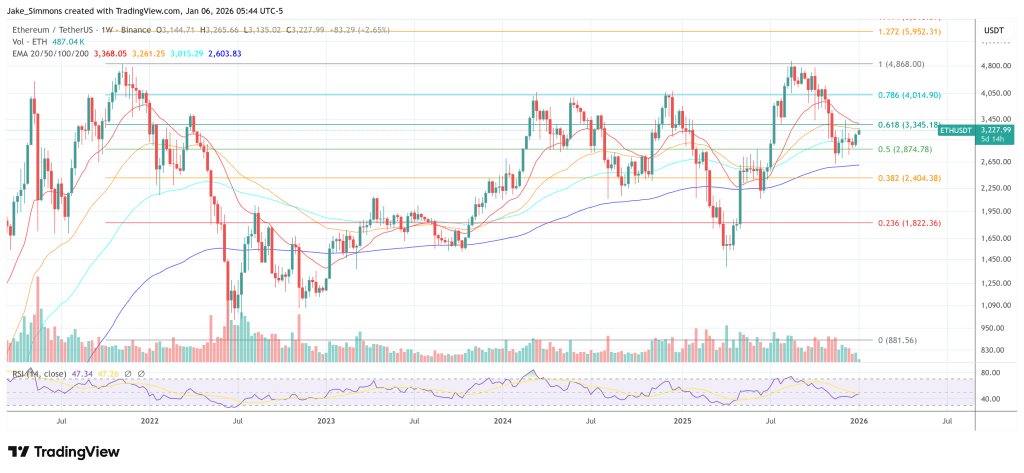
ETH faces the 0.618 Fib, 1-week chart | Source: ETHUSDT on TradingView.com

Related Questions

QWhat is the main reason Vivek Raman believes Ethereum will reach $15,000 by 2026?

AHe believes Ethereum will become 'Wall Street's default chain' due to the acceleration of traditional finance into tokenization, stablecoins, and bespoke Layer 2 blockchains built on Ethereum, leading to a 5x price appreciation.

QAccording to Raman, what is the key business-process upgrade that tokenization provides?

ATokenization upgrades entire business processes by digitizing assets, data, and payments onto the same shared infrastructure, allowing them to move at the speed of the internet.

QWhat role do stablecoins play in Raman's thesis for Ethereum's growth?

AStablecoins represent the clearest product-market fit for onchain finance, with regulatory developments like the GENIUS Act de-risking deployment for institutions and a projected $10T+ in transfer volumes by 2025.

QHow do Layer 2 networks fit into the institutional adoption of Ethereum?

AInstitutions will converge on the interconnected network of Ethereum and its L2 ecosystem, which provides customization by jurisdiction and customer base while inheriting Ethereum's security and liquidity, with attractive economics for operators.

QWhich four public companies does Raman cite as 'MicroStrategy-equivalents' that are accumulating ETH?

ABitMine Immersion (BMNR), Sharplink Gaming (SBET), The Ether Machine (ETHM), and Bit Digital (BTBT).

Related Reads

In-Depth Report on the On-Chain Lending Market: When Off-Chain Credit Meets On-Chain Liquidation

The on-chain lending market has evolved from a peripheral DeFi niche into core financial infrastructure. As of early 2026, total value locked (TVL) in on-chain lending protocols has reached $64.3 billion, accounting for 53.54% of total DeFi TVL, making it the largest and most mature vertical within decentralized finance. Aave dominates the sector with approximately $32.9 billion in TVL, commanding nearly half of the market—a leadership position that is unlikely to be challenged in the foreseeable future. However, the path of on-chain lending forward is not without risk. Liquidation cascades, credit defaults, and cross-chain vulnerabilities remain systemic threats hanging over the industry. At the same time, a deeper structural transformation is underway: on-chain lending is shifting from a “leverage tool for crypto-native users” to a “compliant gateway for institutional capital”. The scale of RWA (Real World Asset) lending has surpassed $18.5 billion, with U.S. Treasuries and government securities increasingly serving as core collateral. Institutional capital inflows are reshaping both the user base and risk appetite of the sector. This report systematically analyzes the evolution of on-chain lending definitions, competitive dynamics, core risks, and future trends, providing a comprehensive industry outlook for investors and trade practitioners. Key findings suggest that the “one dominant player with several strong challengers” structure will persist in the short term, while fixed-rate lending, compliant collateral, and institutional credit underwriting will define the next phase of competition. For investors focused on DeFi infrastructure, three key opportunity tracks stand out, namely, the Aave ecosystem (Morpho, Spark), RWA lending protocols (Ondo, Maple) and fixed-rate innovation (Notional, Pendle).

HTX Learn12m ago

In-Depth Report on the On-Chain Lending Market: When Off-Chain Credit Meets On-Chain Liquidation

HTX Learn12m ago

Fu Peng's First Public Speech in 2026: What Exactly Are Crypto Assets? Why Did I Join the Crypto Asset Industry?

Fu Peng, a renowned macroeconomist and now Chief Economist at New火 Group, delivered his first public speech of 2026 at the Hong Kong Web3 Festival. He explained his perspective on crypto assets and why he joined the industry, framing it within the context of macroeconomic trends and financial evolution. Fu emphasized that crypto assets are transitioning from an early, belief-driven phase to a mature, institutionally integrated asset class. He drew parallels to the 1970s-80s, when technological advances (like computing) revolutionized traditional finance, leading to the rise of FICC (Fixed Income, Currencies, and Commodities). Similarly, current advancements in AI, data, and blockchain are reshaping finance, with crypto assets becoming part of a new "FICC + C" (C for Crypto) framework. He noted that institutional capital, including traditional hedge funds, avoided early crypto due to its speculative nature but are now engaging as regulatory clarity emerges (e.g., stablecoin laws, CFTC classifying crypto as a commodity). Fu predicted that 2025-2026 marks a turning point where crypto becomes a standardized, financially viable asset for diversified portfolios, akin to commodities or derivatives in traditional finance. Fu defined Bitcoin not as "digital gold" in a simplistic sense but as a value-preserving, financially tradable asset. He highlighted that crypto's future lies in regulated, institutional adoption, moving away from retail-dominated trading. His entry into crypto signals this maturation, where traditional finance integrates crypto into mainstream asset management.

marsbit1h ago

Fu Peng's First Public Speech in 2026: What Exactly Are Crypto Assets? Why Did I Join the Crypto Asset Industry?

marsbit1h ago

Justin Sun Sues Trump Family: What $75 Million Bought Was Only a Blacklist

Justin Sun, founder of Tron, has filed a lawsuit in federal court against World Liberty Financial (WLF), alleging he was made the "primary target of a fraudulent scheme" after investing $75 million. Sun claims the investment secured him an advisor title and WLFI tokens, which were later frozen by WLF, causing "hundreds of millions in losses." The dispute began in late 2024 when Sun's investment helped revive WLF's struggling token sale, which ultimately raised $550 million. Shortly after, the SEC dropped its lawsuit against Sun following Donald Trump's inauguration. However, relations soured when Sun refused WLF's demands for additional funding. In August 2025, WLF added a "blacklist" function to its smart contract, allowing it to unilaterally freeze tokens. Sun's holdings, worth approximately $107 million, were frozen, and he was threatened with token destruction. The lawsuit highlights WLF's structure, which directs 75% of token sale profits to the Trump family, who had earned $1 billion by December 2025. WLF's CEO is Zach Witkoff, son of U.S. Middle East envoy Steve Witkoff. The project faces scrutiny for opaque operations, including a controversial loan arrangement on the Dolomite platform, co-founded by a WLF advisor. Despite Sun's history with the SEC, the case underscores centralization risks within DeFi, as WLF controls governance and holds powers to freeze assets arbitrarily. Sun's tokens remain frozen as legal proceedings begin.

marsbit1h ago

Justin Sun Sues Trump Family: What $75 Million Bought Was Only a Blacklist

marsbit1h ago

Trading

Spot
Futures

Hot Articles

Discussions

Welcome to the HTX Community. Here, you can stay informed about the latest platform developments and gain access to professional market insights. Users' opinions on the price of ETH (ETH) are presented below.

活动图片