Ethereum To Hit $15,000 In 2026 As ‘Wall Street’s Default Chain’: Vivek Raman

bitcoinistPublished on 2026-01-06Last updated on 2026-01-06

Abstract

Ethereum could reach $15,000 by 2026 as it becomes Wall Street's preferred blockchain for tokenization, stablecoins, and institutional adoption, according to Vivek Raman of Etherealize. He argues that Ethereum will transition into a commercial deployment era, driven by regulatory clarity, mature infrastructure, and growing institutional use cases. Key factors include the expansion of tokenized assets to nearly $100 billion (with 66% on Ethereum and its L2s), the stablecoin market cap growing to $1.5 trillion, and ETH emerging as a productive store of value. Raman highlights institutional activity from firms like JPMorgan, BlackRock, and Deutsche Bank, alongside the rise of Ethereum Layer 2 networks for customized, high-margin business models.

Ethereum could reprice to $15,000 in 2026 as traditional finance accelerates into tokenization, stablecoins, and bespoke Layer 2 blockchains built on Ethereum, according to Vivek Raman, CEO and co-founder of Etherealize.

In a Jan. 5 guest post, Raman framed 2026 as the point where ETH shifts from a decade-long credibility build to a commercial deployment era, arguing that “from 2026 onward – Ethereum will become the best place to do business,” as regulatory posture, institutional precedent, and infrastructure maturity converge.

Institutions Will Tokenize On Ethereum

Raman’s core claim is that tokenization is moving from proof-of-concept into scaled product deployment, with Ethereum increasingly serving as the base layer institutions choose when the assets are high value and the operational requirements are strict. He describes tokenization as a business-process upgrade that collapses assets, data, and payments onto shared infrastructure, and he leaned heavily on the idea that once institutions experience the efficiencies, they will not revert.

“Tokenization upgrades entire business processes by digitizing assets, data, and payments onto the same infrastructure,” Raman wrote. “Assets (like stocks, bonds, real estate) and money will be able to move at the speed of the Internet. This is an obvious upgrade to the financial system that should have happened decades ago; public global blockchains like Ethereum enable this today.”

The post cites examples of institutional tokenization activity on Ethereum, including money market fund initiatives from JPMorgan and Fidelity, BlackRock’s tokenized fund BUIDL, Apollo’s private credit fund ACRED (with liquidity concentrated on Ethereum and its L2s), and European participation such as Amundi tokenizing a euro-denominated money market fund. Raman also pointed to tokenized products from BNY Mellon and a planned tokenized bond fund tied to Baillie Gifford that would span Ethereum and an L2 network.

Stablecoins As The “Green Light” Moment

Raman positioned stablecoins as the clearest product-market fit for onchain finance, citing “$10T+ in stablecoin transfer volumes in 2025” and claiming that “60% of all stablecoins are on Ethereum and its Layer 2 networks.” He argued that regulatory developments in the US have de-risked deployment for institutions, describing the passage of the GENIUS Act in 2025 as the moment public-chain stablecoin rails effectively received formal clearance.

As a near-term datapoint, Raman highlighted SoFi’s reported launch of a bank-issued stablecoin, SoFiUSD, on a “public, permissionless blockchain,” adding that the bank chose Ethereum. He suggested this is the start of a broader wave where investment banks, neobanks, and fintechs explore stablecoin issuance—either solo or via consortium structures—inside a single public-chain ecosystem to maximize network effects.

Layer 2s As The Institutional Business Model

A major part of Raman’s thesis hinges on the idea that institutions will not converge on a single chain, but will converge on a single interconnected network, Ethereum plus its Layer 2 ecosystem. He argued that L2s provide customization by jurisdiction and customer base while inheriting Ethereum’s security and liquidity, and he described L2 economics as unusually attractive for operators, citing “90+% profit margins” as a reason businesses will want their own chains.

Raman listed examples including Coinbase’s Base, Robinhood’s plans for an Ethereum L2 featuring tokenized stocks and other assets, SWIFT’s use of the Ethereum L2 Linea for settlements, JPMorgan deploying tokenized deposits on Base, and Deutsche Bank building a public, permissioned network as an Ethereum L2.

The $15,000 Ethereum Price Target

Raman also argued ETH is emerging as an institutional treasury asset alongside bitcoin, describing BTC as “digital gold” and ETH as “digital oil”, a productive store of value tied to ecosystem economic activity.

He pointed to four public-company “MicroStrategy-equivalents” accumulating ETH: BitMine Immersion (BMNR), Sharplink Gaming (SBET), The Ether Machine (ETHM), and Bit Digital (BTBT) and claimed they have collectively purchased roughly 4.5% of ETH supply in the last six months, comparing that to MicroStrategy’s 3.2% of BTC ownership.

Those dynamics underpin his 2026 “5x” forecast set: tokenized assets rising to nearly $100 billion (from an estimated $18 billion after growing from ~$6 billion in 2025, with “66%...on Ethereum and its L2s”), stablecoin market cap expanding to $1.5 trillion (from $308 billion), and ETH appreciating 5x to $15,000—an implied $2 trillion market cap in his framing.

At press time, ETH traded at $3,227.
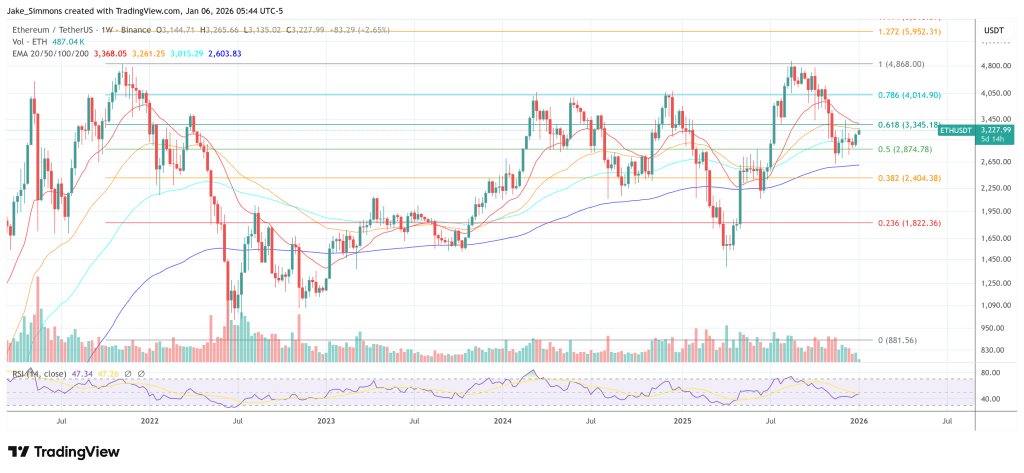
ETH faces the 0.618 Fib, 1-week chart | Source: ETHUSDT on TradingView.com

Related Questions

QWhat is the main reason Vivek Raman believes Ethereum will reach $15,000 by 2026?

AHe believes Ethereum will become 'Wall Street's default chain' due to the acceleration of traditional finance into tokenization, stablecoins, and bespoke Layer 2 blockchains built on Ethereum, leading to a 5x price appreciation.

QAccording to Raman, what is the key business-process upgrade that tokenization provides?

ATokenization upgrades entire business processes by digitizing assets, data, and payments onto the same shared infrastructure, allowing them to move at the speed of the internet.

QWhat role do stablecoins play in Raman's thesis for Ethereum's growth?

AStablecoins represent the clearest product-market fit for onchain finance, with regulatory developments like the GENIUS Act de-risking deployment for institutions and a projected $10T+ in transfer volumes by 2025.

QHow do Layer 2 networks fit into the institutional adoption of Ethereum?

AInstitutions will converge on the interconnected network of Ethereum and its L2 ecosystem, which provides customization by jurisdiction and customer base while inheriting Ethereum's security and liquidity, with attractive economics for operators.

QWhich four public companies does Raman cite as 'MicroStrategy-equivalents' that are accumulating ETH?

ABitMine Immersion (BMNR), Sharplink Gaming (SBET), The Ether Machine (ETHM), and Bit Digital (BTBT).

Related Reads

Huang Renxun Dramatically 'Saves' South Korean Stock Market

In early June, South Korea's stock market experienced a sharp decline, with the KOSPI index dropping over 5% and triggering a trading halt. Amid this volatility, NVIDIA CEO Jensen Huang's visit to Seoul provided a dramatic boost to market sentiment. During his trip, Huang held a dinner meeting with SK Group Chairman Chey Tae-won and SK Hynix CEO Kwak Noh-Jung. He announced that NVIDIA's new Vera CPU would utilize SK Hynix DRAM and confirmed a multi-year technical collaboration between the two companies. This partnership aims to co-develop next-generation memory for NVIDIA's AI infrastructure roadmap, covering products from data center supercomputers to personal AI devices. Huang also publicly commented that AI company stocks were attractively priced. A key announcement was that NVIDIA's upcoming Vera Rubin AI supercomputer systems will use HBM4 memory, with supply qualifications granted to all three major suppliers: SK Hynix, Samsung Electronics, and Micron Technology. Despite this multi-sourcing strategy, Huang warned that the industry-wide chip shortage, affecting everything from wafers to packaging, is expected to persist for several years due to relentless demand from global AI factory construction. The collaboration extends beyond memory supply. SK Hynix will employ NVIDIA's AI platforms and Omniverse digital twin technology to enhance its own semiconductor design, simulation, and manufacturing processes, aiming for more autonomous factory operations. This visit builds upon a prior October 2025 agreement for SK Group to build a large-scale AI data center using over 50,000 NVIDIA GPUs. Huang's itinerary also included meetings with other Korean giants like Hyundai, LG, and Samsung, indicating NVIDIA's broader strategy to deepen ties with South Korea's tech industry.

链捕手2h ago

Huang Renxun Dramatically 'Saves' South Korean Stock Market

链捕手2h ago

When Inference Becomes a Scarce Resource, Who Captures the Value?

When Inference Becomes the Scarce Resource, Who Captures the Value? The core AI bottleneck has shifted from model training to inference (runtime execution). While concerns persisted about an "AI compute gap"—initially a $200B, now a $600B problem—the market is now recognizing that the solution and value lie in the inference layer. Nvidia's financial restructuring around "serving tokens" and Cerebras's successful IPO highlight this shift. Inference is a recurring, usage-based cost, estimated to be 10-50x larger than the one-time training market, especially with the rise of agentic AI. The inference stack spans six layers: silicon (e.g., Nvidia), bare metal (e.g., CoreWeave), GPU rental/aggregation, deployment/optimization, model APIs, and end applications. Most companies operate in one layer. However, Hyperbolic uniquely spans three layers (GPU rental, deployment, and model APIs) without owning any hardware. It aggregates fragmented GPU supply from multiple cloud providers into a standardized pool, offering developers the cheapest available compute through intelligent routing. Its multi-cloud aggregation creates a data moat and a flywheel: more supply leads to better pricing data and liquidity, attracting more developers and providers. In contrast, applications like Venice operate at the top of the stack, reselling privacy-wrapped inference but remaining dependent on and constrained by the underlying compute costs they purchase. As inference demand explodes, value accrues not just to consumer applications but increasingly to the aggregation and routing layer that captures their cost of revenue. The coming potential GPU oversupply reinforces this dynamic. While hardware owners may suffer from depreciation, asset-light aggregators like Hyperbolic benefit from price arbitrage, routing workloads to the cheapest available capacity. The ultimate winner in the inference economy may not be the entity with the most GPUs, but the one that can most efficiently discover, aggregate, and route the world's fragmented compute.

链捕手2h ago

When Inference Becomes a Scarce Resource, Who Captures the Value?

链捕手2h ago

Trading

Spot
Futures

Hot Articles

Discussions

Welcome to the HTX Community. Here, you can stay informed about the latest platform developments and gain access to professional market insights. Users' opinions on the price of ETH (ETH) are presented below.

活动图片