Ethereum Retail Participation Vanishes: Hits One-Year Low In Network Activity

bitcoinistPublished on 2025-12-19Last updated on 2025-12-19

Abstract

Ethereum's network activity has hit a one-year low, with active sending addresses falling to around 170,000, signaling a significant decline in retail participation. This drop reflects deteriorating market conditions and fading investor confidence amid prolonged volatility and bearish sentiment. On-chain data suggests a phase of seller exhaustion rather than capitulation, where selling pressure is easing but new demand remains weak. Without retail momentum, Ethereum's recovery attempts have been shallow and short-lived. However, such low activity periods have often attracted long-term institutional accumulation. A sustainable rebound would require both price stabilization and a recovery in network activity, indicating returning demand. Continued stagnation risks deeper consolidation or a demand-destruction phase.

Ethereum is struggling to maintain a convincing bullish narrative as market conditions continue to deteriorate and a growing number of analysts begin to call for a broader bear market. After months of heightened volatility and repeated corrective phases, price action alone has failed to restore confidence, leaving participants increasingly cautious.

This hesitation is now being reflected clearly in on-chain data, reinforcing the idea that the current weakness is not purely technical, but structural.

According to a recent CryptoQuant report, Ethereum’s network activity has dropped to levels that strongly suggest a withdrawal of retail participation. Active sending addresses have fallen toward the 170,000 mark, a threshold historically associated with reduced engagement from smaller investors. In past cycles, retail activity typically expands during bullish phases as new participants enter the market, then contracts sharply once confidence fades and price momentum weakens.

Prolonged volatility and corrective price action have likely eroded Ethereum’s short-term conviction, pushing retail participants either to the sidelines or out of the market entirely. This absence matters. Retail flow often plays a critical role in sustaining momentum during recoveries, and without it, upside moves tend to stall quickly.

On-Chain Signals Point to Exhaustion, Not Capitulation

According to CryptoOnchain’s analysis, Ethereum’s sharply depressed on-chain activity aligns with a classic phase of seller exhaustion rather than active capitulation. In this regime, selling pressure gradually diminishes as participants willing to exit have largely done so, yet fresh demand has not meaningfully returned. The result is a fragile equilibrium where price may stabilize, but upside remains limited in the absence of new buyers.
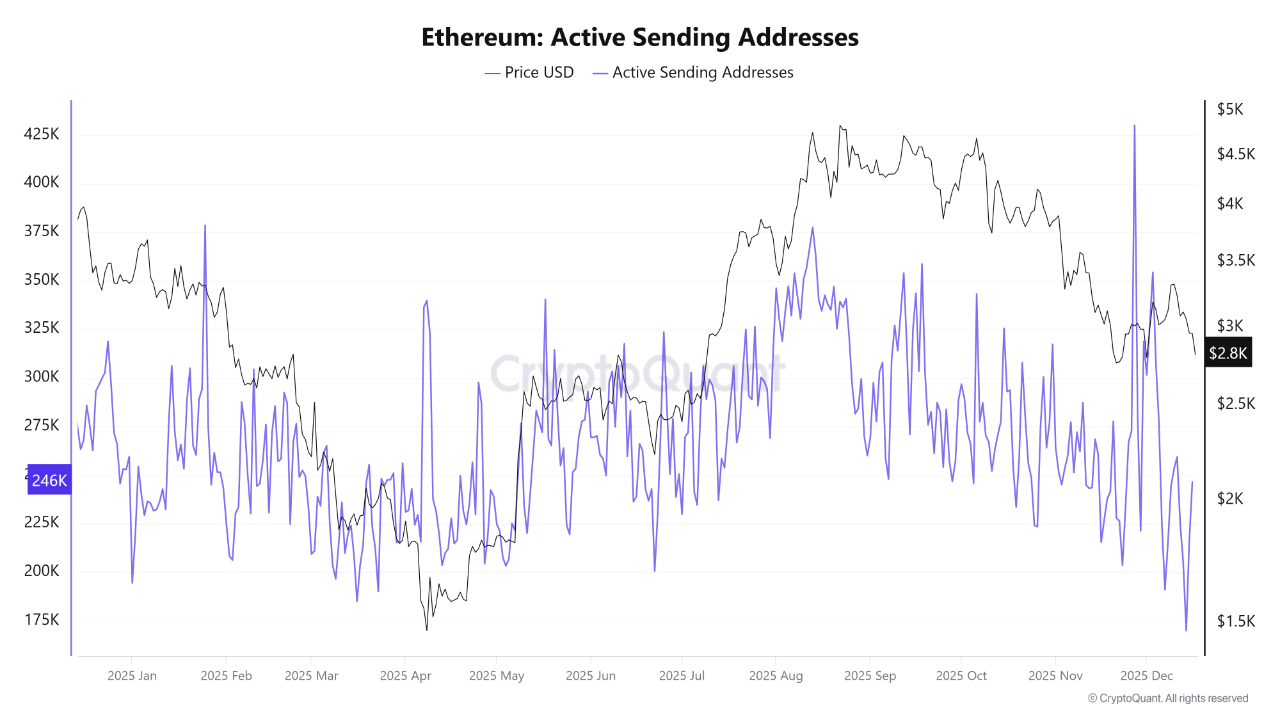
Ethereum Active Sending Addresses | Source: CryptoQuant

The lack of retail participation plays a central role in this dynamic. Retail flow typically provides the initial momentum during early rebounds, amplifying price moves once confidence begins to recover. With active sending addresses at one-year lows, that catalyst is currently missing, which helps explain why upside attempts have been shallow and short-lived.

However, this same environment has historically attracted larger, long-term participants. Institutional and high-conviction holders often accumulate during periods of low activity, when liquidity is thin, and sentiment is decisively negative.

Importantly, a credible recovery signal would not emerge from price action alone. CryptoOnchain emphasizes that a sustainable shift would require a gradual rebound in active sending addresses alongside price stabilization.

That combination would point to returning demand and improving network utilization. Conversely, continued stagnation or further declines in address activity would increase the risk of Ethereum entering a deeper consolidation or even a demand-destruction phase.

While current conditions highlight clear short-term weakness and retail disengagement, similar on-chain setups have historically formed near structural bottoms, creating the potential for medium-term trend shifts if activity begins to recover.


Trending Cryptos

Related Questions

QWhat has happened to Ethereum's network activity according to the CryptoQuant report?

AEthereum's network activity has dropped to a one-year low, with active sending addresses falling toward the 170,000 mark, indicating a significant decline in retail participation.

QWhat role does retail flow typically play in Ethereum's price movements?

ARetail flow often provides the initial momentum during early rebounds and helps sustain recovery momentum by amplifying price moves when confidence begins to recover.

QWhat does the current on-chain data suggest about selling pressure?

AThe on-chain data indicates a phase of seller exhaustion rather than active capitulation, meaning selling pressure is gradually diminishing as most willing sellers have exited, but fresh demand has not yet returned.

QWhat type of participants are often attracted to Ethereum during periods of low activity?

AInstitutional and high-conviction holders often accumulate during periods of low activity, when liquidity is thin and sentiment is decisively negative.

QWhat would be required for a sustainable recovery in Ethereum according to the analysis?

AA sustainable recovery would require a gradual rebound in active sending addresses alongside price stabilization, indicating returning demand and improved network utilization.

Related Reads

Bitcoin Has Yet to Hit Bottom, While Exchange AscendEX Has Already "Run Away"

On July 6, 2026, cryptocurrency exchange AscendEX officially announced it is ceasing operations, with a complete shutdown scheduled for July 1, 2026. The platform cited the full implementation of the EU's MiCA regulation alongside market, financial, and operational challenges. Users can no longer perform most functions, with accounts limited to withdrawal purposes only. Prior to the announcement, on-chain investigator ZachXBT had issued warnings about significant withdrawal delays and a severe lack of high-liquidity assets (like ETH, USDT, SOL) in AscendEX's public hot wallets. Following the news, ZachXBT confirmed that the exchange lacks sufficient liquid assets to process multiple verified seven-figure withdrawal requests. AscendEX acknowledged that all withdrawals now require manual review, with no guarantees on processing times. Chain analysis via Arkham Intelligence shows the platform's marked wallets hold minimal readily accessible funds, with most recent activity being small withdrawals. One highlighted wallet reportedly contains only $13.46 million in altcoins. AscendEX, formerly known as BitMax, launched in 2018 and raised $50 million in a 2021 funding round. However, it suffered a major security breach in December 2021, losing approximately $77.7 million from hot wallets. The exchange compensated users but never fully recovered. The current crisis underscores the inherent risks of centralized exchanges, where poor liquidity management, regulatory pressure, and bear market conditions can trigger a collapse. The event is seen as part of a broader industry shakeout, highlighting the importance for users to prioritize non-custodial wallets or exchanges with transparent proof-of-reserves.

Foresight News38m ago

Bitcoin Has Yet to Hit Bottom, While Exchange AscendEX Has Already "Run Away"

Foresight News38m ago

Sevenfold Oversubscription, Can SK Hynix Save the Semiconductor Industry This Time?

SK Hynix's planned US ADR listing is drawing intense interest, with its offering reportedly oversubscribed by over seven times, potentially making it the largest foreign listing in US history. The fundraising of approximately $24.5 billion is intended for expanding its Korean production capacity, including advanced packaging and EUV equipment. This massive demand from long-term funds and prominent institutions like Baillie Gifford and Situational Awareness Partners (led by noted investor Leopold Aschenbrenner) presents a stark contrast to the recent downturn in the broader semiconductor sector. The sector has faced a significant correction, with SK Hynix's own stock falling nearly 30% from its June high. This sell-off was triggered by concerns that major tech giants might slow their AI infrastructure spending, following signals like Meta's reported plan to sell surplus computing capacity. The strong ADR appetite suggests long-term investors still believe in the AI investment cycle's fundamentals, viewing the recent decline more as a valuation reset than a demand collapse. Some market speculation even suggests the pre-IPO price drop could be strategic, setting the stage for a stronger post-listing performance. While SK Hynix's successful listing may act as a short-term positive catalyst for market sentiment, the article argues the true signal for a sustained semiconductor recovery will come from upcoming earnings reports of tech giants like Microsoft, Google, Meta, and Amazon. Their future capital expenditure plans will be crucial in determining whether the AI-driven growth cycle can continue.

Odaily星球日报1h ago

Sevenfold Oversubscription, Can SK Hynix Save the Semiconductor Industry This Time?

Odaily星球日报1h ago

Breaking News: Musk Delivers the Most Powerful Grok 4.5, Slashes Price of Top-tier Opus Intelligence Drastically

**Elon Musk Launches Grok 4.5: A Cost-Effective, High-Performance AI Rival** SpaceXAI, in collaboration with Cursor, has released Grok 4.5, its new flagship AI model designed specifically for coding and agentic tasks. Trained on tens of thousands of NVIDIA GB300 GPUs using massive, high-quality data filtered from trillions of Cursor developer interactions, the model emphasizes "per-token intelligence." In benchmark performance, Grok 4.5 is highly competitive. It scores 64.7% on SWE Bench Pro (surpassing GPT-5.5's 58.6% and Opus 4.7's 64.3%), 83.3% on Terminal Bench 2.1 (nearly matching GPT-5.5), and 62.0% on DeepSWE 1.0 (beating Opus 4.8). Overall, it ranks fourth in AAAI official tests and first in the Harvey legal agent benchmark. The model's key advantage is its combination of speed, efficiency, and low cost. It generates responses at 80 tokens per second and, crucially, uses far fewer tokens to complete tasks—4.2 times fewer than Opus 4.8 on SWE Bench Pro. It is priced at $2 per million input tokens and $6 per million output tokens, significantly undercutting competitors. Musk stated it is "roughly equivalent to Opus 4.7, but much faster." Early user tests show Grok 4.5 can generate functional code for applications like 3D solar system simulators and basic games from simple prompts, though some note it still lags behind top models in certain creative tasks. Musk has hinted at a major update next month, leveraging real-world engineering data from his companies, with an even larger 2-trillion parameter version reportedly in development. Grok 4.5 positions itself not as the absolute strongest model, but as a highly efficient and affordable alternative in the top tier.

marsbit1h ago

Breaking News: Musk Delivers the Most Powerful Grok 4.5, Slashes Price of Top-tier Opus Intelligence Drastically

marsbit1h ago

Today, The Hong Kong Exchange Was Once Again Overwhelmed

Hong Kong's stock exchange witnessed an exceptionally busy day on July 9, with a record seven companies conducting initial public offerings (IPOs) simultaneously. The list included major firms such as Luxshare Precision, which launched the largest Hong Kong IPO of the year, and other notable names like Tri-Ring Group and Qiyunshan Food. However, the market reception was sharply divided on the first trading day. While Qiyunshan Food's shares surged over 110%, several other newcomers, including Luxshare Precision, Dingtai High-Tech, and Rigol Technologies, opened below their issue prices, with some falling nearly 20%. This event highlights a broader, bustling IPO scene in Hong Kong for 2024, with 82 Chinese companies listing in the first half alone—more than double the figure from the same period last year. A significant portion of this activity comes from dual "A+H" listings, where mainland China-listed firms seek secondary listings in Hong Kong. These larger companies have accounted for nearly 60% of total fundraising. Despite the high volume, recent trends show a cooling market sentiment for many new listings. Several IPOs in early July, including that of Tongrentang Healthcare, debuted with significant losses, indicating increased investor caution and selectivity. The market narrative is shifting, with capital increasingly concentrating on high-growth sectors like artificial intelligence, robotics, and semiconductors, while traditional manufacturing and consumer goods face greater pressure and volatility. This divergence underscores a market where success is no longer guaranteed by merely listing, but depends heavily on a company's growth prospects and sector appeal.

marsbit1h ago

Today, The Hong Kong Exchange Was Once Again Overwhelmed

marsbit1h ago

Trading

Spot

Hot Articles

Discussions

Welcome to the HTX Community. Here, you can stay informed about the latest platform developments and gain access to professional market insights. Users' opinions on the price of ETH (ETH) are presented below.

活动图片