Ethereum’s [ETH] decline through late January and February pushed price sharply toward the $1,924–$1,801 support zone, where selling pressure finally slowed.
As price briefly spiked near $1,801, buyers stepped in aggressively, defending the yellow support level and preventing a deeper breakdown.
Soon after, the price stabilized near $1,924, a historically validated level that has repeatedly attracted demand. Meanwhile, the RSI recovered to 51.48, at press time, signaling that bearish momentum has faded while buyers gradually regain control.
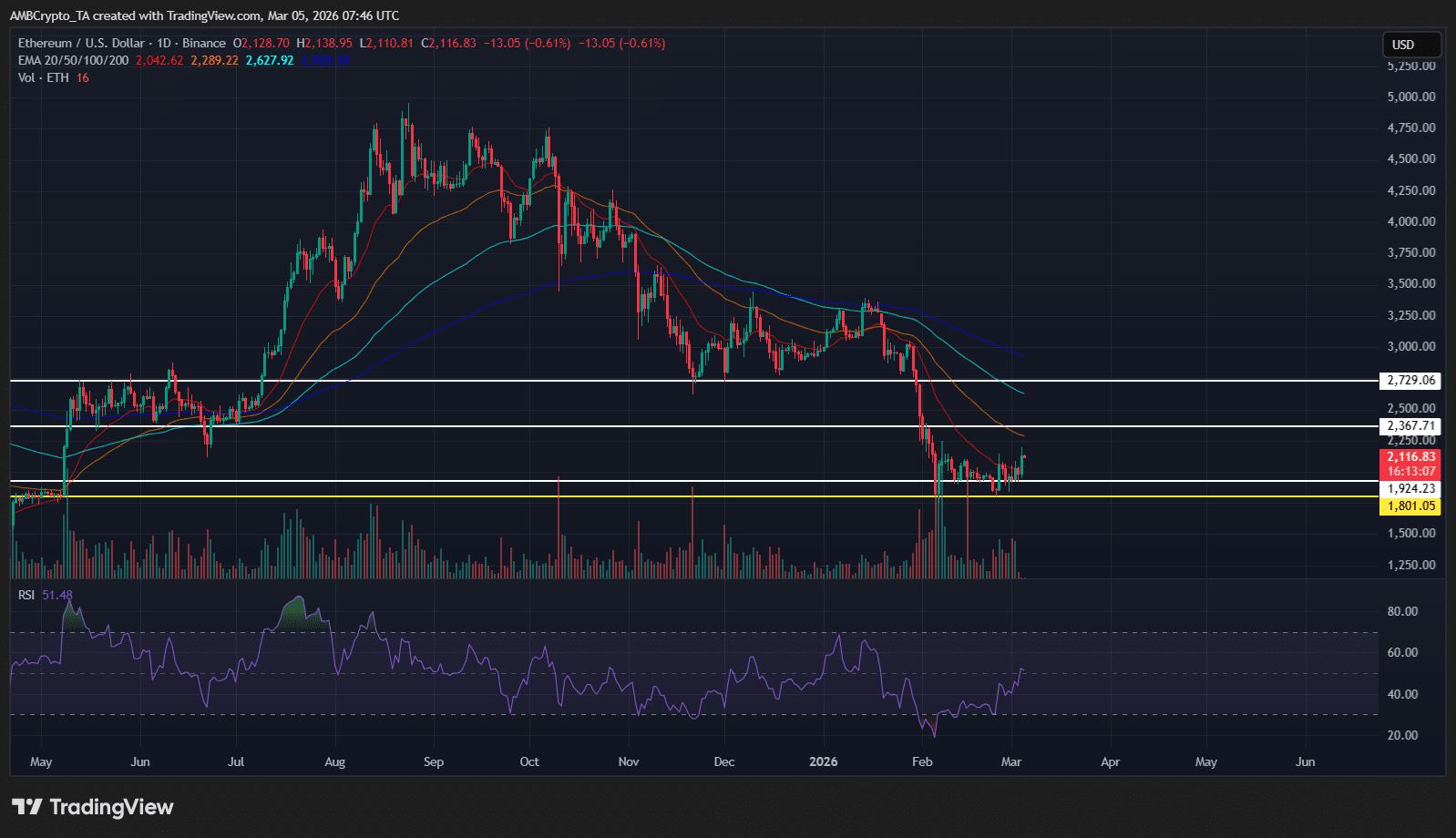
However, Ethereum still trades below major trend indicators. The 20-day EMA neared $2,042, and the 50-day EMA, around $2,289 continue acting as dynamic resistance, showing that sellers remain active during rebounds.
As the recovery unfolds, traders are now watching the $2,111–$2,150 resistance cluster, where the recent bounce approaches the upper boundary of a developing bearish pennant structure.
If buyers reclaim this zone, momentum could extend toward $2,250–$2,300. Meanwhile, failure here may send the price back toward $1,900 to retest the defended accumulation floor.
U.S. buying pressure supports Ethereum’s recovery
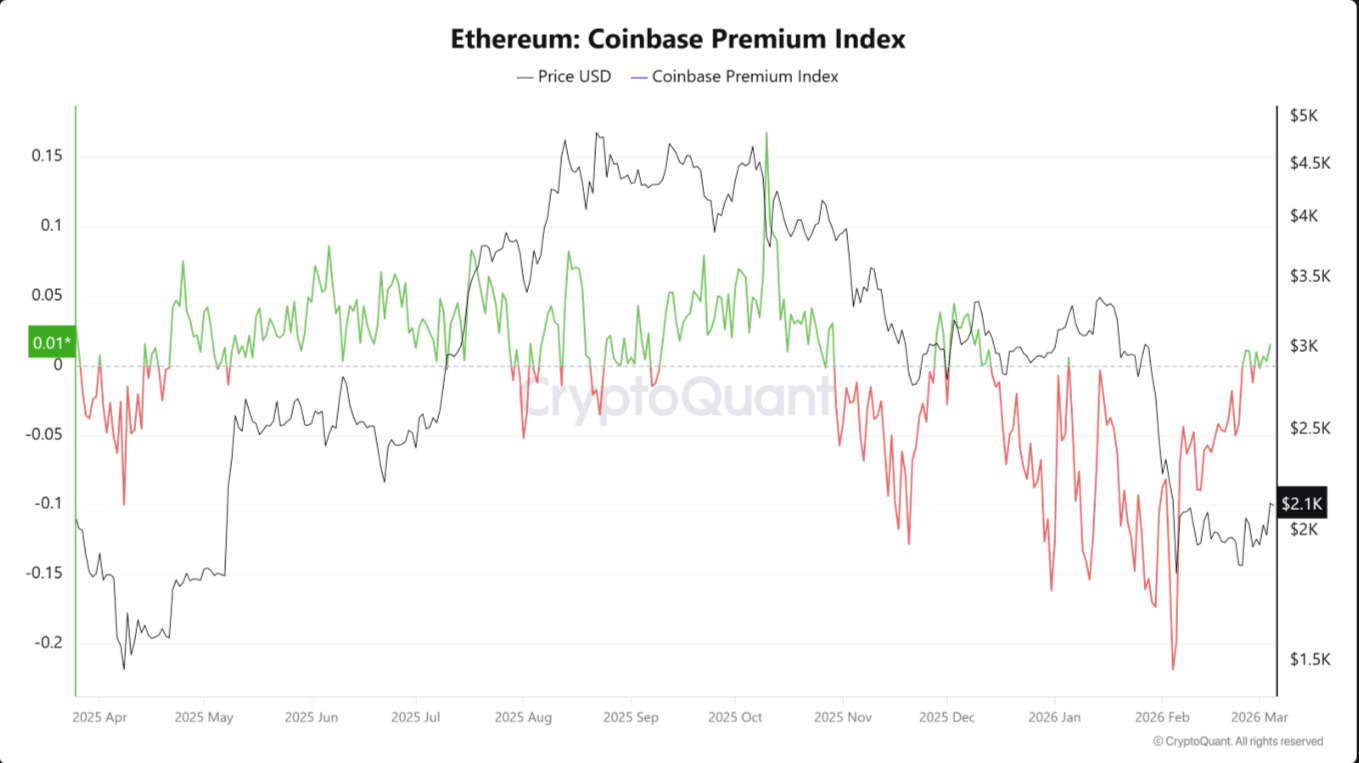
After Ethereum’s rebound from the $1,850–$1,900 demand zone, spot and exchange-flow signals indicate who supported the move.
First, the Coinbase Premium Index has shifted back into positive territory near +0.01, showing ETH has traded slightly higher on U.S. venues. As this premium holds, it suggests steady spot bidding rather than a one-off retail spike.
Meanwhile, CEX activity has also accelerated, which fits the rebound’s volatility regime. The 30-day ETH turnover jumped to roughly 29.6 million ETH, the highest since September.
At the same time, CEX reserves sat near 3.5 million ETH as of writing, meaning the market recycled the available supply multiple times. This lifted the Liquidity Ratio to about 8.47, reflecting intense repositioning and higher speculative churn.
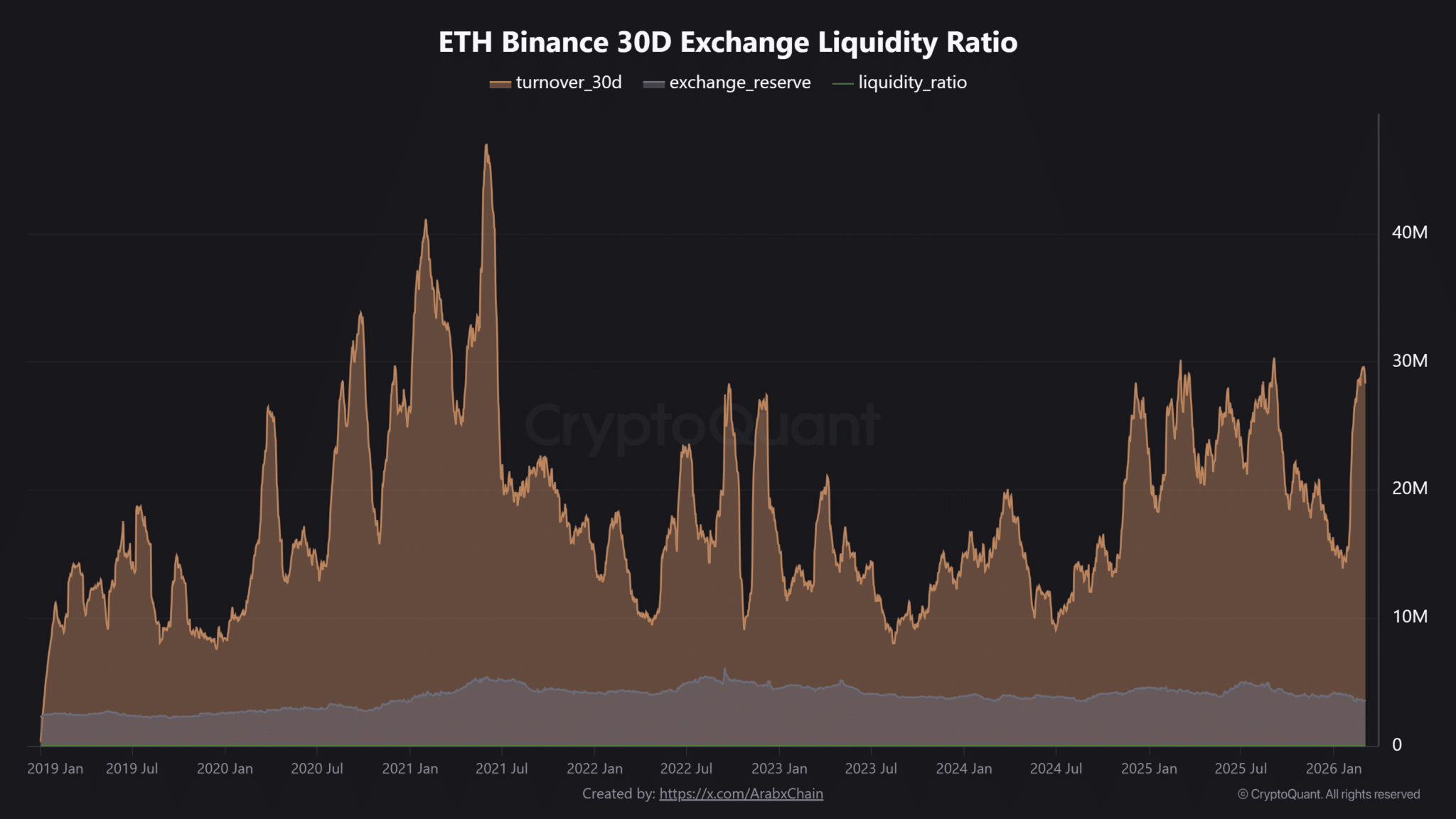
Taken together, fast turnover can reflect short-term trading or derivatives collateral use, while a sustained positive Coinbase premium implies persistent U.S. demand.
If the premium continues rising while the price holds above key supports, institutional accumulation becomes a stronger explanation than retail-driven speculation.
Ethereum rebound faces first structural test!
Ethereum traded near $2,128 at press time while consolidating above the $1,900 support region, where buyers recently absorbed the February sell-off.
This stabilization followed a sharp wick into the $1,700–$1,850 demand zone, signaling aggressive accumulation near the cycle’s lower boundary.
Meanwhile, Fibonacci retracement levels now define the recovery structure, with the first major resistance at the 61.8% level around $2,603, often seen as critical for trend reversals.
As the price approaches this zone, sellers may attempt to defend the broader bearish structure.
Above that, the 50% retracement around $2,985 represents the midpoint of the entire decline and could act as the next major upside objective.
If momentum continues strengthening, the price may eventually test the 38.2% level near $3,368, where a larger supply historically emerges.
At the same time, downside protection remains concentrated near $1,900, while the deeper $1,700–$1,850 zone serves as the key structural floor.
Maintaining this support keeps the current rebound intact while higher Fibonacci levels determine the recovery’s strength.




















