Ethereum Price Move To $20,000: The Accumulation Zone That Shows The Time To Buy

bitcoinistPublished on 2026-04-06Last updated on 2026-04-06

Abstract

A crypto analyst, Crypto Patel, has published a technical analysis on X using the Wyckoff method, suggesting Ethereum is in a multi-year accumulation phase that could lead to a significant price surge. Currently trading around $2,100—57% below its peak—ETH is seen as being in a buying zone, with key support levels at $1,549 and a secondary support at $1,065. The analysis identifies a pattern including a Selling Climax, Automatic Rally, and Secondary Test, forming a trading range with resistance near $4,700. If ETH breaks this resistance, it could enter a parabolic rally reaching up to $20,000 by late 2027 or 2028, representing a potential 10x return from current levels.

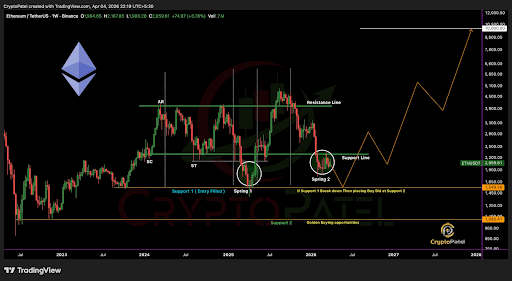
A crypto analyst, who publishes technical analysis to his audience on X, has released a zoomed-out weekly Ethereum chart that interprets the current price weakness as the final stage of a multi-year accumulation cycle. As it stands, the Ethereum price is trading around $2,100 and 57% below its peak. Therefore, the technical analysis is suggesting that the cryptocurrency is in an accumulation zone, one that is setting up a price move to as high as $20,000.

The Accumulation Blueprint Playing Out On ETH’s Weekly Chart

The weekly ETH/USDT chart posted by Crypto Patel on X illustrates a structured price pattern that has been developing since 2024. The chart identifies a Selling Climax (SC) in early 2024, followed by an Automatic Rally (AR) to resistance within two months, and then a Secondary Test (ST) of the Selling Climax in mid-2024.

These are all terminologies of a Wyckoff blueprint, and this has created the sequence of price events that established the boundaries of the current trading range. There is a horizontal resistance line around $4,700 at the top of that range, while Support 1, at $1,549, represents the bottom.

There are also two notable downside wicks labeled as Spring 1 and Spring 2, both of which are situated around Support Spring 1, which occurred in mid-2025 and saw the Ethereum price fall below Support 1 very briefly before recovering and pushing back to a new all-time high just above the resistance line.

Since then, however, the Ethereum price has been on a downside path, and the current price action is labeled as Spring 2, which is just above Support 1. If Support 1 breaks down, the next intended buy zone is Support 2 at $1,065. It is within the projected fall to Support 2 where Crypto Patel identifies the $1,800 to $1,400 range as the best buying and accumulation zone.
Ethereum Price Chart. Source: @CryptoPatel On X

Price Move To $20,000

The ETH accumulation map projects a price rally to as high as $20,000 after Ethereum breaks out of the accumulation zone. This rally is, however, contingent on a big resistance / breakout level around $4,700.

Crypto Patel’s projected targets ($10,000, $15,000, and $20,000) are plotted on the chart as a staged upside trajectory extending into late 2027 and 2028. The projected rally shows a rally from the current accumulation zone to $4,700, a pullback below $4,000 to consolidate the breakout, and then a parabolic extension to new all-time highs as high as $10,000 before continuing higher to $15,000 and $20,000.

A $20,000 price target for Ethereum would represent about a 10x return from the current price, which is trading at $2,135, up by 4.8% in the past 24 hours.

ETH price pushes upwards again | Source: ETHUSDT on Tradingview.com

Related Questions

QAccording to the analyst's Wyckoff analysis, what is the significance of the current Ethereum price level around $2,100?

AThe analyst interprets the current price weakness as the final stage of a multi-year accumulation cycle, suggesting Ethereum is in an accumulation zone that is setting up for a potential major rally.

QWhat are the key support and resistance levels identified in Crypto Patel's weekly ETH chart?

AThe chart identifies a horizontal resistance line around $4,700 at the top of the trading range, with Support 1 at $1,549 representing the bottom. If Support 1 breaks, the next intended buy zone is Support 2 at $1,065.

QWhat specific price range does Crypto Patel identify as the best buying and accumulation zone for Ethereum?

ACrypto Patel identifies the $1,800 to $1,400 range as the best buying and accumulation zone, which is within the projected fall to Support 2 at $1,065.

QWhat is the ultimate price target projected for Ethereum after a successful breakout from the accumulation zone?

AThe ultimate price target projected is $20,000, which would represent about a 10x return from the current price level.

QWhat sequence of price events, according to Wyckoff terminology, established the boundaries of the current trading range?

AThe sequence includes a Selling Climax (SC) in early 2024, followed by an Automatic Rally (AR) to resistance, and then a Secondary Test (ST) of the Selling Climax in mid-2024.

Related Reads

Google and Amazon Simultaneously Invest Heavily in a Competitor: The Most Absurd Business Logic of the AI Era Is Becoming Reality

In a span of four days, Amazon announced an additional $25 billion investment, and Google pledged up to $40 billion—both direct competitors pouring over $65 billion into the same AI startup, Anthropic. Rather than a typical venture capital move, this signals the latest escalation in the cloud wars. The core of the deal is not equity but compute pre-orders: Anthropic must spend the majority of these funds on AWS and Google Cloud services and chips, effectively locking in massive future compute consumption. This reflects a shift in cloud market dynamics—enterprises now choose cloud providers based on which hosts the best AI models, not just price or stability. With OpenAI deeply tied to Microsoft, Anthropic’s Claude has become the only viable strategic asset for Google and Amazon to remain competitive. Anthropic’s annualized revenue has surged to $30 billion, and it is expanding into verticals like biotech, positioning itself as a cross-industry AI infrastructure layer. However, this funding comes with constraints: Anthropic’s independence is challenged as it balances two rival investors, its safety-first narrative faces pressure from regulatory scrutiny, and its path to IPO introduces new financial pressures. Globally, this accelerates a "tri-polar" closed-loop structure in AI infrastructure, with Microsoft-OpenAI, Google-Anthropic, and Amazon-Anthropic forming exclusive model-cloud alliances. In contrast, China’s landscape differs—investments like Alibaba and Tencent backing open-source model firm DeepSeek reflect a more decoupled approach, though closed-source models from major cloud providers still dominate. The $65 billion bet is ultimately about securing a seat at the table in an AI-defined future—where missing the model layer means losing the cloud war.

marsbit3h ago

Google and Amazon Simultaneously Invest Heavily in a Competitor: The Most Absurd Business Logic of the AI Era Is Becoming Reality

marsbit3h ago

Computing Power Constrained, Why Did DeepSeek-V4 Open Source?

DeepSeek-V4 has been released as a preview open-source model, featuring 1 million tokens of context length as a baseline capability—previously a premium feature locked behind enterprise paywalls by major overseas AI firms. The official announcement, however, openly acknowledges computational constraints, particularly limited service throughput for the high-end DeepSeek-V4-Pro version due to restricted high-end computing power. Rather than competing on pure scale, DeepSeek adopts a pragmatic approach that balances algorithmic innovation with hardware realities in China’s AI ecosystem. The V4-Pro model uses a highly sparse architecture with 1.6T total parameters but only activates 49B during inference. It performs strongly in agentic coding, knowledge-intensive tasks, and STEM reasoning, competing closely with top-tier closed models like Gemini Pro 3.1 and Claude Opus 4.6 in certain scenarios. A key strategic product is the Flash edition, with 284B total parameters but only 13B activated—making it cost-effective and accessible for mid- and low-tier hardware, including domestic AI chips from Huawei (Ascend), Cambricon, and Hygon. This design supports broader adoption across developers and SMEs while stimulating China's domestic semiconductor ecosystem. Despite facing talent outflow and intense competition in user traffic—with rivals like Doubao and Qianwen leading in monthly active users—DeepSeek has maintained technical momentum. The release also comes amid reports of a new funding round targeting a valuation exceeding $10 billion, potentially setting a new record in China’s LLM sector. Ultimately, DeepSeek-V4 represents a shift toward open yet realistic infrastructure development in the constrained compute landscape of Chinese AI, emphasizing engineering efficiency and domestic hardware compatibility over pure model scale.

marsbit4h ago

Computing Power Constrained, Why Did DeepSeek-V4 Open Source?

marsbit4h ago

Trading

Spot
Futures

Hot Articles

Discussions

Welcome to the HTX Community. Here, you can stay informed about the latest platform developments and gain access to professional market insights. Users' opinions on the price of ETH (ETH) are presented below.

活动图片















