Ethereum Just Lost The Realized Price, But Here’s What Investors Are Up To

bitcoinistPublished on 2026-02-04Last updated on 2026-02-04

Abstract

Ethereum's price has dropped sharply, falling below the key realized price level and nearing $2,000 amid heightened market volatility. Despite this decline and widespread unrealized losses, on-chain data indicates that investors—particularly large whales and conviction-driven buyers—continue to accumulate ETH. Notably, accumulation addresses have increased their inflows, suggesting strong confidence in the asset's future. Market expert CW points to this persistent buying as a potential precursor to a significant rebound. Additionally, Ethereum is experiencing heightened social media interest, partly driven by major acquisitions such as BitMine's recent purchase of 20,000 ETH. The company now holds over 4.3 million ETH, representing about 3.56% of the total supply, with a significant portion staked. Despite current pressures, investor behavior and large-scale accumulation suggest underlying strength and potential recovery for Ethereum.

With volatility intensifying in the broader cryptocurrency market, the price of Ethereum has fallen sharply, drawing dangerously close to the $2,000 level. While there are speculations that the ongoing trend is akin to a bear market phase, investors seem to be unshaken by the sharp pullback in ETH’s price, with accumulation not showing signs of slowing down.

Investors’ Behavior After Ethereum’s Drop Below Realized Price

Following the sharp pullback on Tuesday, the Ethereum price has now fallen below a key level regarded as the Realized Price. Despite the price experiencing steady downside movements, investors are moving in the opposite direction, as evidenced by their continued interest in the leading altcoin.

Related Reading: Ethereum Holders Jump 3% In January, Clear 175 Million Milestone

According to CW, a market expert and investor, investors continue to steadily stack the altcoin even with ETH trading below its realized price, which puts a large portion of the market in unrealized loss territory. On-chain data points to continued accumulation from large holders or whales and conviction-driven buyers.
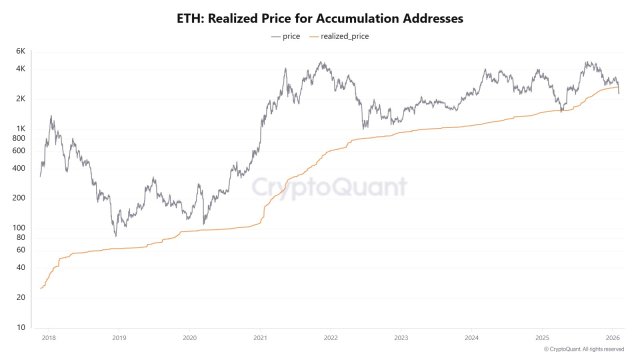
ETH accumulation addresses are still buying | Source: Chart from CW on X

What’s interesting about the whale’s action is that these investors are persistently accumulating Ethereum despite being in a loss. Large investors sitting on unrealized losses are still buying, which is a pattern typically linked to heightened stress and shifting sentiment across the network.

Even with the current pullback, ETH inflows into accumulation addresses have also increased. CW highlighted that Ethereum had previously hit this level in April of last year, but it swiftly recovered before rising again. When the buying power of whales remains intact, this implies that the group has found the current price attractive. As a result, a significant rebound in ETH’s price is expected in the near future.

ETH Seeing Heightened Social Media Interest

Ethereum may be struggling with volatility, but the leading altcoin is experiencing increased interest from investors and social media participants. This is because of price movements, investment strategies, staking, and its potential as a deflationary asset following upgrades like EIP-1559 and the merge.

Related Reading: Here’s How Ethereum Staking Transforms Into A Multi-Billion-Dollar Bet For Bitmine Immersion

Data from Santiment, a popular on-chain data analytics firm, shows that ETH is commonly brought up in flash deals and cryptocurrency trading services, emphasizing its usage across platforms such as Binance, MetaMask, and Trust Wallet.

ETH’s increased social media mentions are attributed to the massive buying activity by BitMine. The company recently bought a large amount of ETH, signaling robust confidence in the altcoin’s future despite ongoing market volatility and unrealized losses.

CW reported that the company has acquired another 20,000 ETH, valued at approximately $46.04 million, through FalconX. With this purchase, Tom Lee’s Bitmine now boasts over 4.305 million ETH, worth a staggering $9.99 billion, which represents about 3.56% of the total ETH supply.

Despite this massive figure, Bitmine’s goal is to own 5% of all ETH supply. Bitmine remains the largest Ethereum treasury company in the world, with 2.87 million of its ETH holdings being locked away in staking. Other coins owned by the company include Bitcoin, of which they hold over 193 BTC.

ETH trading at $2,284 on the 1D chart | Source: ETHUSDT on Tradingview.com

Related Questions

QWhat key price level has Ethereum fallen below according to the article?

AEthereum has fallen below the Realized Price.

QDespite the price drop, what are large investors (whales) doing with Ethereum?

ALarge investors (whales) are persistently accumulating and buying more Ethereum, even while sitting on unrealized losses.

QWhich company made a significant purchase of 20,000 ETH, and what is their ultimate goal for ETH holdings?

AThe company is BitMine (also referred to as Bitmine in the text). Their goal is to own 5% of the total Ethereum supply.

QWhat is the main reason for the increased social media interest in Ethereum mentioned in the article?

AThe increased social media interest is attributed to massive buying activity, specifically by BitMine, and discussions around price movements, investment strategies, staking, and its potential as a deflationary asset.

QWhat does the article suggest is expected for Ethereum's price in the near future based on whale activity?

AThe article suggests that a significant rebound in ETH's price is expected in the near future because whales find the current price attractive and are continuing to buy.

Related Reads

Google and Amazon Simultaneously Invest Heavily in a Competitor: The Most Absurd Business Logic of the AI Era Is Becoming Reality

In a span of four days, Amazon announced an additional $25 billion investment, and Google pledged up to $40 billion—both direct competitors pouring over $65 billion into the same AI startup, Anthropic. Rather than a typical venture capital move, this signals the latest escalation in the cloud wars. The core of the deal is not equity but compute pre-orders: Anthropic must spend the majority of these funds on AWS and Google Cloud services and chips, effectively locking in massive future compute consumption. This reflects a shift in cloud market dynamics—enterprises now choose cloud providers based on which hosts the best AI models, not just price or stability. With OpenAI deeply tied to Microsoft, Anthropic’s Claude has become the only viable strategic asset for Google and Amazon to remain competitive. Anthropic’s annualized revenue has surged to $30 billion, and it is expanding into verticals like biotech, positioning itself as a cross-industry AI infrastructure layer. However, this funding comes with constraints: Anthropic’s independence is challenged as it balances two rival investors, its safety-first narrative faces pressure from regulatory scrutiny, and its path to IPO introduces new financial pressures. Globally, this accelerates a "tri-polar" closed-loop structure in AI infrastructure, with Microsoft-OpenAI, Google-Anthropic, and Amazon-Anthropic forming exclusive model-cloud alliances. In contrast, China’s landscape differs—investments like Alibaba and Tencent backing open-source model firm DeepSeek reflect a more decoupled approach, though closed-source models from major cloud providers still dominate. The $65 billion bet is ultimately about securing a seat at the table in an AI-defined future—where missing the model layer means losing the cloud war.

marsbit5h ago

Google and Amazon Simultaneously Invest Heavily in a Competitor: The Most Absurd Business Logic of the AI Era Is Becoming Reality

marsbit5h ago

Computing Power Constrained, Why Did DeepSeek-V4 Open Source?

DeepSeek-V4 has been released as a preview open-source model, featuring 1 million tokens of context length as a baseline capability—previously a premium feature locked behind enterprise paywalls by major overseas AI firms. The official announcement, however, openly acknowledges computational constraints, particularly limited service throughput for the high-end DeepSeek-V4-Pro version due to restricted high-end computing power. Rather than competing on pure scale, DeepSeek adopts a pragmatic approach that balances algorithmic innovation with hardware realities in China’s AI ecosystem. The V4-Pro model uses a highly sparse architecture with 1.6T total parameters but only activates 49B during inference. It performs strongly in agentic coding, knowledge-intensive tasks, and STEM reasoning, competing closely with top-tier closed models like Gemini Pro 3.1 and Claude Opus 4.6 in certain scenarios. A key strategic product is the Flash edition, with 284B total parameters but only 13B activated—making it cost-effective and accessible for mid- and low-tier hardware, including domestic AI chips from Huawei (Ascend), Cambricon, and Hygon. This design supports broader adoption across developers and SMEs while stimulating China's domestic semiconductor ecosystem. Despite facing talent outflow and intense competition in user traffic—with rivals like Doubao and Qianwen leading in monthly active users—DeepSeek has maintained technical momentum. The release also comes amid reports of a new funding round targeting a valuation exceeding $10 billion, potentially setting a new record in China’s LLM sector. Ultimately, DeepSeek-V4 represents a shift toward open yet realistic infrastructure development in the constrained compute landscape of Chinese AI, emphasizing engineering efficiency and domestic hardware compatibility over pure model scale.

marsbit6h ago

Computing Power Constrained, Why Did DeepSeek-V4 Open Source?

marsbit6h ago

Trading

Spot
Futures

Hot Articles

Discussions

Welcome to the HTX Community. Here, you can stay informed about the latest platform developments and gain access to professional market insights. Users' opinions on the price of ETH (ETH) are presented below.

活动图片















