Ethereum Foundation's Major Overhaul: The Restructuring Challenge Behind the Loss of Several Key Veterans in Four Months

marsbitPublished on 2026-05-19Last updated on 2026-05-19

Abstract

In just a few months, the Ethereum Foundation (EF) has seen a significant exodus of core members, including former co-executive director Tomasz Stańczak and key figures like Josh Stark and Trent Van Epps. This wave of departures coincides with the EF's ongoing internal restructuring, a shift in its declared role from the "primary guardian" to "one of many guardians," and its first public layoffs. The Protocol team, responsible for Ethereum's core protocol development, has been particularly affected but has been reorganized with three new co-leads: Will Corcoran, Kev Wedderburn, and Fredrik Svantes. Their immediate focus is on delivering the next major network upgrade, Glamsterdam, aimed at increasing mainnet throughput, though its launch is now likely delayed to Q3 2026. While concerns exist about talent drain—especially with competitive offers from newer chains—and potential delays to key upgrades, some view this turnover as a natural part of the EF's transition. The foundation's intentional move to decentralize its influence aligns with the broader goal of making Ethereum a more robust and neutral infrastructure, capable of passing the "walkaway test" where the protocol can function independently of its original core developers.

Author: Nancy, PANews

In a short span of months, the departure of several core members from the Ethereum Foundation (EF) has further dampened the already low morale within the Ethereum community, especially amidst the relatively lackluster performance of ETH's price.

Key Transition Period for EF as Seasoned Veterans Depart Collectively

In mid-2025, facing issues of slow execution, insufficient ecosystem support, and long-standing criticism over governance transparency, the Ethereum Foundation initiated an internal adjustment, restructuring its Research and Development teams and conducting its first public layoffs. This move was viewed by the outside world as a long-overdue self-correction.

In March 2026, the EF released a 38-page mission statement. While reaffirming Ethereum's core vision, the Foundation explicitly stated that its role had shifted from "first guardian" to "one of many guardians." To demonstrate its commitment, the EF even created a meme image of a "SOURCE SEPPUKU LICENSE," signifying its readiness to "face the consequences and end itself" if it failed to fulfill its promises to Ethereum.

However, as EF's organizational adjustments continued to progress, core members kept leaving. Since February this year, 7 core members or senior contributors have departed.
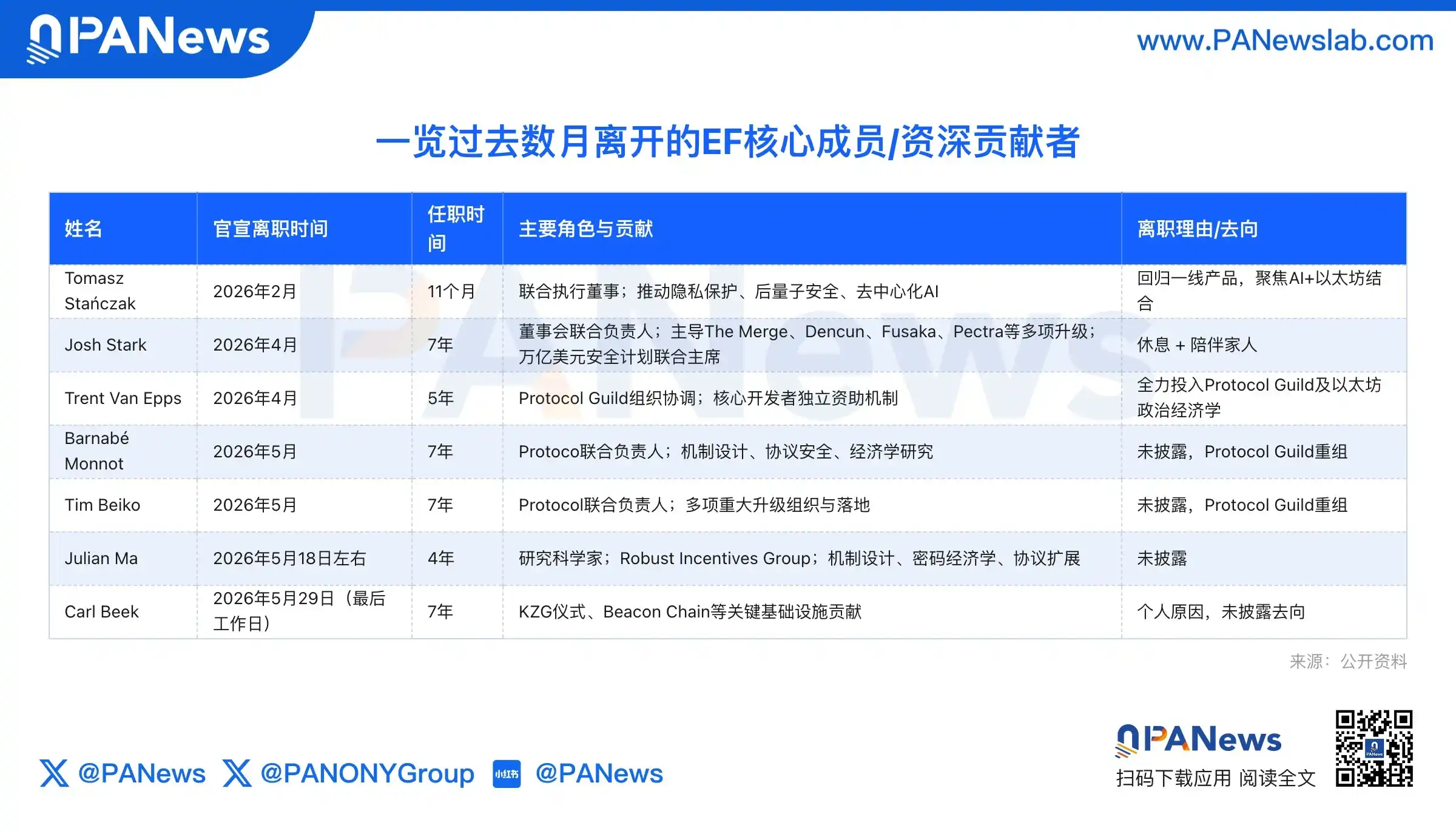
In February, Tomasz Stańczak announced his resignation as EF's Co-Executive Director, less than a year into his tenure. During his time, he promoted initiatives in privacy protection, post-quantum security, and decentralized AI. He stated that the Ethereum ecosystem is currently in a relatively healthy phase, and he wishes to return to hands-on product development, focusing on exploring the integration paths between AI and Ethereum. He also noted that his independent execution space within the EF was gradually shrinking, and staying on felt more like a transitional handover. His successor is Bastian Aue, who joined the EF in 2019. In contrast, Aue has less publicly available information and previously focused on key supportive work such as organizational coordination and operational optimization.

About two months later, in mid-April 2026, key figure Josh Stark announced his departure after seven years at EF. He was deeply involved in several critical Ethereum upgrades, including The Merge, Dencun, Fusaka, and Pectra, and served as Co-Chair of the $1 Trillion Security Plan. He cited his reason for leaving as "plans to rest and spend time with family."

On the same day, Trent Van Epps also announced his departure from EF. He long oversaw the coordination of Protocol Guild, driving the funding mechanism for Ethereum core developers and participating in network upgrades and funding-related matters. After leaving, he will focus on Protocol Guild and research into Ethereum's political economy. He had previously publicly expressed that the EF leadership's association with the Milady NFT series was "perplexing."

In May, Alex Stokes, Co-Lead of Protocol Research, announced a leave of absence. Subsequently, Barnabé Monnot and Tim Beiko, former Co-Leads of Protocol Guild, as well as two senior researchers, Carl Beek and Julian Ma, also left, none publicly stating their reasons.

Although the vast majority of departing members did not publicly disclose specific reasons, sources indicated that EF, based on its emphasized "Anti-Censorship Principle," required internal members to sign a document named Mandate, otherwise facing immediate termination. This principle emphasizes that no entity should, through establishing persistent and exclusive control over key mechanisms, interfere with legitimate use or affect system operation. However, this claim has not yet been officially confirmed by EF.

Nevertheless, the talent drain from EF has also raised concerns about the overall Ethereum ecosystem. Protocol Guild contributor cheeky-gorilla warned that the health of L1 core development is the foundation of the entire Ethereum ecosystem, but core developers' salaries are 50% to 60% lower than market rates for similar positions. High-performance new chains like Monad and top L2 projects are precisely poaching talent with salaries over 10 times higher. He warned that once seasoned researchers familiar with the underlying protocol logic are lost, Ethereum's critical roadmap faces the real risk of stalling.

Protocol Team Leadership Change, Fears of Upgrade Delays Intensify

Within just four months, the consecutive departure of seasoned veterans from the executive to research layers has further heightened the uncertainty surrounding EF's reforms, particularly the adjustments within the Protocol team.

The Protocol team is the core unit responsible for the design, research, development, and coordination of Ethereum's base layer, covering security, cryptography, zkEVM, peer-to-peer networks, and other directions. As one of the core forces within EF, it significantly influences the long-term evolution, security, and scalability of the Ethereum protocol.

Facing personnel changes, EF completed a restructuring of the Protocol team this month, appointing three new Protocol Co-Leads: Will Corcoran, Kev Wedderburn, and Fredrik Svantes, who have been with EF for approximately 2 to 7 years.

Among them, Will Corcoran is a Protocol Research Coordinator, focusing on cutting-edge research in zkVM proof systems, post-quantum consensus, Fast Confirmation Rule, etc., with cross-team coordination experience and familiarity with the overall architecture;

Kev Wedderburn is the Lead of the zkEVM team, with deep expertise in zero-knowledge proofs, zkEVM implementation, and the integration of research and engineering. He will continue to lead zkEVM-related work, promoting the deep integration of the execution layer with zero-knowledge technology;

Fredrik Svantes is the Lead of Protocol Security Research, long overseeing core Ethereum security work, including the $1 Trillion Security Plan, the Ethereum Bug Bounty program, and audit competition organization, and will be deeply involved in cross-team collaboration.

Under the new leadership team, Protocol will prioritize pushing forward the launch of the Glamsterdam upgrade, preparing for the next Hegotá upgrade, and continuing to drive the implementation of the Strawmap roadmap in the short term.

Among these, Glamsterdam is Ethereum's next major network upgrade, with the core goal of enhancing mainnet throughput capacity. It plans to increase the Gas limit from the current ~60 million to 200 million and adjust transaction processing mechanisms and state database management methods.

However, the Glamsterdam upgrade, originally slated for June 2026, has already been delayed. Based on the latest testnet progress and Interop meeting feedback, the actual mainnet launch is more likely to be postponed to Q3 2026. Therefore, some community members and developers worry that recent core personnel changes may further impact the upgrade schedule and execution efficiency.

Nevertheless, some hold the view that this round of personnel turnover is a normal phenomenon during EF's restructuring process. Some members left after completing their phased missions, some aligned with strategic direction adjustments, while a new leadership has gradually taken over, and the core roadmap remains unchanged. More importantly, as the Ethereum ecosystem matures, the EF itself intends to diminish its central role. This helps reduce single-point control risks, alleviate external skepticism about the Foundation's influence, and further strengthen Ethereum's position as neutral infrastructure.

This also aligns with the concept of the "Walkaway Test" advocated by Vitalik, meaning that the protocol should continue to operate safely, predictably, and stably in the long term even if core developers completely exit and cease maintenance.


Related Questions

QAccording to the article, what is the main reason given for the recent wave of high-profile departures from the Ethereum Foundation (EF)?

AThe article states that while most departing members have not publicly disclosed specific reasons, a source indicated that the EF required internal members to sign a document called a "Mandate" based on its "anti-censorship principle," with refusal leading to immediate termination. However, this claim has not been officially confirmed by the EF. Individual reasons mentioned include Tomasz Stańczak wanting to return to hands-on product building and Josh Stark planning to rest and spend time with his family.

QWhat is the "SOURCE SEPPUKU LICENSE" meme referenced in the article, and what does it symbolize for the EF's new role?

AThe "SOURCE SEPPUKU LICENSE" is a meme image created by the Ethereum Foundation. It symbolizes a dramatic commitment to its new mission. The meme, referencing a form of ritual suicide, represents the EF's pledge to "self-destruct" or face severe consequences if it fails to uphold its promises to the Ethereum ecosystem, underscoring its shift from being the "first guardian" to just "one of many guardians."

QWhat is the Protocol team within the Ethereum Foundation responsible for, and who are its three new co-leads following the recent restructuring?

AThe Protocol team is the core team responsible for the design, research, development, and coordination of Ethereum's base layer, covering areas like security, cryptography, zkEVM, and peer-to-peer networking. Following the restructuring, the three new Protocol co-leads are Will Corcoran (focusing on research coordination and zkVM systems), Kev Wedderburn (leading the zkEVM team), and Fredrik Svantes (leading protocol security research).

QWhat major Ethereum network upgrade is currently facing potential delays according to the article, and what is its primary goal?

AThe major network upgrade facing potential delays is called Glamsterdam. Its primary goal is to significantly increase the throughput capacity of the Ethereum mainnet by raising the Gas limit from the current ~60 million to 200 million, alongside adjustments to transaction processing and state database management.

QHow does the concept of the "Walkaway Test," mentioned at the end of the article, relate to the EF's current restructuring and personnel changes?

AThe "Walkaway Test," advocated by Vitalik Buterin, is the idea that the Ethereum protocol should be robust enough to run safely, predictably, and stably in the long term even if all core developers completely stepped away. The article suggests that the EF's restructuring and intentional reduction of its central role align with this philosophy, aiming to reduce single-point-of-control risks and reinforce Ethereum's position as a neutral infrastructure, making the ecosystem less dependent on any single entity like the EF.

Related Reads

Near Returns to the AI Stage: Transformation into a Public Chain Due to 'Payroll Difficulties,' Agent and Privacy Emerge as New Growth Narratives

NEAR Returns to AI Origins: From Payroll Struggles to Blockchain, Now Focusing on AI Agents and Privacy NEAR Protocol's journey began not with grand blockchain ambitions, but from a practical hurdle: its AI startup founders, including Transformer paper co-author Illia Polosukhin, couldn't efficiently pay international developers in 2017. This led them to pivot and build a high-performance, scalable blockchain. After years navigating various crypto narratives like sharding and cross-chain interoperability, NEAR is now leveraging its AI roots to re-enter the AI arena. A key driver is its "NEAR Intents" layer, which abstracts complex cross-chain transactions. Users simply state their goal (e.g., swap BTC for ETH), and a solver network finds the optimal route. This system has processed over $20B in cross-chain volume, generating significant fee revenue. A major growth area is private transactions via "Confidential Intents/Swaps," which hide trade details until settlement to protect against MEV and front-running. Remarkably, private swaps recently accounted for over 40% of NEAR's transaction volume, highlighting strong demand but also potential regulatory scrutiny. With its AI-founder pedigree, NEAR is positioning itself at the intersection of blockchain, AI agents, and privacy, aiming to become infrastructure for the emerging agent economy while navigating the challenges of its rapid adoption.

marsbit47m ago

Near Returns to the AI Stage: Transformation into a Public Chain Due to 'Payroll Difficulties,' Agent and Privacy Emerge as New Growth Narratives

marsbit47m ago

From Ethereum to AI's 'CROPS': What Exactly is This Set of 'Slow Variables' That Vitalik Repeatedly Emphasizes?

In recent discussions, Vitalik Buterin has frequently emphasized the concept of "CROPS," a framework defining core values for Ethereum's development. CROPS stands for Censorship Resistance, Capture Resistance, Open Source, Privacy, and Security. Initially outlined in the Ethereum Foundation's "EF Mandate," it represents a commitment to user sovereignty, ensuring that the network resists external control, remains open, protects privacy, and prioritizes security. The relevance of CROPS extends beyond Ethereum's foundational principles, becoming crucial in the context of AI integration. As AI agents begin handling wallet operations and automated transactions, the risk increases that users may cede control over their digital assets, privacy, and intentions to centralized AI service providers. A "CROPS AI" would therefore emphasize local execution where possible, privacy-preserving remote model calls (e.g., using zero-knowledge proofs), and transparent, verifiable processes to maintain user agency. Vitalik highlights a significant convergence between "CROPS Ethereum access layer" and "CROPS AI." Both address the same fundamental challenge: how users can access powerful services—be it blockchain data via RPCs or AI models—without exposing sensitive information or relinquishing ultimate control. This intersection points toward a future digital entry point that is more private, secure, and user-controlled. Ultimately, CROPS is not merely an abstract ideal but a practical guidepost. It steers development—from protocol resilience and wallet design to AI agent safety—towards a future where users retain self-sovereignty even as digital systems grow more complex and powerful. In an era of accelerating AI adoption, these "slow variables" of censorship resistance, openness, privacy, and security may define Ethereum's enduring value.

marsbit58m ago

From Ethereum to AI's 'CROPS': What Exactly is This Set of 'Slow Variables' That Vitalik Repeatedly Emphasizes?

marsbit58m ago

Silicon Valley 'Startup Guru' Steve Hoffman: Web3 + AI Could Be a Trap

Silicon Valley investor and "Godfather of Startups" Steve Hoffman warns that combining Web3 with AI is likely a trap, not a promising venture. In an interview, Hoffman argues that while AI is a foundational technology touching all industries, Web3 adds complexity, friction, and regulatory risk without solving mainstream consumer or business needs. He advises founders to focus on deep, specialized applications where startups can out-iterate giants, rather than on generic features easily replicated by large tech companies. Hoffman observes that Silicon Valley will lead foundational AI research, while China excels at rapid, large-scale application and commercialization, particularly in robotics. He stresses that AI-driven autonomous agents capable of collaborative, multi-step tasks are 2-4 years away, which will cause significant job displacement. The solution is not to slow AI but to redesign business models around human-AI collaboration and reform social systems like education and retraining. For startups, Hoffman recommends focusing on vertical, expertise-heavy domains to build defensibility. He sees major opportunities in AI fraud detection and cybersecurity. Key founder mindsets include systemic thinking over feature-focus, relentless customer centricity, building adaptive teams, and deeply understanding AI's capabilities and limits. Hoffman is also leading a non-profit initiative to establish university centers aimed at training future leaders in responsible, human-value-aligned AI innovation.

marsbit2h ago

Silicon Valley 'Startup Guru' Steve Hoffman: Web3 + AI Could Be a Trap

marsbit2h ago

Token Inefficient, Economy Tokenless

The article "Tokens Aren't Economical, Economics Aren't Tokenized" analyzes a pivotal shift in the AI industry from a technology-driven narrative to one dominated by capital efficiency. It highlights two concurrent trends: a severe capital shortage due to the exorbitant and recurring costs of compute (e.g., OpenAI's high burn rate) and a wave of corporate spin-offs where major tech companies are separating their AI units (like Kuaishou's Kling and Baidu's Kunlunxin). The core argument is that AI's "anti-internet" business model, where user growth increases costs rather than profits, has created a disconnect between high valuations and actual cash flow. Spin-offs address this by allowing AI assets to be valued independently. Within a parent company, they are seen as cost centers, but as standalone entities, they are priced based on their growth potential and scarcity in the primary market, leading to massive valuation premiums (e.g., Kling's estimated value tripling post-spin-off). The industry is at an inflection point, moving from "model worship" to "value realization." The competition is evolving from a pure compute (GPU) race to a broader focus on systemic efficiency and full-stack engineering (involving CPUs and orchestration) to achieve viable commercialization. The year 2026 is framed as a critical moment where the industry must definitively answer how to economically translate AI capability into tangible business value, reshaping the sector's future power structure.

marsbit2h ago

Token Inefficient, Economy Tokenless

marsbit2h ago

Trading

Spot
Futures

Hot Articles

Discussions

Welcome to the HTX Community. Here, you can stay informed about the latest platform developments and gain access to professional market insights. Users' opinions on the price of S (S) are presented below.

活动图片