Ethereum Coinbase Premium Jumps – Is US Selling Pressure Finally Fading?

bitcoinistPublished on 2026-02-16Last updated on 2026-02-16

Abstract

Ethereum has been consolidating below the $2,000 level since early February, reflecting trader caution amid elevated volatility and limited momentum. According to a CryptoQuant report, the Ethereum Coinbase Premium Index—which compares Coinbase spot prices to other exchanges—has been predominantly negative, indicating weak U.S. investor demand and a lack of aggressive buying during the correction. Recently, however, the index has shown a noticeable rebound, suggesting U.S. selling pressure may be easing. If this trend continues and turns positive, it could signal renewed spot buying interest from U.S. participants. A sustained positive premium, combined with a potential technical breakout from the current chart pattern, may support a more durable recovery phase, especially if broader market sentiment and liquidity conditions improve.

Ethereum has remained locked in a consolidation phase below the $2,000 level since the sharp market decline seen in early February. Despite occasional rebound attempts, price action continues to reflect caution among traders, with volatility elevated and momentum limited. The inability to reclaim this psychological threshold has reinforced a defensive market posture, as investors weigh macro uncertainty, liquidity conditions, and broader crypto sentiment.

A recent CryptoQuant report provides additional context from an on-chain perspective. According to the analysis, the Ethereum Coinbase Premium Index has stayed predominantly in negative territory, signaling relatively weak demand from US-based investors. This metric compares spot prices on Coinbase with those on other major exchanges, offering insight into regional buying pressure. Persistent negative readings suggest that aggressive spot accumulation from US participants has been largely absent during the current corrective phase.

This pattern aligns with the broader technical structure visible on price charts, where rallies have struggled to gain follow-through. While consolidation does not necessarily imply further downside, sustained weakness in spot demand typically delays recovery phases, leaving Ethereum sensitive to shifts in liquidity, macro conditions, and investor confidence in the near term.

Coinbase Premium Rebound Signals Potential Shift In Demand

The report further notes that the Coinbase Premium Index has recently shown a noticeable upward rebound. Although the indicator remains below the neutral threshold, the strength of the move suggests that selling pressure from US-based investors may be starting to ease. This shift is relevant because the index reflects the difference between Ethereum spot prices on Coinbase and those on other major exchanges, making it a proxy for regional demand dynamics.
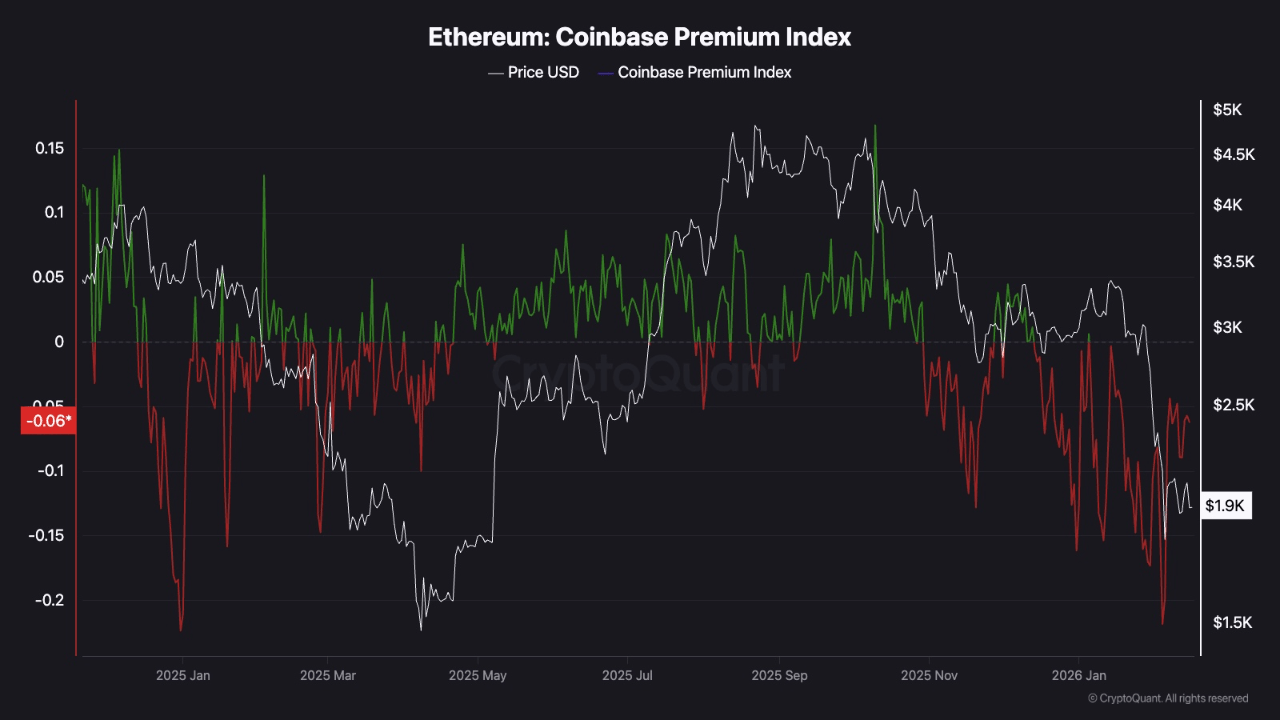
Ethereum Coinbase Premium Index | Source: CryptoQuant

If the current upward momentum continues and the index moves into positive territory, turning green, it would indicate renewed spot buying interest from US market participants. Historically, sustained positive readings have often coincided with phases of stronger accumulation, which can help stabilize price action after periods of corrective pressure.

Such a development could become particularly significant if it aligns with a technical breakout from the triangle structure currently visible on the charts. In that scenario, improving on-chain demand and constructive price structure would reinforce each other. While this does not guarantee an immediate rally, the combination could increase the probability of a more durable recovery phase, especially if broader liquidity conditions and market sentiment also begin to improve.


Related Questions

QWhat does the Ethereum Coinbase Premium Index measure and what does a negative reading indicate?

AThe Ethereum Coinbase Premium Index compares spot prices on Coinbase with those on other major exchanges, offering insight into regional buying pressure. A persistent negative reading indicates relatively weak demand and a lack of aggressive spot accumulation from US-based investors.

QWhat recent change in the Coinbase Premium Index suggests a potential shift in market dynamics?

AThe index has recently shown a noticeable upward rebound, suggesting that selling pressure from US-based investors may be starting to ease, even though it remains below the neutral threshold.

QWhat would a move into green/positive territory for the Coinbase Premium Index signify?

AIf the index moves into positive territory, it would indicate renewed spot buying interest from US market participants, which historically has often coincided with phases of stronger accumulation and helped stabilize price action.

QHow has Ethereum's price action been characterized since the early February decline?

AEthereum has remained locked in a consolidation phase below the $2,000 level, with elevated volatility, limited momentum, and rebound attempts struggling to gain follow-through, reflecting caution among traders.

QWhat combination of factors could increase the probability of a more durable recovery for Ethereum?

AThe combination of improving on-chain demand (signaled by a positive Coinbase Premium Index) and a constructive technical breakout from the current triangle structure, especially if aligned with improving broader liquidity conditions and market sentiment, could increase the probability of a more durable recovery.

Related Reads

Uncovering the Truth About Agent Commerce, Payments, and Infrastructure

Decoding Agent Commerce, Payments, and Infrastructure: The Reality Over the past year, I've been building infrastructure for the Agent economy, engaging with major players like Stripe, Visa, Coinbase, Google, and dozens of startups. A clear conclusion emerges: true, large-scale demand does not yet exist. Startups face structural challenges. Data points illustrate this gap. Stripe's Agent commerce platform has over 1,000 merchants but only single-digit transacting agents. Visa's Agent payment token requires 9-month KYC and a $250M revenue threshold, accessible only to giants like Amazon. On-chain analysis reveals actual daily Agent transaction volume is around $17k, half of which are test transactions. The article analyzes four potential markets: **1. Agent-to-Merchant (A2M):** Current AI shopping UX is often inferior to traditional e-commerce for visual, comparison-heavy purchases (clothing, electronics). Chat interfaces are a step back. Real merchant interest is defensive "Agent Engine Optimization," fearing future obsolescence, not current demand. Potential exists in high-frequency, low-decision purchases (e.g., food delivery) or simplifying terrible UX (complex checkouts, non-native shoppers), but these require massive consumer distribution channels dominated by giants like DoorDash and Amazon. **2. Agent-to-API (A2A):** Developers already have subscriptions and billing for core APIs (compute, data). The argument for micro-payments via crypto for sub-dollar API calls is addressed by pre-paid balances today. The deeper issue is supplier resistance; major SaaS firms rely on enterprise contracts, not fractional cent pricing. Opportunity lies in the long tail of niche services, but this is a smaller market catering to developers, a historically low-paying group. **3. Agent-to-Agent (A2A):** This remains a theoretical long-term vision with near-zero current transaction volume. It involves unique challenges: discovery, trust, negotiation, dispute resolution. When it materializes, it will require a fundamentally new settlement infrastructure for high-speed, variable-value, multi-party transactions. It's a real long-term bet, but not the current market. **4. Agent-to-Finance (A2F):** This is the only category with existing, paying demand. Integrating AI into financial workflows (trading, portfolio management) is a natural evolution and enables new capabilities like autonomous rebalancing. However, competition favors incumbents with regulatory licenses, compliance infrastructure, and existing client relationships. **The Real Issue:** Why is infrastructure still being built? Incumbents can afford long-term bets, and payment companies see every problem as a nail for their payment hammer. However, payment is just one piece. The core challenge is *coordination*—orchestrating work between Agents and humans, verifying outcomes, and settling results. Payment is part of settlement, which is part of coordination. Companies that solve the coordination problem will subsume payments, not the other way around. Startups lack the infinite runway of giants and must find today's real market, which, after a year of exploration, lies outside these four categories—in an area with real, growing, and underserved activity.

marsbit6h ago

Uncovering the Truth About Agent Commerce, Payments, and Infrastructure

marsbit6h ago

Trading

Spot
Futures

Hot Articles

Discussions

Welcome to the HTX Community. Here, you can stay informed about the latest platform developments and gain access to professional market insights. Users' opinions on the price of ETH (ETH) are presented below.

活动图片