Ethereum: Buterin Revives ‘Milady’ For A World Computer Push

bitcoinistPublished on 2026-01-02Last updated on 2026-01-02

Abstract

Ethereum co-founder Vitalik Buterin marked the start of 2026 by switching his profile picture to a Milady-style avatar and publishing a post refocusing Ethereum’s mission on its original ambition: becoming a "world computer" for an open internet. He highlighted 2025 progress such as higher gas limits, improved node software, and zkEVM advancements, but emphasized that Ethereum ecosystem must prioritize its core mission over short-term trends like memecoins or transaction fee-driven incentives. Buterin defined the "world computer" as a platform for decentralized applications resistant to censorship, fraud, and third-party interference—capable of operating even if developers abandon them or centralized services fail. He stressed that scalability, usability, and genuine decentralization are non-negotiable requirements for both base and application layers. The post served as a call to action, urging the community to aggressively improve infrastructure, client diversity, and dapp resilience to fulfill Ethereum’s foundational vision.

Ethereum co-founder Vitalik Buterin rang in 2026 by switching his X profile image back to a Milady-style avatar and pairing it with a manifesto-like post that re-centers Ethereum’s identity around a single, old-school ambition: becoming “the world computer” for an open internet.

“Welcome to 2026! Milady is back,” Buterin wrote, before ticking through what he framed as Ethereum’s 2025 progress: higher gas limits, a larger blob count, better node software quality, and zkEVMs hitting major performance milestones. He also argued that “with zkEVMs and PeerDAS ethereum made its largest step toward being a fundamentally new and more powerful kind of blockchain.”

Ethereum Must Deliver The World Computer

But the post’s center of gravity wasn’t a victory lap. It was a warning that the network is still falling short of its own stated goals and that chasing whatever narrative is currently printing attention is not the point.

Buterin drew a bright line between Ethereum’s long-term mission and trend-driven incentives that often dominate crypto cycles. “Ethereum needs to do more to meet its own stated goals,” he wrote. “Not the quest of ‘winning the next meta’ regardless of whether it’s tokenized dollars or political memecoins, not arbitrarily convincing people to help us fill up blockspace to make ETH ultrasound again, but the mission: To build the world computer that serves as a central infrastructure piece of a more free and open internet.”

From there, he offered a description of what “world computer” should mean in practice: decentralized applications that can’t be quietly altered or shut off, and that remain usable even when the companies and infrastructure most users take for granted fail.

“We’re building decentralized applications. Applications that run without fraud, censorship or third-party interference,” he wrote. “Applications that pass the walkaway test: they keep running even if the original developers disappear. Applications where if you’re a user, you don’t even notice if Cloudflare goes down — or even if all of Cloudflare gets hacked by North Korea.”

Buterin extended that same set of expectations beyond finance, explicitly name-checking identity, governance, and “whatever other civilizational infrastructure people want to build,” and he emphasized privacy as a core property rather than a nice-to-have.

A notable thread in the post is that Buterin refuses to treat usability-at-scale and decentralization as a trade-off Ethereum can punt on. “To achieve this, it needs to be (i) usable, and usable at scale, and (ii) actually decentralized,” he wrote, arguing those requirements apply both to the base layer—“including the software we use to run and talk to the blockchain” and to the application layer.

That framing implicitly puts pressure on multiple constituencies at once: core protocol work, client diversity and quality, infrastructure that doesn’t centralize around a few providers, and dapp architectures that can survive developer abandonment while still meeting user expectations.

Buterin closed on a note of resolve rather than specifics, saying Ethereum has “powerful tools” but needs to apply them more aggressively. “All of these pieces must be improved — they are already being improved, but they must be improved more,” he wrote. “Fortunately, we have powerful tools on our side — but we need to apply them, and we will.”

At press time, ETH traded at $3,030.
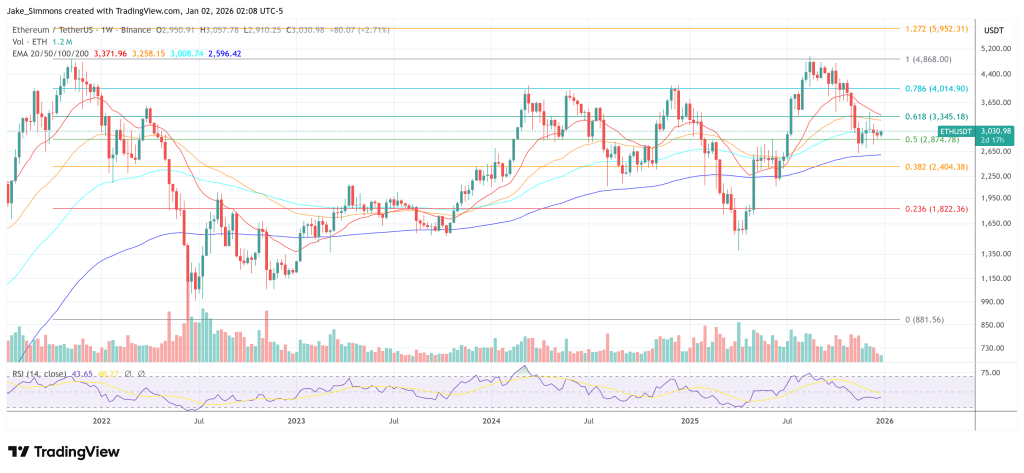
ETH holds above the 0.5 Fib, 1-week chart | Source: ETHUSDT on TradingView.com

Related Questions

QWhat is the main ambition that Vitalik Buterin re-centers Ethereum's identity around in his 2026 post?

ABecoming 'the world computer' for an open internet.

QAccording to Buterin, what are the two key requirements Ethereum needs to meet to achieve its 'world computer' goal?

AIt needs to be (i) usable, and usable at scale, and (ii) actually decentralized.

QWhat does Buterin mean by applications that 'pass the walkaway test'?

AApplications that keep running even if the original developers disappear.

QBeyond finance, what other areas does Buterin suggest the 'world computer' infrastructure should serve?

AIdentity, governance, and 'whatever other civilizational infrastructure people want to build'.

QWhat does Buterin warn against, emphasizing it is not Ethereum's true mission?

AChasing whatever narrative is currently printing attention, such as 'winning the next meta' regardless of whether it's tokenized dollars or political memecoins, or arbitrarily convincing people to fill up blockspace to make ETH 'ultrasound' again.

Related Reads

Trading

Spot
Futures

Hot Articles

What is USOIL

USOILUSDT Perpetual Contract is the trading symbol for West Texas Intermediate (WTI) Crude Oil priced in US dollars, representing 1 barrel of crude oil.

800 Total ViewsPublished 2026.05.25Updated 2026.05.25

What is USOIL

How to Buy USOIL

Welcome to HTX.com! We've made purchasing WTI Crude USOil/ CL (USOIL) simple and convenient. Follow our step-by-step guide to embark on your crypto journey.Step 1: Create Your HTX AccountUse your email or phone number to sign up for a free account on HTX. Experience a hassle-free registration journey and unlock all features.Get My AccountStep 2: Go to Buy Crypto and Choose Your Payment MethodCredit/Debit Card: Use your Visa or Mastercard to buy WTI Crude USOil/ CL (USOIL) instantly.Balance: Use funds from your HTX account balance to trade seamlessly.Third Parties: We've added popular payment methods such as Google Pay and Apple Pay to enhance convenience.P2P: Trade directly with other users on HTX.Over-the-Counter (OTC): We offer tailor-made services and competitive exchange rates for traders.Step 3: Store Your WTI Crude USOil/ CL (USOIL)After purchasing your WTI Crude USOil/ CL (USOIL), store it in your HTX account. Alternatively, you can send it elsewhere via blockchain transfer or use it to trade other cryptocurrencies.Step 4: Trade WTI Crude USOil/ CL (USOIL)Easily trade WTI Crude USOil/ CL (USOIL) on HTX's spot market. Simply access your account, select your trading pair, execute your trades, and monitor in real-time. We offer a user-friendly experience for both beginners and seasoned traders.

582 Total ViewsPublished 2026.05.25Updated 2026.05.25

How to Buy USOIL

Discussions

Welcome to the HTX Community. Here, you can stay informed about the latest platform developments and gain access to professional market insights. Users' opinions on the price of A (A) are presented below.

活动图片