Ethereum and Bitcoin face historic supply squeeze – THESE 2 metrics reveal what’s next

ambcryptoPublished on 2026-07-08Last updated on 2026-07-08

Abstract

Bitcoin and Ethereum are experiencing a historic supply squeeze, as both cryptocurrencies see their exchange balances hit multi-year lows. This persistent withdrawal trend signals a shift toward long-term holding and self-custody models like ETFs, reducing the liquid supply available for trading. For Bitcoin, long-term holders are actively accumulating, with their net position change turning positive and supply held approaching 15 million BTC. This behavior creates scarcity, which could amplify price discovery if demand recovers. However, the analysis concludes that while reduced exchange supply supports accumulation, a sustained Bitcoin uptrend will ultimately require stronger buying demand to absorb available liquidity and maintain momentum.

Despite months of market volatility, Ethereum and Bitcoin holders continue showing little interest in returning coins to exchanges. This does represent much more than decreased investor trading enthusiasm.

Persistent withdrawals continued reducing the amount of liquid supply available on the market.

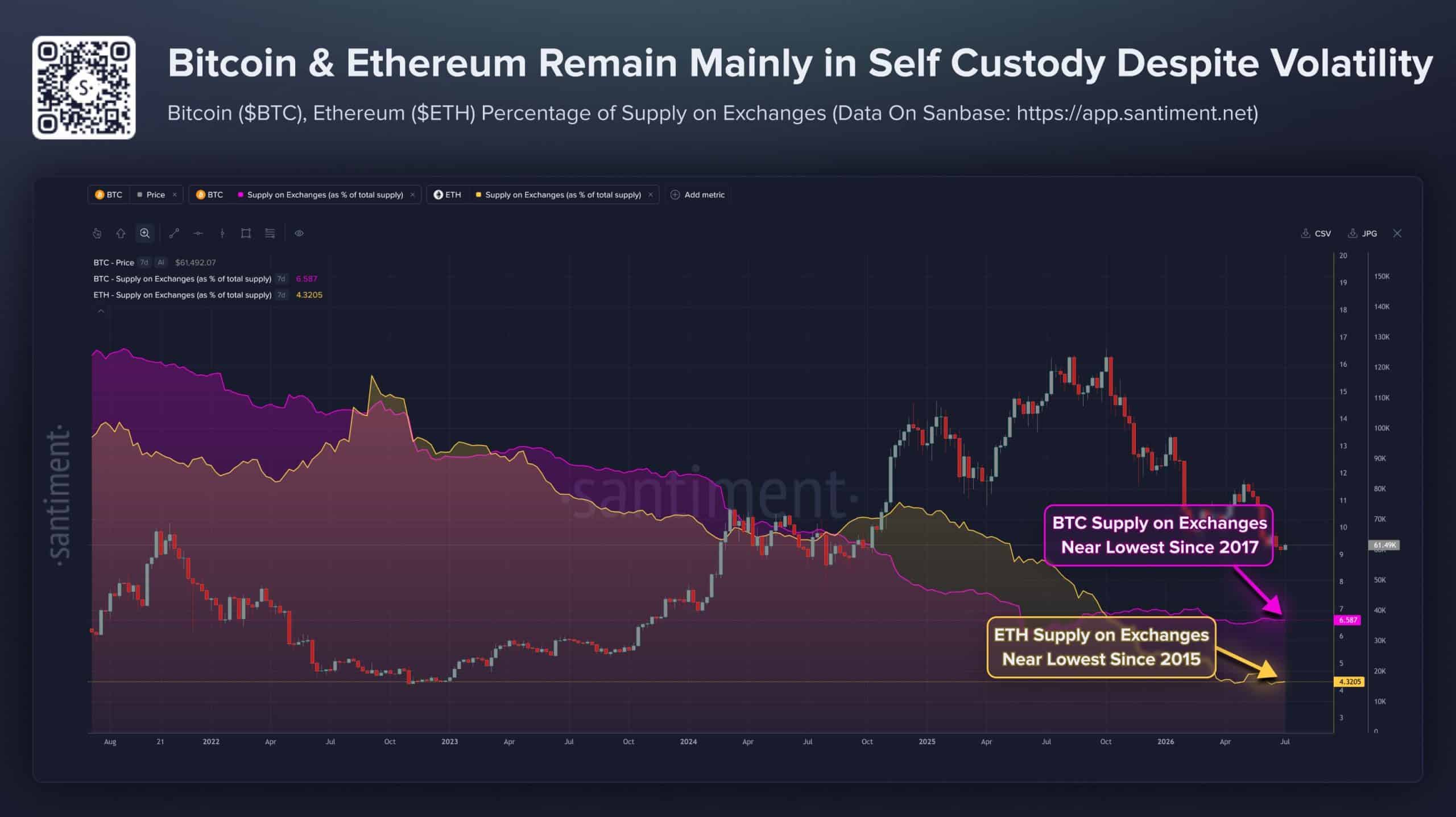
As of press time, the total number of Bitcoins stored on exchanges was at an all-time low for any time period since 2017. At the same time, the total number of Ethereum [ETH] stored on exchanges was also at an all-time low for any time period since 2015.
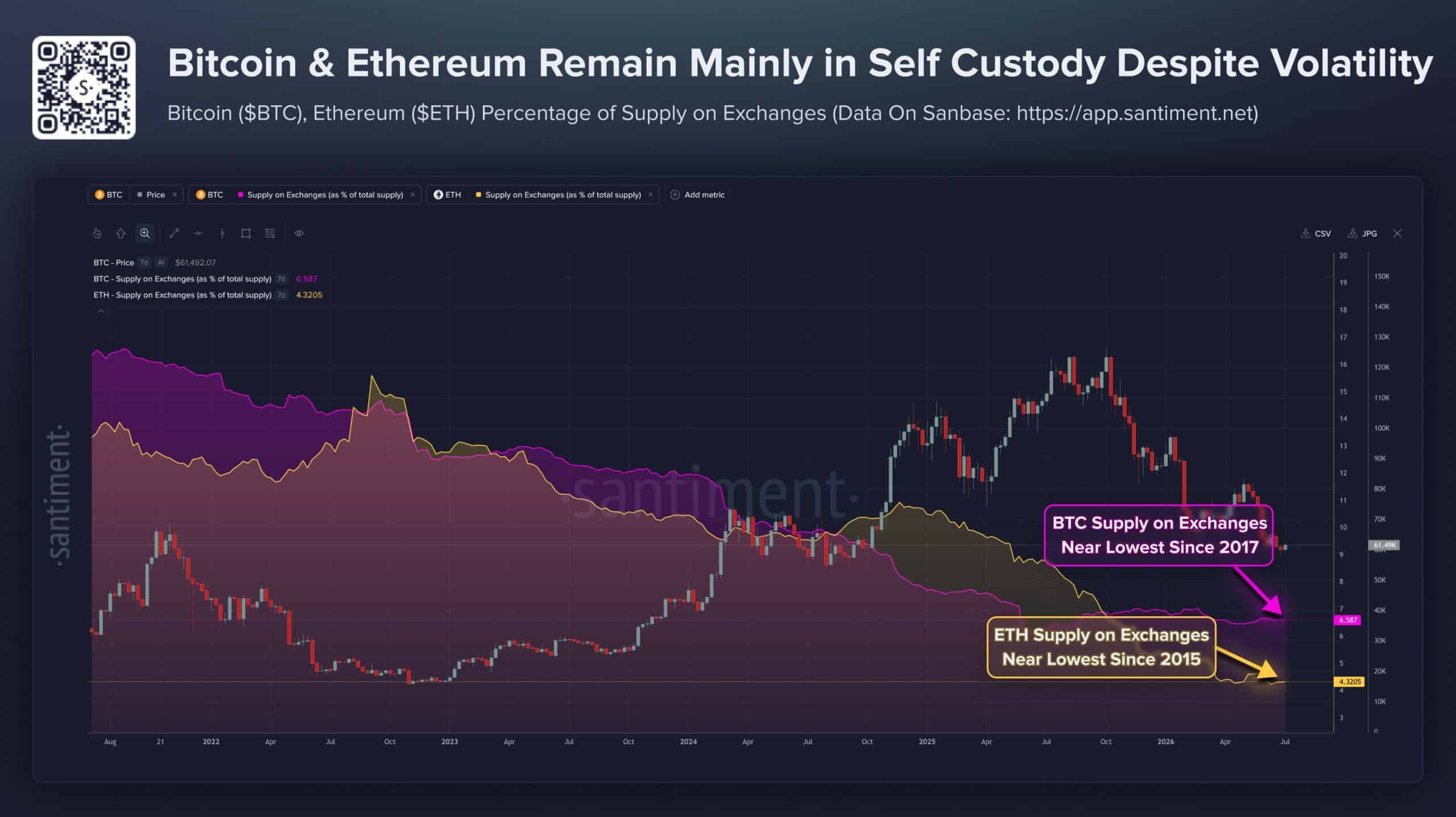
Source: Santiment

Simultaneously, ongoing negative Netflows indicate that institutional and longer-term holders prefer to store their coins using self-custody models such as ETFs or corporate treasuries rather than storing them on exchanges.

Therefore, this migration will remove additional coins from potential sales. Yet in turn, it will provide even less selling pressure in the short term to further increase the conviction behind buying. While lower exchange balances may result in lower prices for investors, they do create scarcity.

If demand continues recovering, limited liquid supply could amplify price discovery and support a more structurally driven market cycle.

Long-term holders reinforce Bitcoin’s supply floor

Behind the continued decline in exchange balances, Bitcoin [BTC] Long-Term Holders are steadily absorbing the circulating supply. That behavior reflects growing conviction rather than defensive positioning, as experienced investors continue accumulating during market weakness.

Long-Term Holder Net Position Change has returned to positive territory, confirming a shift from distribution toward renewed accumulation.

Meanwhile, HODL Waves and rising illiquid supply show older coins remaining dormant despite recent volatility.

That behavior further reduced Bitcoin’s availability for active trading. On top of that, the Accumulation Trend Score indicated continued buying across smaller and medium-sized wallets.

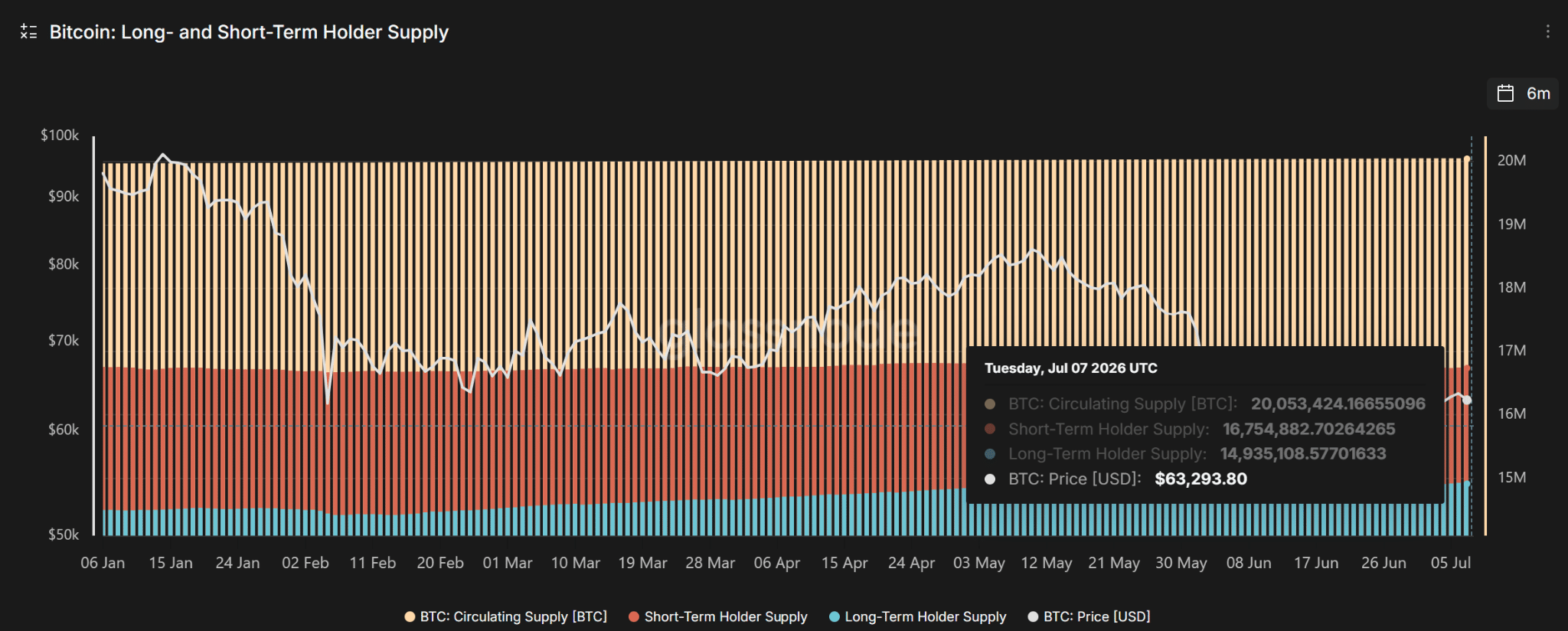
Supply held by Long-Term Holders approached 15 million BTC.

By contrast, Short-Term Holder supply declined to roughly 16.75 million BTC. The shift suggested Bitcoin continued moving from shorter-term participants into stronger conviction holders.
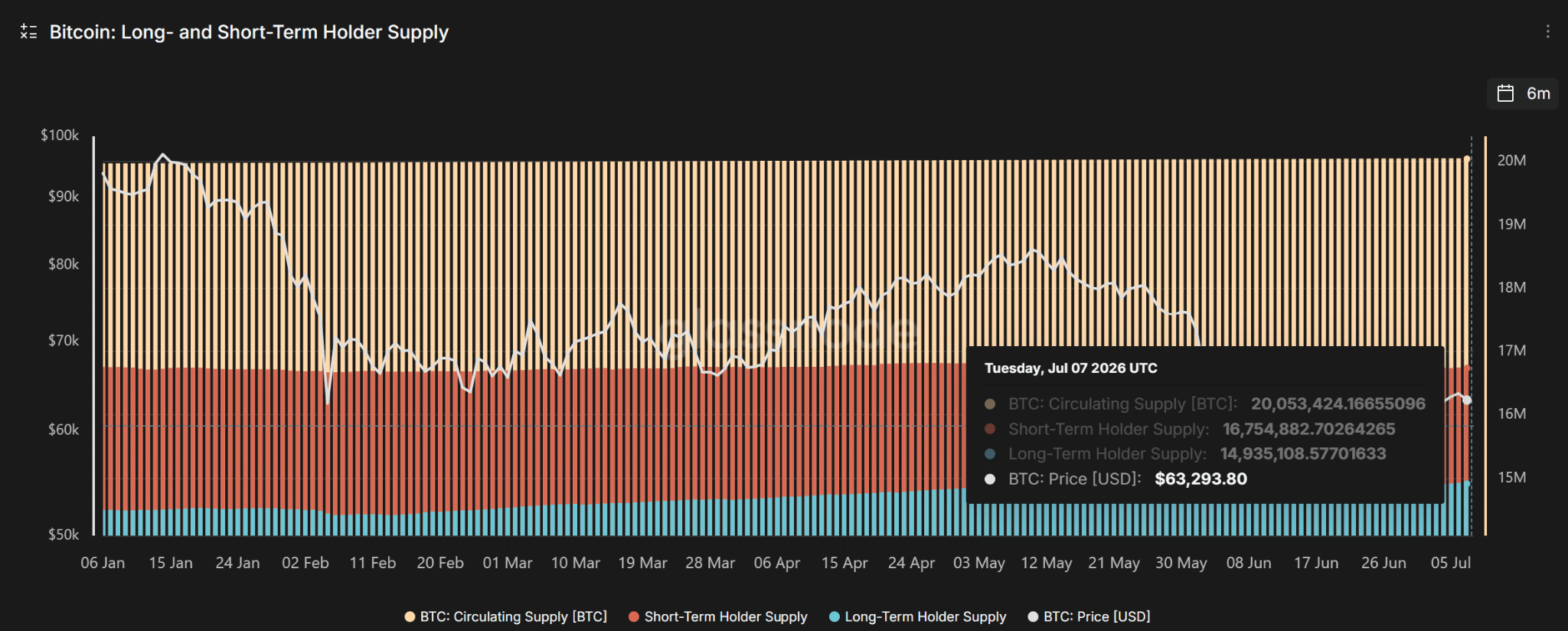
Source: Glassnode

Even so, tightening supply alone may not sustain Bitcoin’s recovery.

A lasting uptrend would still require stronger buying demand to absorb available liquidity. Without that support, Bitcoin could struggle to maintain momentum despite increasingly scarce exchange balances.


Final Summary

  • Bitcoin [BTC] and Ethereum [ETH] exchange supply continues tightening, reinforcing long-term accumulation.
  • Bitcoin needs stronger demand to sustain its recovery amid shrinking supply.

Trending Cryptos

Related Questions

QWhat does the historically low supply of Bitcoin and Ethereum on exchanges indicate about current market behavior?

AIt indicates that holders are showing little interest in selling or trading on exchanges, preferring long-term accumulation and self-custody methods like ETFs, which reduces liquid supply and selling pressure on the market.

QAccording to the article, what role are Bitcoin Long-Term Holders playing in the current market?

ALong-Term Holders are steadily absorbing the circulating supply, shifting from distribution to accumulation. Their behavior, reflected in positive Net Position Change and HODL Waves, reduces Bitcoin's availability for active trading and reinforces a supply floor.

QWhy might lower exchange balances for Bitcoin and Ethereum lead to higher prices, according to the article's analysis?

ALower exchange balances create scarcity by removing coins from potential sales. If demand recovers, this limited liquid supply could amplify price discovery and support a structurally driven market cycle with less selling pressure.

QWhat is one key challenge or condition needed for Bitcoin to sustain its recovery, despite the tightening supply?

ABitcoin needs stronger buying demand to absorb the available liquidity. A lasting uptrend requires this demand support; without it, Bitcoin could struggle to maintain momentum even with scarce exchange balances.

QWhat two major metrics or data points does the article highlight to show the supply squeeze for Bitcoin and Ethereum?

AThe two key metrics are: 1) The total number of Bitcoins on exchanges is at an all-time low since 2017. 2) The total amount of Ethereum on exchanges is at an all-time low since 2015.

Related Reads

The Success of Robinhood Chain Proves Ethereum Is Not Dead

The article argues that Robinhood's decision to build its own dedicated blockchain, Robinhood Chain, as an Ethereum Layer 2 (L2) using Arbitrum technology is a powerful endorsement of Ethereum's L1+L2 model, not a rejection of it. This move reflects a broader shift in the crypto industry from projects focused on token monetization to real-world businesses building cash-generating operations. Historically, many crypto projects chose infrastructure to support token sales and speculative value. In contrast, businesses like Robinhood and Coinbase (with Base) choose infrastructure based on commercial needs: security, liquidity, customer reach, and control. Ethereum's model provides a trusted, neutral, and liquid global settlement layer (L1) coupled with customizable, high-performance execution environments (L2s). This allows companies to maintain control and specialization without the cost and risk of building an independent L1 from scratch. The author contends that as more traditional enterprises enter the space to build sustainable businesses, they will rationally select Ethereum's L1 for maximum security and liquidity and its L2s for scalability and customization. This trend strengthens Ethereum's network effects and the utility of ETH as the native gas and asset within this expanding ecosystem. Robinhood's choice is thus seen as a landmark example of pragmatic business strategy aligning with Ethereum's architectural strengths.

marsbit19m ago

The Success of Robinhood Chain Proves Ethereum Is Not Dead

marsbit19m ago

South Korean Broker's 'Below-Expectations' Forecast Triggers 12% Plunge in SK Hynix, Putting Pressure on Entire Storage Sector

South Korean brokerage KIS released a forecast for SK Hynix's Q2 2026 earnings, predicting operating profit of 60.4 trillion won, up 556% year-over-year. However, this figure was about 8% below the market consensus of 65 trillion won. The shortfall was attributed to SK Hynix's high proportion of HBM (High Bandwidth Memory) revenue. HBM is typically sold under long-term agreements (LTAs) with fixed prices, which limited the company's average selling price (ASP) growth compared to the soaring spot market prices for standard DRAM and NAND. KIS emphasized this was a methodological adjustment to include LTA pricing, not a fundamental deterioration, and maintained its buy rating and 3.8 million won target price. Nevertheless, the report triggered a sharp market sell-off. SK Hynix's stock plunged over 12%, falling below 2 million won and extending its pullback from recent highs. The sell-off spread to related assets: leveraged ETFs tracking SK Hynix and Samsung Electronics fell sharply in Hong Kong, and A-share memory stocks also declined. Analysts note the incident highlights market sensitivity to earnings misses versus high expectations. However, KIS argues the long-term investment thesis remains intact, with the industry shift toward LTAs potentially leading to more stable, sustained profitability rather than volatile quarter-to-quarter ASP gains.

链捕手27m ago

South Korean Broker's 'Below-Expectations' Forecast Triggers 12% Plunge in SK Hynix, Putting Pressure on Entire Storage Sector

链捕手27m ago

Is the MicroStrategy Model Failing? Imitator Holding 30,000 Bitcoins Sees Pre-IPO Investors Backing Out

"The 'Bitcoin Treasury' model is facing a critical test. BSTR Holdings, a company founded by Adam Back and holding 30,021 Bitcoin, has called off its planned merger with SPAC Cantor Equity Partners I. The deal, which would have taken it public, fell apart as the attached private investment (PIPE) financing collapsed. This failure highlights a core vulnerability of the 'Bitcoin accumulation company' strategy popularized by MicroStrategy. The model relies on a key metric: mNAV, or the premium of a company's stock market value over the value of its Bitcoin holdings. This premium fuels a cycle where companies issue shares at a premium, use the cash to buy more Bitcoin, and theoretically increase the Bitcoin per share for investors. However, with Bitcoin's price down roughly 49% from its late-2024 peak, this premium has evaporated across the sector. Companies like American Bitcoin and Metaplanet are also under severe pressure. For BSTR, the lack of premium meant investors were unwilling to fund the original deal structure at the proposed terms. The companies are now renegotiating. The next SEC filing detailing any new agreement will be a crucial indicator. It will show if the model can be repriced for a low-premium environment by preserving Bitcoin holdings and investor commitments, or if it requires significantly diluting shareholders and scaling back ambitions. The outcome is a public stress test for the entire 'Bitcoin treasury' investment thesis."

marsbit50m ago

Is the MicroStrategy Model Failing? Imitator Holding 30,000 Bitcoins Sees Pre-IPO Investors Backing Out

marsbit50m ago

Want Another Bull Market? Bitcoin Needs Trillions in Fresh Capital Inflow

Title: Want Another Bull Run? Bitcoin Needs Trillions in New Capital Bitcoin has fallen 50% from its October 2025 high of $126k, now trading near $63,000. Recent on-chain reports reveal structural differences in this downturn compared to past cycles, extending beyond simple price charts. A key issue is declining capital efficiency. CryptoQuant analysis shows the capital required for price appreciation has surged dramatically. In 2011, $27 billion in net inflows drove a 55,436% gain. From 2018-2021, $36.5 billion fueled a ~2000% rise. This cycle, $69.7 billion in realized cap growth has yielded only a 689% increase. Today, an estimated $101 billion is needed to double the price, versus just $5 million in 2011. The report concludes that triggering a major bull run now likely requires over $1 trillion in new institutional capital, positioning Bitcoin as a core global asset class rather than relying on retail ETF flows. Meanwhile, supply is tightening. K33 Research notes long-term holder supply has hit a record 79% of circulating coins. Dormant bitcoin moving after 2+ years is at its lowest since 2012. Alphractal data confirms this trend, with ~830k BTC recently moving to long-term storage. This scarcity of tradable supply can amplify price moves from any new buying pressure but doesn't guarantee capital inflow. Profitability metrics signal a potential bottom. CryptoQuant's Net Realized Profit/Loss ratio has dropped to -0.35, a 43-month low matching levels seen during the 2022 FTX crash. Historically, such extremes preceded major bull markets in 2015 and 2019. The current price is only 16% above the network's realized price; historically, this has led to average gains of 41% in six months and 81% in one year. Bitcoin is testing key support near $60,000, with analysts noting a potential W-bottom pattern forming. Macro headwinds persist. U.S. spot Bitcoin ETFs saw record monthly outflows of over $4.5 billion in June. Uncertainty around Federal Reserve policy under a potential new chair and mixed economic data add pressure. While European institutional infrastructure is slowly developing (e.g., German banks offering BTC services), this is a demand factor, not an immediate liquidity catalyst. In summary, the market shows signs of bottoming: sell-side pressure is largely exhausted, supply is scarce, and metrics are at historical extremes. However, for a significant bull run akin to past cycles, unprecedented institutional capital—likely exceeding $1 trillion—is required to overcome the new reality of drastically lower capital efficiency. The decisive variable of massive new institutional inflows remains absent.

Foresight News53m ago

Want Another Bull Market? Bitcoin Needs Trillions in Fresh Capital Inflow

Foresight News53m ago

Trading

Spot

Hot Articles

Discussions

Welcome to the HTX Community. Here, you can stay informed about the latest platform developments and gain access to professional market insights. Users' opinions on the price of ETH (ETH) are presented below.

活动图片