Encrypted Capital Favors the 'Big Brother': Under Bitcoin's Hegemony, How Can Altcoins Break Through and Reshape the Landscape?

marsbitPublished on 2026-01-21Last updated on 2026-01-21

Abstract

Crypto investment capital is increasingly concentrated in a narrowing selection of assets, with Bitcoin's market share dominance rising to around 65%, its highest level since early 2021. This trend is reinforced by the growth of stablecoins and on-chain derivatives, which now account for nearly 12.5% of the total crypto market capitalization, further squeezing the market share of altcoins. Within the altcoin sector, a "winner-takes-most" dynamic is intensifying. The top 10 altcoins now represent approximately 82% of the total altcoin market cap, a significant increase from 64% during the 2021 bull market. The number of altcoins with a market cap exceeding $1 billion has also shrunk considerably, indicating a flight to quality and liquidity. Performance data from 2023 onwards shows that large-cap crypto assets have significantly outperformed mid and small-cap tokens, with large-caps returning roughly 365% compared to 70% and 55% for mid and small-caps, respectively. This performance divergence, coupled with events like the large-scale liquidation on October 10, 2025, has strengthened investor preference for high-liquidity, mature assets. The report concludes that the market is undergoing a structural shift towards consolidation and maturity. While new tokens and tokenized traditional assets continue to emerge, finite liquidity is being concentrated in large-cap cryptocurrencies and the infrastructure supporting stablecoins, DeFi, and tokenization. The barrier for altcoins t...

Written by: Tanay Ved

Compiled by: Luffy, Foresight News

TL;DR

  • The crypto investment landscape continues to expand, yet capital's choice of assets is narrowing: Bitcoin's market dominance shows a sustained upward trend, while the growth of stablecoins and on-chain derivatives is continuously squeezing the market space for altcoins.
  • The altcoin market is shrinking, with a significantly enhanced concentration effect at the top: The current top ten altcoins by market cap account for about 82% of the total market cap of the sector, a significant increase from 70% five years ago.
  • Since 2023, the performance of large-cap crypto assets has significantly outperformed mid-cap and small-cap assets; the flow of funds after market volatility has further reinforced investors' preference for high-liquidity, mature leading assets.

The crypto investment landscape is still expanding continuously. Hundreds of new tokens are launched each year, the number of stock targets related to digital asset businesses is increasing, and tokenization technology is gradually bringing traditional assets like stocks and commodities on-chain. While investment choices are becoming richer, market capital is also becoming more selective.

Bitcoin's market dominance rate has rebounded to around 65%, reaching its highest level since early 2021; at the same time, the market value of stablecoins and on-chain derivatives (such as wrapped tokens, staked tokens, cross-chain bridge tokens, etc.) accounts for nearly 12.5% of the total crypto market capitalization. Therefore, altcoins are facing a double squeeze. Despite the growing number of tokens, their total market share is shrinking.

This issue of the "State of the Network Market" report will explore whether the crypto market is undergoing a structural shift towards capital concentration. We will analyze the trends in market dominance and return performance across different market cap tiers and sectors to investigate whether capital is continuously aggregating towards a smaller number of larger, more mature tokens, or whether investment opportunities remain widely distributed.

Evolution of Market Cap Dominance

First, let's analyze market cap dominance. Bitcoin's market cap dominance (i.e., Bitcoin's market cap as a percentage of the total crypto market cap) climbed to 65% in 2025, hitting a new high since 2021. It is worth noting that this growth is not a short-term burst but a long-term steady upward trend since hitting a low in 2022.

The launch of Bitcoin spot ETFs has deepened the institutionalization process, attracting over $150 billion in long-term capital for it, further boosting the continuous rise in its market dominance. This trend has solidified Bitcoin's position as a "safe-haven asset" in the crypto market and made it a highly liquid, standardized entry point for traditional institutional investors into the crypto market. Compared to previous bull markets where "altcoin seasons" quickly diluted Bitcoin's market share, Bitcoin's dominance in this cycle is more enduring.
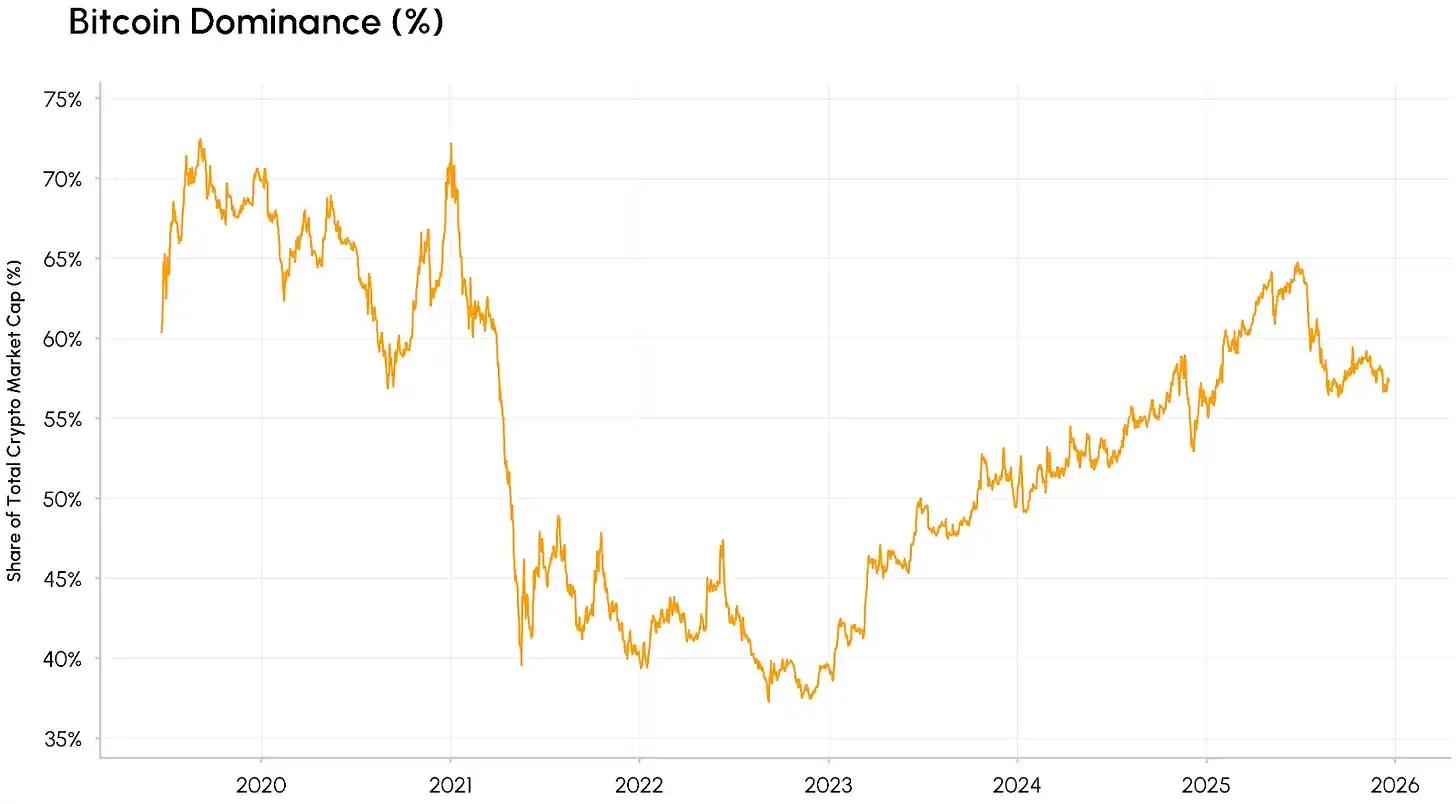
Bitcoin Dominance, Data Source: Coin Metrics

The structure of other assets in the crypto market is also changing. Stablecoins with a current market cap exceeding $300 billion, and on-chain derivatives, are accounting for an increasing proportion of the total market capitalization. These tokens serve different functions in the crypto ecosystem: stablecoins are the primary medium of exchange in the market, while on-chain derivatives provide investors with yield claims on underlying assets or channels to generate interest income.
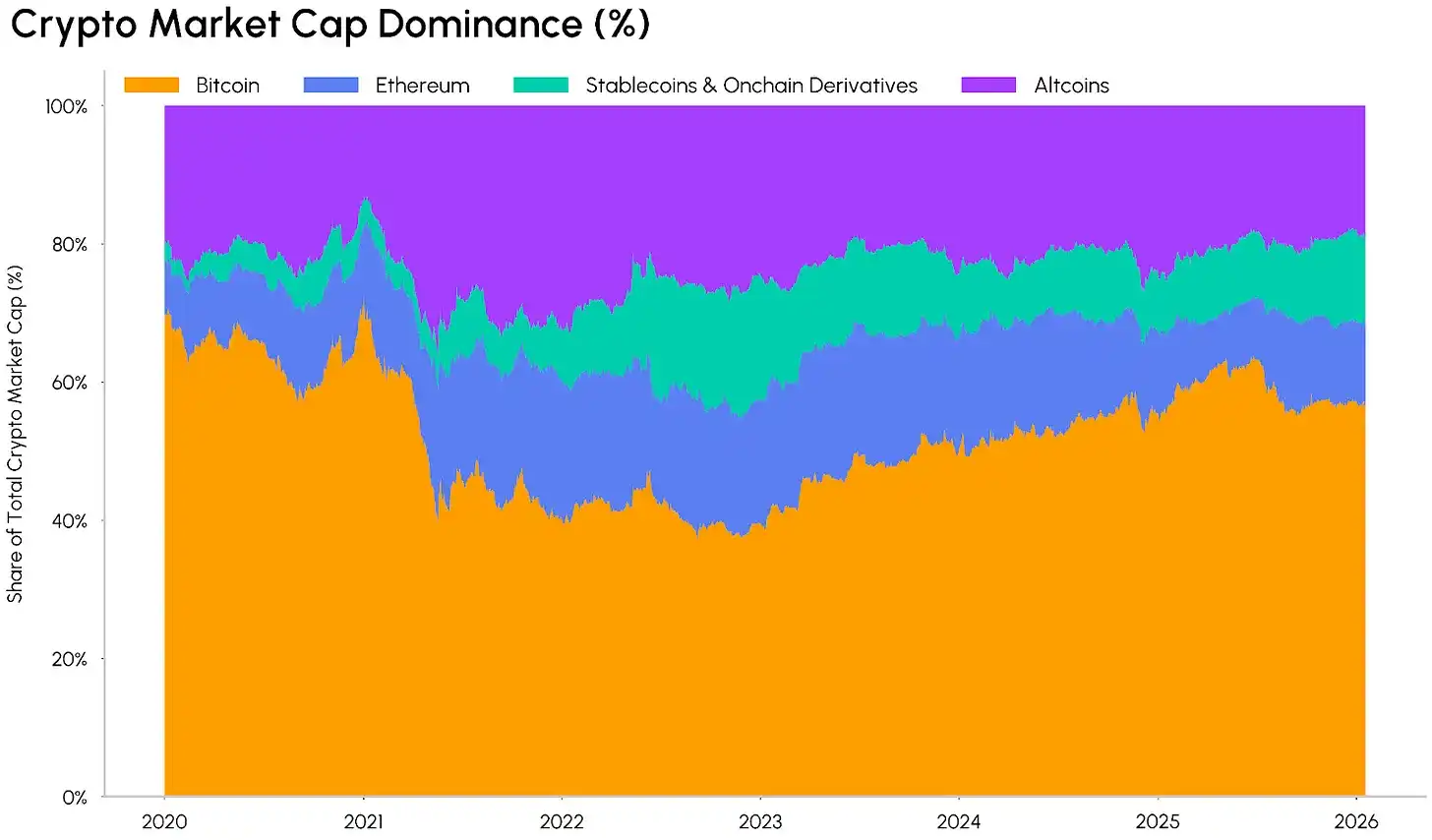
Crypto Market Dominance Distribution, Data Source: Coin Metrics

As a result, the altcoin market is facing a dilemma. The range of investable targets that remain is continuously narrowing, and the concentration effect at the top is becoming more apparent: market value continues to concentrate towards more liquid and mature assets, which often have clear use cases, defined regulatory development paths, and can fully benefit from the development waves of stablecoins, decentralized finance (DeFi), and asset tokenization.

Unlike previous market cycles, the speed of capital rotation from mainstream coins to altcoins has significantly slowed down in this cycle. ETFs and various institutional investment tools have locked market liquidity firmly in top-tier assets. However, with the landing of universal listing standards, the launch of altcoin and multi-asset ETFs broadening investment channels for more large-cap altcoins, coupled with the advancement of market structure-related legislation, this market structure may change.

The "Giant Monopoly" Trend Within the Altcoin Sector

Even within the altcoin sector itself, the trend of capital concentration is intensifying. The current top ten altcoins by market cap (excluding Bitcoin) account for about 82% of the total market cap of the sector, a significant increase from 64% during the 2021 bull market. In the previous bull market, a large number of small-cap altcoins that briefly created value gradually exited the market, replaced by a sector structure with a stronger top effect, and the lifecycle of various short-term market narratives continues to shorten, making it difficult to support sustained increases in asset value.
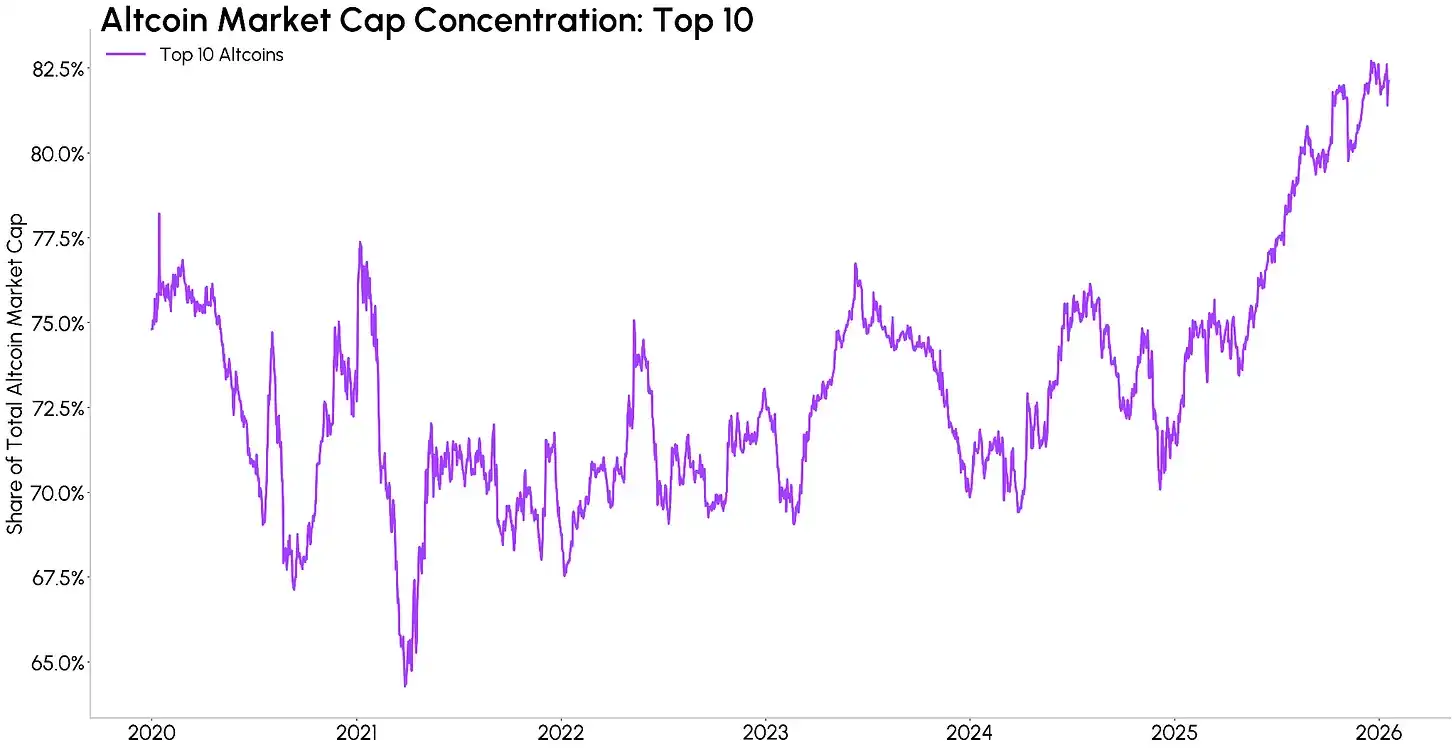
Top 10 Altcoin Market Cap Share, Data Source: Coin Metrics

We can also observe this concentration trend by looking at the number of tokens that break through specific market cap thresholds. Although the total market cap of the crypto market has repeatedly reached new historical highs, the number of altcoins with a market cap exceeding $1 billion has shrunk from about 105 at the peak in 2021 to about 58 currently. This means that even though the total number of assets in the market is increasing, the number of truly "investable" altcoins is continuously decreasing. While this does not mean the altcoin sector is heading for decline, the focus of market funds may further concentrate on targets with solid fundamentals and stronger risk resistance.
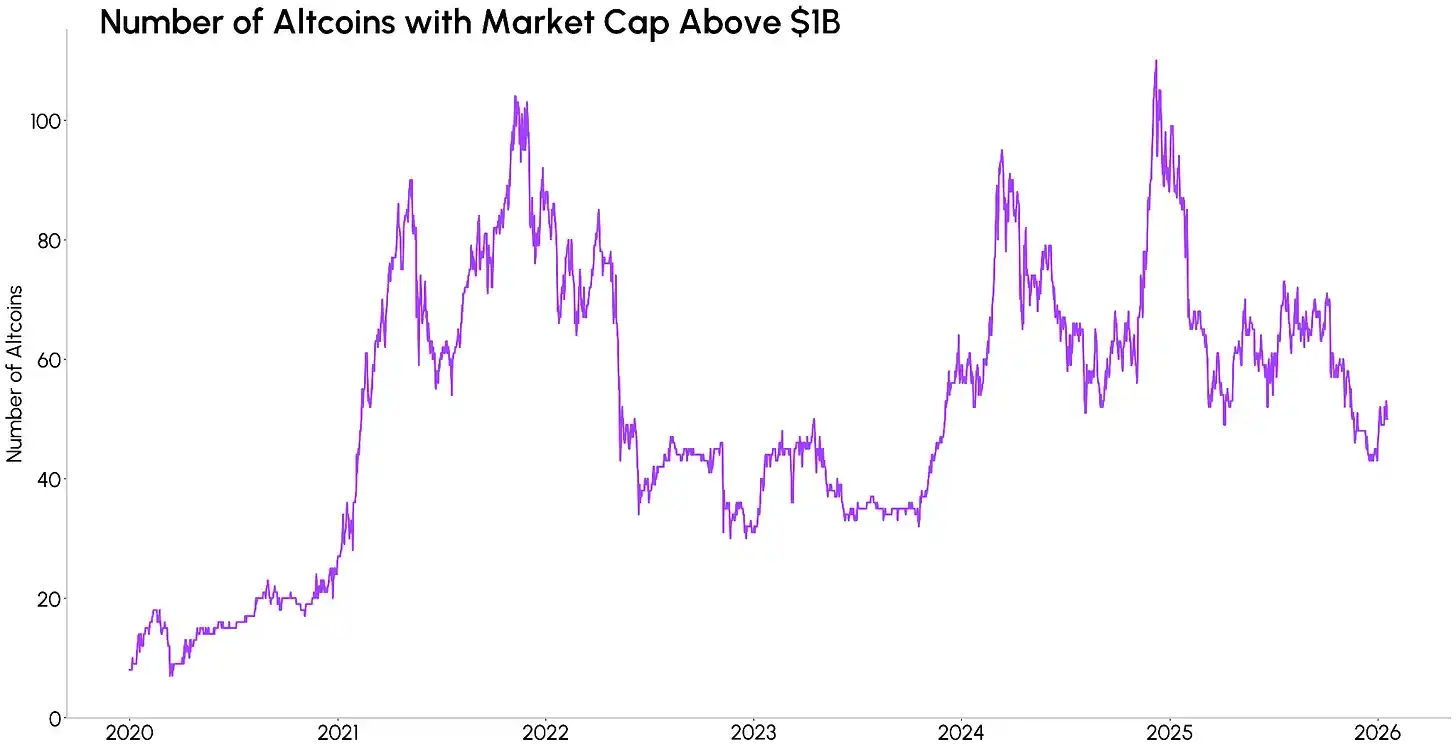
Number of Altcoins with Market Cap Over $1 Billion, Data Source: Coin Metrics

The table below summarizes the annual evolution characteristics of the above market trends. Some indicators still show cyclical characteristics, such as Bitcoin's market dominance falling in bull markets and rising in bear markets, but the market share of the top ten altcoins by market cap has shown a different trend: from 2020-2024, regardless of market conditions, this ratio remained stable at 69%-73%, but it surged to 82% in 2025. This change indicates a structural shift in the market towards mature leading assets, rather than simply short-term "chasing quality assets" behavior.
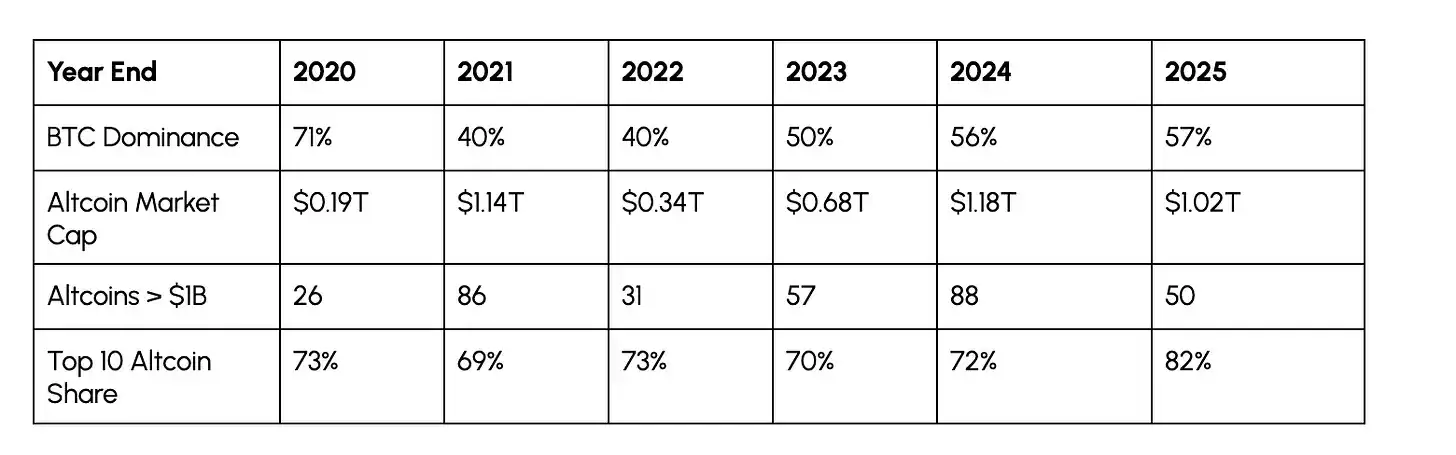
Data Source: Coin Metrics

Capital Flows to Mainstream Coins

This capital concentration trend is also reflected in asset return performance. Since 2023, mid-cap coins (market cap $1B - $10B), and especially small-cap coins (market cap under $1B), had outperformed large-cap coins (market cap over $10B) in the early and late stages of 2024, but this trend reversed dramatically in 2025, due to the rapid fading of market sentiment towards Meme coins and other short-term narrative rotations.

Calculated on an equal-weight basis, from January 2023 to the present, the overall return of large-cap crypto assets is about 365%, while the returns of mid-cap and small-cap assets are only about 70% and 55% respectively, with most of the earlier gains being given back. This divergence in returns fully illustrates that market performance is increasingly tilting towards developed, liquid assets, and the gains of small-cap tokens are difficult to replicate the sustainability seen in previous cycles.
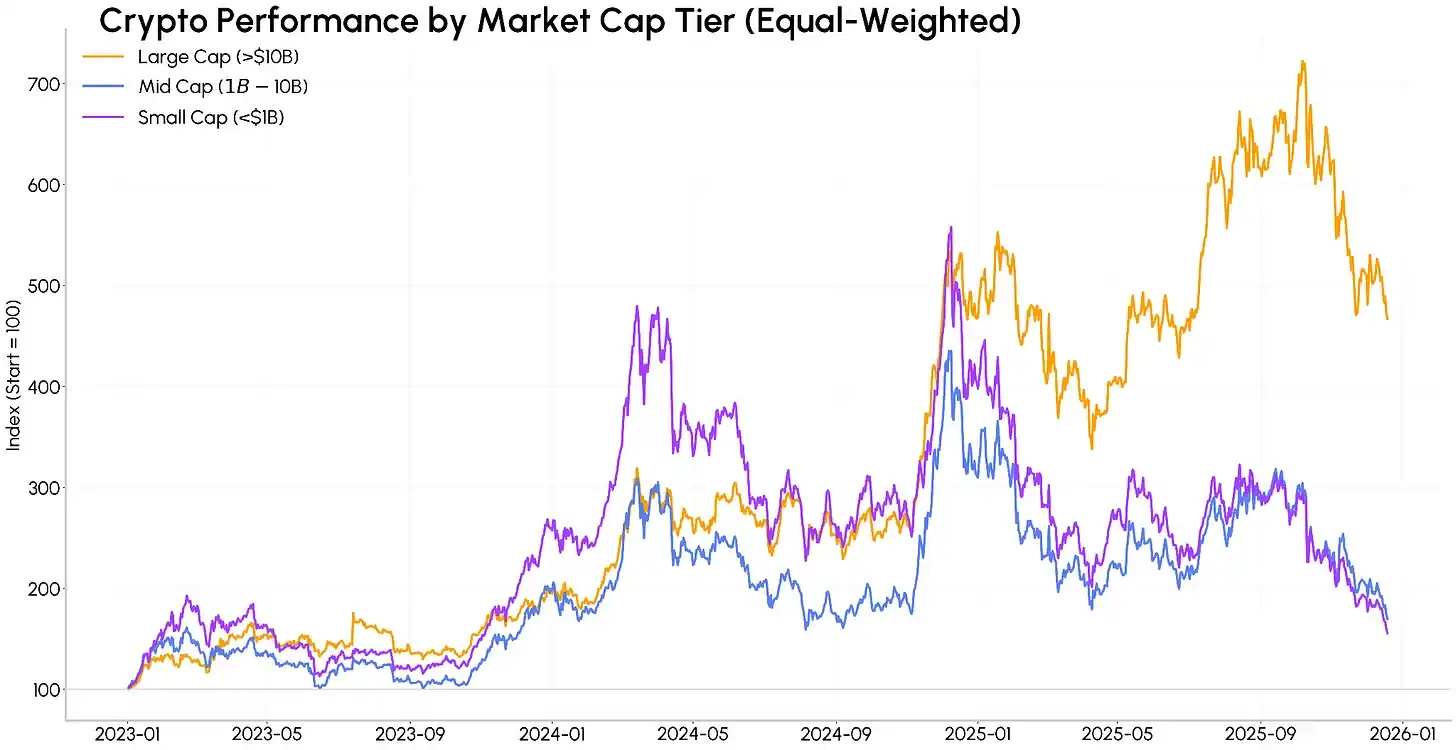
Market Performance of Tokens by Different Market Cap Sizes, Data Source: Coin Metrics

On October 10, 2025, the market experienced a large-scale liquidation event triggered by high leverage positions and liquidity drying up. This event may further strengthen the trend of capital tilting towards defensive assets, with investors increasingly favoring high-liquidity assets rather than significantly more volatile small-cap assets.

Conclusion

Various data indicate that the crypto market is in a stage of changing格局, gradual maturation, and moving towards consolidation. Although the number of assets in the crypto market continues to increase, and as underlying infrastructure, the types of traditional assets it carries are becoming richer, the overall total liquidity of the market is limited. At the same time, in multi-asset investment portfolios, crypto assets also need to compete for space with popular investment themes in the stock market and traditional safe-haven assets like gold.

Currently, capital is continuously aggregating towards large-cap crypto assets and the infrastructure sectors that support the development of stablecoins, tokenized assets, and decentralized finance. The importance of liquidity and scale has increased further compared to the past, and the threshold for altcoins to attract long-term capital has also risen significantly.

Of course, if market structure-related rules become clearer, altcoin and multi-asset ETFs continue to popularize, coupled with improved market liquidity conditions, it is still possible to trigger a new round of altcoin season. But it can be expected that the beneficiaries of this altcoin season will be more concentrated, and capital's choices will be more selective than in any previous cycle.


Trending Cryptos

Related Questions

QWhat is the current market dominance of Bitcoin, and why has it reached its highest level since early 2021?

ABitcoin's market dominance has risen to around 65%, its highest level since early 2021. This growth is attributed to a long-term upward trend since its 2022 low, fueled by the launch of Bitcoin spot ETFs which attracted over $150 billion in long-term capital, solidifying its role as a 'safe-haven asset' and a high-liquidity, regulated entry point for traditional institutional investors.

QHow has the stablecoin and on-chain derivatives market impacted the altcoin sector?

AThe combined market cap of stablecoins and on-chain derivatives (like wrapped tokens, staked tokens, and bridge tokens) now accounts for nearly 12.5% of the total crypto market capitalization. This growth is squeezing the altcoin market, as these assets serve as the primary medium of exchange and provide yield-bearing opportunities, thereby reducing the investable share of the market available to altcoins.

QWhat trend is observed regarding the concentration of capital within the top altcoins?

ACapital concentration within the top altcoins has intensified significantly. The top 10 altcoins by market cap now account for approximately 82% of the total altcoin market capitalization, a substantial increase from 64% during the 2021 bull market. This indicates a stronger 'winner-takes-most' dynamic and a structural shift towards mature, large-cap assets.

QHow did the performance of large-cap, mid-cap, and small-cap crypto assets differ from January 2023 onwards?

AFrom January 2023 onwards, large-cap crypto assets (market cap over $100B) significantly outperformed mid-cap ($1B-$10B) and small-cap (under $1B) assets. The equal-weighted return for large-caps was about 365%, compared to only about 70% for mid-caps and 55% for small-caps, demonstrating that market returns are increasingly skewed towards mature, liquid assets.

QWhat future developments could potentially lead to a new 'altseason', and how might it differ from previous cycles?

AA new 'altseason' could be catalyzed by further clarity on market structure regulations, the broader adoption of altcoin and multi-asset ETFs, and an improvement in overall market liquidity. However, any such season is expected to be more concentrated, with capital flowing to a narrower set of altcoins that have strong fundamentals, and investor selection will be more discerning than in any prior cycle.

Related Reads

In Conversation with Ray Dalio: We Are Currently in an AI Bubble, with 1% of My Portfolio in Bitcoin

Ray Dalio, founder of Bridgewater Associates, warns in an interview that the current AI boom shows classic bubble characteristics, which could lead to significant economic downturns as seen in past cycles like 1929 or 2000. He explains that speculative enthusiasm, fueled by debt and overvaluation, often precedes a crash when rising rates or taxation force asset sales, causing widespread losses and recession. Dalio also outlines his "Big Cycle" theory, describing an approximate 80-year pattern where widening wealth gaps, massive government deficits, and shifting geopolitical power (like China's rise) create internal conflict and global instability. He emphasizes that we are in a late-cycle, transitional phase where traditional powers like the US and UK face decline. For personal wealth protection, Dalio advises diversification beyond cash into assets like stocks, bonds, real estate, and particularly gold, which he prefers over Bitcoin. While he holds about 1% of his portfolio in Bitcoin as a non-printable hard asset, he views gold as more secure from technological or governmental threats. Regarding AI's impact, Dalio believes it will disproportionately benefit capital owners, worsening inequality by replacing both physical and cognitive labor. He suggests that human intuition and emotional intelligence, combined with AI, will be key for future workers. On taxation, Dalio argues that wealth taxes are impractical and risk triggering asset sell-offs, reducing productive investment. He points to the UK as a cautionary example of debt, low productivity, and political strife. Geopolitically, Dalio foresees a more regionalized world, with the US showing weakness in prolonged conflicts like with Iran, akin to past imperial declines. The ideal outcome, he suggests, is coexisting powerful blocs (e.g., Americas, China-Asia Pacific) without major war.

marsbit1h ago

In Conversation with Ray Dalio: We Are Currently in an AI Bubble, with 1% of My Portfolio in Bitcoin

marsbit1h ago

Daily 7.2 Trillion KRW: Foreign Capital's Record Net Buying on Friday! Wall Street Says Headwinds for Korean Stock Fund Flows Have Subsided

South Korean stock market sees a dramatic shift in fund flows. On July 31, foreign investors made a record net purchase of approximately KRW 7.2 trillion in KOSPI stocks, marking a fundamental reversal from the persistent large-scale net outflows seen in previous months. This contributed to a significant narrowing of foreign net selling in July to KRW 9.8 trillion, down sharply from KRW 48.4 trillion in June and KRW 44.5 trillion in May. Simultaneously, domestic institutional pressure eased. South Korean pension funds and asset managers turned to a net buying position in July, purchasing KRW 1.0 trillion worth of KOSPI shares, contrasting with net sales in May and June. Market volatility is expected to be dampened by new financial regulations. Effective July 31, the Financial Services Commission tightened access for retail investors to single-stock leveraged ETFs by raising the minimum cash deposit requirement. Trading volumes for these products subsequently dropped to about 50% of their monthly average. Citigroup Research maintains its year-end KOSPI target of 10,000 points. The firm cites several supportive factors: the substantial easing of headwinds from capital outflows, a robust fundamental outlook for the semiconductor sector, historically low market valuations, strong economic fundamentals, and the potential for policy support from financial authorities if needed.

marsbit1h ago

Daily 7.2 Trillion KRW: Foreign Capital's Record Net Buying on Friday! Wall Street Says Headwinds for Korean Stock Fund Flows Have Subsided

marsbit1h ago

Thanks to Dice Rolls, Bitcoin Keys Are Stored Offline, But Not Everyone Will Do It

The article discusses using dice rolls to generate secure Bitcoin wallet seeds, providing entropy independent of potentially flawed hardware random number generators. It explains that each fair dice roll offers about 2.585 bits of entropy, with around 50 rolls needed for a standard 12-word seed phrase and 99+ recommended for higher security. This method gained attention after a vulnerability was revealed in some Coldcard hardware wallets, where a faulty firmware RNG (dating back to 2021) compromised generated keys. The analysis notes that while a dice-generated main seed was safe from this specific flaw, other Coldcard functions (like creating paper wallets, backup keys, or passwords) could still be vulnerable if they used the defective RNG. The piece argues that while dice-based entropy is technically robust, the manual process is error-prone, tedious, and unrealistic for most new users, who might make mistakes in recording or inputting rolls. It concludes that while manual entropy generation should remain an option for advanced users, the long-term goal is to develop reliable, user-friendly hardware and software that securely generates randomness without requiring specialized knowledge. Coldcard users are advised to check their firmware version and replace any secondary secrets (like paper wallet keys) created with vulnerable devices, while also considering multi-signature setups with devices from different manufacturers for added security.

cryptonews.ru6h ago

Thanks to Dice Rolls, Bitcoin Keys Are Stored Offline, But Not Everyone Will Do It

cryptonews.ru6h ago

Trading

Spot

Hot Articles

Discussions

Welcome to the HTX Community. Here, you can stay informed about the latest platform developments and gain access to professional market insights. Users' opinions on the price of S (S) are presented below.

活动图片














