DWF Labs’ physical gold trade signals crypto capital’s move into commodities

cointelegraphPublished on 2025-12-23Last updated on 2025-12-23

Abstract

DWF Labs, a cryptocurrency market maker, has expanded into physical commodities by settling its first gold transaction—a 25-kilogram gold bar—using traditional bullion infrastructure rather than blockchain. The company plans to scale this operation and trade additional commodities like silver, platinum, and cotton. This move contrasts with the broader crypto industry’s focus on tokenizing real-world assets and reflects a trend of crypto-native firms diversifying into traditional markets. The timing aligns with strong commodity performance, as gold prices hit record highs amid macroeconomic uncertainty, while crypto markets saw more muted gains. DWF Labs continues to invest in digital assets, including a $250 million Liquid Fund and a $75 million DeFi fund. Other firms like Coinbase are also expanding into legacy markets through tokenization and banking services.

DWF Labs, a cryptocurrency-focused market maker, has expanded into physical commodities after settling its first physical gold transaction, a rare move for a crypto-native company as precious metal prices continue to break record highs.

On Monday, managing partner Andrei Grachev said DWF Labs had “just settled our first gold trade,” describing it as a test tranche involving a single 25-kilogram gold bar. Grachev said the company plans to scale the operation, with ambitions to trade physical silver, platinum and cotton.

Notably, the transaction was completed using conventional bullion custody and settlement infrastructure, rather than blockchain-based rails.
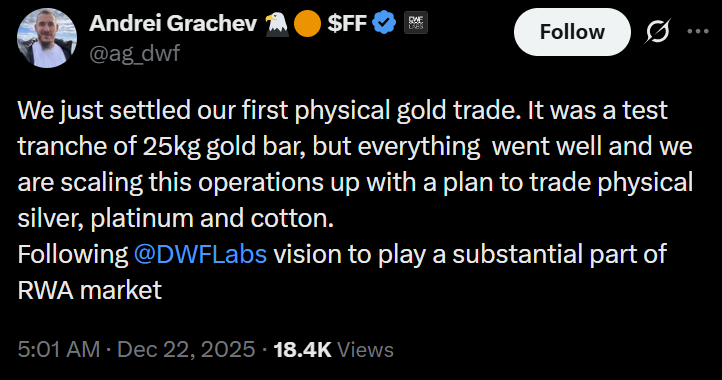
Source: Andrew Grachev

The move stands out at a time when many crypto-native companies are focused on tokenizing real-world assets. DWF Labs, by contrast, has engaged directly in the legacy commodities market in its gold transaction.

The timing reflects strong momentum in commodities markets this year. Gold and silver prices have outperformed much of the crypto sector, as investors seek hedges against macroeconomic uncertainty.

Gold futures recently reached new all-time highs above $4,500 per troy ounce, extending a year-long rally driven by central bank buying, geopolitical risk and expectations of eventual interest-rate cuts. By comparison, Bitcoin (BTC) and broader crypto markets have seen more muted price action over the same period.
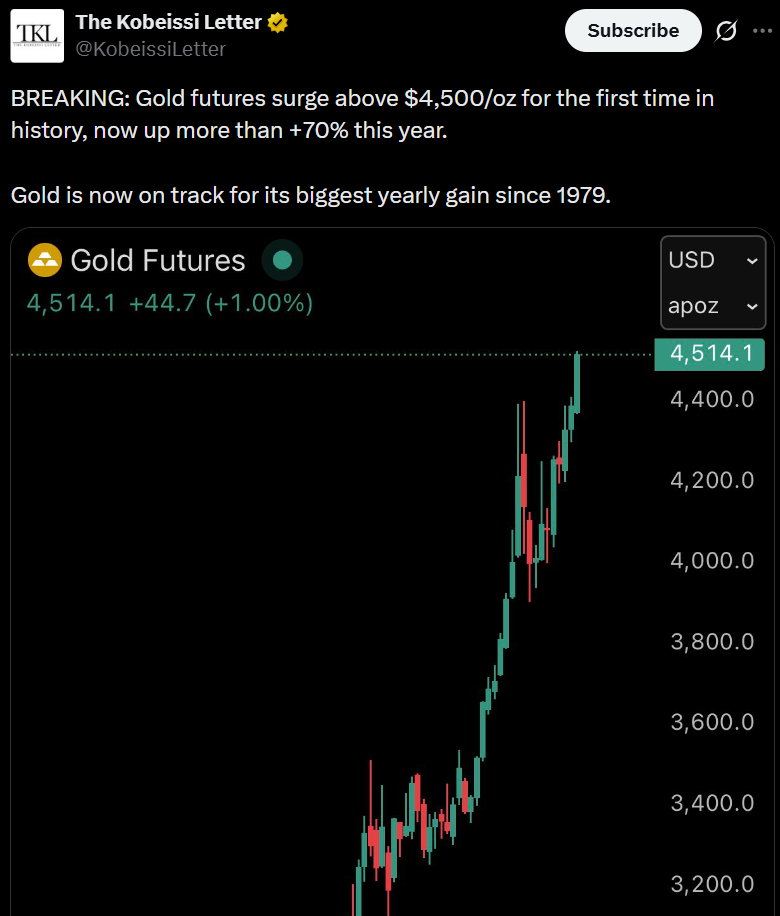
Source: The Kobeissi Letter

Beyond commodities, DWF Labs has expanded its footprint in digital assets. The company has launched multiple investment vehicles aimed at supporting crypto adoption, including a $250 million Liquid Fund focused on helping mid-cap blockchain projects scale, as well as a $75 million institutional DeFi fund.

Related: Tether Gold rides bullion boom as central banks, ETFs rush to accumulate

Is crypto blending into brick and mortar?

DWF Labs’ move into physical commodities appears to reflect a broader trend of crypto-native companies gradually extending into legacy markets to diversify revenue, reach new customers and broaden their operating scope beyond purely digital assets.

Other companies are pursuing parallel, though distinct, strategies. Coinbase, for instance, has outlined ambitions to become what it calls an “everything exchange,” with plans to let companies tokenize their shares for round-the-clock trading.

“In time, we believe everything will be tokenized, and bringing stocks to Coinbase is an important milestone toward enabling tokenized stocks,” Coinbase said in a blog post.

Deutsche Bank Research analysts said the move could “substantially widen [Coinbase’s] addressable market” across both retail and institutional clients, while helping to offset potential future pressure on retail crypto trading volumes, according to Bloomberg.

Several cryptocurrency companies have also sought entry into the traditional banking system through bank or trust charters, including stablecoin issuer Circle and digital asset custodian BitGo, which have pursued regulated banking or trust structures to expand their financial services offerings.

Related: Coinbase ‘cautiously optimistic’ on 2026 as crypto nears institutional inflection point

Trending Cryptos

Related Questions

QWhat is the significance of DWF Labs settling its first physical gold transaction?

AIt marks a rare expansion for a crypto-native company into physical commodities, signaling a move to diversify beyond digital assets and into legacy markets like precious metals.

QHow did DWF Labs complete the gold transaction, and what infrastructure was used?

AThe transaction was completed using conventional bullion custody and settlement infrastructure, rather than blockchain-based rails.

QWhat are DWF Labs' future plans following this initial gold trade?

AThe company plans to scale its physical commodities operations and expand into trading physical silver, platinum, and cotton.

QHow have gold prices performed compared to cryptocurrencies like Bitcoin recently?

AGold futures reached all-time highs above $4,500 per troy ounce, outperforming Bitcoin and broader crypto markets, which saw more muted price action over the same period.

QWhat broader trend does DWF Labs' move into physical commodities reflect among crypto companies?

AIt reflects a trend of crypto-native companies expanding into traditional markets to diversify revenue, reach new customers, and broaden their operating scope beyond purely digital assets.

Related Reads

Goldman Sachs Research Report Analysis: 135% Profit Growth in Q2, APAC Valuations Fall to a Decade Low

Goldman Sachs Asia Pacific Market Report Summary (Aug 21, 2026) Earnings soared 135% YoY in Q2 for the MXAPJ index, with 46% of companies beating expectations, led by the Information Technology sector (+390% YoY). Despite this robust profit growth, the index's forward P/E of 11x sits 2 standard deviations below its 10-year average, indicating deep valuation discount. Market sentiment remains cautious, as seen in hedge fund leverage for Asian long/short funds dropping to a one-year low. While China saw net buying in August, its allocation remains near five-year lows, and foreign investors withdrew $1.5bn from EM Asia ex-China markets. The valuation gap is attributed to market pessimism on future growth, not aligning with consensus EPS growth forecasts of 71% for 2026 and 24% for 2027. The upcoming MSCI index rebalancing is expected to trigger approximately $42bn in total two-way passive fund flows. Leveraged ETF flows in Korea and Taiwan show signs of cooling, suggesting a reduction in crowded long positions. Goldman Sachs' core trades include long positions in stocks with strong earnings revisions and AI infrastructure/semiconductors. Key downside risks are rising long-term US bond yields, heightened geopolitical tensions, and a slower-than-expected Chinese economic recovery. The firm maintains a 12-month target of 1080 for MXAPJ, implying 21% upside.

marsbit4m ago

Goldman Sachs Research Report Analysis: 135% Profit Growth in Q2, APAC Valuations Fall to a Decade Low

marsbit4m ago

Phantom Discontinues Support for Sui as Network Struggles to Recover

On September 24, Phantom wallet will discontinue support for the Sui blockchain, giving users a few weeks to migrate their assets. This marks the end of a partnership that began with much fanfare in January 2025, when Sui became the fourth Layer 1 network supported by the then-15-million-user wallet. Phantom is also dropping support for Monad in August, indicating a broader streamlining of its multi-chain offerings rather than a move specific to Sui. The announcement coincides with a significant downturn for the Sui network. Its Total Value Locked (TVL) in DeFi has plummeted from approximately $2 billion in early 2026 to under $1 billion by July. The price of SUI has also fallen sharply from its all-time high of $5.36 in January 2025 to around $0.83 at the time of reporting. Phantom provided users with two main migration paths: converting SUI to a wrapped version on Solana directly within the wallet (with no proprietary Phantom fee until the cutoff date), or exporting their seed phrase to another Sui-compatible wallet like Sui Foundation's preferred wallet, Sui Wallet. The company emphasized that assets remain on the blockchain, not in the wallet, and warned users against potential migration scams. While both parties describe the split as mutual and leave open the possibility of future collaboration, the loss of a major wallet's support highlights the ongoing fragmentation in the blockchain industry. This poses a challenge for Sui's retail accessibility, even as the network maintains other infrastructure support, such as from Circle for its stablecoins. The future will reveal whether other wallets follow Phantom's lead or seek to attract the displaced Sui user base.

cryptonews.ru18m ago

Phantom Discontinues Support for Sui as Network Struggles to Recover

cryptonews.ru18m ago

Trading

Spot

Hot Articles

Discussions

Welcome to the HTX Community. Here, you can stay informed about the latest platform developments and gain access to professional market insights. Users' opinions on the price of S (S) are presented below.

活动图片