DeFi's Yield Winter: Liquidity Glut, Shrinking Leverage, and No Arbitrage Opportunities

marsbitPublished on 2026-03-12Last updated on 2026-03-12

Abstract

The DeFi market is experiencing a "yield winter," with average stablecoin deposit rates on major lending protocols like Aave V3 falling below 2%—the lowest since mid-2023. This decline is driven by a structural imbalance: stablecoin supply has surged, with total market cap growing over 130% since early 2024, while on-chain demand has stagnated. Over 60% of deposited assets on Aave are idle, causing severe liquidity congestion and suppressed yields. Key factors include reduced leverage demand due to low perpetual funding rates, which disincentivizes arbitrage strategies, and diminished cyclical borrowing activity following the contraction of yield assets like sUSDe. Additionally, declining risk appetite in crypto has shifted capital toward safer, traditional alternatives like U.S. Treasuries (yielding ~4.24%), further draining DeFi liquidity. Amid the downturn, protocols like Sky (formerly MakerDAO) have differentiated themselves by integrating real-world assets (RWA), such as Treasuries and corporate debt, to offer stable yields above 3.75%. This shift highlights a broader trend: DeFi must evolve from speculative yield chasing to sustainable, diversified收益 models. The yield crunch may represent a necessary correction, setting the stage for future growth.

Author: Jae, PANews

The end of a cycle often begins with the most subtle indicators.

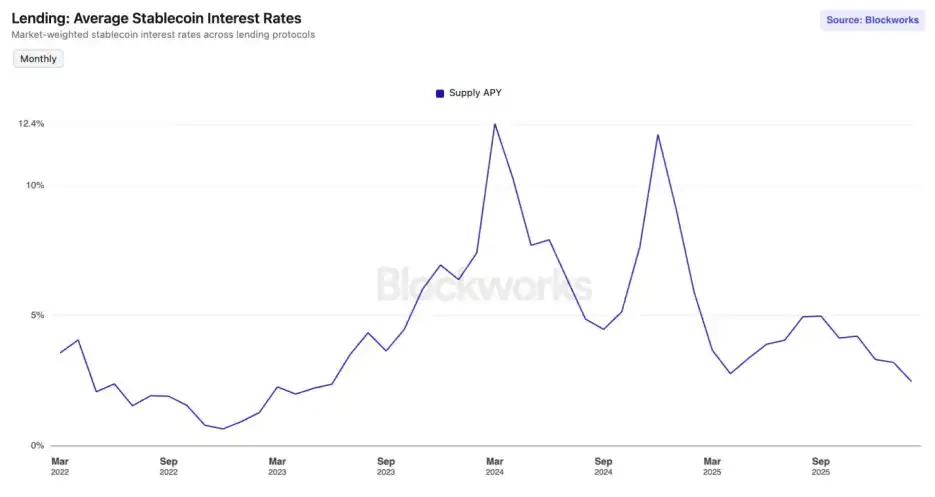
Since September 2025, the DeFi (Decentralized Finance) market has entered a "yield winter." The average annualized deposit yield (APY) for major stablecoins on leading lending protocols has hit its lowest level since June 2023.

On Aave V3 on the Ethereum mainnet, USDC and USDT deposit rates have fallen below 2%. Meanwhile, the yield on the U.S. 10-year Treasury note has rebounded to 4.24%. For DeFi players who experienced DeFi Summer and are accustomed to high APYs, this is not just a numerical decline but more like a death knell for the end of a cycle.

Is this merely a cyclical fluctuation, or is the market undergoing a structural reshaping?

Supply-Demand Mismatch: Excess Liquidity Triggers Interest Rate Collapse

Over the past six months, the interest rate curves of major lending protocols have shown a consistent downward trend, as their interest rate models experience a yield collapse caused by "oversupply."
Interest rates are the price of capital. The physical basis determining this price is the supply of capital.

Since 2024, the stablecoin sector has undergone an unprecedented "expansion wave," with its total market capitalization surging from less than $1.3 trillion to over $3.1 trillion, representing a compound annual growth rate of approximately 55%.
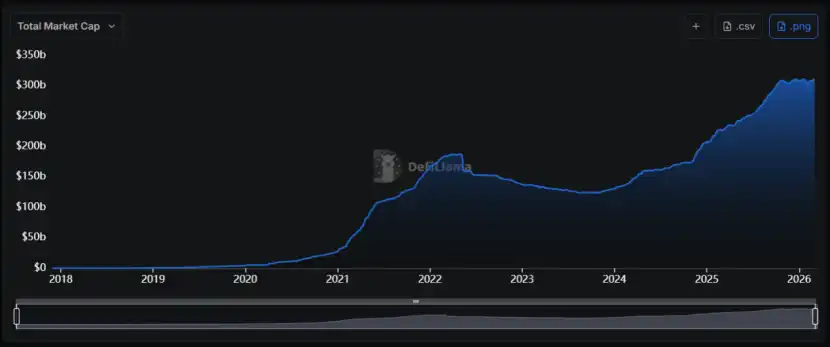
The problem is that the surge in supply has not been accompanied by a proportional expansion of on-chain demand.

When the supply of a certain commodity (stablecoin liquidity) in the market increases significantly while demand remains sluggish, its price (interest rate) will inevitably fall. This is a basic principle of economics, and DeFi is no exception.

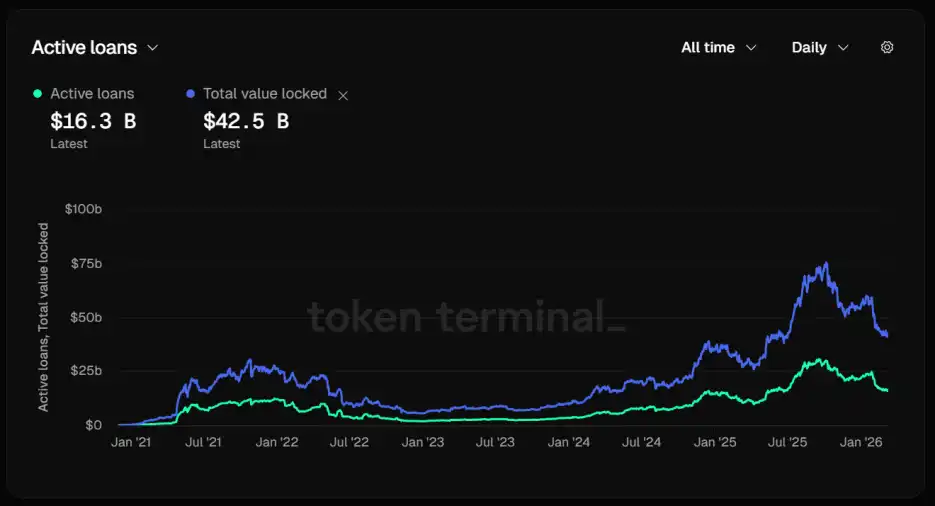
Taking the lending sector leader Aave as an example, its stablecoin utilization rate is declining significantly. As of March 12, Aave's total value locked (TVL) has reached as high as $42.5 billion.

A closer look at the capital structure reveals a concerning figure: active loans amount to only $16.3 billion. Over 60% of deposited assets are idle. This supply-demand imbalance has directly led to a rapid decline in interest rates.

This means that funds are being deposited but not borrowed, leading to severe liquidity congestion. Protocol algorithms are forced to automatically lower the interest rate curve in an attempt to attract more borrowers.
However, these efforts have had little effect. The base rates for USDC and USDT on Aave V3 on the Ethereum mainnet have already fallen below 2%, forming a stark contrast to the double-digit returns common during bull markets.

The stablecoin market has fallen into a "liquidity trap." When the market is flooded with low-cost capital but lacks high-return investment opportunities, these funds pile up in the pools of lending protocols.

Funding Rate Collapse and Cooling Circular Borrowing Lead to Leverage Slowdown

The prosperity of DeFi stablecoin interest rates is essentially driven by "leverage." When arbitrage activity in the perpetual futures market cools down, the borrowing demand for stablecoins shrinks rapidly, causing interest rates to plummet.

In a bull market, high bullish sentiment leads to positive and high funding rates. Arbitrageurs employ delta-neutral strategies like "borrowing stablecoins to buy spot + selling perpetual contracts" for risk-free hedging to earn the funding rate. In this process, stablecoins are the fuel.

However, the derivatives market has recently been sluggish. On major centralized exchanges (CEX), the funding rates for BTC and ETH have repeatedly been negative or at very low positive values. This reflects that bearish forces dominate the market or that bulls are extremely cautious.

Either explanation points to the same result: a lack of motivation for arbitrageurs.

When the annualized funding rate drops significantly, considering borrowing costs and transaction fees, the net profit for arbitrageurs is drastically reduced. Their demand for stablecoin borrowing subsequently plummets.

Another major source of stablecoin borrowing demand is circular borrowing. A typical path for this yield-enhancing strategy is: depositing yield-bearing assets like sUSDe into Aave, borrowing out stablecoins like USDC, and then converting the borrowed USDC into more sUSDe to deposit again.

This strategy was once widely used because the USDe yield was as high as 30%, while the borrowing cost was only around 10%, leaving an arbitrage spread of about 20 percentage points.

However, after the "1011" event, the spread narrowed catastrophically, and USDe also hit a "scalability" ceiling, its size dropping from nearly $15 billion to the current $6 billion.
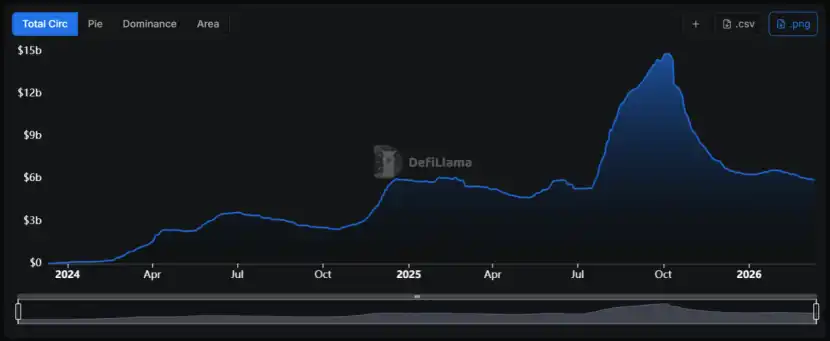
The yield of USDe is highly dependent on the size of short positions in the market. Since the total open interest in the perpetual futures market is limited, when the size of USDe expands to a certain point, the short positions required for hedging themselves will lower the overall market funding rate, thereby suppressing the sUSDe yield.

For ordinary traders, a decrease in sUSDe yield reduces the strategy's spread. Their reduced demand for leveraged positions will further decrease their demand for stablecoin collateral.

This is a self-reinforcing negative cycle: demand shrinks → interest rates fall → demand shrinks further.

Shift in Crypto Market Risk Appetite, Capital Seeks Certainty

The overall decline in risk appetite in the crypto market is another important factor leading to lower stablecoin interest rates.

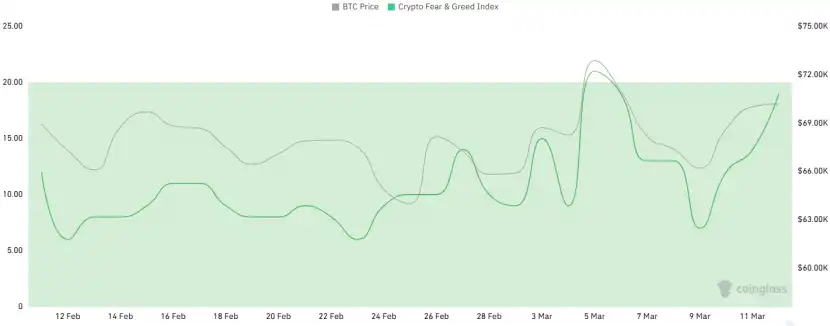
Over the past month, the Crypto Fear & Greed Index has frequently touched the "Extreme Fear" zone, and even with BTC prices holding around $70,000, sentiment has not shown sustained improvement.
CoinDesk Data also shows that total CEX trading volume fell by 2.41% in February to $5.61 trillion, the lowest trading volume since October 2024.
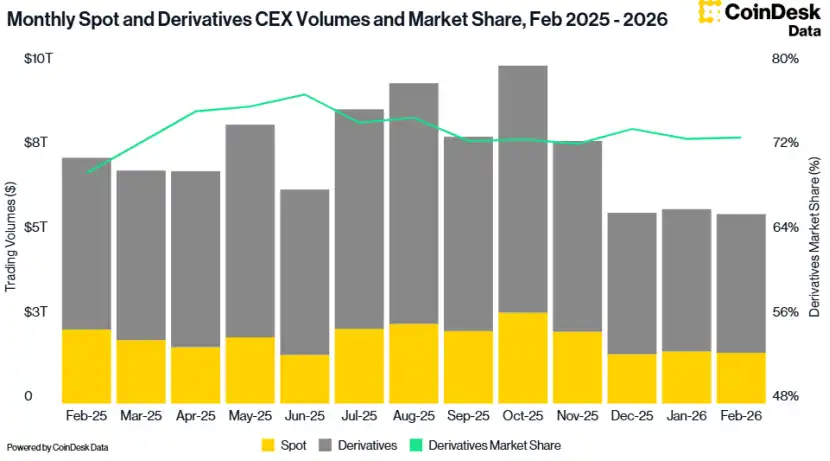
Decreased risk appetite is driving investors towards market segments with higher certainty.

Since January 2024, the U.S. Federal Reserve's effective federal funds rate has remained above 3.6%. Although the market expects a moderate path of future rate cuts, the current real interest rate remains relatively high.
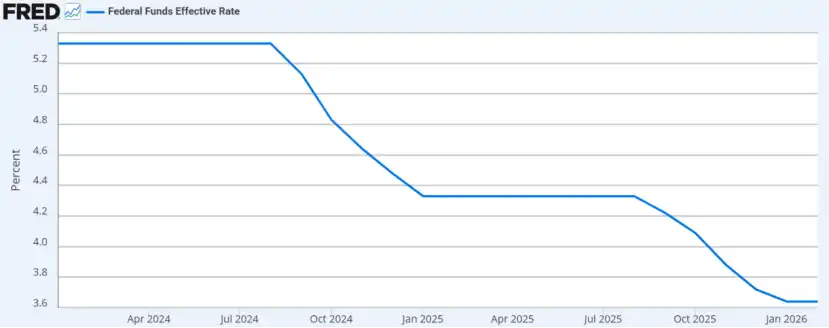
This macroeconomic environment has also exerted a profound suppressive effect on DeFi stablecoin interest rates. When the risk-free Treasury yield is higher than the DeFi deposit rate, rational investors, in the absence of risk premium compensation, will choose to withdraw funds from on-chain protocols or invest them into protocols backed by RWA (Real World Assets).

In this yield winter, not all protocols are shrinking. Sky (formerly MakerDAO) has built a unique "yield moat."

Compared to Aave, which relies more on on-chain borrowing demand, Sky's yield also comes from $1.5 billion in mature RWA assets. These assets include U.S. Treasuries, AAA-rated corporate debt, etc., which are unaffected by crypto market fluctuations and provide stable underlying cash flow.

This model of converting RWA into underlying collateral has driven a 68% month-over-month growth in USDS supply, with a market capitalization approaching $8 billion.
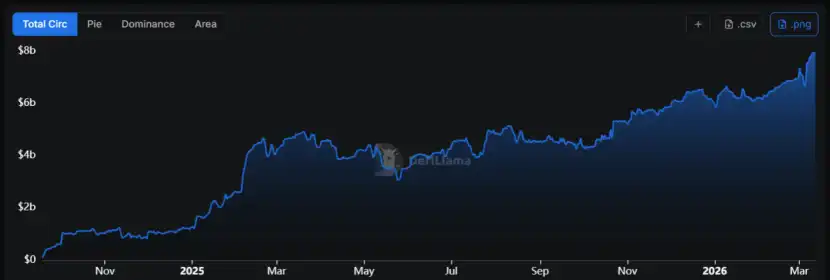
As of now, the sUSDS rate remains around 3.75%, becoming the "de facto floor" for on-chain yields. In vaults related to USDC and USDT, its deposit rate can reach over 5%.

This allows Sky to assume a role similar to a "benchmark rate platform." In comparison, the rates for similar assets on Aave are almost non-competitive.

Thus, it is evident that Sky is transforming from a mere stablecoin protocol into a "fixed-income asset management" protocol, utilizing its massive RWA portfolio to hedge against downside risks in the crypto market. When internal DeFi demand is lacking, it can seek yield externally (from traditional financial markets).

For investors, learning to scrutinize the underlying logic of yields—whether they come from Treasury dividends or volatility premiums from futures markets—will be a required course this cycle. Strategies also need to shift from "chasing APY" to "seeking differentiated risk exposure."

The "yield winter" is not only the result of cyclical fluctuations but also a necessary growing pain for DeFi's "de-bubbling."

Perhaps, just as the trough of 2023 nurtured the prosperity of 2024, this interest rate bottoming may also be DeFi accumulating energy for the next leap forward.

Related Questions

QWhat is the main reason for the decline in DeFi stablecoin deposit APY according to the article?

AThe primary reason is a severe supply-demand imbalance, where the supply of stablecoins has surged (with total market cap growing from under $1.3 trillion to over $3.1 trillion) without a proportional expansion in on-chain borrowing demand, leading to a liquidity glut and a collapse in interest yields.

QHow did the negative or low funding rates on perpetual contracts impact DeFi stablecoin interest rates?

ALow or negative funding rates on CEX perpetual contracts eliminated the profitability of the delta-neutral arbitrage strategy (borrowing stablecoins to buy spot and sell perpetuals), which drastically reduced the demand for borrowing stablecoins and contributed to the decline in their lending rates.

QWhat role did the '1011 event' and the subsequent change in USDe's scalability play in the DeFi yield winter?

AThe '1011 event' caused a catastrophic narrowing of the yield spread for USDe-based looped borrowing strategies. USDe's scalability hit a ceiling, with its size dropping from nearly $15 billion to about $6 billion, reducing leverage demand and further decreasing stablecoin borrowing needs.

QWhy is Sky (formerly MakerDAO) able to maintain a higher stablecoin yield compared to protocols like Aave during this period?

ASky maintains a higher yield because it incorporates Real World Assets (RWA), such as U.S. Treasuries and corporate debt, which provide a stable underlying cash flow unaffected by crypto market volatility, allowing it to offer a competitive yield (e.g., ~3.75% for sUSDS) even when on-chain demand is low.

QHow has the overall risk appetite in the crypto market influenced the DeFi yield environment?

AA decline in overall crypto market risk appetite, indicated by the Fear & Greed Index frequently hitting 'extreme fear' and reduced CEX trading volume, has driven investors toward higher certainty investments. This shift, combined with attractive traditional risk-free rates (e.g., U.S. 10-year Treasury at 4.24%), has reduced capital allocation to volatile DeFi yields, further depressing on-chain interest rates.

Related Reads

Retail Ecology Dwindles, ZKsync Bets on Bank Pilots for a Breakthrough

Amidst declining retail activity, ZKsync is pivoting to target institutional banking as its primary growth strategy. The article explores this shift, contrasting it with the competitive "survival of the fittest" narrative by highlighting a cooperative model inspired by naturalist Peter Kropotkin. ZKsync is developing infrastructure like its private, permissioned Prividium suite for banks (e.g., Deutsche Bank's use case via Memento), enabling private transactions with public verifiability via zero-knowledge proofs. This appeals to institutions needing privacy, compliance, and Ethereum-based settlement security, unlike fully private chains (e.g., JPMorgan's Kinaxis) or consortium models (e.g., R3 Corda). However, this strategic focus has coincided with a steep decline in its public DeFi ecosystem, evidenced by plunging TVL and the departure of major protocols like Aave due to low fees. The network's future now hinges on banking adoption, with upcoming pilots like the Cari Network involving regional banks holding over $600 billion in deposits. A significant challenge is balancing this institutional focus with ZKsync's decentralized governance. Banks must operate on a network where rules and fees (denominated in the volatile ZK token) can be changed via community vote, and where a Security Council holds emergency control—a stark contrast to the predictable, contract-bound environments of traditional finance. The coming 18 months will test whether ZKsync can successfully onboard traditional banks onto a dynamically governed public chain or if institutions will ultimately revert to proprietary solutions.

Foresight News13m ago

Retail Ecology Dwindles, ZKsync Bets on Bank Pilots for a Breakthrough

Foresight News13m ago

The Recursive AI Anthropic Warned About: Tian Yuandong's New Company Has Just Taken the "First Step"

Anthropic recently highlighted the rapid progress toward "recursive self-improvement," where AI systems autonomously design and train their successors. In response, Recursive Superintelligence, a new company co-founded by former Meta researcher Tian Yuan Dong, has publicly demonstrated its first step toward automating AI research. The company released a system designed to autonomously execute the full AI research cycle: generating ideas, implementing code, running experiments, and learning from results. It validated this approach by achieving state-of-the-art results on three diverse benchmarks: 1. **NanoChat Autoresearch:** Optimizing a small language model's validation loss under a fixed 5-minute GPU budget, improving upon the community's best result. 2. **NanoGPT Speedrun:** Reducing the time to train a GPT model to a specific loss on 8 H100 GPUs from 79.7 seconds to 77.5 seconds, beating a highly optimized, human-driven community effort. 3. **SOL-ExecBench:** Improving the overall score on NVIDIA's suite of 235 GPU kernel optimization tasks by 18%, closing the gap to the hardware limit. The system discovered novel optimizations in this highly specialized domain without direct human expertise. Recursive's system operates as a general framework, capable of parallel exploration and cross-task knowledge transfer while incorporating safeguards against reward hacking. The company, backed by $650M in funding and a star-studded team including Richard Socher and Alexey Dosovitskiy, aims to create AI that recursively enhances its own research capabilities. This development represents an early but concrete move toward a new paradigm where AI accelerates its own advancement. It occurs alongside Anthropic's warnings about the need for industry coordination and potential pauses when recursive self-improvement thresholds are reached, highlighting the dual trajectory of rapid technical progress and growing calls for careful stewardship.

marsbit21m ago

The Recursive AI Anthropic Warned About: Tian Yuandong's New Company Has Just Taken the "First Step"

marsbit21m ago

The Gold Buy-on-the-Dip Guide: Watch Interest Rates, Not Just War

"Gold Buying Guide: Focus on Interest Rates, Not Just War" Four months ago, gold buyers likely didn't anticipate buying at a peak that even a war couldn't sustain. After hitting a record high of $5,596 on January 29, gold entered a bear market just 91 days later, its fastest decline since 2008. A key trigger was the Fed's hawkish shift, highlighting that monetary policy, not geopolitics, is the primary driver. The article argues that the traditional "buy gold in turmoil" script has changed. While the US-Iran conflict initially boosted prices, the sustained rally in oil prices heightened inflation fears, forcing central banks to maintain or consider tighter policy. Since gold yields no interest, higher rates increase its opportunity cost, eroding its appeal. This dynamic was evident when gold fell sharply on May 18 despite positive peace talks, as lower oil prices eased inflation and thus rate hike pressures. The recent sell-off is also part of a broader market deleveraging. Correlations between gold, Nasdaq, and Bitcoin spiked as leveraged investors sold liquid assets to cover losses, creating a synchronized downturn. Historically, gold bottoms align with policy shifts, not conflict resolutions. The 2008 and 2022 bear markets ended with shifts to extreme easing and peak inflation expectations, respectively. For potential buyers, the author suggests monitoring three signals: 1) Peak interest rate hike expectations, 2) Reopening of the Strait of Hormuz (to ease oil/inflation pressure), and 3) A return to net inflows for Gold ETFs, indicating the end of forced selling. While predicting the exact bottom is impossible, the author's personal strategy involves scaling into a position across price levels like $4000, $3700, and $3500, committing no more than 30% of the intended total allocation initially, and adding the remainder only if key signals emerge. The core conclusion: In turbulent times, watching interest rates is more crucial than watching wars.

marsbit27m ago

The Gold Buy-on-the-Dip Guide: Watch Interest Rates, Not Just War

marsbit27m ago

Recent On-Chain Review: No Clear Narrative Under U.S. Stock Market Pressure, Just Hype

This article analyzes the current state of the Solana meme coin and community token ecosystem, highlighting a market caught between two dominant forces: attention-based PvP and a gradual return to community-centric projects. The first part explores the "Attention PvP" dynamic, where success is driven by celebrity endorsements, viral events, and speed. Examples include $JOTCHUA, which surged after its meme creator's social media activity, and $WORLDCUP, which outperformed a similar Base chain project ($PITCH) largely due to influencer support. The recent "pump.fun GO" feature, allowing bounty tasks for token promotion, is critiqued for fostering sensationalist and often negative stunts—like people getting token tickers tattooed on their bodies for rewards—reminiscent of old internet shock content. In contrast, the article points to a resurgence of organic, community-driven tokens that survive market volatility through strong holder bases and shared ideology, not just hype. Influencer Ansem is cited, arguing that durable meme coins rely on communities willing to endure losses and promote their core message daily. Examples given are older tokens like $neet (anti-work ethos), $troll, $buttcoin, and $triplet, which have maintained relative price stability. A prime example of this community-build model is the new project $KINS, the token for the browser-based MMORPG Kintara. Its success stems not from advanced graphics but from consistently delivering updates, fostering player trust, and creating genuine engagement (e.g., in-game economies, events, property auctions). It has attracted a growing player base and even notable KOLs as participants, demonstrating that sustainable growth can come from building trust rather than orchestrating pumps. The article concludes by questioning whether the market is ultimately a game of mutual trust or mutual deception, expressing hope that such reflection might lead to a healthier ecosystem.

marsbit27m ago

Recent On-Chain Review: No Clear Narrative Under U.S. Stock Market Pressure, Just Hype

marsbit27m ago

Trading

Spot
Futures
活动图片