DeFi Has Not Collapsed, But Why Has It Lost Its Charm?

marsbitPublished on 2025-12-24Last updated on 2025-12-24

Abstract

DeFi has not collapsed, but it is losing its sense of exploration and novelty. While the infrastructure has matured and execution has become more efficient, participation has become highly homogenized, centered around incentives, short-term financing, and speculative trading rather than genuine credit markets or long-term engagement. The ecosystem has optimized for behaviors favored by traders—liquidity, leverage, and quick exits—making yield less a reward for risk-taking and more an expected compensation for participation. This has led to capital that is highly mobile but discontinuous, often “rented” during incentive periods rather than sustainably engaged. Trust has also shifted from curiosity to caution due to past failures, making users more risk-averse and less likely to experiment. DeFi’s current form successfully serves a niche group but struggles to expand beyond its optimized behaviors. For DeFi to regain relevance, it must encourage new types of rational behavior—such as longer-term capital commitment, structured credit, and sustainable yield—rather than perpetuating the same incentive-driven patterns. This would require building systems that attract users through real utility rather than subsidies, even if growth is slower and less dramatic.

Editor's Note: DeFi has not stagnated, nor has it collapsed, but it is losing something that was once most important—the 'sense of exploration'.

This article reviews the evolution of DeFi from its early exploratory stages to gradual maturation, pointing out that as infrastructure has improved and transaction models have solidified, the ways of participating in on-chain finance are converging: yield has become a basic expectation, lending resembles short-term financing more than credit, and incentives dominate user behavior. The author does not deny the value of DeFi but instead poses a harder question: after efficiency and scale have been sufficiently optimized, can DeFi still shape new behaviors, rather than merely serving the same small subset of existing users?

Below is the original text:

TL;DR

The way people use DeFi is becoming highly convergent. The market and infrastructure have matured, but curiosity has been replaced by caution; yield has shifted from 'returns users actively take risks to earn' to 'compensation waiting to be paid', and participation is increasingly centered around incentives.

The feeling DeFi evokes is slowly fading. I'm not being dramatic. It hasn't stopped functioning, nor has it stopped evolving. What has changed is this: you rarely feel like you're stepping into something truly new anymore.

I entered this industry in 2017 (the ICO era). Everything back then felt rough, unfinished, even a bit out of control. Chaotic, but open. You felt the rules were temporary, and the next 'primitive' could completely reshape the entire landscape.

DeFi Summer was the first time this belief became concrete. You weren't just trading tokens; you were watching market structure form in real-time. New primitives weren't simple upgrades; they forced you to rethink 'what is possible'. Even when systems failed, it still felt like exploration because everything was still in the process of becoming.

Today, much of DeFi looks like repeating the same script with cleaner execution. The infrastructure is more mature, the interfaces are better, the models are already understood. It still works, but it no longer frequently opens new frontiers. This changes people's relationship with it.

People are still building, but the behavioral patterns reinforced by DeFi have shifted.

The Form Optimized by DeFi

DeFi became highly speculative because trading was the first need to be moved on-chain at scale.

Early on, traders were the first real 'power users'. As they flooded in, the system naturally began to adjust around their needs.

Traders value: optionality, speed, leverage, and the ability to exit at any time. They dislike being locked in, dislike risks dependent on others' discretion. Protocols that aligned with these instincts grew rapidly; those that required users to act differently, even if functional, often needed 'subsidies' to compensate for this mismatch.

Over time, this shaped the entire ecosystem's psychological expectations: participation itself began to be seen as an 'action that should be compensated', rather than because the product was useful under normal circumstances.

Once this expectation formed, people didn't 'step away'; they just became more proficient: rotating faster, holding stablecoins longer, only appearing when trading conditions were clearly favorable. This isn't a moral judgment but a rational response to the environment DeFi created.

Lending Became Financing, Not Credit

Lending most clearly illustrates the gap between DeFi's narrative and its actual path to scale.

In the traditional understanding, lending implies credit, credit implies time—it means someone is borrowing for a real need, and someone is willing to bear the uncertainty of that time period.

But what has truly scaled in DeFi is more like short-term financing. The primary borrowers aren't borrowing for 'duration', but for positions: leverage, looping, basis trading, arbitrage, or directional exposure. People borrow money not to hold a loan.

Lenders have adapted to this reality. They no longer act like credit underwriters, but more like liquidity providers: valuing exitability, wanting redemption at par, preferring sustainably repricing terms. When both sides act this way, the market behaves more like a money market than a credit market.

Once the system grows around these preferences, building true credit structures on top becomes extremely difficult. You can add features, but you can't forcibly change motivations.

Yield Became a 'Basic Expectation'

Over time, yield stopped being just a return and became a justification for participation.

On-chain risk isn't just price volatility; it includes contract risk, governance risk, oracle risk, cross-chain risk, and the uncertainty that 'there's always something you didn't think of that could go wrong'. Users gradually learned: bearing these risks deserves explicit compensation.

This is reasonable in itself, but it changed behavior.

Capital doesn't slowly trickle back from high yields to normal yields and stay参与; it just leaves. Users maintain liquidity, waiting for the next moment to 'be rewarded for participating again'.

The result: high intensity, but lacking continuity. Activity surges when incentives are on, and rapidly subsides after they end. What looks like adoption is often just 'rented behavior'.

When participation only occurs during incentive windows, anything meant to last long-term becomes difficult to build.

The Trust Problem

Another thing that has彻底 changed the ecosystem is trust.

Years of exploits, rug pulls, and governance failures have reshaped user psychology. Novelty no longer sparks curiosity; it triggers caution. Even sophisticated users enter later, with smaller positions, preferring systems that have 'survived' over those that are 'theoretically better'.

This might be healthy, but the culture changed with it: exploration turned into due diligence, the frontier turned into a checklist. The space became more serious, and seriousness does not equal charm.

More difficultly: DeFi trains users to demand high compensation for risk while simultaneously making them less willing to take new risks. This compresses the middle ground where past experiments thrived.

Why Both Sides Are 'Right'

This is where DeFi debates often misalign.

If you dislike DeFi, you're not wrong—it does appear closed and self-referential, many products serve the same small group, and historical growth relied heavily on incentives.

If you still believe in DeFi, you're not wrong either—permissionless access, global liquidity, composability, and open markets are still powerful ideas.

The mistake is pretending these were ever the same goal.

DeFi didn't fail; it successfully optimized for a narrow set of intents. It is this very success that makes it harder to expand into new behavioral patterns.

Whether you see this as progress or stagnation depends entirely on what you originally expected DeFi to become.

How Charm Can Return

DeFi won't regain its charm by recreating DeFi Summer. Frontier moments don't repeat.

What has truly receded is not innovation, but the feeling that 'behavior is still being changed'. When a system stops reshaping how people use it, and只剩下 execution efficiency, the sense of exploration disappears.

If DeFi wants to become important again, it must do the harder thing: build structures that make different types of behavior rational.

Make capital willing to stay sometimes; make duration an understandable, exitable choice, not a reluctantly endured burden; make yield more than just a headline number, but a decision that can be truly underwritten.

That kind of DeFi would be quieter, grow slower, and wouldn't dominate timelines like past cycles—but this usually means: usage is driven by real demand, not continuous incentives.

I'm not even sure if such a transition is possible without disrupting the systems people still rely on. That is the real constraint.

DeFi cannot expand the boundaries of behavior without changing 'for whom participation makes sense'.

A system that continuously rewards speed, optionality, and quick exit will only continue to attract users optimizing for those traits.

The path is actually quite clear:

If DeFi continues to reward the behaviors it has already optimized for, it will remain highly liquid but permanently niche;

If it is willing to bear the cost to shape a different type of user, then charm will return not in the form of hype, but in the form of gravity—a silent force that keeps capital around even when nothing is happening.

Related Questions

QAccording to the article, what is the core reason why DeFi is losing its charm?

ADeFi is losing its charm because the sense of exploration has faded. The infrastructure has matured and transaction models have solidified, leading to highly convergent user behavior focused on incentives and efficiency, rather than pioneering new financial primitives and possibilities.

QHow has the nature of 'yield' changed in the current DeFi landscape as described in the text?

AYield has transformed from 'a return that users actively take risks to earn' into 'compensation that is expected to be paid.' It is no longer just a reward but has become a basic expectation and a justification for participation, which leads to capital leaving when incentives end rather than sustaining continuous engagement.

QWhat does the article suggest is the fundamental difference between lending in traditional finance and the 'lending' that has scaled in DeFi?

AIn traditional finance, lending implies credit and time, where borrowers have a genuine need for a loan duration. In DeFi, what has scaled is short-term financing, where the primary borrowers are not seeking a 'term' but are using loans for positions like leverage, recycling, basis trading, arbitrage, or directional exposure.

QWhat does the author propose as the necessary condition for DeFi to regain its importance and 'charm'?

AFor DeFi to regain its importance, it must build structures that make different types of behavior rational. It needs to create an environment where capital is willing to stay, where duration is a understandable and exit-ready choice, and where yield is a decision that can be genuinely underwritten, rather than just a headline number driven by incentives.

QHow has user psychology around 'trust' evolved in DeFi, and what has been its cultural impact?

AYears of exploits, rug pulls, and governance failures have reshaped user psychology. Freshness no longer sparks curiosity but triggers vigilance. Exploration has turned into due diligence, and the frontier has become a checklist. The space has become more serious, which is healthier but lacks the charm and excitement of the early days.

Related Reads

Bitroot Public Chain Invited to Attend Tencent Cloud Singapore AI Conference, Discussing the Future Alongside Solana

On May 19, Bitroot, an emerging Layer 1 blockchain, participated in the Tencent Cloud AI Summit in Singapore alongside key industry players like Solana Foundation. The event explored the intersection of AI infrastructure, enterprise applications, AI Agents, and Web3. Bitroot's invitation, despite being pre-mainnet, highlights industry interest in its focus on high-performance, AI-native architecture tailored for future AI Agent execution and verifiable on-chain automation. Bitroot CEO Juan Jose emphasized that AI competition is shifting from model performance to data, real-world application scenarios, and trust infrastructure. He argued that for AI Agents to evolve from assistants to autonomous executors managing transactions and assets, they require low-latency, low-cost, and high-throughput blockchain environments. Bitroot aims to address this through its EVM-compatible design, optimistic parallel execution, and a consensus mechanism targeting high scalability. Currently in its Testnet 5.0 phase, Bitroot reports metrics like over 50,000 peak TPS and sub-0.3 second average block time. Its narrative positions it within a growing landscape where next-generation Layer 1s like Monad and Aptos also compete on performance, while Bitroot differentiates by integrating AI computational capabilities natively across its stack. The summit underscored that the fusion of AI and Web3 is moving from concept to infrastructure competition, where networks balancing performance, security, and verifiability will be crucial for enabling scalable AI-driven applications.

marsbit7m ago

Bitroot Public Chain Invited to Attend Tencent Cloud Singapore AI Conference, Discussing the Future Alongside Solana

marsbit7m ago

Hedge Fund Q1 Interpretation: Everyone Is Selling Software, Buying Chips

Hedge Funds and Mutual Funds Aligned in Q1: Dumping Software, Buying Chips A clear consensus emerged among major U.S. hedge funds and mutual funds in Q1: they were simultaneously selling software stocks and pouring capital into the semiconductor sector. This aggressive rotation pushed semiconductor exposure in hedge fund long portfolios to a record high. Hedge funds delivered a 7% return year-to-date, while only 30% of large-cap active mutual funds outperformed their benchmarks. The average short interest for S&P 500 constituents rose to 3% of market cap, the highest since 2011. Within technology, the structural shift was stark. Hedge funds' semiconductor weighting hit an all-time high, while software fell to its lowest since 2019. Excluding Microsoft, mutual funds' relative overexposure to semis vs. software was the largest since 2012. Microsoft was among the most net-sold stocks by both groups. Hedge funds net purchased semiconductor names like LRCX and AMAT. Strategies diverged on leverage and cash. Hedge funds increased their net exposure to near a one-year high after an initial cut. Mutual funds raised their cash allocation, though it remains historically low at 1.4%. Sector alignment was high in Industrials (both overweight) but divergent in Tech: hedge funds increased their Tech net tilt by a record 853 basis points, while mutual funds reduced theirs. Clear splits also appeared in Financials and Consumer Discretionary. Four stocks appeared on both Goldman's hedge fund VIP and mutual fund overweight lists: BA, MA, MRVL, and V. This "shared favorites" basket has returned 10% YTD, outperforming the equal-weight S&P 500. Notably, all "Magnificent Seven" stocks are on the hedge fund VIP list but are uniformly underweighted by mutual funds.

marsbit17m ago

Hedge Fund Q1 Interpretation: Everyone Is Selling Software, Buying Chips

marsbit17m ago

The Evolution Path of Physical Bitcoin

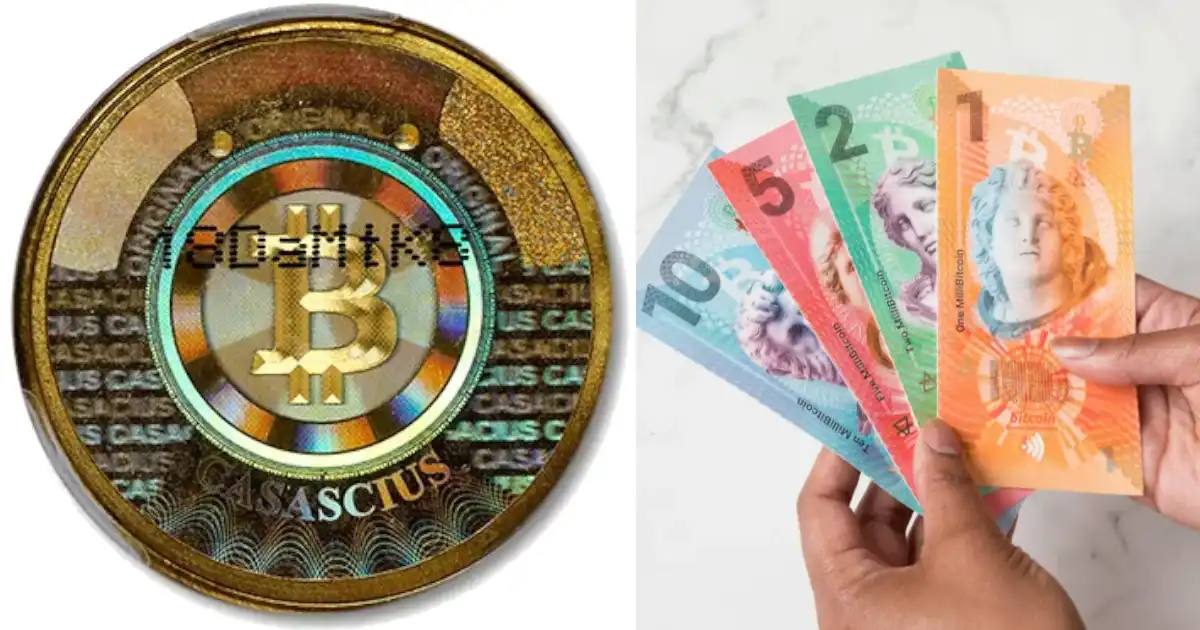
The Evolution of Physical Bitcoin Bitcoin's digital nature is its core strength, enabling self-custody and rapid global transfers. However, its intangibility also hinders mainstream adoption. For over a decade, creators have attempted to materialize Bitcoin while preserving its cash-like properties, yielding notable results. Casascius Coins, launched in 2011, were the first and most iconic physical Bitcoin. Creator Mike Caldwell generated private keys offline, printed them on coins, and sealed them with tamper-evident holograms. This model relied on user trust in the centralized issuer. Production ceased in 2013 due to regulatory pressure from FinCEN. RavenBit Coins emerged in 2014 aiming to decentralize minting by letting users generate and apply their own keys. However, this led to trust issues with numerous untrusted minters and insecure key generation methods. In 2016, Coinkite introduced Opendimes—a breakthrough in bearer asset technology. These USB-shaped devices generate and store keys internally. Funds can be received by checking the public key, but spending requires physically breaking the device to extract the private key. While innovative and open-source, its cost (~$20) and form factor limit its use for small, everyday transactions. Satochip's Satodime, a card-shaped device using similar secure chip technology, followed. It supports NFC interaction and comes in various forms. While potentially cheaper in bulk (~13€), it remains a high-security hardware wallet, not a low-cost cash substitute. A fundamental cost barrier exists. For physical Bitcoin to achieve widespread commercial use, hardware costs must drop below $1 to match the production cost of fiat banknotes. Current secure chips capable of running Bitcoin's cryptographic algorithms (like secp256k1) are too expensive. Chips like NXP's NTAG X DNA (~$3) show cost-reduction potential but lack native Bitcoin curve support. Projects like OfflineCash embed chips in banknote-like paper, but face challenges with durability, the need for custom Bitcoin-enabled chips, and the inherent requirement for users to verify balances online—which conflicts with Bitcoin's trustless ideal. Coinkite's Tapsigner, a ~$20 card with a proprietary Bitcoin NFC chip, is seen as a more practical step forward. It functions as a reloadable hardware wallet for contactless payments, solving the "change" problem and focusing on real-world retail integration, a direction also pursued by companies like Cash App and Square. In summary, the journey to physical Bitcoin has progressed from trusted centralized mints (Casascius) to user-generated keys (RavenBit) and finally to self-contained secure hardware (Opendimes, Satodime, Tapsigner). The core challenge remains developing a sufficiently low-cost, durable, and truly trustless physical bearer asset that can function like cash in daily transactions. Current solutions are either too expensive or introduce new trust assumptions, keeping the ideal of ubiquitous physical Bitcoin just out of reach for now.

marsbit1h ago

The Evolution Path of Physical Bitcoin

marsbit1h ago

Trading

Spot
Futures
活动图片