Decoding Unitree's IPO Prospectus: The True Picture of the Robot Market

marsbitОпубликовано 2026-05-25Обновлено 2026-05-25

Введение

Unitree Robotics's IPO prospectus reveals a profitable and rapidly growing company, dominating the global humanoid robot market by shipment volume (5,500 units in 2025). A key shift is that humanoids now constitute over half of its revenue, up from just 1.9% in 2023. However, the current market reality is stark: 74% of humanoid sales are for academic research, 17% for commercial "display" purposes, and only 9% for genuine industrial applications. In contrast, its quadruped robots see more mature industrial use (e.g., inspection). Financially, Unitree is strong with 335% revenue growth to ~$252M in 2025, ~60% gross margins (bolstered by deep vertical integration of key components like motors), and GAAP profitability since 2024. The company plans to invest nearly half of its $620M IPO proceeds into AI and "embodied" large model development, signaling a strategic push beyond hardware into the critical software layer for future differentiation. Unitree's story highlights that while advanced, cost-effective hardware exists, widespread commercial and industrial adoption awaits more capable AI models.

Author:Tanay Jaipuria

Compiled by: Deep Tide TechFlow

Deep Tide Guide: Unitree robotics is about to conduct an IPO on the Shanghai Stock Exchange's Sci-Tech Innovation Board, raising $620 million. The prospectus reveals for the first time the complete financial data of a profitable robot company. The company shipped 5,500 humanoid robots in 2025, ranking first globally, but 74% were sold to universities for research, with genuine industrial applications accounting for only 9%—this is the current reality of the robotics industry: hardware is ready, but commercialization is waiting for AI models to catch up.

Unitree Robotics recently submitted an IPO application to the Shanghai Stock Exchange's Sci-Tech Innovation Board, planning to raise $620 million. This prospectus is quite interesting because it gives us a clear view of the current state of the robot market.

Unitree is already profitable, growing rapidly, and leads in global humanoid robot shipments.

This article will discuss:

  • What Unitree produces
  • The shift in revenue structure towards humanoid robots
  • Who is buying robots (and why)
  • The vertical integration strategy
  • Financial status
  • Ambitions at the model layer

1. What Unitree Produces

Unitree was founded in 2016 and is based in Hangzhou. Its founder, Wang Xingxing, is a self-taught robotics expert who built the first quadruped robot in his own apartment. The company currently has 480 employees, with about 175 engaged in R&D.
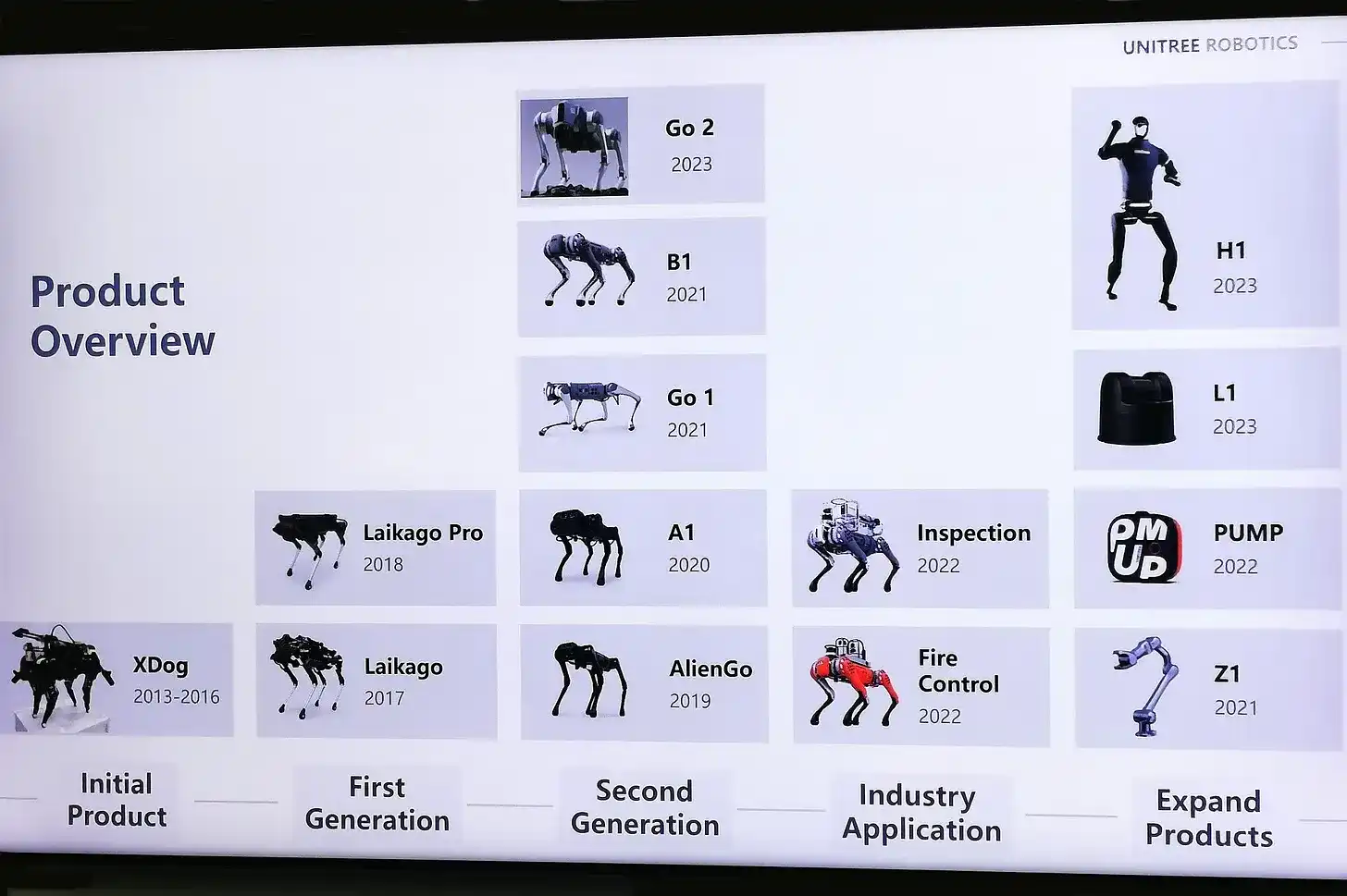
The company sells two product lines:

Quadruped Robots: Go2 (consumer and research grade), B2 (industrial grade), and A2

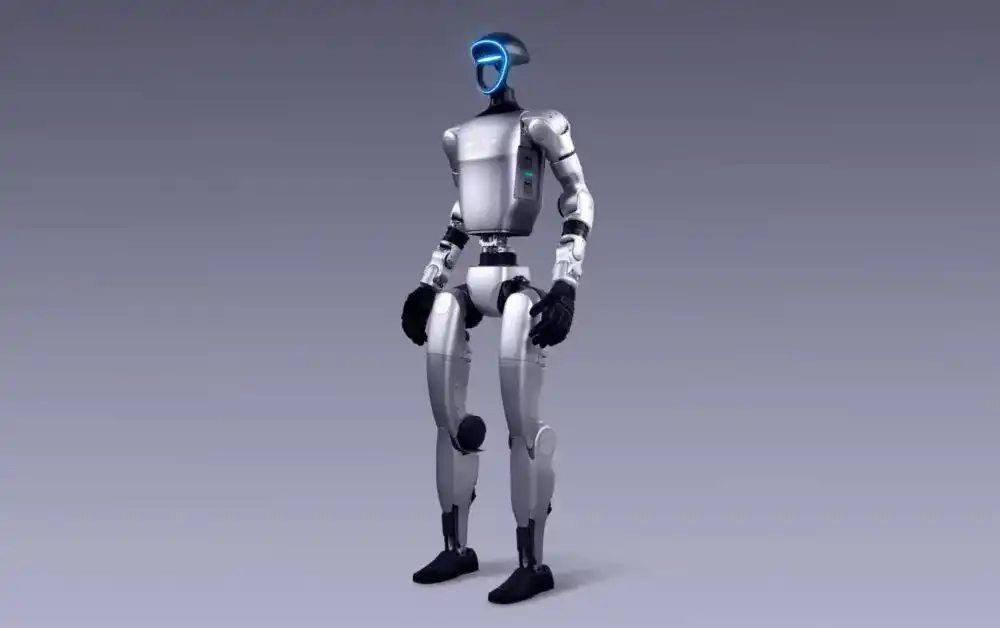
Humanoid Robots: H1, H2, G1, and R1. The G1 is the one you might have seen in viral videos, standing 1.32 meters tall and weighing 35 kg.
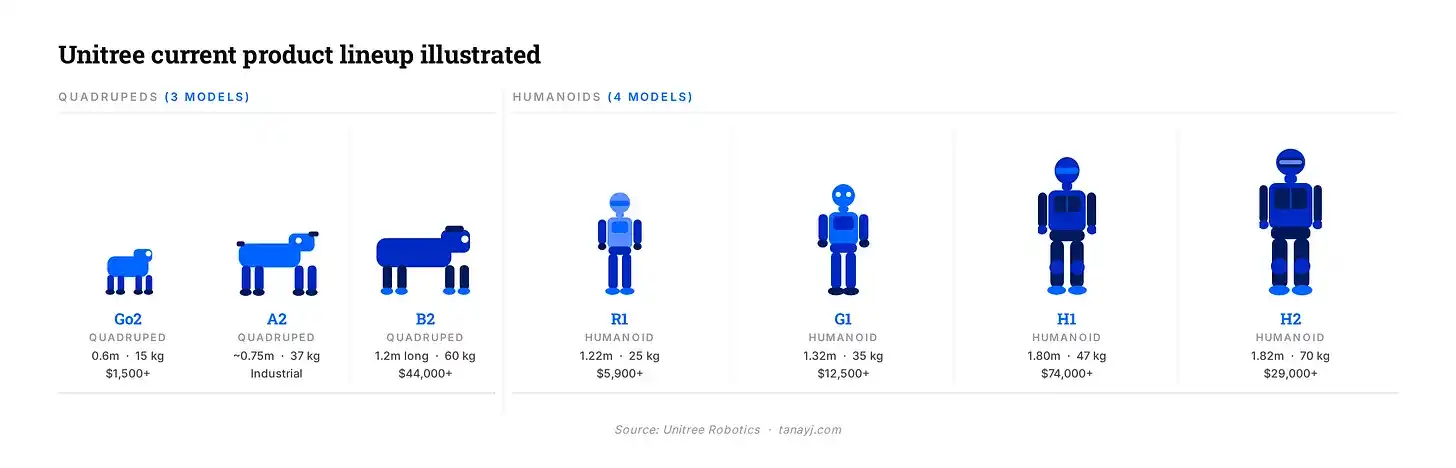
The company began international sales in 2018. Over 35% of revenue comes from outside China, including a significant number of academic customers in the US.

2. The Shift in Revenue Structure Towards Humanoid Robots

Two years ago, Unitree was essentially a robot dog company, primarily selling quadruped robots. Humanoid robots accounted for only 1.9% of revenue in 2023.

By the first three quarters of 2025, humanoid robots already accounted for over half of core revenue.
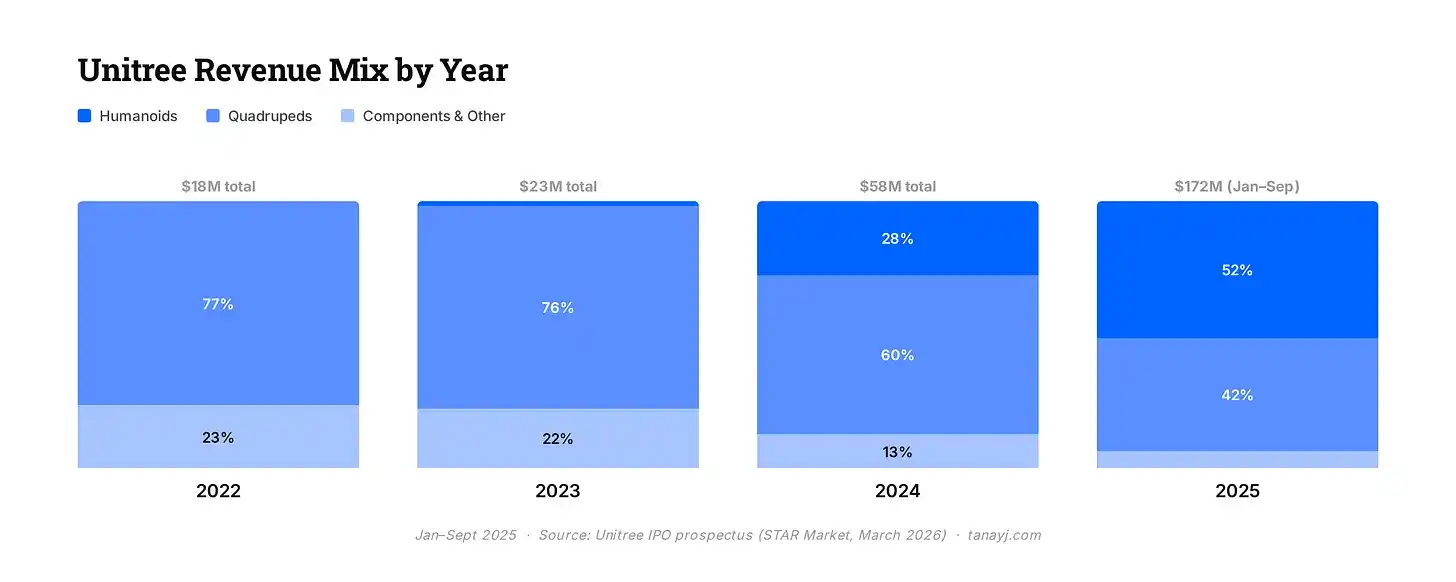
This shift was driven by improved product-market fit and aggressive marketing. The company's humanoid robots have appeared on CCTV's Spring Festival Gala for two consecutive years, one of the most-watched programs globally. Jensen Huang brought Unitree robots on stage at the 2024 GTC conference.

This brand exposure translated into commercial and research demand, something most Chinese hardware companies have never truly achieved.

The shipment data for humanoid robots is particularly impressive. Unitree shipped about 5,500 humanoid robots in 2025, making it the world's largest manufacturer of humanoid robots by shipment volume. China's Zhiyuan Robotics comes closest to this number. In contrast, well-known US companies like Figure AI and Agility Robotics have only shipped in the hundreds.
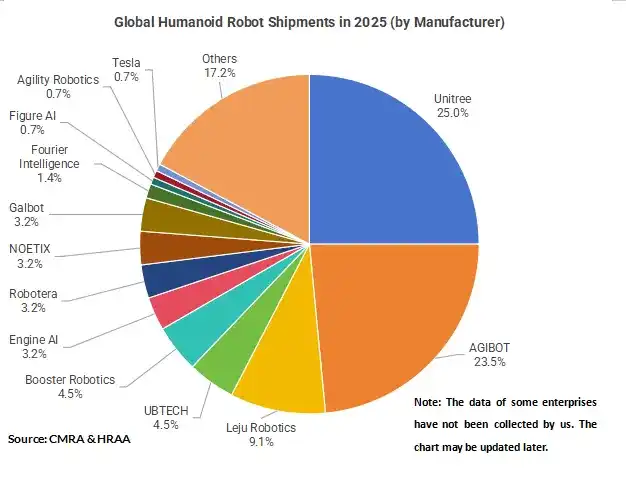
The 5-year target in the prospectus is an annual production capacity of 75,000 humanoid robots and 115,000 quadruped robots. This is about 14 times the humanoid robot shipments in 2025. The goal is aggressive but also highlights how early stage we still are.

3. Who is Really Buying Robots

The prospectus categorizes buyers into three types: Research & Education, Commercial & Consumer, and Industrial Applications.

The reality is that most current demand for humanoid robots comes from research and education purposes.
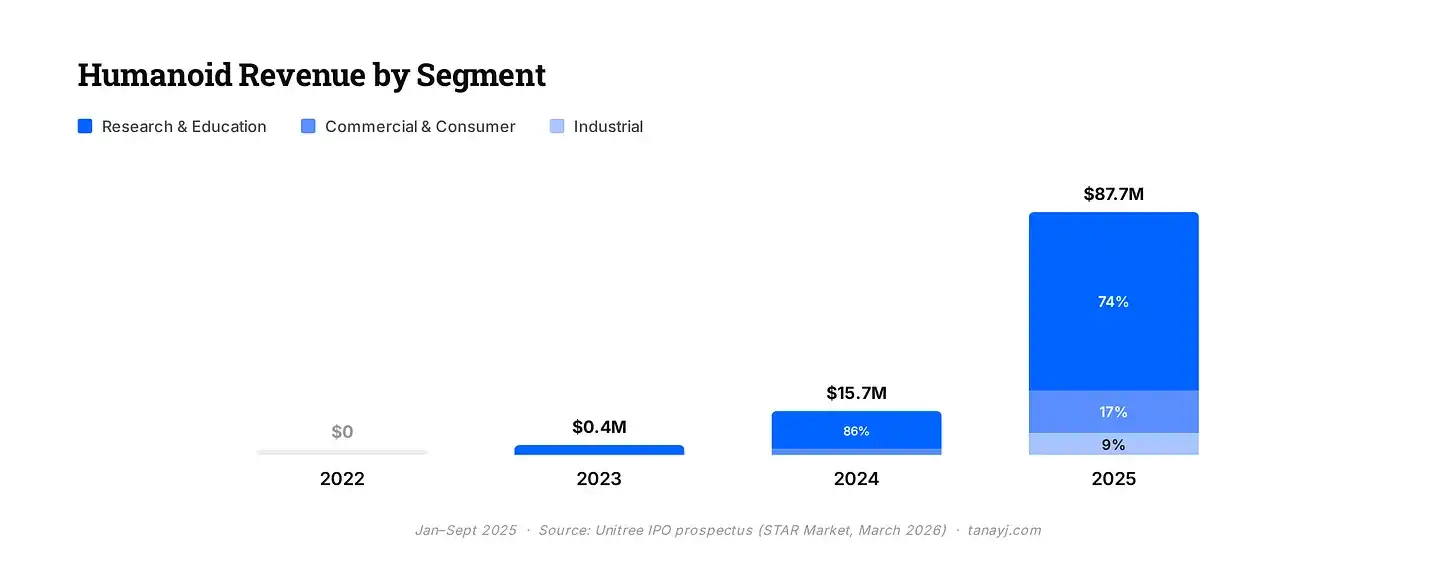
1/ Research & Education accounts for 74% of humanoid robot revenue/shipments. Academic buyers have been Unitree's core support since at least 2022 and remain the company's largest revenue source.

2/ Commercial & Consumer accounts for 17% of humanoid robot shipments. Non-academic consumers who buy these robots mainly use them for "showcasing": acting as eye-catching promoters in retail stores, tourist spots, performances, and exhibitions. Consumer revenue grew nearly fourfold year-on-year in the first nine months of 2025, which sounds impressive, but the base was actually very small. In reality, the practical use of a $25,000 humanoid robot today is to stand at the entrance of a store in Shenzhen attracting tourists.

3/ Industrial Applications account for only 9% of humanoid robot shipments. Unitree acknowledges that industrial deployment is more limited because the technology is not yet mature enough, which illustrates the current technological state. Within this 9% of shipments, about 50-70% are used in scenarios like corporate reception and guiding tours. So overall, only 3-4% of humanoid robot shipments are genuinely used for work like corporate reception and inspection.

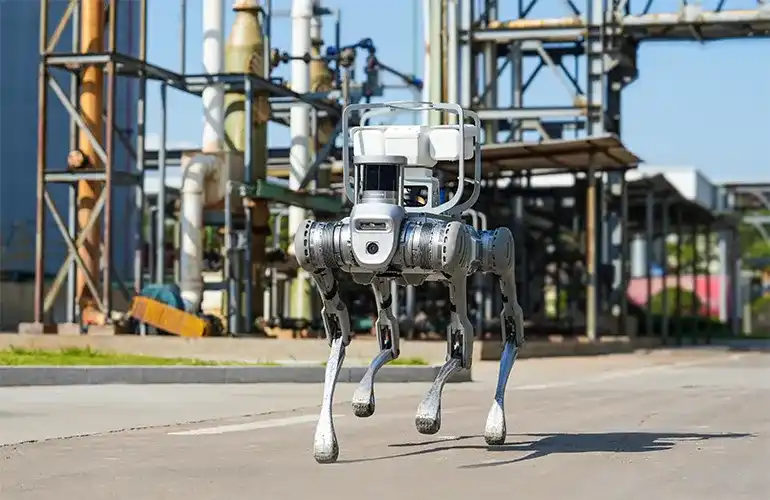
For quadruped robots, the situation is better: only about one-third of revenue comes from research, over 40% from commercial use, and the rest from industrial use. Productive use cases there are relatively more mature. Clients include State Grid, Southern Grid, PetroChina, Sinopec, Baowu Group, and JD.com (Unitree's largest customer). These companies use quadruped robots for real inspection scenarios in chemical plants, substations, coal mines, pipelines, etc.
4. Vertical Integration Strategy

A unique aspect of Unitree is that it independently designs and manufactures most of its key components: high-torque motors, precision reducers, encoders, joint modules, intelligent controllers, high-precision sensors, dexterous hands, lidars, and cameras. According to McKinsey data, the drive system (motors, reducers, and the joint systems that actually make the robot move) typically accounts for 40-60% of the total BOM cost of a humanoid robot.

Most companies in this field source these components externally, but Unitree manufactures them itself. Outsourced components account for only about 14-18% of the total cost. What it outsources are only generic parts like batteries, flash memory, and differentiated parts like the core computing board.

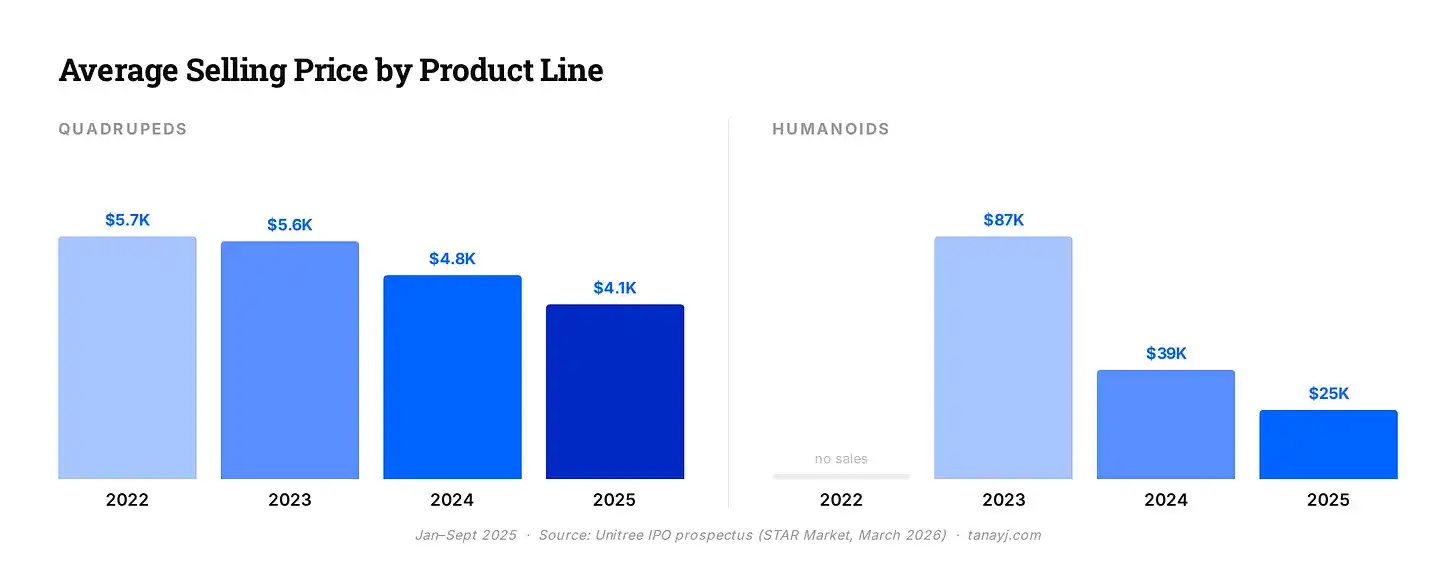
The unit manufacturing cost for quadruped robots has decreased from about $3,300 in 2022 to about $1,800 in mid-2025, a 46% reduction. Humanoid robot costs have also decreased, from about $10,800 to $9,200 over the same period.

Interestingly, as shown in the chart below, the average selling prices for both quadruped and humanoid robots have also dropped significantly year by year. However, gross margins have actually expanded over the period, rising from the low 40s in 2022-2023 to nearly 60% in 2025, largely due to their vertical integration strategy.
5. Financial Status

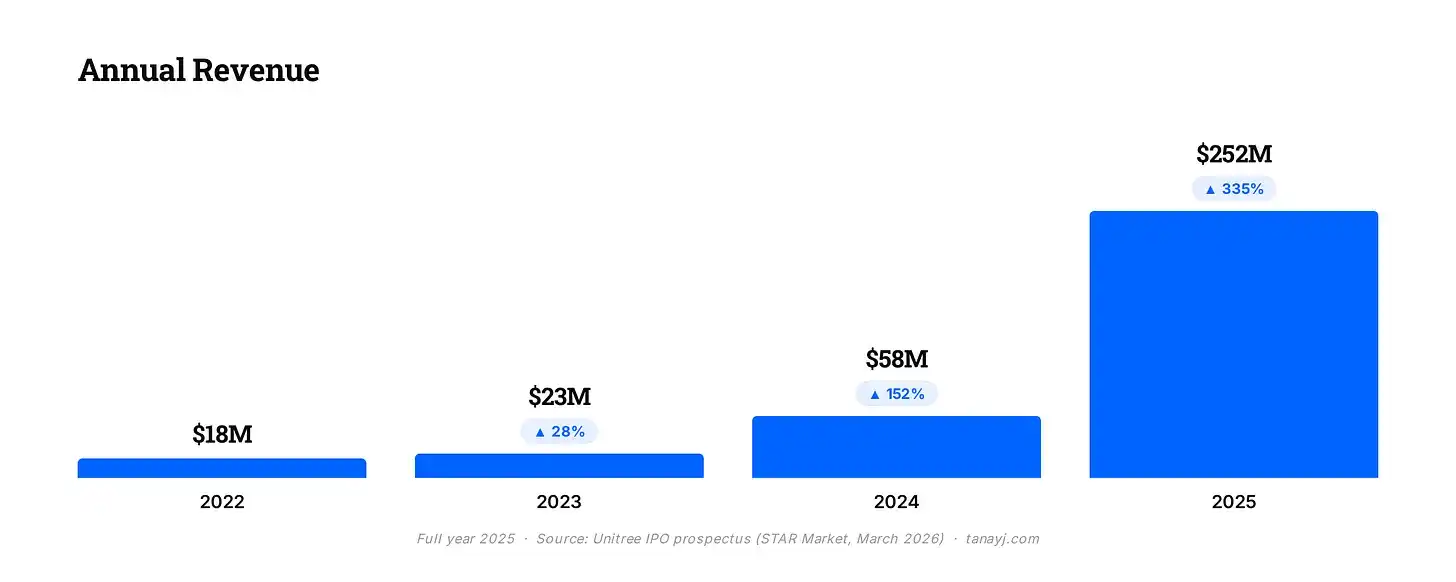
Revenue grew from $58 million in 2024 to an estimated ~$252 million in 2025, a 335% increase, primarily driven by strong performance in humanoid robots. For most of the company's history, international sales accounted for over 55% of revenue. In 2025, the domestic Chinese market surpassed exports for the first time, although the absolute value of export revenue still more than doubled year-on-year.
Gross margins are close to 60% and have been expanding over the years.
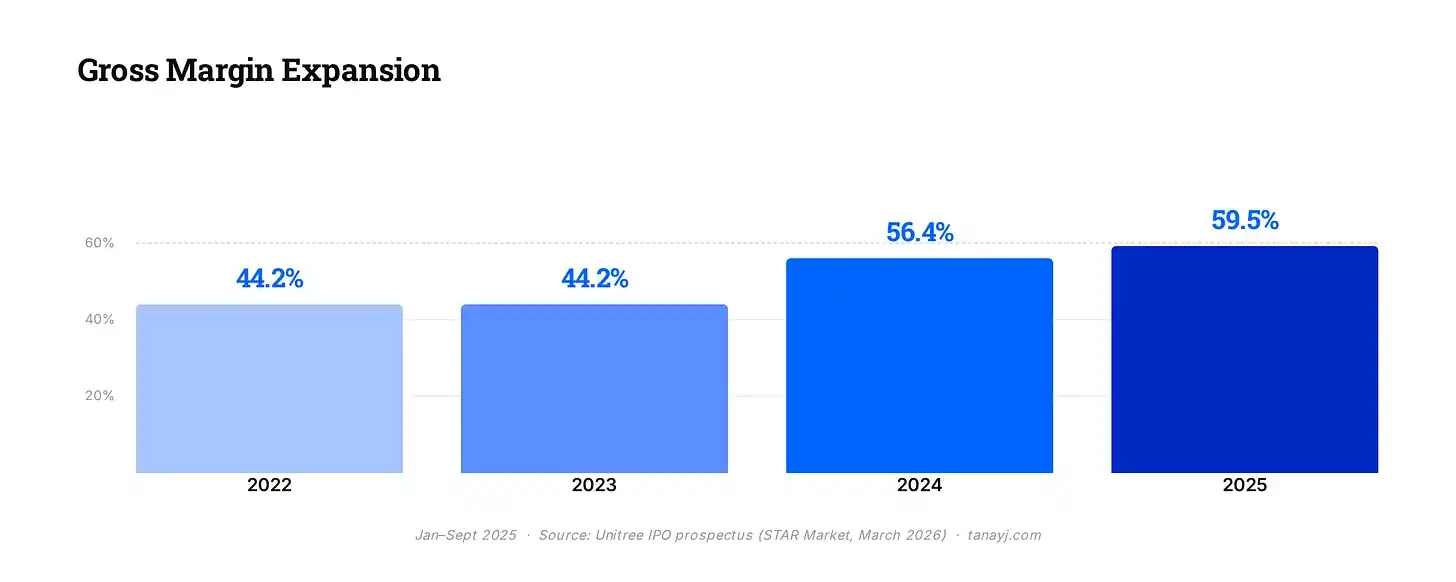
For comparison: Most hardware companies have gross margins of 30-40%. Software companies typically achieve 70-80%. For a company selling physical robots, Unitree's gross margins are relatively high, benefiting from their vertical integration strategy and currently relatively differentiated products.

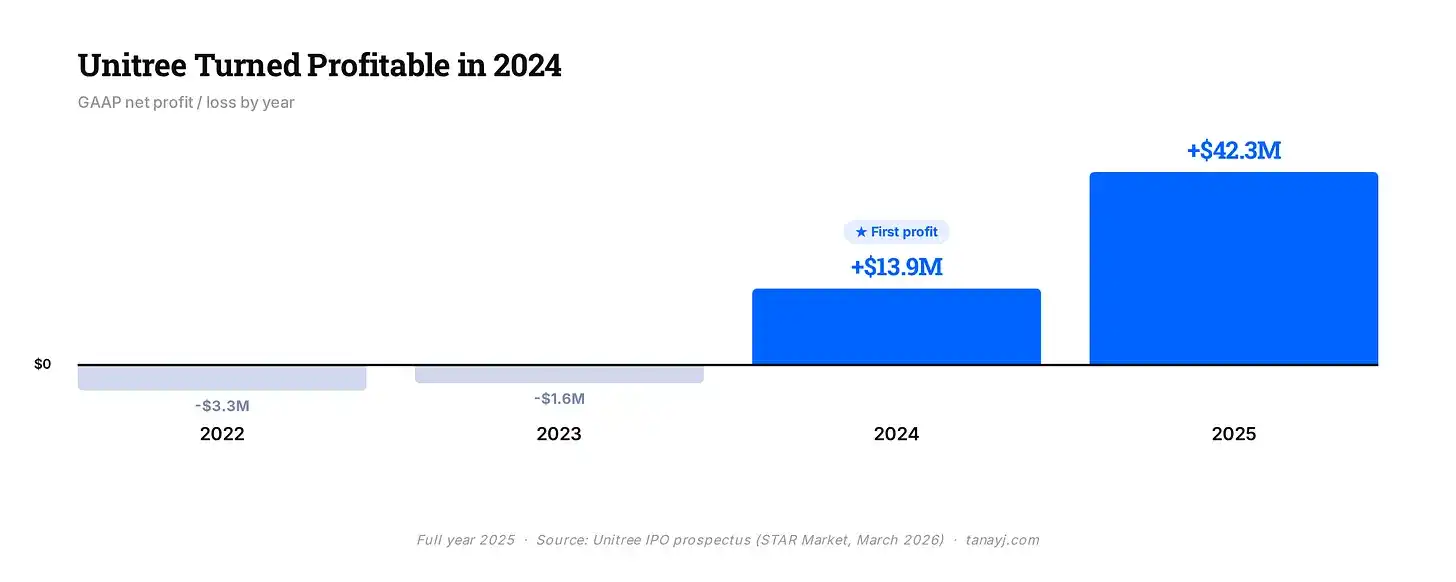
The company became profitable on a GAAP basis in 2024, with a profit margin of about 18%, and close to 35% on an adjusted basis.
Unitree's IPO target valuation is approximately $6-7 billion.

6. Ambitions at the Model Layer

Unitree plans to allocate nearly half of the IPO proceeds to software. Out of the $620 million raised, about $300 million will be used for AI model training over the next three years, with approximately $100 million invested annually in what the company calls the "Embodied Large Model."

The prospectus describes two parallel model architectures. The first is VLA (Vision-Language-Action): a model that directly maps visual and language inputs to motor commands, allowing the robot to generalize to unfamiliar tasks without manually coded instructions. The second is WMA (World Model + Action), which is their preferred direction. The WMA model builds an internal simulation of physical reality. The robot predicts what will happen before acting, rather than learning purely through trial and error.

They have already released initial versions of both. They open-sourced UnifoLM-WMA-0 in September 2025; UnifoLM-VLA-0 was released in January 2026.

They also detailed the approximate allocation of spending on the model side, as shown below:
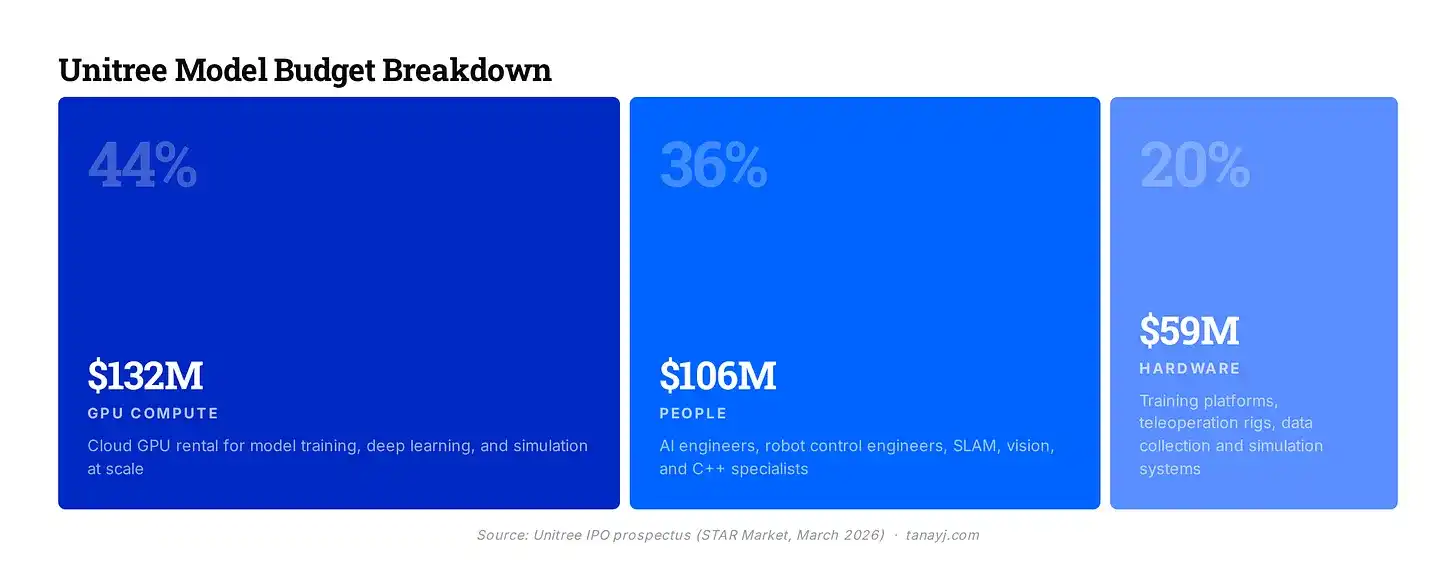
Unitree's current hardware leadership is real, but the company understands that lasting advantage in robotics may require control over the model layer: the systems that decide what the robot does and how it moves. Software ambition is also a hedge against commoditization. Unitree has built a moat in hardware manufacturing.

But if actuators and joint modules eventually become standard components like batteries in electric vehicles, then defensibility shifts to the model layer.

7. Summary

Unitree has a profitable hardware business, a genuine manufacturing moat, and ships more humanoid robots than anyone else, at prices others cannot match. But as the actual usage patterns of humanoid robots show, the story of widespread commercial application is still in its early stages. "Showcase" use cases dominate consumer demand, and industrial deployment is narrow.

Unitree gives us a glimpse of the current state of the robotics market; there is still much work to be done in models, hardware, and use cases. If you're building in robotics and embodied AI, feel free to reach out at tanay at wing.vc.


Связанные с этим вопросы

QWhat were the key financial highlights and performance metrics revealed in Unitree Robotics' IPO prospectus?

AUnitree's prospectus shows rapid growth, with revenue expected to reach approximately $252 million in 2025, a 335% increase from 2024's $58 million. The company achieved GAAP profitability in 2024 with margins around 18% (nearly 35% on an adjusted basis). Gross margins are near 60%, which is high for a hardware company, largely due to its vertical integration strategy. The IPO aims to raise $620 million at a target valuation of $6-7 billion.

QWho are the primary customers for Unitree's humanoid robots, and what does this indicate about the current state of the market?

AAs of 2025, 74% of Unitree's humanoid robot shipments were for scientific research and education, 17% for commercial/consumer 'showcase' uses (like retail displays), and only 9% for industrial applications. Furthermore, within that 9%, 50-70% are used for enterprise reception and guided tours. This indicates that widespread commercial and industrial deployment is still in its early stages. The primary productive use for robots today remains in research and niche, non-autonomous applications, highlighting that hardware capabilities may be ahead of the AI models and software needed for complex tasks.

QWhat is Unitree's vertical integration strategy, and what benefits has it provided?

AUnitree's vertical integration strategy involves independently designing and manufacturing most of its robots' key components, including high-torque motors, precision reducers, encoders, joint modules, controllers, sensors, dexterous hands, LiDAR, and cameras. Only generic components like batteries and flash memory are outsourced. This strategy has reduced manufacturing costs (e.g., quadruped robot costs dropped 46% from ~$3300 in 2022 to ~$1800 in mid-2025) while allowing the company to expand its gross margins to nearly 60% despite falling average selling prices. It provides cost control, supply chain security, and a hardware moat.

QWhat are Unitree's ambitions in the AI model layer, and how does it plan to use funds from the IPO?

AUnitree plans to invest heavily in AI software development, allocating roughly $300 million (about half of the $620 million IPO proceeds) over the next three years for AI model training. The focus is on developing 'Embodied Large Models,' specifically two architectures: VLA (Vision-Language-Action) models for direct mapping from sensory input to action, and WMA (World Model + Action) models, which it favors. WMA models create an internal simulation of physical reality to predict outcomes before acting. The company has already released open-source versions of both. This investment is a strategic move to build a defensible advantage in the software layer as hardware components potentially become commoditized.

QHow has Unitree's product mix and market focus shifted in recent years?

AUnitree has undergone a significant shift from being primarily a quadruped robot company to a leader in humanoid robots. In 2023, humanoids accounted for only 1.9% of its revenue. By the first three quarters of 2025, humanoid robots constituted over half of its core revenue. This shift was driven by improved product-market fit and aggressive marketing (e.g., appearances on China's Spring Festival Gala and NVIDIA's GTC stage). The company shipped approximately 5,500 humanoid robots in 2025, making it the world's largest manufacturer by volume. Its ambitious 5-year goal is to produce 75,000 humanoids annually.

Похожее

NodeStrategy: The First Ordinals DAT Project, Bringing the Strategy Treasury Narrative to NFTs

**Summary: The Fundamental Flaws of NodeStrategy, the 'First Ordinals DAT'** NodeStrategy presents itself as the first Ordinals Digital Asset Treasury (DAT) on Bitcoin. Its model mirrors MicroStrategy's treasury narrative but for NFTs, specifically targeting the NodeMonkes collection (not officially affiliated). The project's core mechanism is a four-step flywheel: a 10% fee on all trades (90% to treasury, 10% to radFi/Bound marketplace) is used to buy NodeMonkes. These NFTs are then listed for sale on Satflow, with 100% of the sale proceeds used to buy back and burn the project's token, NODESTRAT, aiming to create a perpetual value cycle. However, the design contains critical, self-defeating flaws: 1. **Platform Lock-In:** As a Bitcoin Rune, NODESTRAT lacks smart contract functionality and cannot natively enforce the 10% fee. The fee can only be collected on the radFi/Bound marketplace itself. This makes the entire flywheel dependent on a single platform. If liquidity moves elsewhere, fee revenue drops to zero, halting the mechanism. 2. **Self-Suffocating Economics:** The 10% fee acts both as the flywheel's fuel and a major drag on demand. A buy/sell roundtrip incurs a 20% cost, creating a massive hurdle for traders. This strangles the very trading volume needed to generate fees. 3. **Ineffective Value Support:** The flywheel is starved. Low daily volume (~$9K) generates minimal fees for NFT purchases. The NFT "ladder" sales are slow and unpredictable (only 39 total sold), meaning buybacks are infrequent. While 30.77% of the supply has been burned, this supply reduction cannot lift price without corresponding demand, which is suppressed by the high transaction tax. 4. **Meaningless NAV:** The Net Asset Value (NAV), currently at a 0.46x discount to market cap, is merely a marketing figure. There is no redemption mechanism for token holders to claim the underlying NodeMonkes assets. Price is set by market liquidity flows, not by this theoretical backing. In essence, NodeStrategy's design forces its revenue source (trading fees) to simultaneously cripple the demand and liquidity required for its own success, trapping the project in a stagnant state.

marsbit6 мин. назад

NodeStrategy: The First Ordinals DAT Project, Bringing the Strategy Treasury Narrative to NFTs

marsbit6 мин. назад

Agentic Design Patterns: A Book That Made Me Re-Understand "What Is an Agent, Really?"

"Agentic Design Patterns" is a 2025 book by Antonio Gullí, a Google engineering director, which offers a systematic framework for AI Agent development through 21 design patterns. A core contribution is the "Four Levels of Agency": Level 0 (bare LLMs) are not true agents. Level 1 agents actively decide when and how to use tools. Level 2 agents engage in strategic planning, context engineering (curating and filtering information), and self-reflection. Level 3 involves multi-agent collaboration with defined communication topologies. The book introduces **Context Engineering** as a superset of prompt engineering, managing four layers of information for the agent: system prompts, external data, implicit context (user history, environment), and feedback loops for automated optimization. A key pattern is **Reflection (Producer-Critic)**, where two distinct agents with different prompts collaborate iteratively—one produces output, the other critiques it—until quality is satisfactory or a max iteration limit is reached. For **Memory**, a three-layer model is proposed: Session (ephemeral conversation context), State (temporary task data), and Memory (persistent, long-term storage). Regarding **Multi-Agent Systems**, the book advises against unnecessary complexity, recommending simple topologies like Supervisor or Peer-to-Peer based on task needs. It emphasizes perfecting a single Level 2 agent before moving to multi-agent setups. The author concludes with three actionable takeaways: 1) Add a Critic agent to existing workflows, 2) Practice Context Engineering beyond simple prompts, and 3) Avoid premature multi-agent complexity; first master a robust single agent. The book provides a practical map, codifying common challenges like reflection, memory, and coordination into reusable patterns, saving developers from reinventing foundational solutions.

链捕手52 мин. назад

Agentic Design Patterns: A Book That Made Me Re-Understand "What Is an Agent, Really?"

链捕手52 мин. назад

An AI Read SpaceX's Prospectus and Wrote This Investment Memo in 12 Minutes

An AI agent autonomously analyzed SpaceX's 226MB S-1 filing, purchased real-time market data on-chain for $1.87, and generated a comprehensive investment memo in 12 minutes. The memo concludes a "Hold" recommendation. Bull Thesis: SpaceX holds a near-monopoly in commercial launch (80% of global orbital mass since 2023), operates the profitable Starlink business (10.3M subscribers, $7.2B adj. EBITDA), and is vertically integrated from rockets to AI via the xAI acquisition. Starlink alone is a standout, high-margin business. Bear Thesis: The AI division is a massive cash burn ($6.4B operating loss on $3.2B revenue in 2025). True debt obligations approach ~$42B, not the headline $29B, due to bridge loans and X-related debt. Significant contingent liabilities exist, including a potential $10B fee from a Cursor option agreement. The company faces concentrated counterparty risk (e.g., a $45B Anthropic contract), slowing revenue growth, and complex governance as a controlled company with four share classes. Valuation anchors Starlink's standalone value at ~$84B (applying Iridium's 7.4x sales multiple), suggesting the current ~$500B+ IPO target prices in immense future execution risk for Starship and AI. Key risks include Starship delays, accelerating AI losses, and underwriter conflicts (the IPO's lead banks are also lenders on the $20B bridge loan it aims to refinance). Investment triggers: upgrade to "Overweight" if priced ≤$350B and Starship meets milestones; downgrade to "Pass" if priced >$510B or key risks materialize.

marsbit1 ч. назад

An AI Read SpaceX's Prospectus and Wrote This Investment Memo in 12 Minutes

marsbit1 ч. назад

Торговля

Спот
Фьючерсы

Популярные статьи

Как купить S

Добро пожаловать на HTX.com! Мы сделали приобретение Sonic (S) простым и удобным. Следуйте нашему пошаговому руководству и отправляйтесь в свое крипто-путешествие.Шаг 1: Создайте аккаунт на HTXИспользуйте свой адрес электронной почты или номер телефона, чтобы зарегистрироваться и бесплатно создать аккаунт на HTX. Пройдите удобную регистрацию и откройте для себя весь функционал.Создать аккаунтШаг 2: Перейдите в Купить криптовалюту и выберите свой способ оплатыКредитная/Дебетовая Карта: Используйте свою карту Visa или Mastercard для мгновенной покупки Sonic (S).Баланс: Используйте средства с баланса вашего аккаунта HTX для простой торговли.Третьи Лица: Мы добавили популярные способы оплаты, такие как Google Pay и Apple Pay, для повышения удобства.P2P: Торгуйте напрямую с другими пользователями на HTX.Внебиржевая Торговля (OTC): Мы предлагаем индивидуальные услуги и конкурентоспособные обменные курсы для трейдеров.Шаг 3: Хранение Sonic (S)После приобретения вами Sonic (S) храните их в своем аккаунте на HTX. В качестве альтернативы вы можете отправить их куда-либо с помощью перевода в блокчейне или использовать для торговли с другими криптовалютами.Шаг 4: Торговля Sonic (S)С легкостью торгуйте Sonic (S) на спотовом рынке HTX. Просто зайдите в свой аккаунт, выберите торговую пару, совершайте сделки и следите за ними в режиме реального времени. Мы предлагаем удобный интерфейс как для начинающих, так и для опытных трейдеров.

1.3k просмотров всегоОпубликовано 2025.01.15Обновлено 2025.03.21

Как купить S

Sonic: Обновления под руководством Андре Кронье – новая звезда Layer-1 на фоне спада рынка

Он решает проблемы масштабируемости, совместимости между блокчейнами и стимулов для разработчиков с помощью технологических инноваций.

2.3k просмотров всегоОпубликовано 2025.04.09Обновлено 2025.04.09

Sonic: Обновления под руководством Андре Кронье – новая звезда Layer-1 на фоне спада рынка

HTX Learn: Пройдите обучение по "Sonic" и разделите 1000 USDT

HTX Learn — ваш проводник в мир перспективных проектов, и мы запускаем специальное мероприятие "Учитесь и Зарабатывайте", посвящённое этим проектам. Наше новое направление .

1.8k просмотров всегоОпубликовано 2025.04.10Обновлено 2025.04.10

HTX Learn: Пройдите обучение по "Sonic" и разделите 1000 USDT

Обсуждения

Добро пожаловать в Сообщество HTX. Здесь вы сможете быть в курсе последних новостей о развитии платформы и получить доступ к профессиональной аналитической информации о рынке. Мнения пользователей о цене на S (S) представлены ниже.

活动图片