Decentralization at risk as 100 wallets hold 80% of DeFi supply: Report

ambcryptoPublished on 2026-03-29Last updated on 2026-03-29

Abstract

DeFi's decentralization is under threat as new data reveals extreme concentration of governance power. A report from the ECB shows the top 100 wallets control over 80% of the token supply across major protocols, while just 10-20 voters hold up to 96% of delegated voting power in some cases. With participation rates as low as 4-12%, decision-making is effectively controlled by a small group of entities, including founders, treasuries, and centralized exchanges. This makes regulators' jobs easier, as they can now identify clear control points, increasing DeFi's regulatory exposure under frameworks like MiCA. Consequently, markets are repricing DAO tokens, with a growing premium placed on protocols that demonstrate broader participation and transparency, while those with concentrated control face valuation pressures.

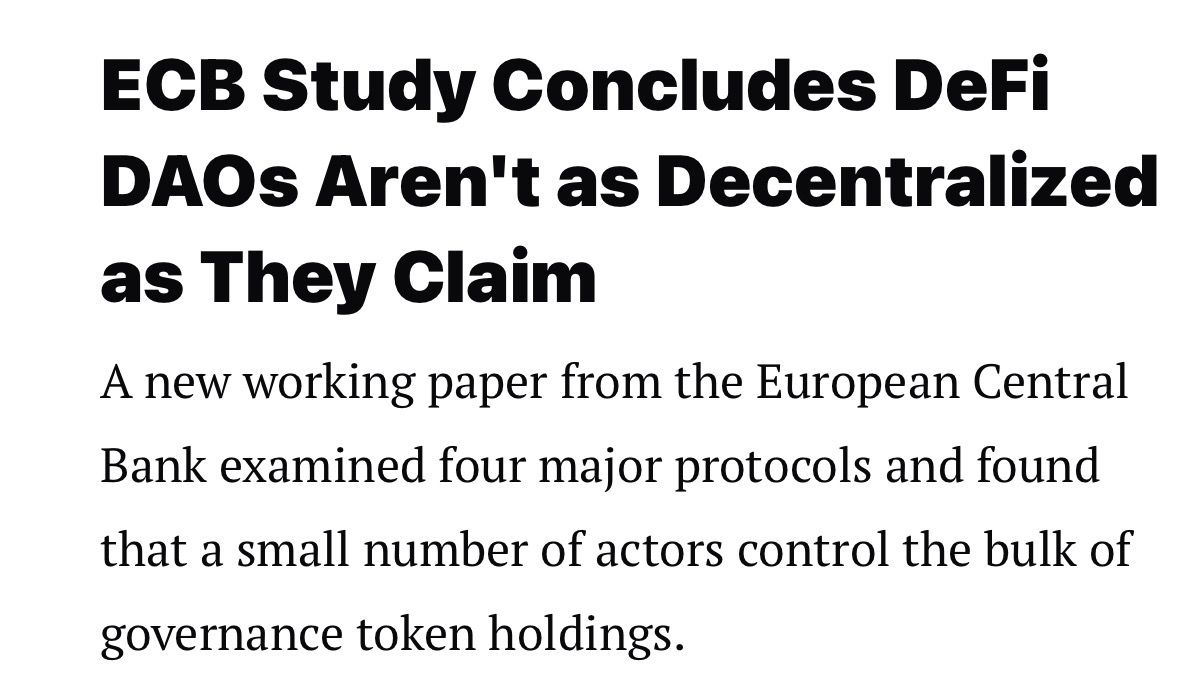
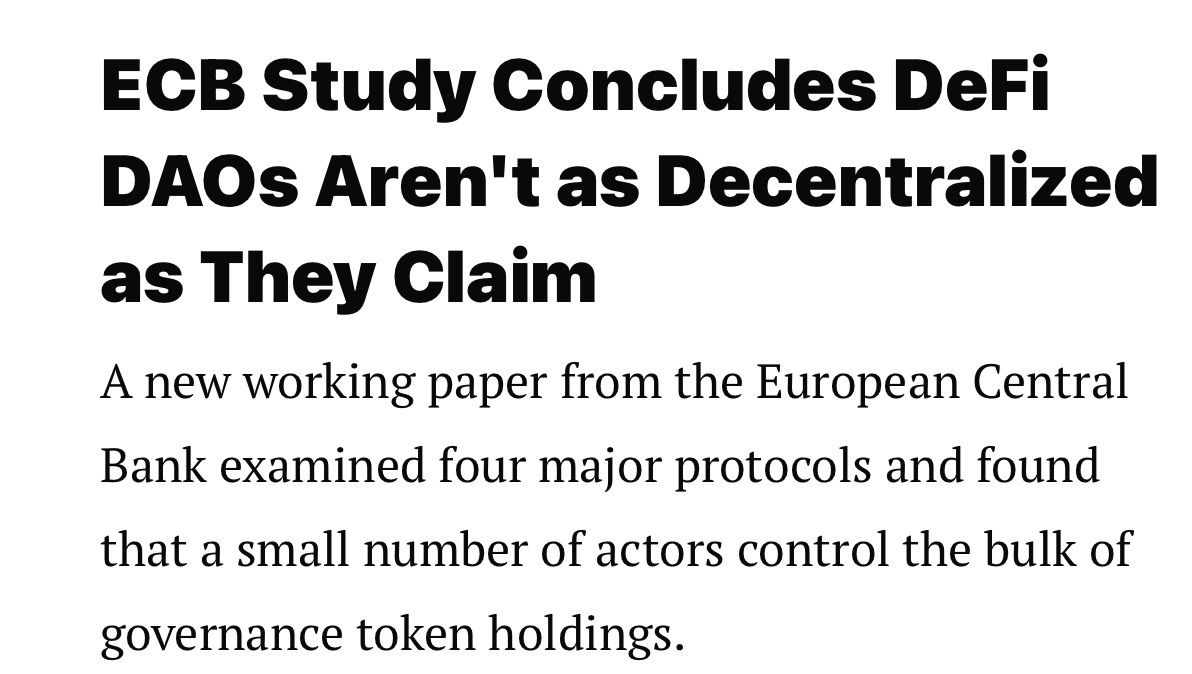
DeFi’s decentralization narrative is now being tested, as governance data reveals power is not widely distributed. The ECB’s March 2026 paper shows the top 100 holders control over 80% of tokens across major protocols, forming a clear concentration.

As this structure persists, decision-making shifts toward a small group, often including treasuries, founders, and centralized exchanges. Delegation intensifies this effect, as just 10–20 voters control up to 96% of delegated power.
Source: X

Participation remains low at 5–12%, which means most holders do not influence outcomes, leaving control in fewer hands. This imbalance matters because regulators can now identify who shapes protocol decisions.

As frameworks like MiCA tighten, these visible control points increase regulatory exposure. This shift suggests DeFi may face oversight similar to traditional finance structures.

DeFi governance narrows, but who is in control?

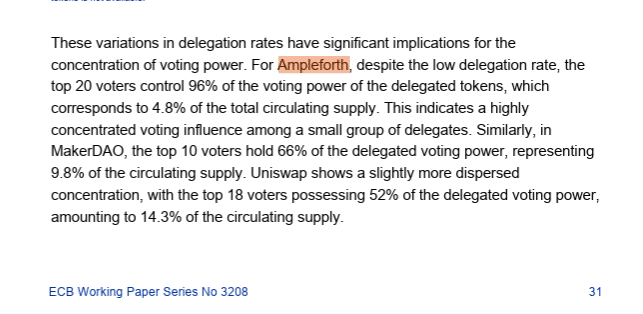
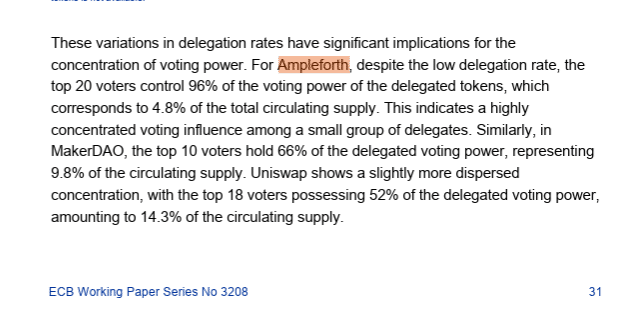
DeFi governance is shifting from broad ownership to concentrated control, as delegation hands decision power to a small group. The ECB’s March 2026 paper shows the trend clearly, with the top 20 voters in Ampleforth controlling 96.04% of delegated votes.
Source: ECB.Europa.eu

As this structure develops, the results rely more on a small number of active delegates than on the larger holder base. Influence clusters quickly, as seen by the fact that Uniswap’s top 18 hold 52% and MakerDAO’s top 10 control 66%.

Nevertheless, since one-third to almost 50% of the top voters cannot be identified, this focus does not translate into obvious accountability. Delegation separates traceable ownership from influence, which is why this occurs.

This creates a market where control is concentrated but partially hidden. As a result, DeFi’s decentralization weakens, while regulatory pressure rises without fully resolving enforceability.

DAO tokens reprice as decentralization weakens

Such a concentration of delegated voting power is now affecting DAO token prices, as markets reassess how decentralized these systems really are. Decision-making remains limited to a small group, with participation staying at 4–12%.

Due to the lack of widespread control, the decentralization premium decreases as the trend continues. Investors start to doubt the true worth of governance tokens, which makes this trend significant.

Perceived risk rises when regulators highlight distinct control groups, which puts further pressure on tokens with lax governance. At the same time, protocols that are more transparent and involve more people are becoming more popular.

This shift suggests DAO tokens will be priced based on governance quality, where broader participation supports value, while concentrated control leads to weaker performance.


Final Summary

  • DeFi governance shows concentrated control, weakening decentralization and increasing regulatory exposure.
  • DeFi governance concentration pressures DAO token valuations, as markets favor stronger transparency and broader participation.


Related Questions

QWhat percentage of tokens across major DeFi protocols are controlled by the top 100 holders, according to the ECB's report?

AThe top 100 holders control over 80% of tokens across major DeFi protocols.

QHow does delegation intensify the concentration of power in DeFi governance?

ADelegation intensifies this effect, as just 10–20 voters control up to 96% of delegated power.

QWhat is the typical participation rate in DeFi governance, and what does this imply for decision-making?

AParticipation remains low at 5–12%, which means most holders do not influence outcomes, leaving control in fewer hands.

QHow is the market reassessing the value of DAO tokens in light of governance concentration?

AMarkets are reassessing how decentralized these systems really are, and the decentralization premium decreases. DAO tokens are being priced based on governance quality, where broader participation supports value, while concentrated control leads to weaker performance.

QWhat regulatory risk arises from the visible concentration of control in DeFi protocols?

AAs regulatory frameworks like MiCA tighten, these visible control points increase regulatory exposure, suggesting DeFi may face oversight similar to traditional finance structures.

Related Reads

STRC Major De-pegging's First Financial Report, How Will Strategy Repair Its Capital Flywheel?

Bitcoin treasury company Strategy released its Q2 2026 earnings report on July 31. Despite a 6.9% year-over-year revenue increase to $122 million, the company recorded a net loss of $8.22 billion, largely due to $8.32 billion in unrealized losses from Bitcoin price fluctuations. As of quarter-end, Strategy holds 843,775 BTC with an average cost of $75,000 per coin, and Bitcoin per share increased. The report highlights a critical shift in Strategy's capital model following the de-pegging of its key financing tool, STRC (Strategic Coin), which fell below its $100 target. Management's top priority is restoring STRC to its target value, aiming for a recovery by September 8. They rule out discounted STRC issuances and plan to maintain its dividend yield at 12%, instead focusing on bolstering its $3.75 billion cash reserve. Strategy has moved from a one-way "buy-and-hold" Bitcoin strategy to active capital management. This new approach, part of its "Digital Credit Capital Framework," involves flexibly managing its balance sheet across four elements: BTC, USD cash, common stock (MSTR), and digital credit securities like STRC. This allows for BTC monetization (having sold $218.4 million in BTC so far), strategic repurchases of discounted securities, and debt optimization, as seen with a $1.5 billion convertible bond buyback. The company's future hinges on two key tests: successfully re-pegging STRC to restore market confidence in its digital credit system, and a long-term recovery in Bitcoin's price to ultimately support its growth thesis.

marsbit4m ago

STRC Major De-pegging's First Financial Report, How Will Strategy Repair Its Capital Flywheel?

marsbit4m ago

STRC's First Financial Report Post-Depegging, How is Strategy Restoring the Capital Flywheel?

On July 31, 2026, Bitcoin treasury company Strategy released its Q2 financial report. Despite a 6.9% year-over-year increase in revenue to $122 million, the company recorded a substantial net loss of $8.22 billion, primarily due to $8.32 billion in unrealized losses from Bitcoin holdings. While Strategy's core Bitcoin strategy remains intact—its holdings grew 11% to 843,775 BTC—the company is undergoing a fundamental shift in its capital model. Following the de-pegging of its key financing tool, the STRCoin (STRC), from its $100 target in May, Strategy has pivoted from a one-directional "raise funds, buy Bitcoin" cycle to a more dynamic, multi-asset capital management approach. A key part of this new framework is the "Monetization Program," through which Strategy has sold approximately $218.4 million worth of BTC to bolster liquidity. The company's top priority is repairing STRC's peg, committing not to issue discounted shares until it returns to its target range. It has initiated a $1 billion buyback program for discounted digital credit securities, having repurchased $28.9 million face value of STRC so far. Management aims to restore the peg around September 8, 2026. Strategy now actively manages a matrix of assets: Bitcoin (for accumulation or strategic sales), USD cash reserves (now at $3.75 billion), common stock (MSTR), and digital credit securities like STRC. This allows for tactical moves like repurchasing discounted debt or equity to capture value. The future success of Strategy's "capital flywheel" hinges on two factors: the short-term ability to successfully re-peg STRC to restore market confidence in its digital credit system, and the long-term price trajectory of Bitcoin, upon which its entire investment thesis ultimately depends.

Odaily星球日报9m ago

STRC's First Financial Report Post-Depegging, How is Strategy Restoring the Capital Flywheel?

Odaily星球日报9m ago

With Two Consecutive Quarters of Losses, Coinbase Must Rely on Paths Beyond Trading

Coinbase posted its second consecutive quarterly net loss of $359 million on $1.22 billion in revenue for Q2, highlighting its vulnerability to crypto market cycles where weaker prices and lower volatility reduce user trading. However, the report also reveals a strategic shift in its business model. Despite a 25% quarter-over-quarter decline in global spot trading volume, Coinbase increased its market share to a company-record 10.3%. This suggests its position as a compliant U.S. on-ramp is strengthening even in a cooler market. A key development is the diversification of revenue streams. Transaction revenue fell to $599 million, nearly equaling subscription and services revenue of $555 million. Stablecoin services, generating $292 million, are becoming a crucial revenue "floor." This income, derived from interest on the $20 billion average USDC balance held on its platform, is less tied to daily trading activity. Furthermore, while spot trading volume dropped significantly, derivatives volume held steady at $1.03 trillion. Coinbase is pushing to integrate spot, stablecoin, and derivatives liquidity to create a more interconnected and sticky ecosystem for users. The GAAP net loss includes non-cash expenses like stock-based compensation and crypto asset valuation changes. Its adjusted EBITDA remained positive at $208 million for the 14th straight quarter, indicating core operations can cover ongoing costs. The company is also reducing expenses to manage the downturn. The central question moving forward is whether Coinbase's growing market share, stablecoin revenues, and expanding product integration can sufficiently offset the inherent cyclicality of its core trading business during future market contractions.

marsbit24m ago

With Two Consecutive Quarters of Losses, Coinbase Must Rely on Paths Beyond Trading

marsbit24m ago

Trading

Spot
活动图片