December 19 Market Analysis: Why the Decline Today? BTC, ETH, BNB, SOL, F, RESOLV, GHST, DOLO Altcoin Trading Suggestions

金色财经Published on 2025-12-19Last updated on 2025-12-19

Abstract

The cryptocurrency market declined by 1.5% in the past 24 hours, with a weekly cumulative drop of 7%, it is currently in a corrective phase. Key factors behind the downturn include high-leverage liquidations, macroeconomic uncertainties such as Fed policy expectations and a stronger dollar, and spillover effects from AI-related stock valuation concerns. Over $556 million in positions were liquidated, affecting 151,369 traders—mostly long positions. Bitcoin (BTC) is hovering around $87,001, with critical support at $86,600. Ethereum (ETH) is up 3.36% to around $2,922, with key support at $2,870. BNB and SOL also show similar patterns, needing to hold $840 and $122 respectively to sustain upward momentum. Market sentiment remains extremely fearful at 17, but oversold conditions may lead to a potential rebound. The expiration of $23 billion in Bitcoin options this Friday could trigger further volatility. Top gainers include F (+30%), RESOLV (+21%), and HOLO (+16%), while GHST (-14%), DOLO (-8%), and TNSR (-7%) led the losses. Other major altcoins showed mixed performance.

? Over the past 24 hours, the cryptocurrency market has fallen by 1.5%, with a cumulative weekly decline of 7%. The market is currently in a correction phase, facing short-term pressure. It is advisable to monitor macroeconomic data and changes in leverage levels. The main factors contributing to this decline include:

1. Liquidation of high-leverage positions and increased market volatility (recent large-scale long and short liquidations).

2. Macroeconomic uncertainties, such as Federal Reserve policy expectations, inflationary pressures, and a stronger U.S. dollar suppressing risk assets.

3. Concerns over AI-related stock valuations spilling over into the crypto market (increased correlation between crypto and tech stocks). Additionally, technical events like options expirations have amplified price fluctuations.

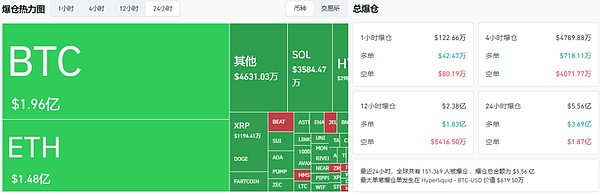
? Liquidation Alert:

In the past 24 hours, 151,369 traders were liquidated across the network, totaling $556 million. Long positions suffered heavily ($369 million), while short positions were also impacted ($187 million).
? Major Cryptocurrency Performance:

1. Bitcoin (BTC): Price around $87,001, up 0.58% in 24 hours.

Today, the key level to watch for Bitcoin is $86,600. As long as it holds above this level on the 4-hour chart, a rebound may begin. Upside resistance levels to watch are around $88,000, $89,450, and $90,370.

If $86,600 is broken, the current 4-hour rebound may pause. Keep an eye on support levels around $85,220, $83,830, and $82,170.

2. Ethereum (ETH): Price around $2,922, up 3.36% in 24 hours.

For Ethereum, the key level to observe is $2,870. If it holds above this level on the 4-hour chart, a rebound is likely. Upside resistance levels are around $2,964, $3,025, and $3,062.

If $2,870 is lost, the rebound may stall. Downside support levels to watch are around $2,815, $2,773, and $2,720.

3. BNB: Price around $839, up 0.77% in 24 hours.

BNB needs to stabilize above $840 today to open up rebound potential on the 4-hour chart. Upside resistance levels are around $853, $866, and $876.

If it fails to hold above $840, the rebound momentum may weaken. Downside support levels to note are around $829, $818, and $808.

4. SOL: Price around $123, up 0.31% in 24 hours.

The key level for SOL is around $122. If it holds above this level on the 4-hour chart, a rebound toward $126, $130, and $134 is possible.

If it fails to break above $122, short-term rebound momentum may weaken. Downside support levels to watch are around $117, $112, and $109.

?️ Market Sentiment:

Today, the total cryptocurrency market capitalization is approximately $3.03 trillion, with a 24-hour trading volume of about $159 billion.

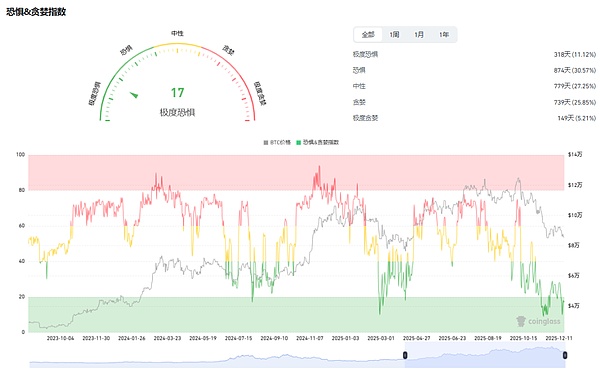
Current market sentiment is at 17 (Extreme Fear). Market sentiment has turned particularly pessimistic due to technical weakness and panic selling, but oversold conditions also suggest the market may be nearing balance. Cryptocurrencies remain closely tied to traditional markets. The $23 billion Bitcoin options expiring this Friday will be a key signal for market volatility. Focus on whether the closing price can break above the 7-day moving average of $2.96 trillion, which would likely trigger a short-term rebound.
Today's Crypto Gainers and Losers?

? Top 3:

1. F: Price $0.00753, up 30% in 24 hours

2. RESOLV: Price $0.0802, up 21% in 24 hours

3. HOLO: Price $0.0685, up 16% in 24 hours

? Bottom 3:

1. GHST: Price $0.165, down 14% in 24 hours

2. DOLO: Price $0.03390, down 8% in 24 hours

3. TNSR: Price $0.0849, down 7% in 24 hours

Other Major Cryptocurrency Performance:

Dogecoin (DOGE): Price $0.12570, up 0.67% in 24 hours

Tron (TRX): Price $0.2786, up 0.47% in 24 hours

Cardano (ADA): Price $0.3607, down 0.33% in 24 hours

Hyperliquid (HYPE): Price $23.593, down 2.95% in 24 hours

Avalanche (AVAX): Price $11.70, down 0.43% in 24 hours

Stellar (XLM): Price $0.2107, up 1.20% in 24 hours

Sui (SUI): Price $1.3903, down 0.54% in 24 hours

Chainlink (LINK): Price $12.23, up 0.91% in 24 hours

Hedera (HBAR): Price $0.10666, down 1.52% in 24 hours

Bitcoin Cash (BCH): Price $587.0, up 10.03% in 24 hours

Shiba Inu (SHIB): Price $0.00000726, down 2.42% in 24 hours

Litecoin (LTC): Price $75.41, up 0.40% in 24 hours

Pepe Shiba Inu (PEPE): Price $0.00000382, down 1.04% in 24 hours

Toncoin (TON): Price $1.441, down 1.91% in 24 hours

Trending Cryptos

Related Questions

QWhat were the main factors that caused the cryptocurrency market to drop on December 19th?

AThe main factors causing the drop were: 1. High-leverage position liquidations and increased market volatility, with significant recent long and short liquidations. 2. Macroeconomic uncertainty, including Federal Reserve policy expectations, inflation pressures, and a strong U.S. dollar suppressing risk assets. 3. Concerns over AI-related stock valuations spilling over into the crypto market, as the correlation between crypto and tech stocks has increased. Additionally, technical events like options expirations amplified price swings.

QWhat was the total amount and breakdown of liquidations in the crypto market over the past 24 hours mentioned in the article?

AOver the past 24 hours, there were 151,369 traders liquidated for a total of $556 million. Long positions were hit hardest, losing $369 million, while short positions lost $187 million.

QWhat is the critical support level for Bitcoin (BTC) to watch for a potential rebound, and what are the key resistance levels above it?

AThe critical support level for Bitcoin is at $86,600. If it holds on the 4-hour chart, a rebound could begin. The key resistance levels to watch above are $88,000, $89,450, and $90,370.

QAccording to the article, what was the overall market sentiment and what key event could be a signal for market volatility?

AThe overall market sentiment was 'Extreme Fear' with a reading of 17. A key event that could signal market volatility is the expiration of $23 billion worth of Bitcoin options on Friday.

QWhich three altcoins were the top gainers and which three were the top losers in the last 24 hours?

AThe top gainers were: 1. F, up 30% to $0.00753. 2. RESOLV, up 21% to $0.0802. 3. HOLO, up 16% to $0.0685. The top losers were: 1. GHST, down 14% to $0.165. 2. DOLO, down 8% to $0.03390. 3. TNSR, down 7% to $0.0849.

Related Reads

Tiger Research: Three Strategies for Financial Institutions to Keep Up with the Tokenization Wave

Tiger Research's in-depth report analyzes the strategic choices for financial institutions entering the rapidly growing Real-World Asset (RWA) tokenization market. With the market projected to be worth $25-36 billion and a lack of complete regulatory frameworks in many jurisdictions, institutions face three options: waiting for domestic legislation, using regulatory sandboxes for limited experiments, or moving first into established overseas markets to gain a competitive edge. Tokenization is not magic; it requires meticulous preparation. Before entry, institutions must strategically plan across six core areas: choosing a jurisdiction, obtaining necessary licenses, defining the asset type, targeting the appropriate investor base, selecting settlement currencies, and designing operational requirements like custody and governance. The report outlines two main operational paths. The first is a direct jurisdictional path, establishing a legal presence in mature markets like Hong Kong, Singapore, or the U.S., often leveraging local licensed platforms to accelerate market entry. The second is a chain-native path, using platforms like Ondo or Plume that are built with regulatory compliance embedded, allowing for faster, more flexible market access without being tied to a specific jurisdiction. Ultimately, the report advises against waiting for perfect regulation. The preparation process can take 6-12 months and requires thorough legal review. Using the example of a mid-sized securities firm, it details steps from evaluating existing entities to final execution. The core message is that accumulating real-world operational experience is paramount, as the market is moving ahead and will not wait for latecomers.

Foresight News48m ago

Tiger Research: Three Strategies for Financial Institutions to Keep Up with the Tokenization Wave

Foresight News48m ago

Unitree's IPO Frenzy: The Real Mystery is How It Will Spend the 42 Billion Raised

Unitree, a Chinese robotics company, is set for a public listing after its IPO registration was approved by regulators. The company, which started with quadruped robots and has expanded into humanoids, plans to raise approximately 4.2 billion yuan through its offering. The article traces Unitree's rapid growth from its founding in 2016 to its current status. It highlights key milestones like the 2021 CCTV Spring Festival Gala performance, the 2023 launch of its affordable Go2 robot dog and the H1 humanoid robot, and a series of subsequent product launches. By 2025, the company reported revenue of 1.71 billion yuan, profitability, and sales exceeding 5,500 humanoid robots. As the first publicly-listed humanoid robot company on China's STAR Market, Unitree's main challenges are sustaining growth and deploying its newly raised capital effectively. The humanoid robot sector in China is crowded, with over 140 companies. Competitors include UBTech (focusing on industrial and consumer markets), Fourier, and international players like Tesla Optimus and 1X NEO. The article outlines three critical challenges for Unitree: establishing a strong second product line beyond its quadruped robots, maintaining its price advantage while ensuring quality, and successfully advancing its embodied AI capabilities through partnerships like the one with NVIDIA for the H2 Plus platform. Unitree's likely strategy involves a "developer tools + industry benchmarks" approach: using low-cost models like the R1 and G1 to build developer adoption and volume, leveraging high-end platforms for AI training, and securing pilot projects in sectors like logistics and manufacturing to build case studies. The company's future success hinges on converting its current momentum in shipments and pilot programs into sustainable, large-scale commercial contracts as the broader market evolves.

marsbit2h ago

Unitree's IPO Frenzy: The Real Mystery is How It Will Spend the 42 Billion Raised

marsbit2h ago

Trading

Spot

Hot Articles

What is $BITCOIN

DIGITAL GOLD ($BITCOIN): A Comprehensive Analysis Introduction to DIGITAL GOLD ($BITCOIN) DIGITAL GOLD ($BITCOIN) is a blockchain-based project operating on the Solana network, which aims to combine the characteristics of traditional precious metals with the innovation of decentralized technologies. While it shares a name with Bitcoin, often referred to as “digital gold” due to its perception as a store of value, DIGITAL GOLD is a separate token designed to create a unique ecosystem within the Web3 landscape. Its goal is to position itself as a viable alternative digital asset, although specifics regarding its applications and functionalities are still developing. What is DIGITAL GOLD ($BITCOIN)? DIGITAL GOLD ($BITCOIN) is a cryptocurrency token explicitly designed for use on the Solana blockchain. In contrast to Bitcoin, which provides a widely recognized value storage role, this token appears to focus on broader applications and characteristics. Notable aspects include: Blockchain Infrastructure: The token is built on the Solana blockchain, known for its capacity to handle high-speed and low-cost transactions. Supply Dynamics: DIGITAL GOLD has a maximum supply capped at 100 quadrillion tokens (100P $BITCOIN), although details regarding its circulating supply are currently undisclosed. Utility: While precise functionalities are not explicitly outlined, there are indications that the token could be utilized for various applications, potentially involving decentralized applications (dApps) or asset tokenization strategies. Who is the Creator of DIGITAL GOLD ($BITCOIN)? At present, the identity of the creators and development team behind DIGITAL GOLD ($BITCOIN) remains unknown. This situation is typical among many innovative projects within the blockchain space, particularly those aligning with decentralized finance and meme coin phenomena. While such anonymity may foster a community-driven culture, it intensifies concerns about governance and accountability. Who are the Investors of DIGITAL GOLD ($BITCOIN)? The available information indicates that DIGITAL GOLD ($BITCOIN) does not have any known institutional backers or prominent venture capital investments. The project seems to operate on a peer-to-peer model focused on community support and adoption rather than traditional funding routes. Its activity and liquidity are primarily situated on decentralized exchanges (DEXs), such as PumpSwap, rather than established centralized trading platforms, further highlighting its grassroots approach. How DIGITAL GOLD ($BITCOIN) Works The operational mechanics of DIGITAL GOLD ($BITCOIN) can be elaborated on based on its blockchain design and network attributes: Consensus Mechanism: By leveraging Solana’s unique proof-of-history (PoH) combined with a proof-of-stake (PoS) model, the project ensures efficient transaction validation contributing to the network's high performance. Tokenomics: While specific deflationary mechanisms have not been extensively detailed, the vast maximum token supply implies that it may cater to microtransactions or niche use cases that are still to be defined. Interoperability: There exists the potential for integration with Solana’s broader ecosystem, including various decentralized finance (DeFi) platforms. However, the details regarding specific integrations remain unspecified. Timeline of Key Events Here is a timeline that highlights significant milestones concerning DIGITAL GOLD ($BITCOIN): 2023: The initial deployment of the token occurs on the Solana blockchain, marked by its contract address. 2024: DIGITAL GOLD gains visibility as it becomes available for trading on decentralized exchanges like PumpSwap, allowing users to trade it against SOL. 2025: The project witnesses sporadic trading activity and potential interest in community-led engagements, although no noteworthy partnerships or technical advancements have been documented as of yet. Critical Analysis Strengths Scalability: The underlying Solana infrastructure supports high transaction volumes, which could enhance the utility of $BITCOIN in various transaction scenarios. Accessibility: The potential low trading price per token could attract retail investors, facilitating wider participation due to fractional ownership opportunities. Risks Lack of Transparency: The absence of publicly known backers, developers, or an audit process may yield skepticism regarding the project's sustainability and trustworthiness. Market Volatility: The trading activity is heavily reliant on speculative behavior, which can result in significant price volatility and uncertainty for investors. Conclusion DIGITAL GOLD ($BITCOIN) emerges as an intriguing yet ambiguous project within the rapidly evolving Solana ecosystem. While it attempts to leverage the “digital gold” narrative, its departure from Bitcoin's established role as a store of value underscores the need for a clearer differentiation of its intended utility and governance structure. Future acceptance and adoption will likely depend on addressing the current opacity and defining its operational and economic strategies more explicitly. Note: This report encompasses synthesised information available as of October 2023, and developments may have transpired beyond the research period.

656 Total ViewsPublished 2025.05.13Updated 2025.05.13

What is $BITCOIN

Discussions

Welcome to the HTX Community. Here, you can stay informed about the latest platform developments and gain access to professional market insights. Users' opinions on the price of BTC (BTC) are presented below.

活动图片