Crypto’s Dark Side: Funds To Suspected Human Traffickers Climb 85% In 2025

bitcoinistPublished on 2026-02-14Last updated on 2026-02-14

Crypto transfers tied to suspected human trafficking networks surged 85% year over year in 2025, according to Chainalysis.

Reports say the total volume reached hundreds of millions of dollars across services that investigators have linked to forced labor operations, prostitution rings, and the sale of child sexual abuse material.

The firm said much of the activity it tracked was concentrated in Southeast Asia, where trafficking networks have been connected to scam compounds and cross-border fraud hubs.

The flows were identified through wallet clustering, transaction tracing, and analysis of services believed to be facilitating exploitation.

Stablecoins Dominate Payment Channels

Based on reports, international escort services and prostitution networks operated almost entirely using stablecoins. These tokens were preferred over more volatile cryptocurrencies, allowing operators to receive payments without sharp price swings.
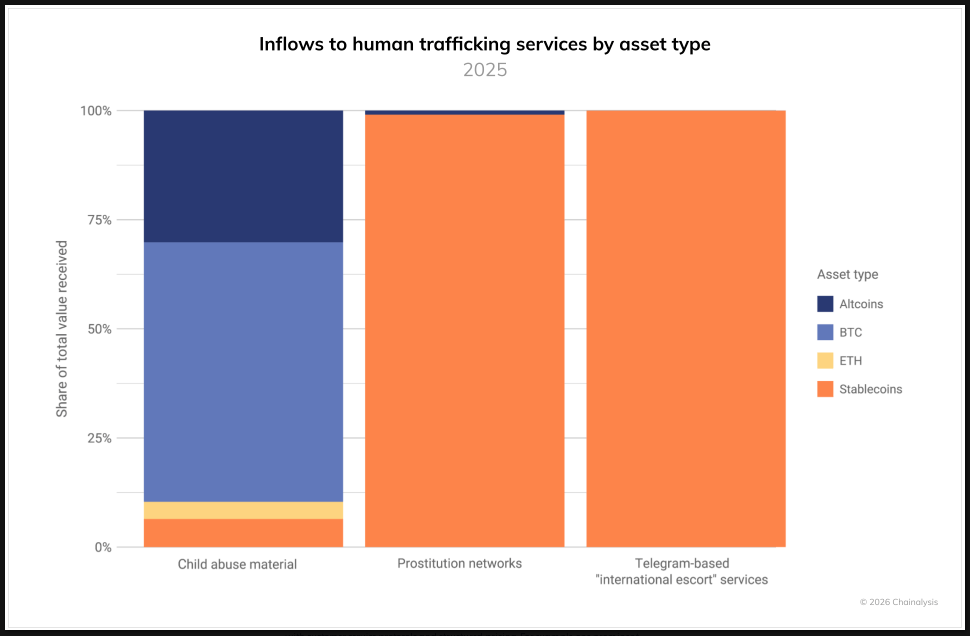
Chainalysis said that labor placement agents — some accused of kidnapping workers and forcing them into scam operations — also relied on crypto to collect and move funds.

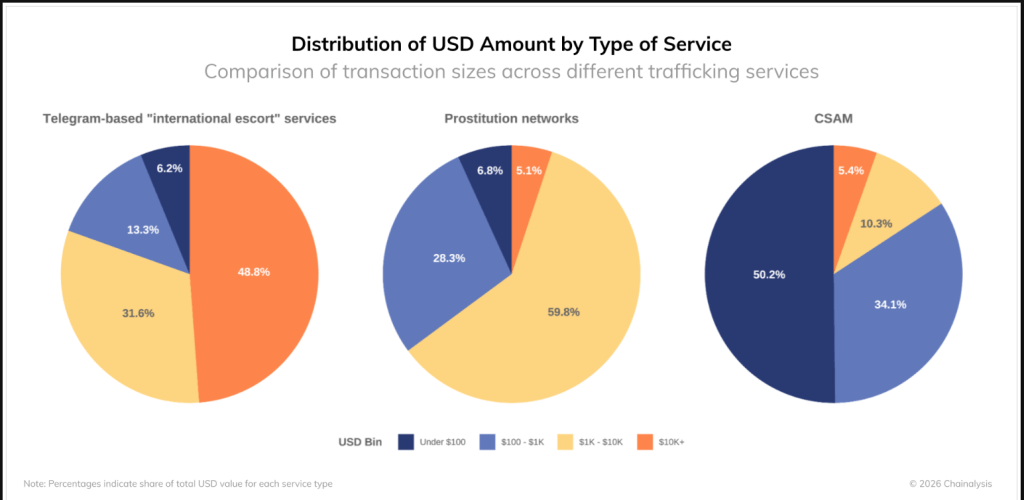
Messaging platforms such as Telegram were cited as distribution points for certain services, including escort listings and recruitment ads. Crypto wallets linked to these listings showed repeated payment patterns and connections to broader illicit clusters.
Links To Scam Compounds And Laundering Networks

Reports note that many of the identified wallets were closely aligned with online casinos and Chinese-language money-laundering groups.

Scam compounds, which have drawn global attention for coercing victims into running online fraud schemes, appeared interconnected with trafficking-related payment flows.

In several cases, funds moved between services before being routed toward exchanges or converted into other digital assets.

Chainalysis noted that the convergence of the networks indicated that there is a shared financial infrastructure. Instead of individual operations, the data indicated that there are clusters of wallets that overlap and interact with each other under different categories of illicit activities.

Total crypto market cap currently at $2.27 trillion. Chart: TradingView

Blockchain Transparency As An Investigative Tool

However, Chainalysis asserted that even with the increase in crypto-related trafficking flows, there were advantages to blockchain investigation. For instance, digital assets are permanently recorded and publicly visible, unlike cash.

This record enables compliance and law enforcement to track movement, detect transaction patterns, and recognize suspicious activity.

The firm advised monitoring for large, recurring transfers to labor brokers, wallet clusters active across several illicit service types, and repeated stablecoin conversion patterns.

The exchanges are seen as strategic choke points, where intervention is possible when funds try to re-enter the traditional financial system.

The Chainalysis findings are a reflection of the increased use of crypto currencies in criminal activities and the increased ability to track them.

Chainalysis argues that although digital assets are utilized in these trafficking networks, the transparency of these systems will aid in the disruption of these networks.

Featured image from Pixabay, chart from TradingView

Related Questions

QAccording to the Chainalysis report, what was the percentage increase in crypto transfers tied to suspected human trafficking networks in 2025?

ACrypto transfers tied to suspected human trafficking networks surged 85% year over year in 2025.

QWhich type of cryptocurrency was predominantly used by international escort services and prostitution networks, and why was it preferred?

AStablecoins were the predominant payment method. They were preferred over more volatile cryptocurrencies because they allowed operators to receive payments without sharp price swings.

QWhat specific region did the report identify as a concentration point for the tracked human trafficking activity?

AThe report identified Southeast Asia as a region where much of the tracked activity was concentrated, with trafficking networks connected to scam compounds and cross-border fraud hubs.

QWhat are the three main techniques mentioned that were used to identify these illicit crypto flows?

AThe illicit flows were identified through wallet clustering, transaction tracing, and analysis of services believed to be facilitating exploitation.

QHow does Chainalysis argue that the transparency of blockchain technology can be an advantage in combating these crimes?

AChainalysis argues that blockchain transparency is an advantage because digital asset transactions are permanently recorded and publicly visible, unlike cash. This enables compliance and law enforcement to track movement, detect transaction patterns, and recognize suspicious activity.

Related Reads

First Batch of Keynote Speakers and Partners Announced! Web2+3 Summit: Defining the Next Generation of Digital Economy

Web2+3 Summit: Defining the Next Generation of Digital Economy The 6th BEYOND International Technology Innovation Expo (BEYOND Expo 2026), Asia's largest tech and ecosystem exhibition, is launching a dedicated Web2+3 stage for the first time. Co-hosted by BEYOND Expo and ChainNeXT Group, the Web3 Summit will take place from May 28–30, 2026. Against the backdrop of accelerating global tech integration, the boundaries between Web2 and Web3 are rapidly blurring. With clearer global regulations for blockchain-driven internet (Web3) and the special issuance of a Hong Kong dollar stable币 license by the Hong Kong SAR government on April 10, 2026, Web3's decentralized principles are quickly merging with traditional industries (Web2) such as e-commerce, finance, and artificial intelligence. Focused on blockchain-driven digital economy elements, the summit will center on three core principles—implementability, commercial viability, and compliance. It will bring together top Web3 experts to discuss key integration areas like stablecoin payment finance (PayFi), real-world asset tokenization (RWA), and decentralized AI (DeAI), unveiling new opportunities for industrial innovation. The first wave of confirmed speakers includes Jack Kong (Director of Hong Kong Cyberport, Chairman of Nano Labs), Yat Siu (Chairman of Animoca Brands), Michael Wu (Co-founder & CEO of Amber Group), Michael Heinrich (Co-founder & CEO of 0G), and Art Abal (Co-founder of Vana). More Web3 ecosystem pioneers, AI, and fintech experts will be announced soon. Core forum topics include: - Web2+DeAI: New AI Paradigms Driven by Decentralized Infrastructure - Web2+RWA: Real-World Asset Tokenization and Global Liquidity - Web2+PayFi: Cross-Border Payments and Financial Innovation Powered by Crypto Infrastructure - Web2+3 AI: Autonomous Agents and the Crypto Economy - Web2+3 Wealth: On-Chain and Off-Chain Integrated Investment Ecosystems - Web2+3 Commerce: A New Landscape for Global Trade Driven by Stablecoins Additional agenda details will be released in the near future.

marsbit2h ago

First Batch of Keynote Speakers and Partners Announced! Web2+3 Summit: Defining the Next Generation of Digital Economy

marsbit2h ago

Trading

Spot
Futures

Hot Articles

Discussions

Welcome to the HTX Community. Here, you can stay informed about the latest platform developments and gain access to professional market insights. Users' opinions on the price of S (S) are presented below.

活动图片