Crypto’s Dark Side: Funds To Suspected Human Traffickers Climb 85% In 2025

bitcoinistPublished on 2026-02-14Last updated on 2026-02-14

Crypto transfers tied to suspected human trafficking networks surged 85% year over year in 2025, according to Chainalysis.

Reports say the total volume reached hundreds of millions of dollars across services that investigators have linked to forced labor operations, prostitution rings, and the sale of child sexual abuse material.

The firm said much of the activity it tracked was concentrated in Southeast Asia, where trafficking networks have been connected to scam compounds and cross-border fraud hubs.

The flows were identified through wallet clustering, transaction tracing, and analysis of services believed to be facilitating exploitation.

Stablecoins Dominate Payment Channels

Based on reports, international escort services and prostitution networks operated almost entirely using stablecoins. These tokens were preferred over more volatile cryptocurrencies, allowing operators to receive payments without sharp price swings.
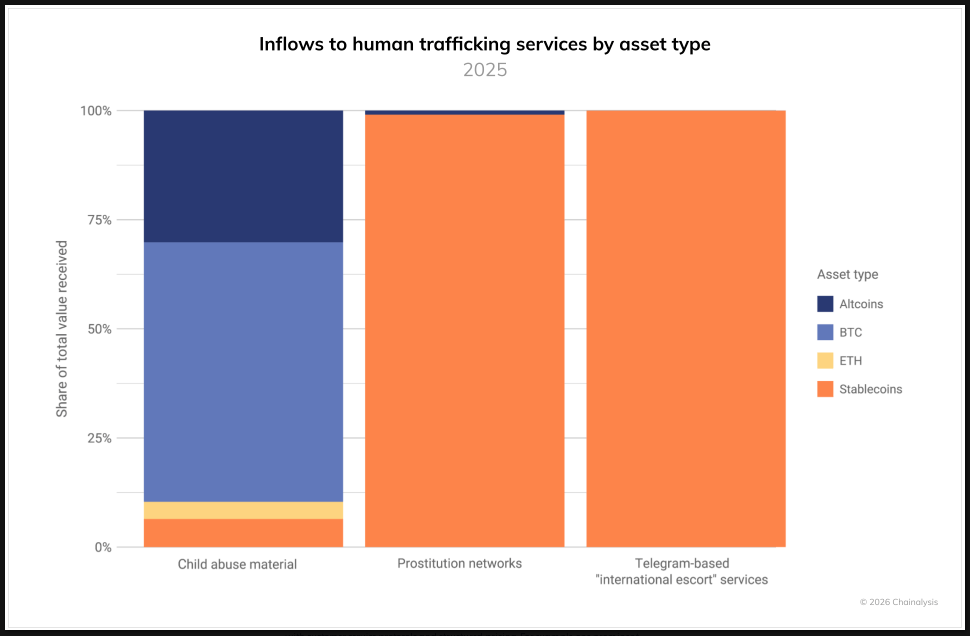
Chainalysis said that labor placement agents — some accused of kidnapping workers and forcing them into scam operations — also relied on crypto to collect and move funds.

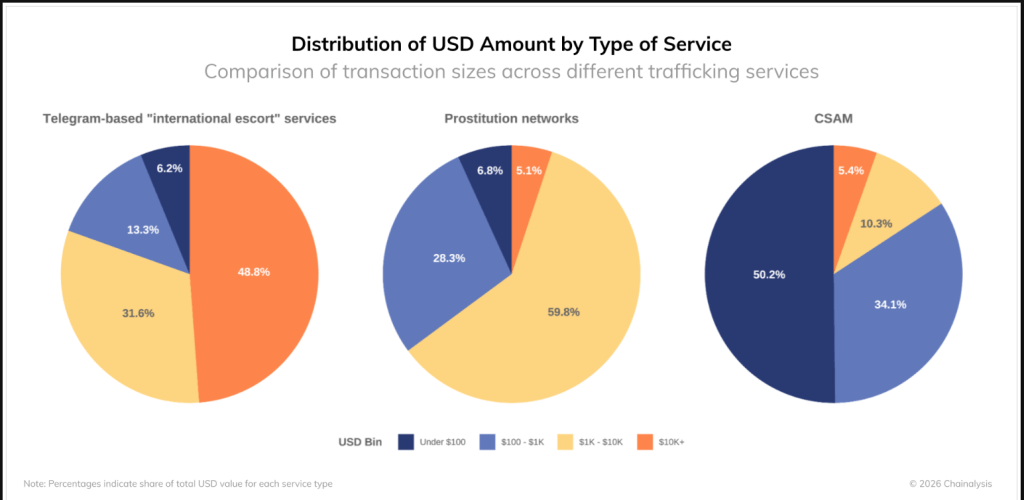
Messaging platforms such as Telegram were cited as distribution points for certain services, including escort listings and recruitment ads. Crypto wallets linked to these listings showed repeated payment patterns and connections to broader illicit clusters.
Links To Scam Compounds And Laundering Networks

Reports note that many of the identified wallets were closely aligned with online casinos and Chinese-language money-laundering groups.

Scam compounds, which have drawn global attention for coercing victims into running online fraud schemes, appeared interconnected with trafficking-related payment flows.

In several cases, funds moved between services before being routed toward exchanges or converted into other digital assets.

Chainalysis noted that the convergence of the networks indicated that there is a shared financial infrastructure. Instead of individual operations, the data indicated that there are clusters of wallets that overlap and interact with each other under different categories of illicit activities.

Total crypto market cap currently at $2.27 trillion. Chart: TradingView

Blockchain Transparency As An Investigative Tool

However, Chainalysis asserted that even with the increase in crypto-related trafficking flows, there were advantages to blockchain investigation. For instance, digital assets are permanently recorded and publicly visible, unlike cash.

This record enables compliance and law enforcement to track movement, detect transaction patterns, and recognize suspicious activity.

The firm advised monitoring for large, recurring transfers to labor brokers, wallet clusters active across several illicit service types, and repeated stablecoin conversion patterns.

The exchanges are seen as strategic choke points, where intervention is possible when funds try to re-enter the traditional financial system.

The Chainalysis findings are a reflection of the increased use of crypto currencies in criminal activities and the increased ability to track them.

Chainalysis argues that although digital assets are utilized in these trafficking networks, the transparency of these systems will aid in the disruption of these networks.

Featured image from Pixabay, chart from TradingView

Related Questions

QAccording to the Chainalysis report, what was the percentage increase in crypto transfers tied to suspected human trafficking networks in 2025?

ACrypto transfers tied to suspected human trafficking networks surged 85% year over year in 2025.

QWhich type of cryptocurrency was predominantly used by international escort services and prostitution networks, and why was it preferred?

AStablecoins were the predominant payment method. They were preferred over more volatile cryptocurrencies because they allowed operators to receive payments without sharp price swings.

QWhat specific region did the report identify as a concentration point for the tracked human trafficking activity?

AThe report identified Southeast Asia as a region where much of the tracked activity was concentrated, with trafficking networks connected to scam compounds and cross-border fraud hubs.

QWhat are the three main techniques mentioned that were used to identify these illicit crypto flows?

AThe illicit flows were identified through wallet clustering, transaction tracing, and analysis of services believed to be facilitating exploitation.

QHow does Chainalysis argue that the transparency of blockchain technology can be an advantage in combating these crimes?

AChainalysis argues that blockchain transparency is an advantage because digital asset transactions are permanently recorded and publicly visible, unlike cash. This enables compliance and law enforcement to track movement, detect transaction patterns, and recognize suspicious activity.

Related Reads

Anthropic Starts Poaching Scientists? $27K Weekly Onsite Stipend to Fix Claude's Expert-Level Errors

Anthropic has launched a new STEM Fellow program, offering $3,800 per week for a three-month, in-person residency in San Francisco. The role targets experts from science, technology, engineering, and mathematics (STEM) fields—machine learning experience is helpful but not required. Instead, Anthropic values scientific judgment and a willingness to learn quickly. Fellows will work with Claude models and internal tools under the guidance of an Anthropic researcher. Example projects include a materials scientist identifying errors in Claude’s reasoning or a climate scientist integrating atmospheric modeling software with Claude. The goal is to have experts "tell Claude where it's wrong" and improve its scientific capabilities. This initiative is part of Anthropic’s broader strategy to strengthen its scientific ecosystem, following earlier programs like the AI Safety Fellows and AI for Science programs. The company acknowledges that current AI models, while powerful, still produce high-confidence errors and lack end-to-end research autonomy. The program aims to embed domain expertise directly into model development, turning scientists into "high-level reviewers" for AI. Anthropic CEO Dario Amodei has previously emphasized AI’s potential to accelerate scientific breakthroughs, particularly in biology and healthcare. The company believes that the next phase of AI competition will depend not on scaling parameters, but on integrating human expertise to refine model accuracy and reliability.

marsbit50m ago

Anthropic Starts Poaching Scientists? $27K Weekly Onsite Stipend to Fix Claude's Expert-Level Errors

marsbit50m ago

On the Eve of X Money's Launch, Musk Dismantles the Referee First

"X Money Launches After Dismantling Regulator: Musk's 9-Day Power Play" In February 2025, a team from the "Department of Government Efficiency" (DOGE), led by Elon Musk, entered the Consumer Financial Protection Bureau (CFPB) headquarters. Shortly after, the CFPB was effectively dismantled—its funding frozen, activities suspended, and nearly 90% of staff laid off. This move came just nine days after X announced a partnership with Visa and as X Money prepared to launch. The article contrasts this with the decade-long regulatory battles faced by companies like Coinbase and PayPal. Coinbase spent over $75 million in political contributions and endured a major SEC lawsuit to operate legally. PayPal complied with strict state and federal rules for its stablecoin PYUSD, including 100% reserve requirements and monthly audits. However, Musk’s approach was different. After the CFPB introduced a rule placing large digital payment apps under federal oversight, Musk tweeted "Delete CFPB." Within months, the rule was revoked by Congress. Meanwhile, DOGE operatives gained "god-tier" access to CFPB databases, potentially obtaining sensitive competitive information from rivals like Apple, Google, and PayPal. The article also highlights a "suspicious exemption clause" in the GENIUS Act, which allows private companies like X to issue stablecoins with fewer restrictions. Senator Elizabeth Warren questioned whether Musk, who was a senior presidential advisor during the Act’s drafting, influenced this clause. X Money offers a 6% APY on deposits, despite FDIC warnings that stablecoin users are not insured. As X Money launches to 600 million monthly users, the article questions the fairness of a system where Musk can bypass regulations that others spent years and millions to comply with. The dismantling of the CFPB and the alleged regulatory advantages raise concerns about the future of equitable rule-making in the U.S. financial system.

marsbit59m ago

On the Eve of X Money's Launch, Musk Dismantles the Referee First

marsbit59m ago

Trading

Spot
Futures

Hot Articles

Discussions

Welcome to the HTX Community. Here, you can stay informed about the latest platform developments and gain access to professional market insights. Users' opinions on the price of S (S) are presented below.

活动图片